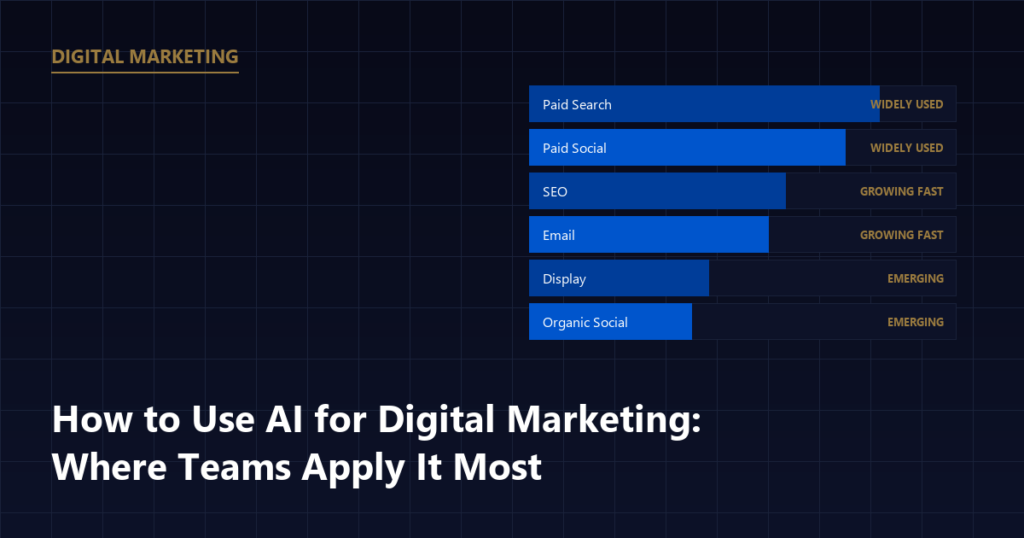
Using AI for digital marketing means applying it across the channels a regional business actually runs, paid search, paid social, SEO, email, and organic social, at different levels of maturity depending on the channel. Paid advertising platforms have the most built-in AI already, since Google and Meta run bidding algorithms behind the scenes regardless of whether a business opts in deliberately. Organic channels require more manual setup to get comparable value.
Where AI adoption actually differs by channel
Not every digital channel benefits from AI the same way, and the differences matter for where a small team should focus first.
- Paid search, the most mature. Automated bidding, audience expansion, and asset generation are largely built into the platform itself. Manual bid management is increasingly the exception, not the norm.
- Paid social, close behind paid search. Meta and LinkedIn’s ad systems use machine learning for audience targeting and creative rotation by default.
- SEO, growing quickly but less automated by default. AI helps with research, technical audits, and draft content, but ranking well still depends on decisions a platform can’t make for you.
- Email, covered in depth in how to use AI for email marketing, growing fast as segmentation and send-time tools mature.
- Organic social, the least automated of the group for a small business, since authentic engagement is hard to fake and platforms actively suppress content that reads as generic or automated.
Per Google’s published Performance Max case studies, real advertisers report meaningful gains from automated bidding, though results vary widely by account history and category, these are individual case results, not guaranteed outcomes.
Where teams tend to apply AI most
A channel-by-channel starting point
| Channel | First AI use case to try | What still needs a human |
|---|---|---|
| Paid search | Switch underperforming manual campaigns to automated bidding | Setting budget caps, excluding irrelevant search terms |
| Paid social | Let the platform’s built-in audience expansion run instead of narrow manual targeting | Creative direction, offer strategy |
| SEO | Use AI for technical audit summaries and content briefs | Deciding what to actually publish and fixing site structure |
| Automated re-engagement segmentation | Message content and offer framing | |
| Organic social | Draft captions from a real photo or job update, then edit | Posting anything that reads as generic or clearly automated |
The mistake most regional businesses make
Treating every channel the same way. A landscaping company that puts equal effort into “AI-optimizing” organic social and paid search is misallocating time, paid search has the platform-level automation already built in and mostly needs a person setting guardrails, while organic social genuinely needs more hands-on, specific, local content to perform at all. The channels with the least built-in AI leverage are usually the ones that need the most human effort, not the least.
This connects to the technical side of visibility too. If AI search tools like ChatGPT and Perplexity are starting to matter for how customers find your business, our full guide to GEO covers how that differs from traditional SEO.
Bringing it together
For the broader framework these channel decisions sit inside, see how to use AI in marketing, and for a step-by-step rollout across whichever channel you start with, the practical guide walks through the audit-to-scale sequence. If paid media specifically is where you want to focus first, our AI advertising services page covers what a managed setup looks like.
Which digital channel should a small business apply AI to first?
Paid search, usually. It has the most built-in AI already through automated bidding, and switching from manual campaign management to automated bidding is a low-effort first move that doesn’t require building anything new.
Does AI help with organic social media for a small business?
It can help draft captions faster from a real photo or job update, but organic social is the channel where AI leverage is lowest. Platforms actively suppress content that reads as generic or automated, so this channel needs more human specificity, not less.
Is automated ad bidding actually better than manual bidding?
For most accounts with reasonable conversion tracking in place, yes, automated bidding systems process far more signals per second than a person checking a dashboard once a day can. Results vary by account history and category, so it’s worth testing against a manual baseline rather than assuming.
If you want a channel-by-channel review of where AI could actually move the needle for your business, book a conversation with MV3 and we’ll map it out together.
Share this article

Alex Carter leads SEO and content strategy at MV3 Marketing, specializing in generative engine optimization, technical SEO, and AI-driven content systems for B2B companies.
Ready to audit your organic growth opportunity?
$2,500 flat. 5 business days. Six deliverables tied to pipeline , not rankings. No retainer required.
Get the Organic Growth Audit →