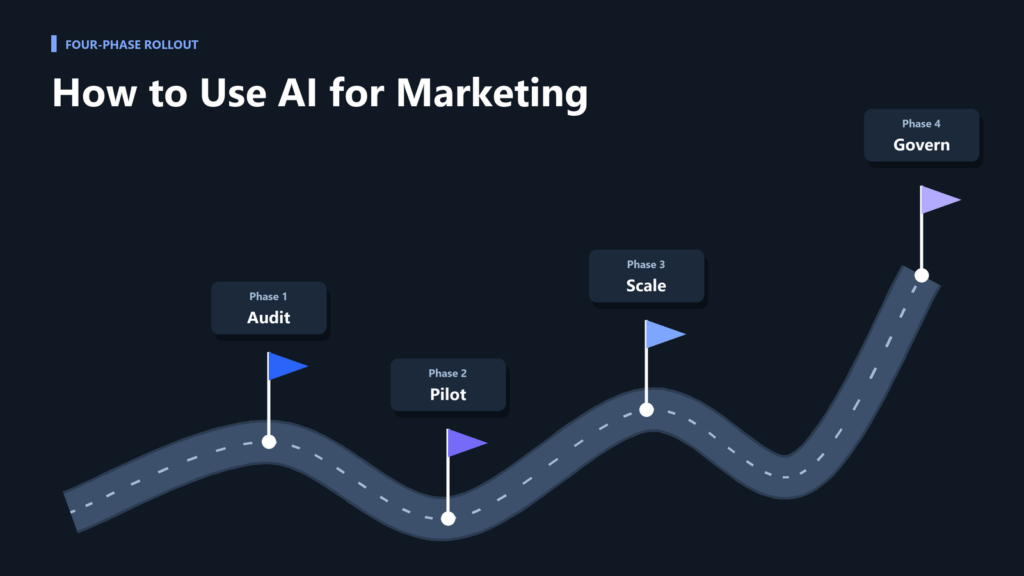
The practical way to use AI for marketing is a four-phase rollout, audit, pilot, scale, measure, applied to one workflow at a time instead of the whole marketing operation at once. Most stalled AI projects fail not because the tools don’t work, but because a team tried to automate five processes simultaneously with no way to tell which one was actually responsible for the results.
Phase 1: Audit, before you touch a single tool
Before adding AI anywhere, map where time actually goes in a normal week. For most B2B SaaS and fintech teams, this means sitting down with whoever handles marketing and sales admin and tracking, honestly, where the hours go: writing content, checking an inbox for form submissions, updating a spreadsheet, formatting a report. The audit has one job, find the task that’s both high-frequency and low-judgment. That combination is where AI produces the most value with the least risk.
A Series A SaaS team might find that someone spends four hours a week manually copying demo-request submissions into a CRM. A fintech marketing team might find that follow-up emails after a webinar take a full afternoon every week to write from scratch. Neither of those requires much judgment, they’re exactly the kind of task that automation compresses without much risk.
Phase 2: Pilot, one workflow, three to four weeks
Pick exactly one workflow from the audit. Build it end to end, including the human review step, and run it for three to four weeks before touching anything else. A pilot that isn’t measured against a clear before-and-after number isn’t a pilot, it’s just a new habit nobody can evaluate.
- Define the metric before you start (response time, hours saved, conversion rate on the specific step).
- Keep a human reviewing every output during the pilot, even ones that will eventually run unsupervised.
- Write down what broke. Something will. The pilot’s job is to surface that cheaply, before it’s running across ten workflows.
Per McKinsey’s State of AI research, the gap between adoption and measurable value is the norm, not the exception. A phased rollout with a defined metric at each stage is what closes that gap, not adding more tools.
Phase 3: Scale, only what the pilot actually proved
Once a pilot hits its target metric for a full measurement cycle, expand it, more lead sources feeding the same workflow, more email sequences using the same personalization approach, more content briefs running through the same editorial pipeline. Scaling before the pilot proves out just multiplies an unproven process, which is how a small mistake in one workflow becomes a sitewide problem.
| Phase | Typical duration | What “done” looks like |
|---|---|---|
| 1. Audit | 1 to 2 weeks | One clear, high-frequency, low-judgment task identified |
| 2. Pilot | 3 to 4 weeks | A defined metric hit consistently, with a human reviewing every output |
| 3. Scale | 4 to 8 weeks | The same workflow running across more volume without a drop in review quality |
| 4. Measure | Ongoing | A recurring review cadence, monthly or quarterly, checking the metric still holds |
Phase 4: Measure, and keep measuring after launch
The most common failure after a successful pilot is dropping the measurement once the workflow feels routine. Set a recurring check, monthly for fast-moving workflows like ad bidding, quarterly for slower ones like content performance, and revisit whether the original metric still holds. Tools change, data drifts, and a workflow that worked at ten leads a week can behave differently at fifty.
Why this beats a big-bang rollout
A single-workflow pilot means that when something breaks, you know exactly what caused it. A five-workflow simultaneous rollout means a bad result could be caused by any of the five, and untangling that after the fact costs more time than the phased approach would have taken in the first place. This is the same discipline behind how to build AI agents the practical way, narrow scope first, proven results, then expand.
For the underlying framework this rollout maps to, see how to use AI in marketing. If your team wants a structured audit done by people who do this across B2B SaaS and fintech companies regularly, our AI operations services page covers what a guided rollout looks like.
How do I pick which workflow to pilot first?
Look for a task that’s both frequent and low-judgment, something repeated weekly that doesn’t require a difficult decision each time it happens. Lead follow-up drafting and report formatting are common first picks because they’re high-frequency and don’t require deep judgment calls.
What if the pilot doesn’t hit its target metric?
Don’t scale it. Diagnose why first, usually it’s an unclear brief, a missing data connection, or a metric that was set unrealistically. A pilot that doesn’t hit target is useful information, not a failure, as long as it’s caught before scaling multiplies the problem.
How many workflows should be running at once after a year?
There’s no fixed number, it depends on team size and how much marketing and sales admin work exists. What matters more than the count is that each one went through its own audit-pilot-scale-measure cycle rather than being copy-pasted from another workflow without validation.
If you want a real audit of where your marketing operation should start rather than guessing, book a conversation with MV3 and we’ll walk through your specific workflows together.
Share this article

Ryan Brooks leads technical SEO at MV3 Marketing, specializing in schema architecture, entity graphs, crawlability, and the structural signals that determine whether AI answer engines cite a page.
Ready to audit your organic growth opportunity?
$2,500 flat. 5 business days. Six deliverables tied to pipeline , not rankings. No retainer required.
Get the Organic Growth Audit →