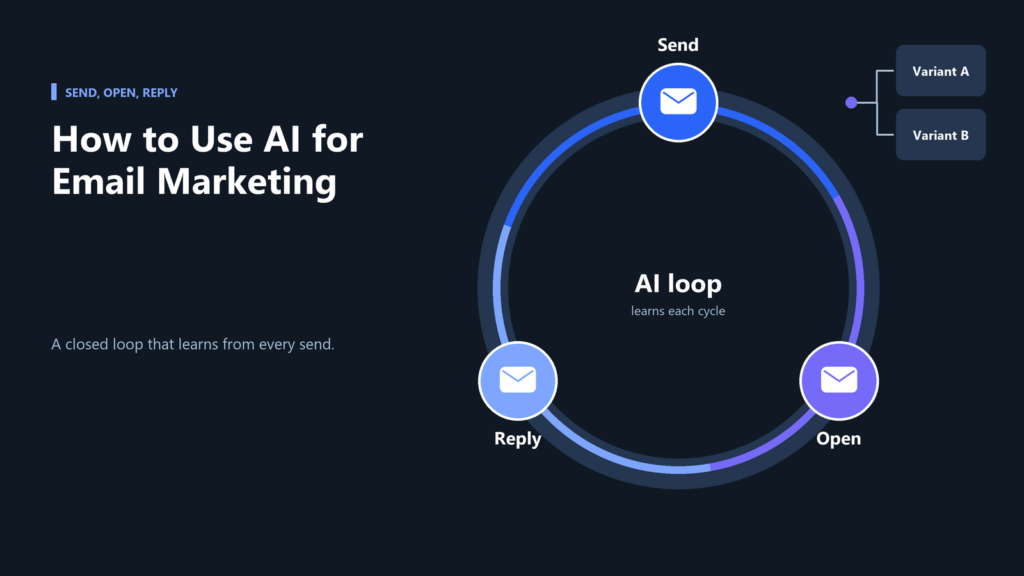
Using AI for email marketing means automating the parts of the send loop that don’t require judgment, segmenting a list, drafting subject line variants, timing sends around individual open behavior, and flagging which contacts have gone cold, while a person still decides what the offer is and approves the message before it goes out. The technology speeds up the mechanics. It doesn’t replace the strategy.
The five-step send loop AI actually touches
Email marketing breaks into segment, personalize, send, track engagement, and re-engage. AI has a real role in four of those five steps.
- Segment, grouping contacts by behavior (opened last three emails, hasn’t engaged in 90 days, clicked a specific link) faster than building segments by hand in a spreadsheet.
- Personalize, drafting subject line and preview text variants, and in more advanced setups, adjusting body copy based on what a segment has responded to before.
- Send, this step is mechanical scheduling, not a judgment call, and has been automatable for years independent of AI.
- Track engagement, AI is genuinely useful here for surfacing patterns a person would miss scanning a report, which subject line pattern is losing opens, which send time is underperforming for a specific segment.
- Re-engage, flagging contacts that have gone quiet and triggering a win-back sequence on a schedule, rather than someone remembering to check a “last engaged” column.
Per Litmus’s State of Email research, the same reporting found production timelines dropped sharply, teams needing two weeks or more to produce a single email fell from 62% in 2024 to just 6% in 2025.
What breaks when this is done wrong
The most common mistake is letting AI personalization run without a person checking what it’s actually saying. A subject line generator optimizing purely for open rate will drift toward clickbait if nobody’s reviewing output against brand voice, and that damages trust with a list faster than a slightly lower open rate would. There’s a real, documented consumer trust cost here too, in a Validity survey of over 1,000 consumers, two in five said they’d trust an email less if they knew it was AI-written. That’s a strong argument for using AI to speed up drafting and segmentation, not for sending unreviewed AI copy at scale.
| Task | Safe to automate fully | Needs human review first |
|---|---|---|
| Segment building from behavior data | Yes | |
| Send-time optimization | Yes | |
| Subject line drafting | Yes, review before send | |
| Body copy and offer framing | Yes, always | |
| Re-engagement trigger timing | Yes | |
| Re-engagement message content | Yes, always |
A realistic starting point for a B2B SaaS team
Most Series A and B teams aren’t running complex nurture programs, they’re running a product newsletter and maybe a trial-expiration sequence. The highest-value first move is usually re-engagement, identifying past trial users or stalled opportunities who went cold and triggering a check-in sequence, rather than building an elaborate personalization engine for a list that’s still fairly small. This ties directly into the account-based and outbound pipeline work covered in what an AI BDR actually does, since email re-engagement and outbound follow-up run on the same underlying logic.
Where email fits into the bigger picture
Email is one channel in a broader AI marketing setup. For the full sequencing model, see how to use AI in marketing, and for a channel-by-channel comparison of where teams are applying AI most, see how to use AI for digital marketing. If you’d rather have a team manage segmentation, send strategy, and re-engagement sequencing for you, our demand generation services page covers what that setup includes.
Should I let AI write my email subject lines without review?
No. AI-drafted subject line variants are a good starting point for A/B testing, but they should be reviewed against brand voice before sending. Optimizing purely for open rate without review tends to drift toward clickbait phrasing that damages trust with a list over time.
What’s the easiest AI email workflow for a small business to start with?
Automated re-engagement segmentation, identifying contacts who’ve gone cold and triggering a check-in sequence. It requires less ongoing judgment than personalized nurture content and often recovers revenue from past customers or old quote requests that would otherwise sit untouched.
Does AI personalization actually improve email performance?
It can, but the gains come from better segmentation and timing, not from the novelty of AI-written copy. A well-segmented list with a clear, human-approved offer will outperform an AI-personalized message sent to a poorly segmented list every time.
If your email list has gone quiet and you want a real re-engagement sequence built for it, book a conversation with MV3 and we’ll look at what’s sitting unused in your list.
Share this article

Jordan Reeves leads account-based marketing and outbound pipeline strategy at MV3 Marketing, specializing in account selection, intent-signal targeting, and multi-channel orchestration for B2B companies.
Ready to audit your organic growth opportunity?
$2,500 flat. 5 business days. Six deliverables tied to pipeline , not rankings. No retainer required.
Get the Organic Growth Audit →