
Generative Engine Optimization (GEO) is the practice of making your content visible, citable, and recommendable inside AI-generated answers. Traditional SEO earns you a ranked position on a results page. GEO earns you a citation, a mention, or a recommendation when someone asks ChatGPT, Perplexity, or Google’s AI Overviews a question your company should own.
That definition is simple. The mechanics underneath it are not, and most of the advice floating around treats GEO as either a rebrand of SEO or a mystical new discipline. It is neither. This guide covers what GEO actually is, how answer engines mechanically differ from search engines, what changes in practice, and what a B2B SaaS marketing team should do about it this quarter.
Why GEO exists at all
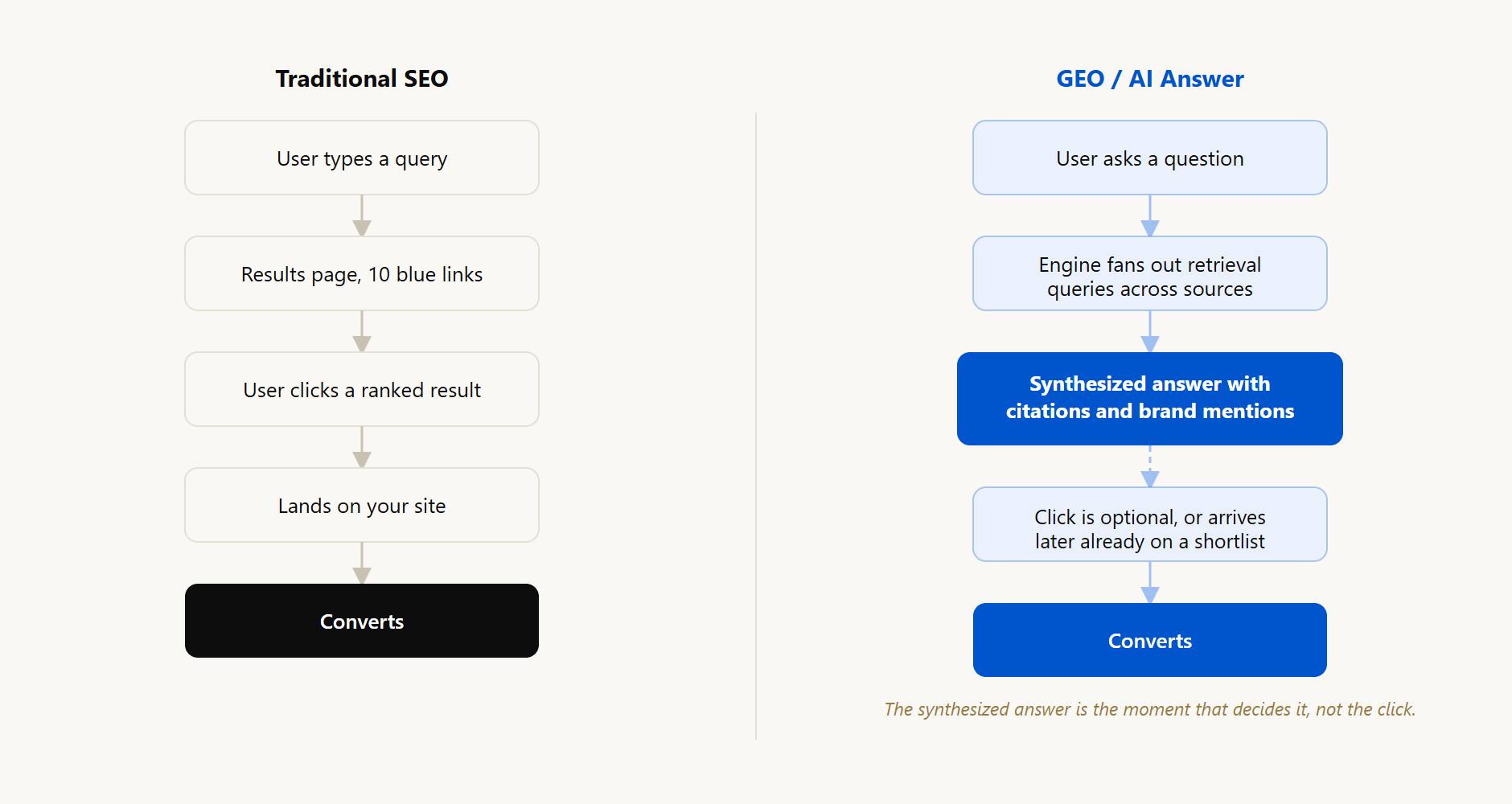
For twenty years, the deal between businesses and Google was stable. You published content, Google ranked it, users clicked through, and you got the visit. Every SEO practice, from keyword research to link building, was built on that click.
Generative engines broke the deal. When someone asks ChatGPT to compare project management tools, or asks Perplexity how SOC 2 compliance works, or types a question into Google and gets an AI Overview, they receive a synthesized answer. Sometimes that answer cites sources. Sometimes it names specific vendors. Often the user never clicks anything, because the answer was the destination.
Two things follow from this, and they define the entire discipline.
First, the unit of competition changed. You are no longer competing for a position on a page of ten links. You are competing to be the material an engine synthesizes from, and to be one of the handful of sources or brands it names. There is no position eight in an AI answer. You are in it or you are absent.
Second, the buyer journey now starts in places your analytics barely see. ChatGPT alone is used by hundreds of millions of people every week, and a meaningful share of commercial research now happens in conversational interfaces before a prospect ever lands on a website. We see this in our own client work: referral traffic from AI assistants is still small in absolute volume for most SaaS sites, but the visitors who do arrive from those sources tend to show up unusually far along, already holding a shortlist. If your brand is not part of the answer that built that shortlist, you were eliminated before you knew the deal existed.
The term itself has a real origin worth knowing. “Generative Engine Optimization” was coined in a 2023 research paper from Princeton University, Georgia Tech, and collaborating institutions, which tested which content characteristics made sources more likely to appear in generative engine responses. The measured result: the strategies they tested improved a source’s visibility in generative engine responses by up to 40%, with quotations, citations to sources, and concrete supporting detail among the strongest levers. That insight, that machines synthesizing answers prefer material that looks like evidence, still underpins most practical GEO work today.
How answer engines actually work (and why it changes your job)
To optimize for something, you need to know how it selects. Generative engines pull information through two distinct paths, and each one demands something different from you.
Path one: training data
Large language models memorize a compressed picture of the public web during training. When ChatGPT answers without browsing, it draws on that picture. Your influence here is slow and indirect: the breadth and consistency of your brand’s footprint across the sites, forums, and publications that end up in training corpora shapes whether the model “knows” you at all, and what it believes you do. This is why consistent positioning language and third-party mentions matter more than they ever did for classic SEO. You cannot patch a model’s memory with a meta tag.
Path two: live retrieval
This is where most day-to-day GEO work happens. When you ask Perplexity a question, or ChatGPT with search enabled, or trigger a Google AI Overview, the engine typically does something like this:
- Rewrites your question into several search queries (often called query fan-out)
- Retrieves candidate pages, frequently leaning on an existing search index
- Breaks those pages into passages and selects the chunks most relevant to the question
- Synthesizes an answer from those chunks
- Attaches citations to some or all of the claims
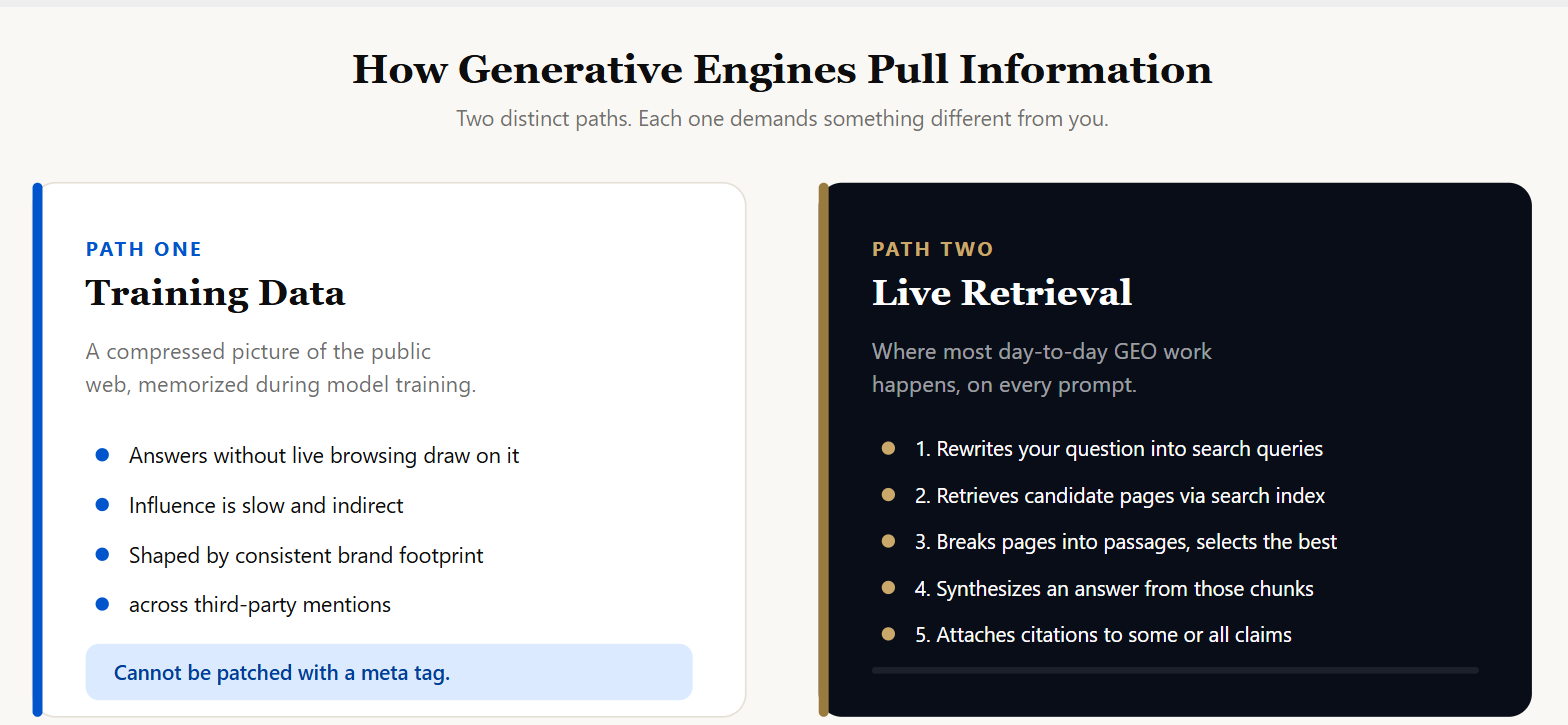
Every step is an optimization surface. Step two means classic SEO still matters, because retrieval leans on search indexes: if you are invisible to search, you are usually invisible to retrieval. Step three is the big shift. The engine does not evaluate your page as a whole; it evaluates passages. A 3,000-word page whose actual answer is smeared across twelve paragraphs loses to a page that states the answer cleanly in one extractable block. Step five rewards content that makes claims a machine can confidently attribute: specific, sourced, clearly written statements rather than vague marketing language.
There is also a plumbing layer people skip. AI crawlers such as GPTBot, OAI-SearchBot, PerplexityBot, and ClaudeBot need access to your site, and many of them handle JavaScript-rendered content poorly or not at all. A SaaS marketing site built as a client-rendered app can look complete to a human and nearly empty to the crawler feeding an answer engine. Checking your robots.txt directives and confirming your key pages render meaningful HTML without JavaScript is unglamorous work that sits upstream of everything else.
A robots.txt line that explicitly welcomes AI crawlers looks like this:
User-agent: GPTBot
Allow: /

User-agent: PerplexityBot
Allow: /

User-agent: ClaudeBot
Allow: /

User-agent: OAI-SearchBot
Allow: /
If any of those user-agents instead show Disallow: /, that crawler cannot retrieve your content at all, and no amount of on-page GEO work will matter for it.
GEO vs. traditional SEO: what actually changes
The honest framing: GEO is not a replacement for SEO. It sits on top of it, shares maybe two-thirds of its foundation, and diverges sharply in the last third. Here is the side-by-side.
| Dimension | Traditional SEO | GEO |
|---|---|---|
| What you win | A ranked position on a results page | A citation or brand mention inside a generated answer |
| Unit of evaluation | The page (and site) | The passage or chunk |
| Outcome for the user | A click to your site | Often an answer with no click at all |
| Content that wins | Comprehensive coverage of a keyword | Direct, extractable, well-evidenced answers to specific questions |
| Authority signal | Backlinks above all | Backlinks plus breadth of third-party mentions the engine can corroborate |
| Where competition happens | Your pages vs. competitor pages | Your entire corroborating footprint (reviews, communities, press) vs. theirs |
| Measurement | Rankings, clicks, organic sessions | Citation share across prompts, AI referral traffic, AI crawler activity |
| Failure mode | Ranking on page two | Being absent from the answer entirely, with no report that tells you |
Three of those rows deserve emphasis.
Passage-level evaluation changes how you write. Every important section of a page should work when lifted out alone: a heading that states the question, an opening sentence that answers it, supporting detail after. If a passage requires the three paragraphs above it to make sense, an engine will pass it over for one that stands alone.
Corroboration changes where you invest. When an engine answers “best subscription analytics tools,” it is heavily influenced by third-party roundups, review platforms like G2, community threads on Reddit, and industry publications, not primarily by vendor homepages. Engines synthesize consensus. If the only source claiming you belong in a category is you, you are a weak candidate for the answer. Off-site presence used to be a link building concern; it is now a direct input into whether you get named.
Measurement changes what “winning” looks like. There is no single rank tracker for generative answers, because answers vary by phrasing, session, and model version. GEO measurement means tracking citation frequency across a defined set of buyer prompts over time, which is closer to brand share-of-voice tracking than to a keyword ranking report.
What this looks like for a real SaaS company
A quick illustration. This is a hypothetical composite, not a client case study, but it mirrors a pattern we run into constantly in audits.
Picture a SaaS company selling contract management software. Their category page ranks third on Google for “contract management software.” Organic traffic is healthy. By every dashboard the team looks at, content is doing its job.
Then someone on the team asks ChatGPT and Perplexity the questions their actual buyers ask: “What contract management tools work best for mid-size legal teams?” “How should I evaluate contract management software?” The answers name four competitors. Their company appears in none of them, across dozens of phrasings.
When you dig into why, the reasons are usually mundane. The category page that ranks third is a wall of feature marketing with no clean definitional passages an engine can lift. The comparison content that does exist buries direct claims under hedged copy. The company is thin on G2 and absent from the community threads and independent roundups the engines lean on for “best tools” synthesis. And the server logs show GPTBot was blocked eighteen months ago by a robots.txt rule nobody remembers adding.
Nothing in that picture shows up in a rankings report. That is the uncomfortable property of the AI answer layer: it fails silently. The rank tracker says third place while a growing slice of buyers get a shortlist you are not on.
The GEO playbook for service business marketing teams
Here is what we actually do, in order, when we take a SaaS site through this. It is also roughly the sequence our GEO Audit follows, so if you want the diagnostic version done for you, that is the productized form of this list.
1. Define your answer surface
List the prompts that matter: definitional questions in your category, “best tools for” questions, comparison questions against named competitors, and problem questions your product solves. Twenty to fifty prompts is a workable starting set. This is the GEO equivalent of a keyword universe, except phrased the way buyers talk to an assistant.
2. Baseline your citation presence
Run those prompts through ChatGPT, Perplexity, Gemini, and Google’s AI Overviews. Record whether you are mentioned, whether you are cited, and who is. Do this on a schedule, because answers drift. The first baseline is usually the moment a leadership team starts taking GEO seriously, because absence is visible in a way no analytics dashboard makes it.
3. Fix machine access
Audit robots.txt for AI crawler rules, deliberate or accidental. Check server logs for GPTBot, OAI-SearchBot, PerplexityBot, and ClaudeBot activity. Confirm your money pages render real content without JavaScript execution. Publishing an llms.txt file is worth doing as a low-cost hedge, though we will say plainly that evidence of engines consistently consuming it is still thin, so treat it as cheap insurance rather than a strategy.
4. Restructure priority pages for extractability
For each priority page: put a direct answer in the first block, use question-phrased H2s and H3s, keep paragraphs tight enough to lift, and turn comparative claims into structured lists and tables. Add named authorship with real expertise signals, publication and update dates, and sources for factual claims. This work also tends to improve classic SEO performance, which is why we sequence it early; it pays on both surfaces.
5. Apply schema where it earns its keep
Organization, Article, Product, and FAQPage markup will not make a language model love your prose, but it feeds the knowledge-graph and search-index layer most retrieval pipelines sit on, and it helps engines resolve who you are, what you sell, and which category you belong to. Entity clarity, meaning consistent naming and descriptions of your company and product everywhere they appear, matters more in GEO than any single markup type.
6. Build the corroborating footprint
Invest in the sources engines synthesize from: a real review presence on G2 and similar platforms, genuine participation where your category gets discussed in communities, digital PR that lands you in independent roundups and industry publications. The test is simple: if an engine tried to corroborate the claim “this company is a credible option in its category” without visiting your website, what would it find?
7. Measure and iterate
In GA4, segment referral traffic from AI domains and watch its trend and conversion behavior. Monitor AI crawler hits in logs as a leading indicator of retrieval interest. Re-run your prompt set monthly and track citation share like you would track share of voice. Expect movement over months, not days.
GEO, AEO, LLMO: do the names matter?
You will see Generative Engine Optimization, Answer Engine Optimization (AEO), LLM Optimization (LLMO), and AI SEO used almost interchangeably. There are shades of difference: AEO is often used more narrowly for featured-snippet and direct-answer optimization, LLMO sometimes refers specifically to influencing model training data. In practice the working discipline is the same, and we would rather you build the capability than adjudicate the vocabulary. We keep a running glossary of GEO, AEO, SEO, and LLMO terms if you want the distinctions pinned down for internal alignment, which is genuinely useful when you need a team rowing with shared language.
Frequently asked questions
Is GEO replacing SEO?
No. Retrieval-based answer engines lean on search indexes to find candidate sources, so classic SEO health remains a prerequisite for GEO visibility. What changes is the finish line. SEO gets you into the candidate pool; GEO determines whether you make it into the answer. Teams that frame it as either/or usually end up weak at both.
How long does GEO take to show results?
On-page changes, extractable answer blocks, and technical access fixes can influence retrieval-based citations within weeks, since those engines pull live content. Footprint work, reviews, community presence, and press operate on a months-long horizon, and influence on model training data is slower still. We tell clients to expect early citation movement inside a quarter and compounding gains after that, and to distrust anyone promising precise timelines, because the engines change too often for precision to be honest.
Can you actually measure GEO?
Yes, imperfectly. The workable stack today: scheduled citation tracking across a defined prompt set (some SEO platforms now offer this natively), AI referral segments in your analytics, and AI crawler activity in server logs. What you cannot yet get is impression-style data showing how often answers mentioned you to users who never clicked, so treat measured numbers as the floor of your actual AI visibility, not the ceiling.
Does GEO require different content than good SEO content?
Mostly it requires better-structured content, not different topics. The same guide can win both surfaces if every major section answers its question directly, claims are specific and sourced, comparisons are structured, and authorship is real. Where GEO does demand something SEO never did is off-site: third-party corroboration is now part of the content strategy, not a separate PR line item.
Keep going on this
We publish practitioner-level breakdowns like this one throughout our content sprint: what is changing in AI search, what we are seeing in real client data, and what is working, with no invented statistics and no filler. If that is useful to you, join the MV3 newsletter and get each new guide in your inbox, along with the prompt-set template we use to baseline citation presence for SaaS brands. One email when we publish, nothing else.
Subscribe to the MV3 newsletter →
Alex Carter leads SEO and Content Strategy at MV3 Marketing, where we build organic and AI-answer visibility programs for B2B SaaS companies.
Share this article

Alex Carter leads SEO and content strategy at MV3 Marketing, specializing in generative engine optimization, technical SEO, and AI-driven content systems for B2B companies.
Ready to audit your organic growth opportunity?
$2,500 flat. 5 business days. Six deliverables tied to pipeline , not rankings. No retainer required.
Get the Organic Growth Audit →