Using AI in marketing means applying machine learning and generative AI tools to specific, repeatable tasks, drafting content, scoring leads, personalizing email, adjusting ad bids, so a smaller team can cover more ground without losing quality control. It isn’t one tool or one campaign. It’s a maturity model most businesses move through in four stages, and where a business should start depends on what’s actually broken in its marketing operation today, not on what a vendor is selling this quarter.
What “using AI in marketing” actually covers
The phrase gets used as a catch-all, which makes it hard to act on. In practice, AI in marketing breaks down into a handful of distinct jobs:
- Content production, drafting blog posts, ad copy, email sequences, and social captions from a brief, then a human edits and fact-checks before anything ships.
- Lead scoring and routing, ranking inbound inquiries by fit and urgency so a rep calls the right one first.
- Ad optimization, adjusting bids and creative rotation in paid search and paid social faster than a person checking a dashboard once a day.
- Personalization, tailoring email subject lines, send times, and on-site messaging to segment or individual behavior.
- Analytics and reporting, pulling GA4, CRM, and ad-platform data into one summary instead of a person exporting three spreadsheets every Monday.
Each of these is a narrow task. None of them is “AI runs my marketing.” A B2B SaaS team that tries to adopt all five at once usually ends up with five half-finished pilots instead of one that actually works.
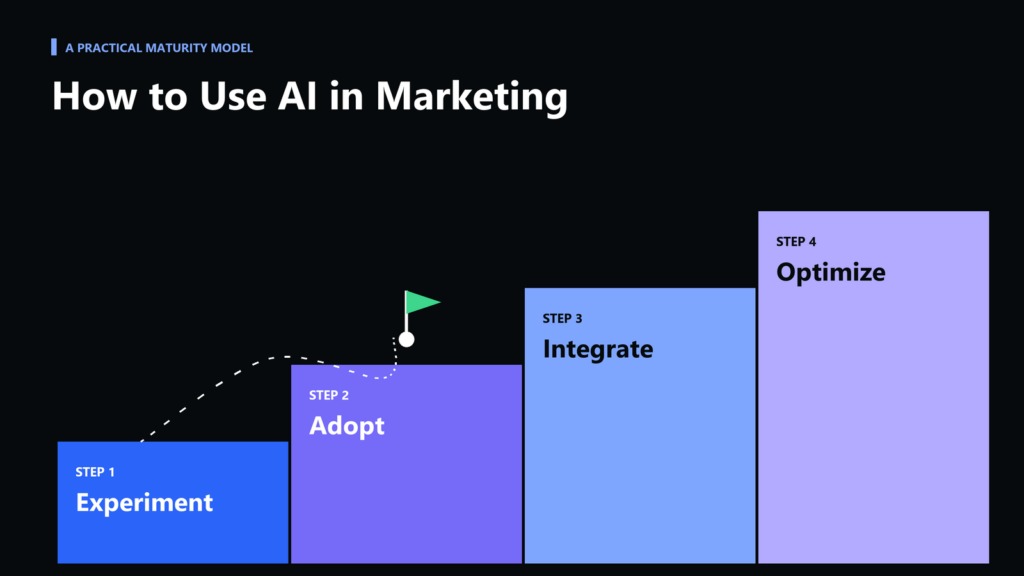
The four-stage maturity model
Most businesses move through the same rough sequence, whether they plan to or not:
Per Salesforce’s State of Marketing 2026 report (4,450 marketing decision-makers surveyed October to November 2025), adoption has nearly doubled in two years. The gap that remains isn’t whether teams use AI, it’s whether they’ve moved past stage one below.
Stage 1: Foundational
A person on the team uses ChatGPT or a similar tool for one-off tasks, drafting a social caption, brainstorming headlines, summarizing a call transcript. Nothing is connected to a workflow. This is where most small service businesses are right now, and it’s a reasonable place to start as long as it doesn’t stay the whole plan.
Stage 2: Automated
AI is wired into a repeatable process: a form submission triggers an AI-drafted follow-up email, a content brief auto-generates a first draft, a chatbot handles the first qualifying question on the website. A human still reviews before anything goes out, but the trigger-to-draft step no longer requires someone to start from a blank page.
Stage 3: Predictive
The system starts making judgment calls based on patterns, flagging which leads are likely to close, which ad creative is fatiguing, which blog topics are gaining search interest before a competitor writes about them. This stage requires enough historical data to train on, which is why most businesses can’t skip to it.
Stage 4: Autonomous
Defined, bounded tasks run without a human in the loop for each instance, an AI agent re-engages a cold lead on a set schedule, or a bidding system reallocates ad spend within pre-approved limits. A person still sets the rules and reviews outcomes on a cadence, but doesn’t approve every individual action.
Skipping stages is the most common failure mode. A construction company that jumps straight to an “autonomous AI marketing agent” without the Stage 2 review habits in place usually ends up with unreviewed, off-brand content going out under its name.
Where a B2B SaaS team should actually start
For a Series A or Series B SaaS company, the highest-leverage starting point is almost never content generation, even though that’s what most “AI marketing” content assumes. It’s the lead response gap. As covered in our breakdown of what lead generation automation actually replaces, most missed revenue comes from the 10 to 40 minutes after an inquiry arrives, not from a shortage of content or ad spend.
| Use case | What AI actually replaces | What still needs a person |
|---|---|---|
| First-draft content | The blank page, staring at an empty doc for an hour | Fact-checking, brand voice, deciding what to publish |
| Lead follow-up | Manually checking an inbox every hour | The actual sales conversation and judgment call |
| Ad bid management | Daily manual bid adjustments across campaigns | Setting budget limits, creative strategy, brand guardrails |
| Email personalization | Building segments and variants by hand | Deciding what the offer actually is |
| Reporting | Exporting and formatting data from three tools | Interpreting what the numbers mean for the business |
What AI does not do
It doesn’t fix a broken sales process, decide your pricing strategy, or replace the judgment call on which leads are worth chasing. It also doesn’t make bad content good, an AI-drafted blog post built on a weak brief produces a weak post faster than a person would have. The tools compress the time between “we should do this” and “this exists in draft form.” They don’t compress the thinking that has to happen before or after.
Building out the rest of the stack
Once the lead-response gap is closed, the next moves usually branch into specific channels. If content is the bottleneck, how to use AI for content creation covers the editorial pipeline in detail. If email is underused, how to use AI for email marketing walks through the send loop. For a step-by-step rollout sequence rather than a conceptual model, the practical guide to using AI for marketing lays out a four-week audit-to-scale plan, and how to use AI for digital marketing breaks down channel-by-channel adoption for paid and organic.
If you’re weighing whether to build this internally or bring in outside help, our AI automation services page covers what a managed setup actually includes.
Is AI in marketing just ChatGPT for writing content?
No. Content drafting is the most visible use case, but AI in marketing also covers lead scoring, ad bid management, email personalization, and reporting. A business that only uses AI for writing is stuck at the earliest stage of a much bigger opportunity.
How long does it take to move from Stage 1 to Stage 2?
For most B2B SaaS teams, connecting one workflow, usually lead intake to a drafted follow-up, takes a few weeks once the underlying CRM or form system is in place. The bottleneck is rarely the AI tool itself, it’s having a single source of truth for leads to connect to.
Do small businesses need Stage 3 or 4, or is Stage 2 enough?
Most small and regional businesses get the bulk of the available value at Stage 2. Predictive and autonomous stages require enough historical data and process maturity that jumping there early often produces worse results than a well-run Stage 2 setup.
If you want a second opinion on where your marketing operation actually sits on this model before you invest in more tools, book a conversation with MV3 and we’ll walk through it together.
Share this article

Alex Carter leads SEO and content strategy at MV3 Marketing, specializing in generative engine optimization, technical SEO, and AI-driven content systems for B2B companies.
Ready to audit your organic growth opportunity?
$2,500 flat. 5 business days. Six deliverables tied to pipeline , not rankings. No retainer required.
Get the Organic Growth Audit →