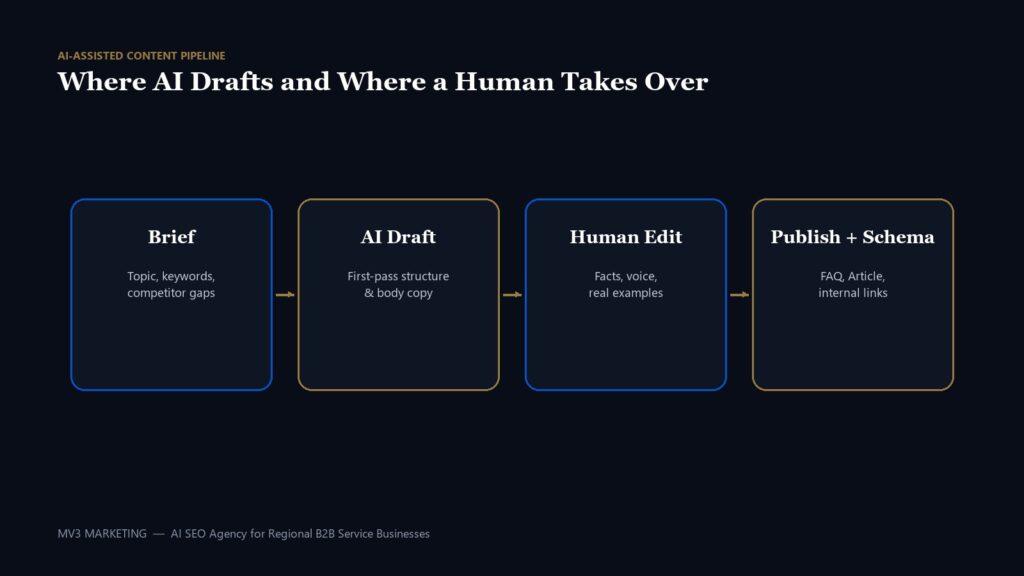
AI writes usable SEO content when it’s given a real, structured brief and treated as a first draft, not a finished piece. The process that actually works: brief, AI draft, a real human edit pass for facts and voice, then publish with schema. Skip the edit pass and the result reads exactly like what it is, generic and unverified, which is also what search engines are increasingly good at identifying and ranking down.
The gap between “AI-written content that ranks” and “AI-written content that gets ignored” almost never comes down to the model used. It comes down to whether a real editing pass happened before it published. Here’s what that pass actually needs to check.
What AI is actually good at in the writing process
AI is reliable at producing a structured first draft fast: an outline that follows a brief, a reasonable opening paragraph, transitions between sections, and a first pass at an FAQ section based on real questions provided in the brief. What it’s not reliable at is knowing which specific facts are true, which examples are real versus plausible-sounding, and whether the tone matches how a specific business actually talks to its customers.
The editorial pipeline that works
- Brief. Topic, target keywords, real competitor gaps, and any specific facts or examples that need to appear. Built from the keyword clustering process in how to use AI for keyword research.
- AI draft. A first-pass structure and body copy built strictly from the brief, not an open-ended prompt.
- Human edit. Every specific claim gets checked against a real source, examples get replaced with real ones where possible, and generic phrasing gets rewritten in the business’s actual voice.
- Publish with schema. Article and, where relevant, FAQPage schema added before the piece goes live, following the standard covered in how to use AI for article and on-page SEO.
Where AI drafts fail without a real edit pass
- Unsourced numbers. A model can state a statistic confidently and be wrong. Every number in a published piece needs a real, checkable source, not just a plausible-sounding one.
- Generic examples. “A business owner might struggle with X” reads as filler compared to a specific, real scenario relevant to the actual reader.
- Uniform sentence rhythm. Unedited AI text tends to have unnaturally consistent sentence length and rhythm. Human writing varies more, and that variance is one of the more reliable free signals that a piece was actually edited, not just generated.
- Overused phrasing. Terms like “unlock,” “dive into,” “in today’s landscape,” and “game-changer” show up disproportionately in unedited AI output and read as filler to an actual reader.
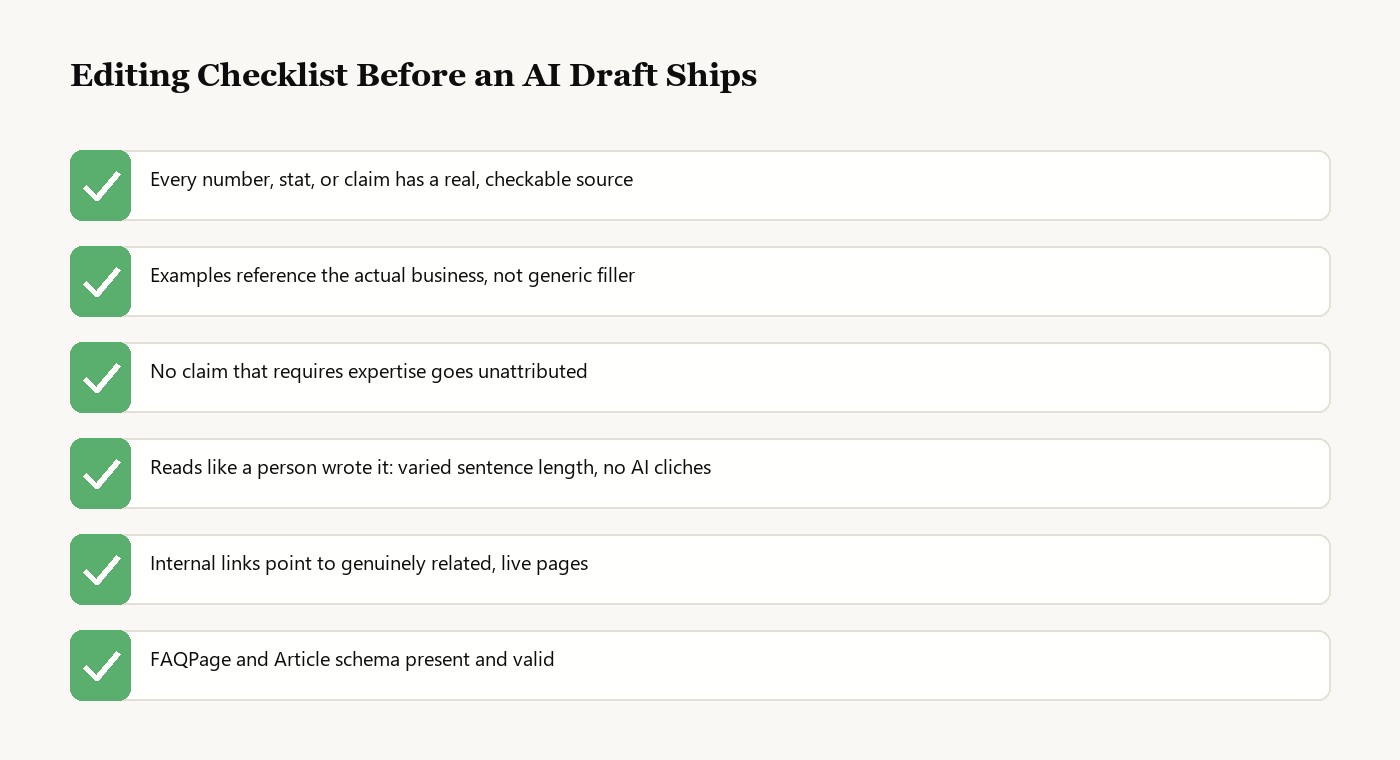
A practical editing checklist before anything publishes
- Every number, stat, or claim has a real, checkable source
- Examples reference the actual business or a real, specific scenario, not generic filler
- Any claim requiring expertise is attributed to a named, credible source
- Reads like a person wrote it: varied sentence length, no AI cliches
- Internal links point to genuinely related, live pages
- Article and FAQPage schema present and valid
Google has been explicit that it doesn’t penalize content for being AI-assisted specifically, it evaluates whether the content is genuinely helpful, accurate, and demonstrates real expertise, the same bar applied to human-written content. That bar is exactly what this checklist is built to hit.
How this ties into AI answer engine visibility
The same editing standards (real sources, specific claims, no filler) matter even more for whether AI answer engines like ChatGPT and Perplexity cite a page, since those systems tend to favor content with concrete, verifiable specifics over generic marketing language. That’s a distinct enough topic to cover on its own in LLM optimization, but the underlying discipline (write something specific and real, not generic) is the same one this checklist enforces. This editing pass fits into the broader workflow in how to use AI for SEO, and teams running drafting through a connected pipeline instead of one tool at a time should also see how to use AI agents for SEO for where a human still has to approve the output.
Can search engines detect AI-written content?
Google has said it doesn’t specifically detect or penalize AI-generated text as its own category, it evaluates whether content is helpful and accurate regardless of how it was produced. In practice, unedited AI drafts tend to read as generic and thin, which is what gets ranked down, not the fact that AI was involved.
How long should editing an AI draft actually take?
It varies by piece, but a real edit pass (fact-checking, replacing generic examples, rewriting for voice) typically takes as long as writing a solid first draft from scratch would have. The time savings comes from not starting with a blank page, not from skipping the edit.
Is it obvious to readers when content wasn’t edited after an AI draft?
Often, yes. Uniform sentence rhythm, generic examples, and overused phrases like unlock or game-changer are recognizable patterns that make unedited content feel less trustworthy, even to readers who can’t name exactly why.
If you want AI-assisted content that actually goes through a real edit pass before it publishes, book a conversation with MV3. This exact editorial process is how content gets produced under MV3’s AI SEO agency retainer.
Share this article

Alex Carter leads SEO and content strategy at MV3 Marketing, specializing in generative engine optimization, technical SEO, and AI-driven content systems for B2B companies.
Ready to audit your organic growth opportunity?
$2,500 flat. 5 business days. Six deliverables tied to pipeline , not rankings. No retainer required.
Get the Organic Growth Audit →