AI helps with article and on-page SEO by checking title tags, heading structure, internal links, schema markup, and image alt text against a consistent standard on every single page, something that’s realistic to do by hand on 5 pages and impossible to do consistently on 500. The judgment calls (which internal links actually make sense, whether a heading is genuinely descriptive) still need a person reviewing the output.
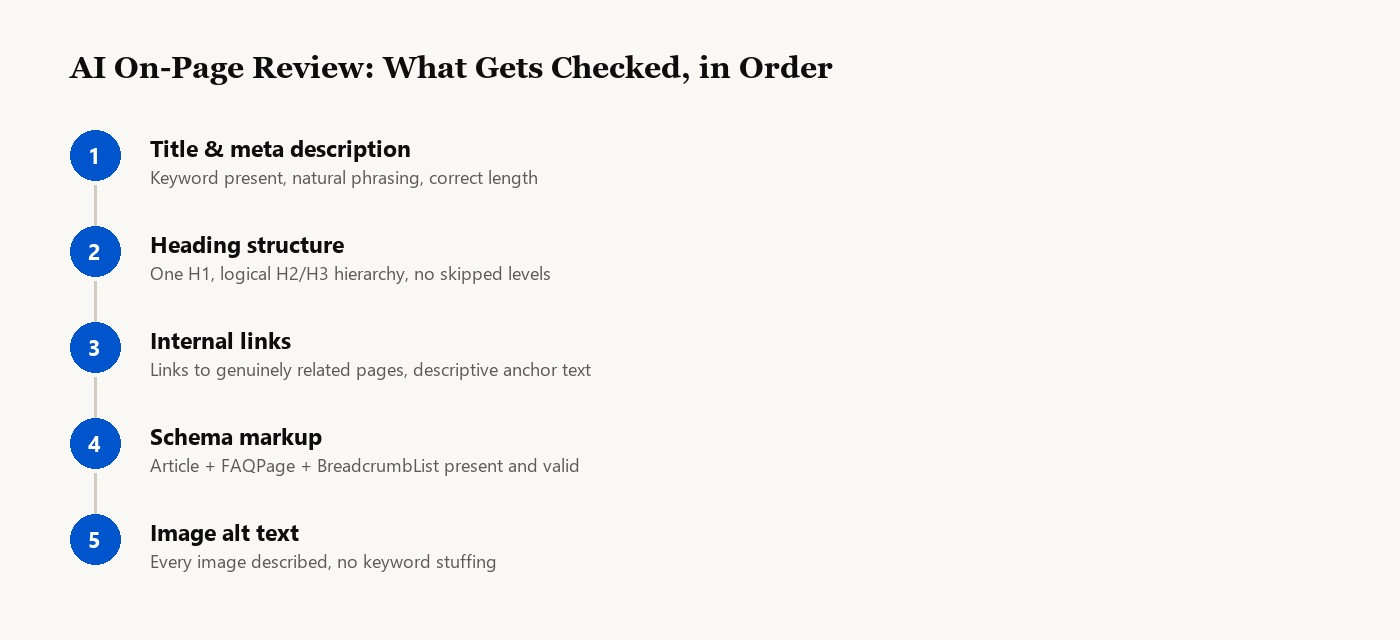
On-page SEO is the part of the work most likely to get skipped once a site has more than a handful of pages, simply because manually checking title length, heading hierarchy, and schema on every page doesn’t scale. This is what AI actually checks, in order, and what still needs a human pass before anything publishes.
What on-page SEO actually covers
On-page SEO is everything about a specific page’s own content and markup that affects whether search engines and AI answer engines understand it: the title tag, meta description, heading structure, internal links, image alt text, and structured data. It’s distinct from technical SEO (site-wide crawlability, speed, indexing) and from off-page factors like backlinks. Google’s SEO Starter Guide covers these fundamentals directly, and none of them have changed because AI tools exist, only the speed of checking them at scale has.
Title tags, meta descriptions, and heading structure
An AI-assisted review checks each page for a title tag that’s unique, under roughly 60 characters, includes the real target keyword without stuffing, and accurately describes the page. Meta descriptions get checked for length and whether they actually summarize the content or just repeat the title. Heading structure gets checked for a single H1, a logical H2/H3 hierarchy, and no skipped levels, which matters for both SEO and for screen reader accessibility, not just search engines.
Internal linking AI can help with, and where it can’t
AI is useful for finding internal linking opportunities at scale: scanning a site for pages that mention a topic without linking to the page that actually covers it in depth. What it shouldn’t be trusted to do unsupervised is decide that a link makes sense just because two pages share a keyword. Google’s own guidance is specific that internal links should use descriptive anchor text and point to genuinely relevant pages, not just insert links for the sake of link count.
Schema markup: what to actually add
Every published page benefits from Article schema (headline, author, publish and modified dates) and BreadcrumbList schema for navigation context. Pages that answer specific questions should also carry FAQPage schema, using real questions a reader would actually ask, not manufactured ones stuffed with keywords. Google’s Article structured data documentation and FAQPage documentation both specify the exact fields search engines expect, and getting the structure wrong (a common AI-generated schema mistake) means the markup gets ignored entirely rather than penalized.
ON-PAGE ELEMENTS AI CAN CHECK AT SCALE
| Element | What gets checked | Still needs a human |
|---|---|---|
| Title tag | Length, keyword presence, uniqueness | Whether it’s genuinely compelling |
| Headings | Hierarchy, no skipped levels | Whether each heading is descriptive |
| Internal links | Missed linking opportunities | Whether the link genuinely helps the reader |
| Schema | Valid structure, required fields present | Whether the claims inside it are accurate |
A pre-publish on-page checklist
- Title tag under 60 characters, keyword present, no stuffing
- Meta description unique and summarizes the actual content
- One H1, logical H2/H3 hierarchy
- Every image has real, descriptive alt text
- Internal links point to genuinely related, live pages with descriptive anchor text
- Article and, where relevant, FAQPage schema present and valid
This checklist works best as a gate before anything ships, not a cleanup pass after. It pairs directly with the drafting process covered in how to use AI to write SEO content, the topic clusters it starts from in how to use AI for keyword research, and the broader workflow in how to use AI for SEO. Teams running this checklist as an automated step in a larger pipeline should also see how to use AI agents for SEO for where a human still has to sign off.
Can AI write valid schema markup on its own?
It can produce the structure, but it needs to be checked against Google’s actual required and recommended fields before publishing. Invalid or incomplete schema is typically just ignored by search engines rather than penalized, but it also means the page gets none of the benefit.
How many internal links should a typical page have?
There’s no fixed number. The real standard is whether every link genuinely helps the reader get to a more relevant page, not hitting a target count.
Does keyword stuffing in a title tag still hurt rankings?
Yes. It reads as manipulative to both search engines and to actual readers deciding whether to click, and a title that doesn’t reflect the real content can also hurt click-through rate even if it briefly ranks.
If you want a real on-page audit of your existing pages, not a generic checklist, book a conversation with MV3. This kind of ongoing on-page review is a standing part of MV3’s AI SEO agency retainer.
Share this article

Vance Moore is Chief Growth Officer at MV3 Marketing and leads its team of SEO professionals, engineers and auditors.
Ready to audit your organic growth opportunity?
$2,500 flat. 5 business days. Six deliverables tied to pipeline , not rankings. No retainer required.
Get the Organic Growth Audit →