An AI agent for SEO is a system that carries out a multi-step task on its own, like crawling a site, pulling keyword data, or drafting a page, then hands the result to a person or another agent for review, instead of a single tool that just answers one prompt. The real value is dividing SEO work into specialized steps that run continuously. The real risk is letting anything customer-facing publish without a human checking it first.
“AI agent” gets used loosely enough that it’s worth being specific about what actually changes when SEO work runs through agents instead of one-off AI tools, and exactly where human oversight still has to sit in that process.
What an “AI agent” actually means in an SEO context
A single-purpose AI tool answers one question: draft this paragraph, summarize this page, suggest these keywords. An agent chains several steps together and can act on intermediate results without a person re-prompting it at every step: crawl a site, identify pages with thin content, pull keyword data for each, draft an improvement plan, and flag the results for review. The distinction matters because agents can compound errors across steps if nothing checks the output between them, which is exactly why the review layer below isn’t optional.
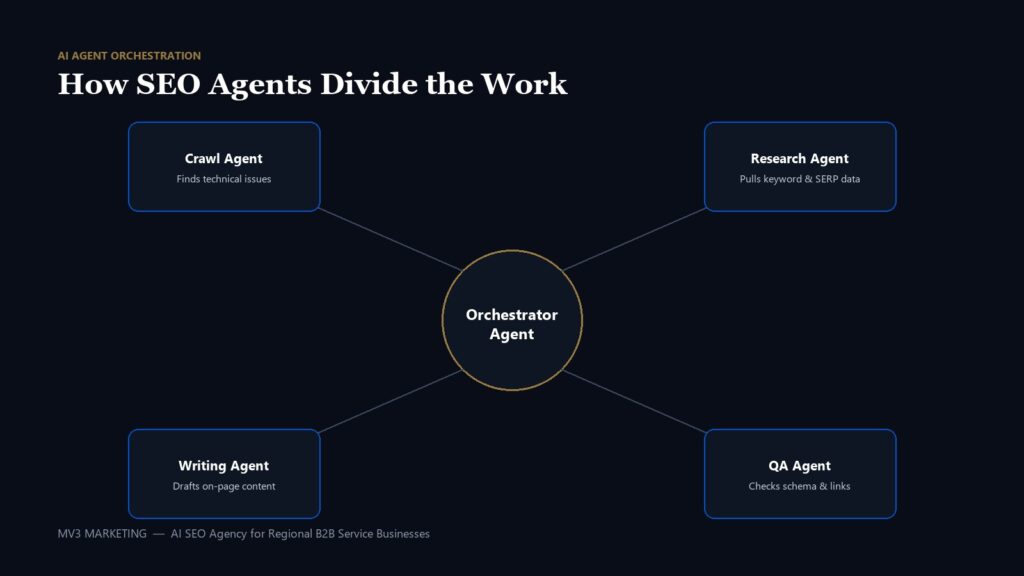
An orchestrator layer coordinates the handoffs so one agent’s output becomes the next agent’s input.
How SEO agents divide the work
A realistic multi-agent SEO setup splits work by specialty rather than running one agent that tries to do everything:
- Crawl agent. Finds technical issues: broken links, missing schema, slow-loading pages.
- Research agent. Pulls keyword and SERP data, flags content gaps against competitors.
- Writing agent. Drafts on-page content and briefs based on what the research agent surfaces.
- QA agent. Checks the writing agent’s output against schema requirements, internal linking standards, and factual claims that need a source.
An orchestrator layer coordinates the handoffs between agents so the output of one becomes the input to the next, rather than each agent working in isolation.
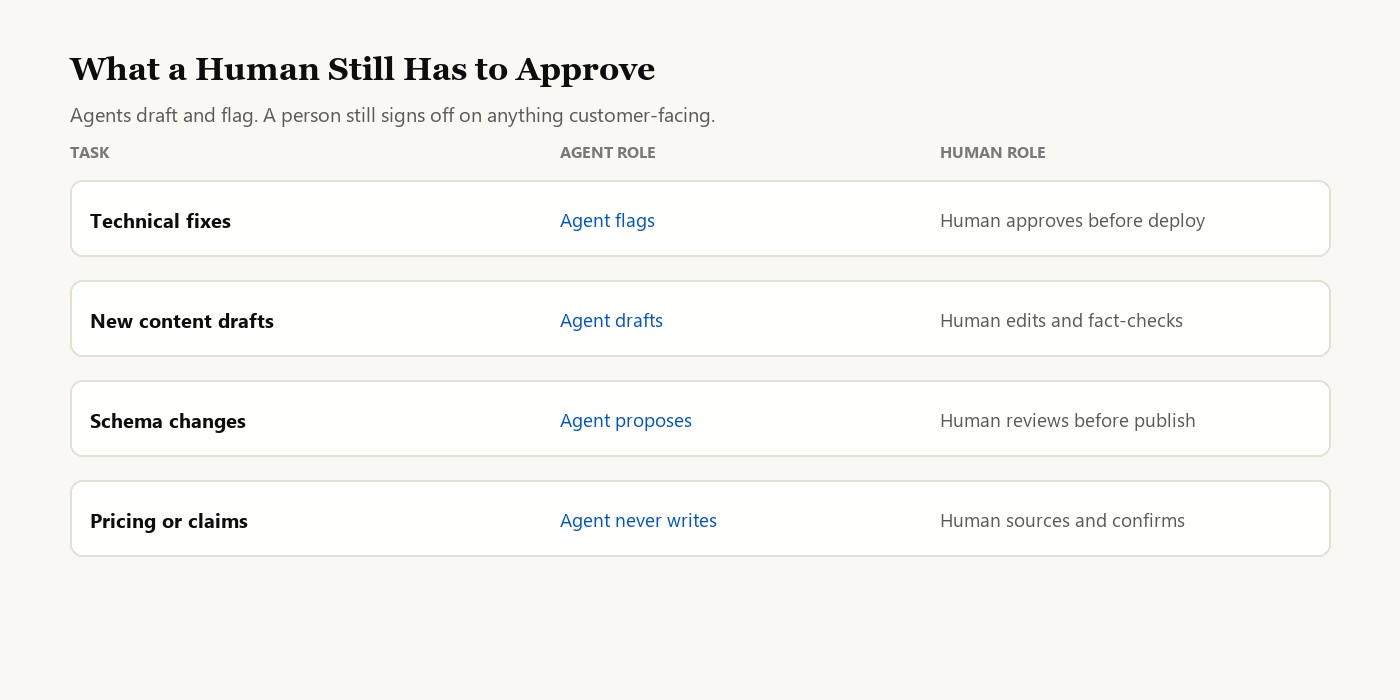
What a human still has to approve
Every one of those agents produces a draft, a flag, or a proposal, never a final, published action on anything customer-facing. Technical fixes get flagged by the crawl agent and approved by a person before deployment. Content drafts get written by the writing agent and edited, fact-checked, and voiced by a person before publishing. Schema changes get proposed and reviewed before going live. Anything involving pricing or a specific factual claim never gets written by an agent without a human sourcing and confirming it first, the same standard covered in how to use AI to write SEO content.
A realistic agent-assisted SEO workflow
- Crawl agent scans the site weekly and flags real technical issues
- Research agent pulls fresh keyword and competitor data for priority topics, the same clustering process covered in how to use AI for keyword research
- Writing agent drafts based on an approved brief, never an open-ended topic
- QA agent checks the draft against the schema and linking checklist in how to use AI for article and on-page SEO
- A person reviews, fact-checks, and approves before anything publishes
This is the same underlying process described in how to use AI for SEO, just coordinated through connected agents instead of separate manual steps.
Risks of running agents without oversight
Agents that publish directly to a live site without a review step can compound small errors into visible problems: a factually wrong claim that gets indexed, a schema change that breaks structured data sitewide, or duplicate content generated at a pace no one is checking. Google’s spam policies treat scaled, low-effort automated content as a violation regardless of intent, which means an unsupervised agent publishing at volume is a real ranking risk, not just a quality concern.
Should AI agents be allowed to publish directly to a live website?
Not for anything customer-facing. A safer pattern is agents drafting and flagging, with a person approving before anything goes live, especially for pricing, claims, or schema changes.
How is an AI agent different from a regular AI tool like a chatbot?
A chatbot answers one prompt at a time. An agent chains multiple steps together and can act on the results of earlier steps without a person re-prompting at each stage, which is useful but also means errors can compound if nothing reviews the output between steps.
What SEO tasks are safest to fully automate with agents?
Monitoring and flagging tasks: crawling for technical issues, tracking rank changes, pulling fresh keyword data. Anything that results in a published claim or a live site change still needs a human approval step.
If you want to see what an agent-assisted SEO workflow with real human review would look like for your business, book a conversation with MV3. This kind of agent-plus-human-review process runs behind MV3’s AI SEO agency retainer.
Share this article

Vance Moore is Chief Growth Officer at MV3 Marketing and leads its team of SEO professionals, engineers and auditors.
Ready to audit your organic growth opportunity?
$2,500 flat. 5 business days. Six deliverables tied to pipeline , not rankings. No retainer required.
Get the Organic Growth Audit →