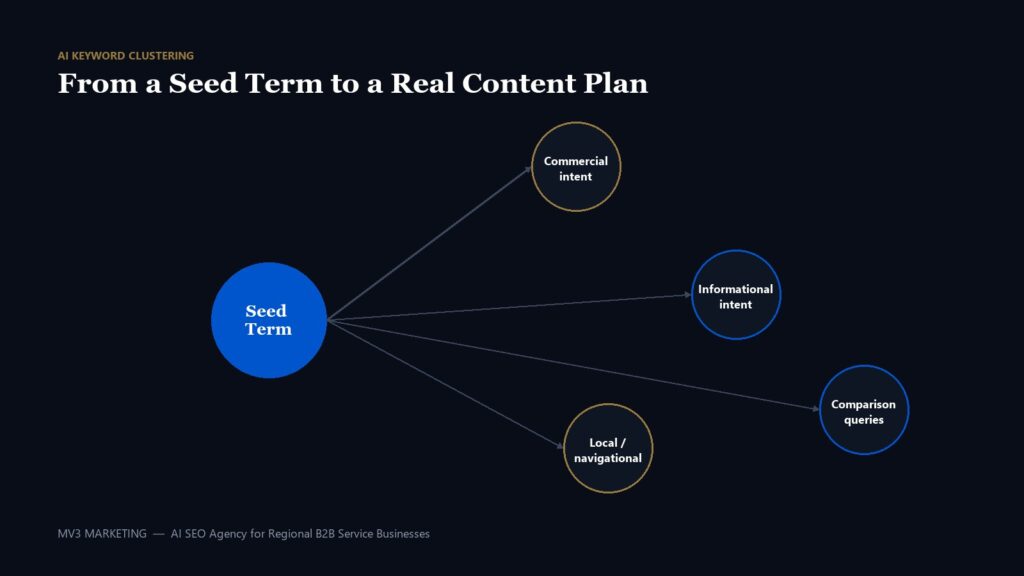
AI-assisted keyword research works by expanding one seed term into hundreds of real, related queries, pulling actual search volume and difficulty for each, then clustering them by intent so a business can see which topics are worth writing about first. The AI doesn’t decide strategy, it compresses a process that used to take half a day into about 20 to 30 minutes.
Most small and mid-sized service businesses either skip keyword research entirely or do it once and never touch it again. Here’s a real, step-by-step process for doing it with AI tools, without ending up with a spreadsheet of terms nobody will ever act on.
What AI actually adds to keyword research
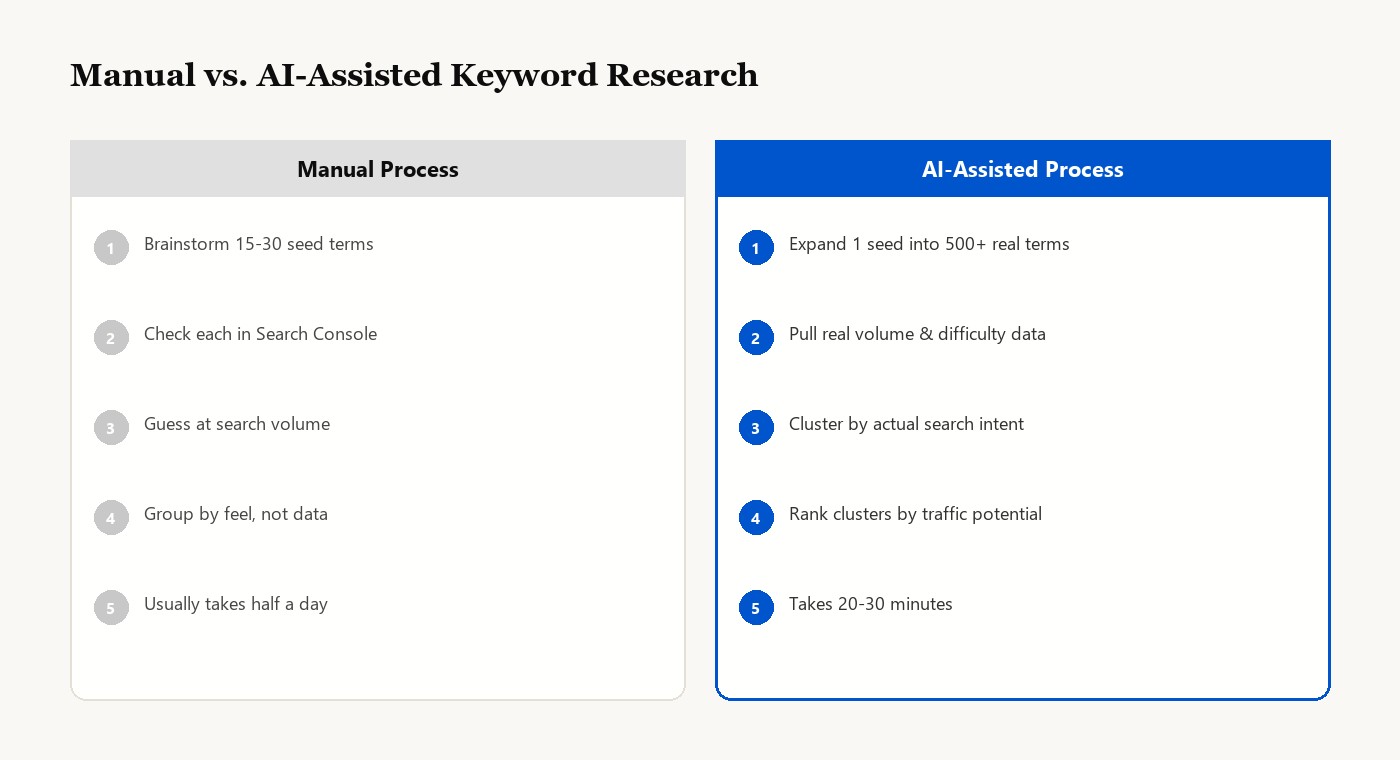
Manual keyword research usually starts with 15 to 30 seed terms someone brainstorms, checked one by one, with volume estimated by feel rather than real data. AI-assisted research starts the same way, with one or two seed terms, but expands each into hundreds of real variations, pulls actual monthly search volume and keyword difficulty, and groups the results by what a searcher is actually trying to do. The output isn’t a list. It’s a set of decisions about what to build first, ranked by real opportunity instead of gut feel.
Step by step: from a seed term to a content plan
- Start with 1 to 3 seed terms that describe a real service, not a vague category. “Contract lifecycle management pricing” works better than “CLM software.”
- Expand each seed using a keyword research tool’s related-terms and search-suggestions features to pull the real variations people actually search.
- Pull real volume and difficulty data for every term in the expanded list. Skip this step and every later decision is a guess.
- Cluster by intent, not just by shared words. “How much does CLM software cost” and “best CLM software for legal teams” look similar but serve completely different pages.
- Rank clusters by realistic opportunity: real search volume, achievable difficulty given the site’s current authority, and whether the topic actually serves a real customer question.
How to cluster keywords by real intent
Search intent generally splits into four buckets, and each one calls for a different kind of page:
| Intent type | Example query | What it points to |
|---|---|---|
| Commercial | “best CLM software for enterprise teams” | A service or comparison page, not a blog post |
| Informational | “how does contract lifecycle management work” | A genuinely useful guide, the kind that tends to get cited by AI answer engines when it’s specific and well-sourced |
| Local or navigational | “[company name] reviews” | A comparison page or reputation-focused content |
| Comparison | “Ironclad vs. DocuSign CLM” | A comparison piece, often one of the highest-converting formats for a considered purchase |
Ahrefs’ keyword research guide covers the mechanics of pulling this data in more depth; the part AI genuinely speeds up is the clustering and prioritization step that comes after.
Common mistakes with AI keyword research
- Trusting AI-estimated volume without checking a real data source. A model can guess plausibly wrong numbers. Cross-check estimates against an actual keyword tool before making decisions.
- Building a list and never acting on it. A cluster of 40 keywords is only useful if it turns into a real content or page plan, covered next.
- Chasing volume over intent fit. A high-volume term that doesn’t match what the business actually offers wastes the effort of ranking for it.
Turning clusters into a real content plan
Once clusters are ranked by opportunity, each one becomes either a new page, an update to an existing page, or gets dropped because it doesn’t fit the business. The highest-priority clusters are where AI-assisted drafting actually earns its time savings, detailed in how to use AI to write SEO content, and the resulting pages should go through the pre-publish checklist in how to use AI for article and on-page SEO before they ship. This same clustering process is also the starting point for the broader workflow covered in how to use AI for SEO, and for teams running research as a coordinated pipeline rather than a manual step, see how to use AI agents for SEO.
Is AI keyword data as accurate as manual research?
The underlying volume and difficulty numbers come from the same real search data either way. What AI changes is the speed of expanding and clustering that data, not the accuracy of the raw numbers themselves.
How many keywords should a small business target at once?
Fewer than most spreadsheets suggest. A realistic starting point is 5 to 10 high-priority clusters that map to real pages, not a list of 200 individual terms with no plan attached.
Should low search volume keywords be ignored?
Not automatically. A low-volume, low-competition term that matches a real, high-intent customer question can be worth more than a high-volume term that’s nearly impossible to rank for and only loosely related to the business.
If you want a real keyword plan built around your actual services and service area, book a conversation with MV3. Keyword clustering like this is one piece of the ongoing work covered under MV3’s AI SEO agency retainer.
Share this article

Vance Moore is Chief Growth Officer at MV3 Marketing and leads its team of SEO professionals, engineers and auditors.
Ready to audit your organic growth opportunity?
$2,500 flat. 5 business days. Six deliverables tied to pipeline , not rankings. No retainer required.
Get the Organic Growth Audit →