
SEO optimizes your site to rank in traditional search results. AEO optimizes content to be the direct answer to a specific question. GEO optimizes for being cited inside AI-generated responses from tools like ChatGPT and Perplexity. LLMO optimizes how your brand appears in large language model outputs overall. The four overlap heavily, and most B2B teams need one integrated strategy, not four.
That is the short version. The long version is worth your time, because these four acronyms are now doing real damage in marketing meetings. Vendors use them interchangeably. Consultants use them to invent new service lines. Executives hear four terms and assume they need four budgets. None of that is true, and by the end of this article you will be able to explain exactly why.
Why there are suddenly four names for search
For roughly twenty-five years, one discipline covered organic visibility: SEO. Then AI assistants started answering questions directly instead of returning ten blue links, and the industry needed language for the new behavior. Different people coined different terms at different times, from different starting points. Academics contributed one. The featured-snippet era contributed another. The SEO community itself contributed a third.
The result is a pile of labels that describe overlapping practices, not cleanly separated disciplines. That distinction matters, so let’s put the four side by side before going deeper on each.
The comparison table: SEO vs AEO vs GEO vs LLMO
| Term | Stands for | Origin | What it optimizes for | Primary metric |
|---|---|---|---|---|
| SEO | Search Engine Optimization | Mid-1990s, alongside the first commercial search engines | Ranking web pages in traditional search results (Google, Bing) | Rankings, organic traffic, and the conversions that follow |
| AEO | Answer Engine Optimization | Grew out of the featured-snippet and voice-assistant era, before the current AI wave | Being selected as the direct answer to a specific question, whether in a snippet, a voice response, or an AI answer | Answer capture: how often your content is the answer shown, not just a link listed |
| GEO | Generative Engine Optimization | Coined in a 2023 academic paper by researchers at Princeton, Georgia Tech, and collaborating institutions | Being cited and referenced inside AI-generated responses (ChatGPT, Perplexity, Google’s AI Overviews, Copilot) | Citation frequency: how often AI engines cite your domain when answering relevant prompts |
| LLMO | Large Language Model Optimization | Emerged from the SEO practitioner community after ChatGPT’s launch | How a brand is represented in LLM outputs broadly, including answers generated without live web retrieval | Brand mention share: how often and how favorably models mention you across relevant prompts |
Read the table twice and a pattern shows up. The rows differ in emphasis, not in kind. Every one of them is about earning visibility in systems that decide, algorithmically, whose content deserves attention. Now let’s take each term on its own.
SEO: the foundation everything else sits on
Search Engine Optimization is the oldest and least ambiguous of the four. The term dates to the mid-1990s, when the first generation of search engines made it possible, and profitable, to influence where a page appeared in results. Three decades later the core job has not changed: make your content technically crawlable, topically relevant, and credible enough that a ranking system puts it in front of the right searcher.
What is genuinely distinct about SEO in this comparison is its scope and its measurability. SEO covers everything from server response codes to internal linking to backlink acquisition, and it comes with mature measurement infrastructure: rank trackers, Search Console, decades of attribution practice. None of the newer terms has anything close.
Here is the part that gets lost in the acronym wars: the newer disciplines all depend on SEO. AI assistants that retrieve live web content lean on search indexes to find it. A page that cannot be crawled cannot be cited. If your technical SEO is broken, no amount of “GEO strategy” fixes your AI visibility, because the engines cannot see you in the first place.
AEO: optimizing to be the answer, not the link
Answer Engine Optimization predates the current AI moment. The term gained traction during the featured-snippet and voice-assistant years, when Google started answering questions directly at the top of the results page and devices like smart speakers read out a single response. Marketers needed a name for a specific goal: not “rank on page one” but “be the one answer that gets surfaced.”
That framing is AEO’s genuine contribution. It forces a structural discipline on content: state the answer plainly, near the top, in a self-contained block that a machine can lift out and present on its own. Question-shaped headings, concise definitional paragraphs, FAQ schema, and clean HTML structure all come from this school of thought.
The reason AEO conversations blur into GEO conversations today is simple: AI assistants are answer engines. The techniques that won featured snippets, direct answers formatted for extraction, are close to the same techniques that get content quoted inside a ChatGPT response. AEO was, in hindsight, a rehearsal for the generative era.
GEO: the term with an actual birth certificate
Generative Engine Optimization is the only one of the four with a specific, documented origin. The term was coined in a 2023 academic paper by researchers at Princeton, Georgia Tech, and collaborating institutions, who tested which content characteristics improved a source’s visibility in the responses generated by AI engines. Their measured result: the optimization strategies they tested improved visibility by up to 40%, with citing sources, including quotations, and adding relevant statistics among the strongest levers, signals that make content easier for a generative engine to trust and reference.
What is distinct about GEO is the surface it targets. SEO competes for position on a results page. GEO competes for inclusion inside a synthesized answer. Those are different games. A results page has ten or more slots; a generated answer might cite three sources, or one, or none. Winning looks different too: the user may never click, so the value is often the citation itself, your brand named as the source of the answer a buyer just read.
GEO is the term we use most at MV3, and we have covered it in depth already. If you want the full strategic picture, from how generative engines select sources to how to structure content for citation, read our pillar guide, What Is GEO? The Full 2026 Guide to Generative Engine Optimization. This article you are reading now is the taxonomy companion to that piece.
LLMO: the broadest and blurriest of the four
Large Language Model Optimization is the newest label and the hardest to pin down. It emerged from the SEO practitioner community after ChatGPT’s launch, as people looked for a term that covered something GEO technically does not: how a brand shows up in model outputs that do not involve live web retrieval at all.
That is the genuinely distinct idea inside LLMO. When someone asks a model “what are the best ABM platforms for mid-market SaaS,” part of the answer can come from what the model absorbed during training, not from a real-time search. LLMO asks: what does the model already believe about your brand, and can you influence it? In practice that means building a consistent brand footprint across the sources models train on and retrieve from: your own site, third-party reviews, industry publications, community discussions, structured data.
The honest caveat: you cannot directly edit a model’s training data, and nobody outside the labs controls what gets absorbed or when. LLMO work is therefore probabilistic, building broad, consistent, credible brand presence and letting the models pick it up over time. Anyone selling you deterministic “LLM ranking” outcomes is overpromising. But as a lens, LLMO is useful: it reminds you that AI visibility is bigger than any single engine’s citation behavior.
Some vendors also use AIO, for AI Optimization, as an umbrella label over this whole space. Treat it as a synonym for the GEO and LLMO territory rather than a fifth discipline. You will find these and hundreds of related terms defined in our marketing glossary if you hit an acronym this article does not cover.
Where the overlap is bigger than the difference
Here is the section most taxonomy articles skip, because it undercuts the premise that you need all four as separate services. We would rather be straight with you.
Look at what each discipline actually asks you to do:
- SEO says: make your site crawlable and fast, build topical authority, earn credible links, structure content clearly.
- AEO says: answer questions directly, near the top, in extractable blocks, with schema markup.
- GEO says: be citable, be specific, show sources, structure content so generative engines can lift and attribute it.
- LLMO says: build a consistent, credible brand footprint across the web so models represent you accurately.
Now try to design four separate strategies from that list. You cannot, because the underlying work converges on one set of behaviors: publish genuinely useful, clearly structured, well-sourced content on a technically sound site, and build enough third-party credibility that both ranking algorithms and language models treat you as a trustworthy source.
A page built that way ranks in Google, wins the featured snippet, gets cited by Perplexity, and feeds the brand footprint that shapes model outputs. Same page. Same work. Four acronyms describing it from four angles.
There are real tactical differences at the edges. GEO cares more about quotable, self-contained passages than classic SEO did. AI crawlers need explicit access in robots.txt, which was never an SEO consideration. Citation tracking requires different tooling than rank tracking. But these are variations within one practice, not grounds for four teams, four budgets, or four agencies.
A simple mental model, and which term to actually use
If you want one frame to carry out of this article, use this:
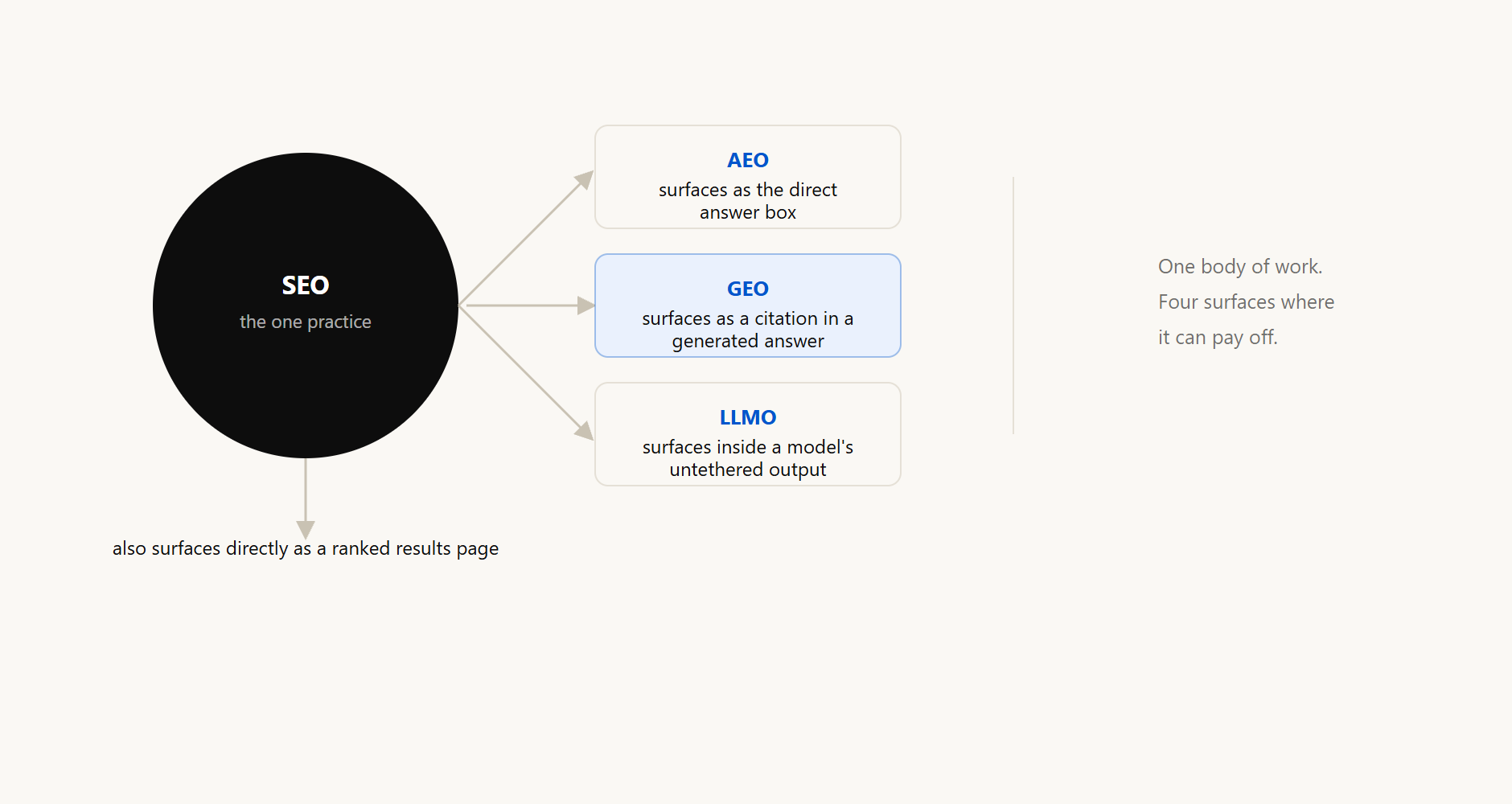
SEO is the practice. AEO, GEO, and LLMO are lenses on where the output surfaces.
The practice is building content and authority that machines trust. The lenses describe the surfaces where that trust pays off: a results page (SEO’s classic home turf), an answer box (AEO), a generated response with citations (GEO), or a model’s untethered output (LLMO).
For which term to use in your own communication, match the vocabulary to the audience:
- Talking to your board or CEO: skip the acronyms. Say “search visibility and AI visibility.” Executives do not need the taxonomy; they need to know buyers increasingly get answers from AI tools and your brand either shows up there or does not.
- Talking to your marketing team: use SEO for the foundational practice and GEO for the AI-citation work. Two terms cover the operating reality, and GEO is the label with the clearest definition and an academic origin you can point to.
- Evaluating agencies and vendors: ignore whichever acronym they lead with and ask what they measure. If the answer includes both classic organic metrics and AI citation tracking across specific engines, the label on the proposal barely matters. If they cannot explain how they measure AI visibility, the fancy acronym is decoration.
- Writing job descriptions or budgets: budget for one integrated organic program, not parallel line items per acronym. Splitting them creates duplicate work and turf disputes over what is ultimately the same content.
What a B2B SaaS team should actually do
Strip the labels away and the work for a B2B SaaS marketing team in 2026 looks like this:
- Fix the foundation. Crawlable site, fast pages, clean architecture, and explicit access for AI crawlers alongside traditional ones. Every downstream goal depends on this.
- Publish answer-shaped content. Lead with direct answers. Structure pages so a machine can extract a self-contained response. Add appropriate schema. This one habit serves SEO, AEO, and GEO simultaneously.
- Make content citable. Specific claims, named sources, original data or perspective where you have it. Generative engines cite content that gives them something concrete to attribute.
- Build presence beyond your own domain. Reviews, industry publications, communities, directories. This is the LLMO lens in practice, and it doubles as classic authority building.
- Measure both surfaces. Track rankings and organic traffic as you always have, and track how often AI engines cite you for the prompts your buyers actually ask. If you have never checked the second one, start with our GEO audit checklist for ChatGPT and Perplexity citation visibility. It walks through the process step by step.
Step 2’s “add appropriate schema” is the one item on that list most teams skip. A minimal FAQPage snippet, dropped on any page that answers a real question, looks like this:
{
  "@context": "https://schema.org",
  "@type": "FAQPage",
  "mainEntity": [{
    "@type": "Question",
    "name": "Is GEO replacing SEO?",
    "acceptedAnswer": {
      "@type": "Answer",
      "text": "No. GEO extends SEO to a new surface rather than replacing it."
    }
  }]
}
It costs a few minutes per page and gives every one of SEO, AEO, and GEO the same unambiguous signal about what the content is and what question it answers.
Notice that nothing in that list requires choosing a favorite acronym. The terms describe the same hill from four sides. Climb the hill.
FAQ
Is GEO replacing SEO?
No. GEO extends SEO to a new surface rather than replacing it. Generative engines that retrieve live web content rely on search infrastructure to find sources, so a site with broken SEO fundamentals will struggle in AI citations too. Traditional search still drives substantial B2B traffic, and the same content quality signals feed both. Treat GEO as an expansion of the job, not a successor to it.
Are AEO and GEO the same thing?
They are close cousins with different emphases. AEO grew out of optimizing for featured snippets and voice assistants: the goal of being the single direct answer to a question. GEO targets AI-generated responses specifically and focuses on being cited as a source within a synthesized answer. The techniques overlap heavily, since both reward clearly structured, extractable, well-sourced content. Most teams can treat AEO as a subset of the same integrated practice.
Who coined the term GEO?
The term Generative Engine Optimization comes from a 2023 academic paper by researchers at Princeton and Georgia Tech. The paper tested which content characteristics improved a source’s visibility in AI-generated responses, which gives GEO something the other newer acronyms lack: a documented origin and an empirical starting point. That is part of why it has become the most widely adopted label for AI-visibility work.
Do I need a separate budget for SEO, GEO, AEO, and LLMO?
No. The four terms describe overlapping lenses on one integrated practice, and funding them separately creates duplicate work on the same pages and channels. Budget for a single organic visibility program that covers technical foundations, answer-shaped content, citable sourcing, off-site authority, and measurement across both traditional rankings and AI citations. What deserves a new line item is the measurement: AI citation tracking is genuinely new tooling for most teams.
How do I measure AI visibility if there is no rank tracker for ChatGPT?
Start with structured manual testing: build a list of the prompts your buyers would realistically ask, run them across ChatGPT, Perplexity, and Google’s AI Overviews, and log which domains get cited. Repeat on a consistent cadence so you can see movement. Purpose-built AI citation tracking tools are emerging and worth evaluating, but a disciplined manual audit gets you a usable baseline in an afternoon.
One practice, one partner, both surfaces
If the conclusion of this article is that SEO, GEO, AEO, and LLMO converge into one integrated practice, the practical question is who runs that practice for you. That is exactly how we built our Starter AI plan: an entry-level monthly retainer at $2,997/mo that combines SEO, GEO, and AI-visibility work for B2B SaaS companies, with ongoing content production and a monthly report covering both traditional rankings and AI citation visibility. One program, both surfaces, measured honestly. Book a call and we will show you where your brand currently stands in AI answers before you spend a dollar.
Share this article

Alex Carter leads SEO and content strategy at MV3 Marketing, specializing in generative engine optimization, technical SEO, and AI-driven content systems for B2B SaaS companies.
Ready to audit your organic growth opportunity?
$2,500 flat. 5 business days. Six deliverables tied to pipeline , not rankings. No retainer required.
Get the Organic Growth Audit →