
To audit your AI citation visibility: build a set of 25 to 50 real buyer questions, run each one through ChatGPT and Perplexity, and record whether your brand is mentioned, whether your pages are cited as sources, and who gets cited instead. Then fix the crawler access, content structure, and authority gaps the results expose.
That is the whole method in one paragraph. The rest of this article breaks it into a checklist you can execute this week, a scoring framework you can reuse every month, and the diagnostic patterns we see most often when we run GEO Audits for B2B SaaS companies.
This is the tactical companion to our pillar guide. If you want the strategic background on why AI engines cite what they cite, read What Is GEO? The Full 2026 Guide to Generative Engine Optimization first. This piece assumes you already know what GEO is and want to measure where you stand.
What a GEO Audit Actually Measures
A GEO audit measures three distinct things: whether AI engines mention your brand when buyers ask relevant questions, whether they cite your pages as sources, and whether they can technically access and parse your content in the first place. Most teams only think about the first one. The second and third are where the fixable problems live.
The distinction between a mention and a citation matters. A mention is your brand name appearing in an AI answer: “tools like YourProduct and CompetitorX handle this.” A citation is your URL appearing as a linked source the engine used to construct its answer. Perplexity shows citations prominently on every answer. ChatGPT shows sources on browsing-enabled responses. These are different signals with different causes, and your audit needs to track both separately.
A mention without a citation usually means the engine knows about you from training data or third-party coverage, but your own site is not the source it trusts. A citation without a mention means your content is useful as reference material but your brand is not positioned as the answer. You want both. The audit tells you which one you are missing and why.
If any of the terminology in this article is unfamiliar, our GEO, AEO, and SEO glossary defines every term we use here.
Before You Start: Build a Prompt Set That Matches Real Buyer Behavior
The quality of your audit depends entirely on the quality of your prompt set, so build it from real buyer questions, not keyword lists. AI search queries are longer and more conversational than Google queries. Nobody types “CRM software” into ChatGPT. They type “what CRM should a 40-person B2B sales team use if we’re outgrowing spreadsheets.”
Build your prompt set from four sources:
Sales call transcripts and demo questions. The questions prospects ask your sales team are the questions they ask ChatGPT first. Pull the recurring ones verbatim.
Your category’s comparison and alternative queries. “Best [category] for [segment],” “[Competitor] alternatives,” “[Your product] vs [Competitor].” These are the highest-intent prompts in the set, and they are where citation gaps cost you actual pipeline.
Problem-first questions. Buyers early in the journey describe problems, not categories: “how do I reduce churn in a PLG product” rather than “churn reduction software.” Include 8 to 10 of these.
Your existing top-of-funnel keywords, rewritten as questions. Take your top organic keywords from Search Console and rewrite each as the conversational question a person would actually ask an assistant.
Aim for 25 to 50 prompts total. Fewer than 25 and single-response randomness dominates your results. More than 50 and the manual audit becomes a multi-day project, which means you will never repeat it, which defeats the purpose. Write them in a spreadsheet with columns for each engine before you run anything.
One more rule: run each prompt fresh, in a new conversation, logged out or in a clean session where possible. AI engines personalize based on conversation history and memory. An audit contaminated by your own prior sessions will overstate your visibility, because you have been asking these engines about your own company for months.
The GEO Audit Checklist: 12 Steps You Can Run This Week
Here is the full checklist. A marketer with a spreadsheet and a few focused hours can complete steps 1 through 9 in a week. Steps 10 through 12 are the remediation planning that turns findings into a roadmap.
-
Build your prompt set. 25 to 50 buyer questions across comparison, problem, and category intent, as described above. Put them in a spreadsheet with one row per prompt.
-
Run every prompt through ChatGPT. Use a clean session. For each response, record three fields: brand mentioned (yes/no), your URL cited (yes/no), and every competitor or third-party domain that was mentioned or cited. Paste the relevant answer excerpt into a notes column. Screenshots help for stakeholder reporting later.
-
Run the same prompts through Perplexity. Perplexity cites sources on every answer, which makes it the clearest window into which domains the retrieval layer trusts for your category. Record the same three fields, plus the position of your citation if you appear (first source cited versus eighth is a meaningful difference).
-
Run the set through at least one more surface. Google’s AI Overviews and AI Mode, Gemini, or Copilot. Different engines have different retrieval pipelines and different source preferences. A brand can be visible in Perplexity and invisible in ChatGPT, and the remediation for each is different.
-
Check AI crawler access in your robots.txt. Open yourdomain.com/robots.txt and look for rules affecting GPTBot, OAI-SearchBot, ChatGPT-User, PerplexityBot, ClaudeBot, and Google-Extended. We regularly find sites that blocked these crawlers years ago during the “block AI scrapers” wave and forgot. If you block the retrieval crawlers, you are opting out of citations. This is the single fastest finding to fix in the entire audit.
A blocking rule that quietly kills your GEO visibility looks like this:
User-agent: GPTBot
Disallow: /

User-agent: PerplexityBot
Disallow: /
The fix is almost always this simple:
User-agent: GPTBot
Allow: /

User-agent: PerplexityBot
Allow: /

User-agent: ClaudeBot
Allow: /

User-agent: OAI-SearchBot
Allow: /

User-agent: Google-Extended
Allow: /
Check for these rules before you do anything else on this list. A single leftover
Disallow: /line under any of these user-agents makes every other fix on this checklist irrelevant for that crawler. -
Verify your content is readable without JavaScript. Fetch your key pages with a plain HTTP request (curl, or a browser with JavaScript disabled) and confirm the main content is present in the raw HTML. Many AI crawlers do not reliably render JavaScript. If your pricing page or comparison content only exists after client-side rendering, engines may effectively see an empty page.
-
Audit your key pages for extractable answers. Pick your ten most important commercial and editorial pages. For each, ask: does the first section directly answer the question the page targets, in a self-contained 40 to 80 word passage? Or does the answer arrive after 600 words of preamble? AI engines lift passages, not pages. Pages that bury the answer lose citations to pages that lead with it.
-
Check your structured data. Verify that articles carry Article schema with real author and date fields, FAQ content carries FAQPage schema, and your organization schema is present and consistent. Schema is not a magic citation switch, but it removes ambiguity about what your content is and who published it.
-
Map the third-party surface. From your step 2 through 4 data, list every non-competitor domain that got cited for your prompts: review sites, industry publications, Reddit, comparison posts on other blogs. These are the sources engines already trust for your category. Check whether you are present, accurate, and current on each. In nearly every audit we run, a large share of citations go to third-party pages, not vendor sites, and being absent from those pages is a bigger visibility problem than anything on your own domain.
-
Score every prompt and compute your baseline. Use the rubric in the next section. The output is a single visibility number you can track month over month, plus a per-prompt breakdown that shows exactly where you are losing.
-
Rank the gaps by revenue proximity. A missing citation on “[Competitor] alternatives” outranks a missing citation on a top-of-funnel definitional query every time. Sort your gap list by how close each prompt sits to a purchase decision.
-
Assign fixes to the four gap types. Every gap you found is one of four problems: access (crawlers blocked or content unreadable), structure (answers buried, schema missing), authority (absent from the third-party sources engines trust), or coverage (you have no content addressing the prompt at all). Each type has a different owner and a different timeline. Label every gap with its type and you have a remediation roadmap instead of a pile of screenshots.
The Scoring Rubric: Turn Observations Into a Number You Can Track
Score each prompt on each engine using a simple 0 to 3 scale, then average across your prompt set to get a baseline you can re-measure monthly. Without a number, your audit is a one-time snapshot. With one, it becomes a trendline you can put in front of leadership.
Per prompt, per engine:
- 0: Not mentioned, not cited.
- 1: Mentioned in passing, no citation, competitors featured more prominently.
- 2: Mentioned substantively or cited, but not the lead recommendation or first source.
- 3: Cited as a source and positioned as a primary recommendation.
Average the scores and you have a visibility index per engine. Just as useful is the distribution: a wall of zeros on comparison prompts with decent scores on definitional prompts tells a very different story than the reverse.
Alongside the prompt scoring, run this diagnostic table against your site. This is the “why” layer underneath the scores:
| What to check | Why it matters | How to check it |
|---|---|---|
| AI crawler rules in robots.txt | Blocked crawlers cannot retrieve you, so you cannot be cited | Read robots.txt for GPTBot, OAI-SearchBot, PerplexityBot, ClaudeBot, Google-Extended |
| Content present in raw HTML | Many AI crawlers do not render JavaScript reliably | Fetch key pages with curl or JS disabled; confirm main content appears |
| Answer-first page structure | Engines lift self-contained passages, not whole pages | Check if each key page answers its core question in the first 40 to 80 words |
| Schema markup (Article, FAQPage, Organization) | Removes ambiguity about content type, authorship, and freshness | Validate key templates with a schema testing tool |
| Citations and named sources in your content | The original GEO research paper (Princeton, Georgia Tech, and collaborating institutions) measured up to a 40% visibility improvement from adding citations, quotations, and statistics to content | Review key pages: do claims reference named, checkable sources? |
| Presence on third-party cited domains | A large share of AI citations point to review sites, communities, and publications, not vendor sites | List domains cited in your prompt runs; verify your presence and accuracy on each |
| Brand and positioning consistency | Conflicting descriptions across the web produce vague or outdated AI answers | Compare how your site, review profiles, and directories describe you |
| Freshness signals | Engines prefer current sources for fast-moving categories | Check visible dates and dateModified fields on key pages; flag anything stale |
Work through the table once during the audit, then only re-check rows that were failing on subsequent runs.
Reading Your Results: The Four Patterns and What Each One Means
Almost every audit resolves into one of four patterns, and identifying yours tells you where the next quarter of effort goes.
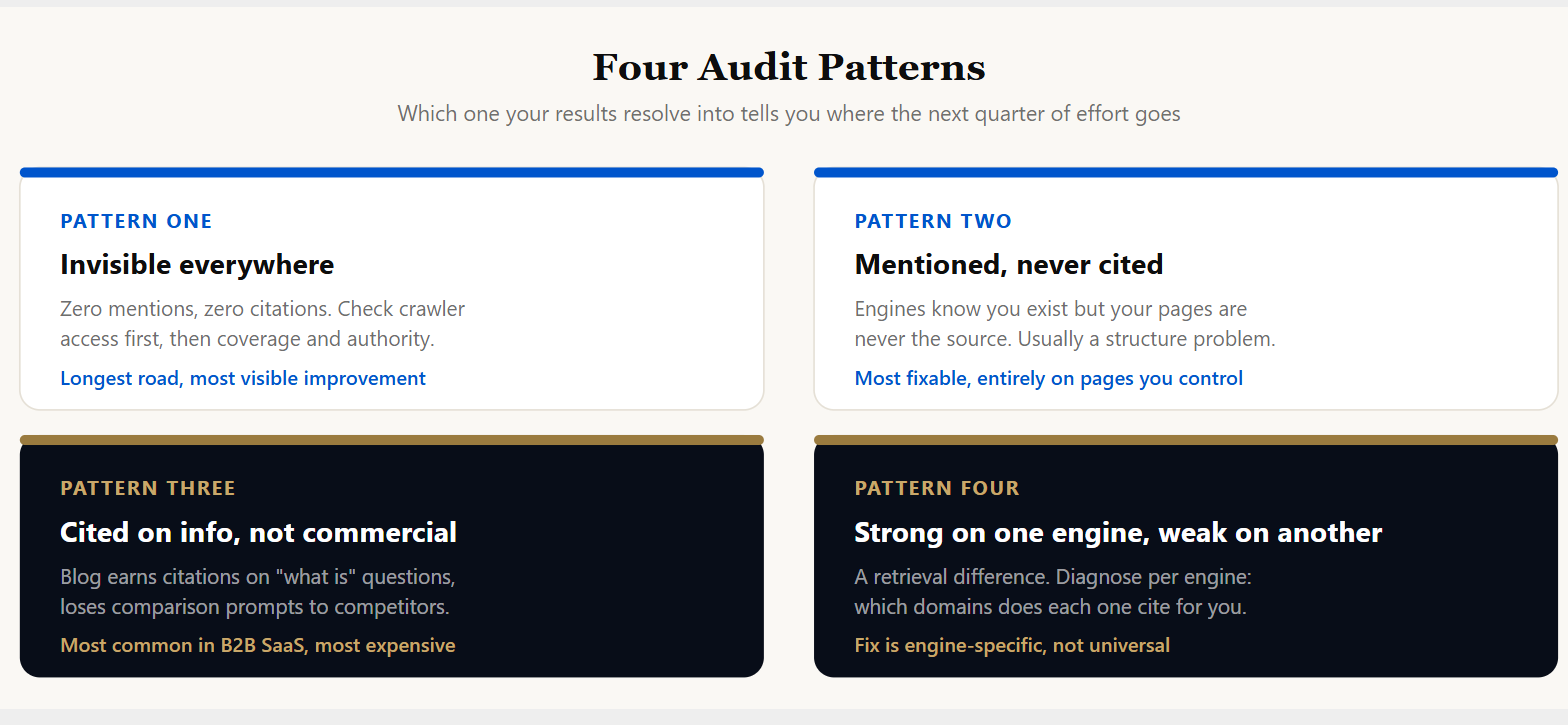
Pattern one: invisible everywhere. Zero mentions, zero citations, across engines. First check access (steps 5 and 6). If crawlers can reach you, this is usually a coverage and authority problem: your content does not address the questions buyers ask, and the sources engines trust have never heard of you. The fix is content built around your prompt set plus a deliberate third-party presence effort. This is the longest road, but it is also where improvement is most visible once it starts.
Pattern two: mentioned but never cited. Engines know you exist, competitors’ third-party coverage or training data put you in the conversation, but your own pages are never the source. This is typically a structure problem: answers buried under narrative intros, thin schema, or content locked behind JavaScript. It is the most fixable pattern because the remediation is entirely on pages you control.
Pattern three: cited on informational prompts, absent on commercial ones. Your blog earns citations on “what is” and “how to” questions, but comparison and alternative prompts return competitors and review sites. This is the most common pattern we see in B2B SaaS, and the most expensive, because the prompts you are losing are the ones closest to revenue. The fix is commercial content that engines can actually use: honest comparison pages, alternative pages, and a presence on the review platforms being cited in your place.
Pattern four: strong on one engine, weak on another. Usually a retrieval difference. Perplexity’s index and source preferences differ from ChatGPT’s, and Google’s AI surfaces lean on its own index. Diagnose per engine: check which domains each one cites for your prompts and where your footprint on those domains differs.
Picture a company that sells compliance automation software to mid-market fintechs. It ranks on page one of Google for its main category terms, so the team assumes AI visibility follows. The audit says otherwise: on 40 prompts, ChatGPT mentions the brand 3 times and cites it never, while Perplexity cites a review site, a competitor’s comparison hub, and two industry blogs for nearly every commercial prompt. Their robots.txt, updated by a cautious legal review two years earlier, blocks GPTBot outright. That is pattern one layered on pattern three, and the roadmap writes itself: restore crawler access this week, restructure the top ten pages to lead with extractable answers this month, then spend the quarter earning accurate presence on the four third-party domains the engines already trust. This example is illustrative, not a client case, but it is assembled from findings we see repeatedly.
Manual Audits vs. Tooling: What You Actually Need
You need a spreadsheet, a clean browser session, and a few hours. You do not need to buy a platform to get your baseline. Manual auditing has a real advantage tooling lacks: you read the full answers, so you see how you are framed, not just whether you appeared. Positioning nuance (“YourProduct, though it is often considered expensive for smaller teams”) never shows up in a mention counter, and it is often the most actionable finding in the audit.
Tooling earns its place at scale. AI visibility trackers (Ahrefs Brand Radar, Profound, Otterly, and a growing field of similar products) run prompt panels continuously and chart mentions over time, which beats manual sampling once you are tracking hundreds of prompts across engines or reporting monthly to leadership. The sensible sequence: run your first audit manually so you understand the terrain, then add tooling to automate the re-measurement, not to replace the judgment.
Two cautions regardless of method. AI answers are non-deterministic, so the same prompt can produce different results on different runs; treat single-run results as a sample, not a verdict, and weight patterns across the full prompt set over any individual response. And audit on a schedule, not once. Model updates and index refreshes move results. Monthly re-runs of the same prompt set with the same rubric is the minimum cadence that produces a usable trendline; quarterly is the minimum for the full diagnostic table.
This is also exactly the labor that makes a done-for-you audit worth considering. Our $997 GEO Audit runs this entire process against your domain and your competitors, so if you would rather start from a completed baseline than a blank spreadsheet, that is the shortcut.
FAQ
How do I check if my site is cited by ChatGPT?
Ask ChatGPT the questions your buyers ask, in a clean session, and check the sources on browsing-enabled responses for your domain. Record both mentions (your brand named in the answer) and citations (your URL listed as a source) separately, because they have different causes. A reliable read requires 25 or more prompts run fresh, since individual responses vary between runs.
How many prompts do I need for a reliable GEO audit?
25 to 50. Below 25, the natural randomness of AI responses dominates your results and one lucky or unlucky answer skews the picture. Above 50, a manual audit becomes too slow to repeat monthly, and repetition matters more than exhaustiveness. Weight the set toward commercial intent: comparison, alternatives, and “best X for Y” prompts are where citation gaps cost pipeline.
Why does my site rank well in Google but never gets cited by AI engines?
Because rankings and citations are produced by different systems with different preferences. Common causes, in the order we find them: AI crawlers blocked in robots.txt, key content rendered only by JavaScript, answers buried beneath long introductions so no passage is liftable, and the engines preferring third-party sources (review sites, communities, publications) where your brand is absent or stale. Traditional SEO strength is a foundation for GEO, not a guarantee of it.
How often should I run a GEO audit?
Re-run your prompt set monthly and the full technical and content diagnostic quarterly. AI engines update models and refresh indexes frequently enough that a six-month-old audit is a historical document. Use the same prompts and the same 0 to 3 scoring rubric every time, so changes in your score reflect changes in visibility rather than changes in your measurement.
Can I block AI crawlers and still get cited?
Mostly no, and the exceptions are not worth relying on. Blocking retrieval crawlers like OAI-SearchBot and PerplexityBot prevents engines from fetching your pages, which removes your site from consideration as a citable source. You might still be mentioned through training data or third-party coverage, but you surrender control of how you are represented. If citation visibility is a goal, allow the search and retrieval crawlers; the blocking decision should be a deliberate policy choice, not a leftover line in robots.txt.
Get Your Baseline Without Building the Spreadsheet
Everything above is executable in-house, and if you run it, you will know more about your AI visibility than most of your competitors know about theirs. But it is hours of prompt-running, scoring, and cross-referencing, and the value is in the repetition, not the first pass. If you want the completed baseline instead: our GEO Audit is $997, one time, delivered in 5 business days. You get your citation visibility measured across the engines that matter, benchmarked against your competitors, with the gaps identified and prioritized by revenue impact, so your team starts on the fixes instead of the fieldwork. It is the fastest way to find out whether AI engines are recommending you or recommending someone else.
Share this article

Alex Carter leads SEO and content strategy at MV3 Marketing, specializing in generative engine optimization, technical SEO, and AI-driven content systems for B2B companies.
Ready to audit your organic growth opportunity?
$2,500 flat. 5 business days. Six deliverables tied to pipeline , not rankings. No retainer required.
Get the Organic Growth Audit →