Before You Start
You need a keyword list with search volume and competition data, a place to tag each keyword with a topic, and a spreadsheet or database you can group by that tag. We used our own DataForSEO-sourced keyword table for this walkthrough. Budget two to three hours for the first pass on a site with a few hundred tracked keywords, and expect to revisit the grouping every quarter as new keywords get added.
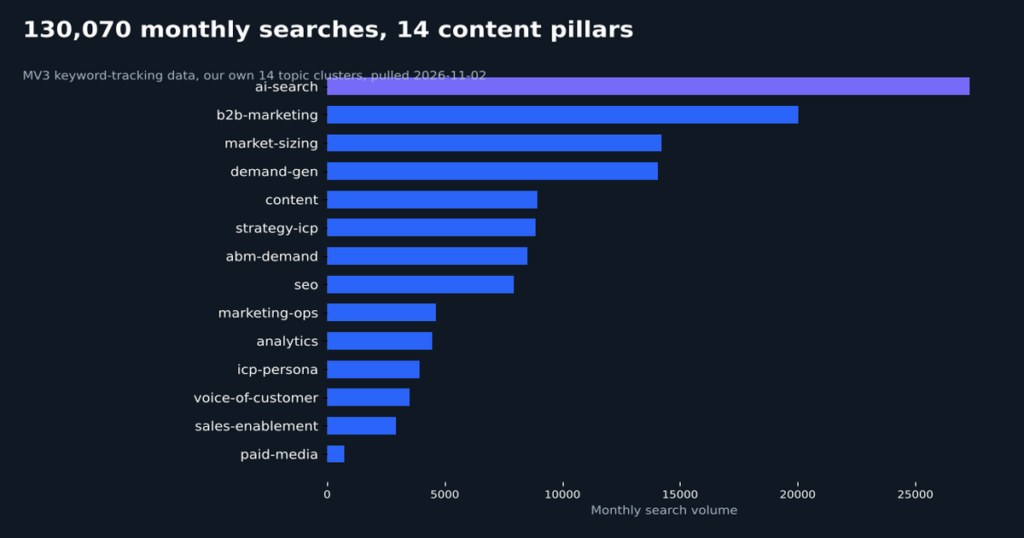
You do not need special software. A spreadsheet with a “topic” column works, and so does a database table like ours. What matters is that every keyword gets exactly one topic, so you can count and sum by group without double-counting demand. The featured chart above shows what our own grouping looks like once that step is done: 14 pillars, ranked by total monthly search demand.
Step 1: Group Your Keywords Into Topics
Pull every keyword you track into one list, then assign each one a single topic label. We use labels like ai-search, b2b-marketing, demand-gen, content, and sales-enablement. The label should describe the buyer problem, not the exact phrase, so “ai seo” and “generative engine optimization” both sit inside ai-search even though the wording differs.
Expected result: every tracked keyword has exactly one topic tag, and no keyword is left unlabeled. Common mistake: creating a new topic for every slightly different phrase. That produces dozens of one-keyword “pillars,” which is not a pillar structure, it is an unsorted list with extra steps.
Step 2: Measure Demand and Competition Per Pillar
Once every keyword has a topic, sum the search volume and count the keywords inside each group. This tells you which pillars carry the most demand and which ones are mostly long-tail noise. In our own data, the ai-search pillar carries the most total demand at 27,290 monthly searches across 18 keywords, while paid-media is our smallest pillar at 750 monthly searches across 9 keywords.
Expected result: a ranked list of pillars by total demand, like the chart above. Common mistake: ranking pillars by keyword count alone. A pillar with 66 keywords and low average volume per keyword can carry less real demand than a pillar with 4 keywords and high volume per keyword, which is exactly what we found in our own set.
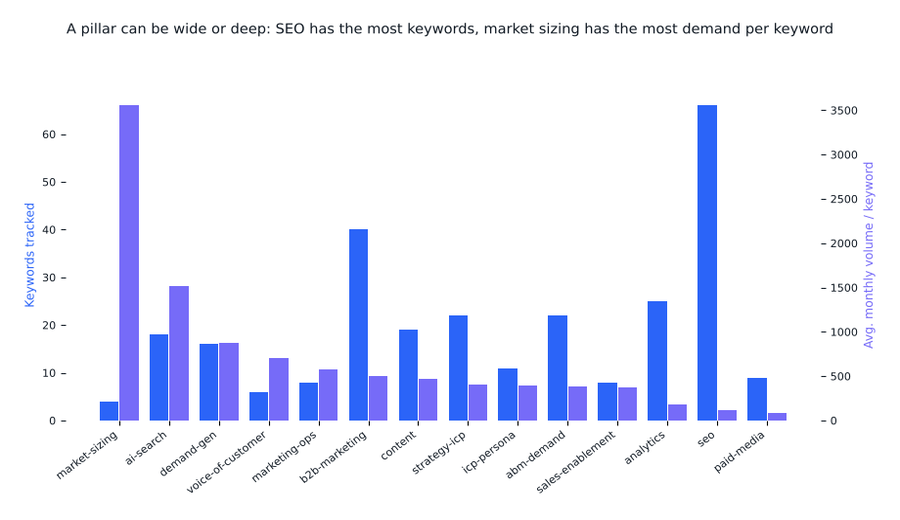
Source: seo_keywords table (DataForSEO), pulled 2026-11-02, n = 274 keywords, grouped by topic.
Step 3: Decide Pillar Width Versus Pillar Depth
A wide pillar has many keywords but low demand per keyword. A deep pillar has fewer keywords but each one carries more search volume. Our seo pillar is wide: 66 tracked keywords averaging 120 monthly searches each. Our market-sizing pillar is deep: 4 tracked keywords averaging 3,553 monthly searches each.
Wide pillars usually need more individual posts to cover the ground. Deep pillars can often be served by fewer, more thorough pages built around the handful of high-demand terms. Neither shape is wrong, but treating a wide pillar like a deep one means you under-cover it, and treating a deep pillar like a wide one means you publish more pages than the demand supports.
Expected result: a stated plan for how many hub and supporting pages each pillar realistically needs. Common mistake: applying the same page count to every pillar regardless of its shape.
Step 4: Map Each Pillar to a Hub and Supporting Posts
Pick one page per pillar to act as the hub, the page that defines the topic and links out to the supporting posts underneath it. Supporting posts answer the narrower questions inside that pillar. This is the structural part of “content pillar” that most short explainers skip, so here is the shape in a single diagram.
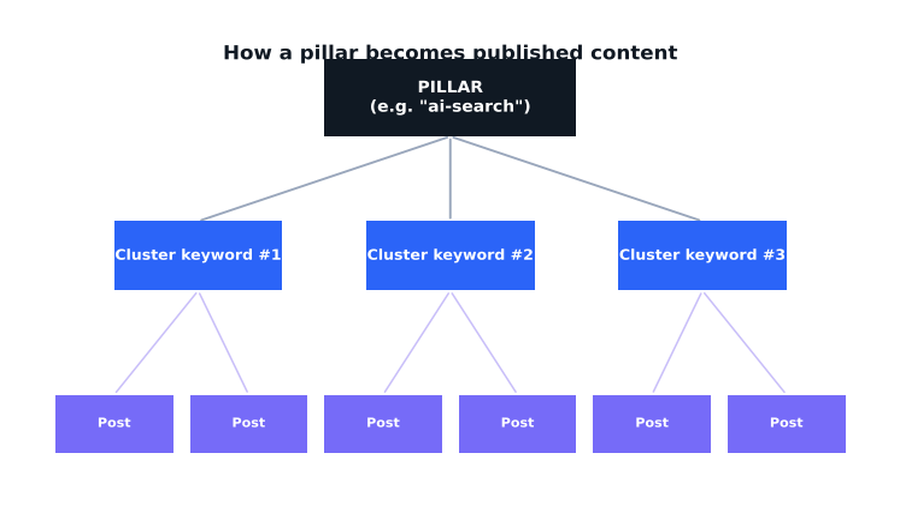
Illustration of the pillar, cluster keyword, and post hierarchy described in this guide.
Expected result: every pillar has one clear hub page, and every supporting post links back to it. Common mistake: publishing supporting posts with no hub page to link to, which leaves the pillar structure invisible to both readers and search engines.
Step 5: Track Coverage So Pillars Do Not Get Overbuilt
Once a pillar is live, keep a running count of how many posts you have published against it versus how much demand the pillar actually carries. We did this ourselves while researching this guide, and it changed what we picked to write about next.
Expected result: a simple published-count-per-pillar view you check before picking the next topic. Common mistake: continuing to publish inside a pillar out of habit after it is already well covered relative to its demand, which is scaled content with no new value.
What We Found
Pulling our own 274 tracked keywords by topic on 2026-11-02 produced 14 pillars and 130,070 combined monthly searches. The three largest pillars by demand are ai-search (27,290), b2b-marketing (20,030), and market-sizing (14,210). The three smallest are sales-enablement (2,940), voice-of-customer (3,510), and icp-persona (3,910).
The clearest finding is the width-versus-depth split. Our seo pillar has the most keywords of any pillar, 66, but the lowest average demand per keyword, 120 monthly searches. Our market-sizing pillar has only 4 keywords but the highest average demand per keyword, 3,553 monthly searches. A pillar count alone would have told us seo was our biggest priority. Looking at demand per keyword told us market-sizing deserved more attention than its small keyword count suggested.
We are sharing our own structure as a worked example, not a universal template. Your pillar boundaries should match your own keyword data and your own buyers, not ours. If you have not pulled your own keyword set yet, our guide to keyword research for B2B SaaS covers that first step, and our framework for mapping content to the buying committee is a useful next read once your pillars are grouped.
Common Mistakes and Fixes
| Symptom | Likely cause | Fix |
|---|---|---|
| Dozens of tiny pillars | Topics created per exact keyword phrase instead of per buyer problem | Merge topics that answer the same underlying question |
| One pillar has no hub page | Supporting posts were published before the hub was planned | Write the hub page next and link existing posts into it |
| A pillar is overbuilt | Posts kept publishing after demand was already covered | Check published count against total pillar demand before adding more |
| Pillars do not match search intent | Topics were grouped by internal jargon instead of buyer language | Re-check topic labels against the actual keyword wording |
Checklist Recap
Group every tracked keyword into one topic. Sum volume and count keywords per topic to rank pillars by real demand. Decide whether each pillar is wide or deep and size your page plan to match. Assign one hub page per pillar and link supporting posts back to it. Recheck published coverage against demand before adding another post to a pillar.
FAQ
Is a content pillar the same as a topic cluster?
They describe the same structure from two angles. The pillar is the broad topic and its hub page, the cluster is the group of keywords and supporting posts underneath that hub.
How many pillars should a B2B SaaS site have?
There is no fixed number. We run 14, grouped from our own 274 tracked keywords. The right count depends on how many distinct buyer problems your keyword data actually shows, not a round number picked in advance.
Does every pillar need the same number of posts?
No. A wide pillar with many keywords and low volume per keyword usually needs more posts than a deep pillar with few keywords and high volume per keyword, as shown in the width-versus-depth comparison above.
MV3 Marketing builds and maintains SEO content programs, including pillar and cluster structures like the one described here, for B2B SaaS clients. If you want a second set of eyes on your own pillar structure, book time with us.
Share this article

Vance Moore is Chief Growth Officer at MV3 Marketing and leads its team of SEO professionals, engineers and auditors.
Ready to audit your organic growth opportunity?
$2,500 flat. 5 business days. Six deliverables tied to pipeline , not rankings. No retainer required.
Get the Organic Growth Audit →