An AI BDR (business development representative) is an AI agent that handles outbound prospecting, researching leads, sending initial outreach, and following up across multiple touches, so a human sales rep only steps in once a prospect responds or is ready to talk. It runs the repetitive early outreach work a human BDR would otherwise do by hand.
The Job an AI BDR Is Actually Doing
A human business development representative spends most of their day on a repeatable
loop: find a prospect that fits the target profile, find a way to reach them, send an
opening message, follow up if there’s no response, and log what happened. It’s necessary
work, and it’s also the most mechanical part of a sales role.
An AI BDR automates that loop. It does not replace the strategic parts of sales, deciding
who the ideal customer actually is, crafting the value proposition, negotiating terms. It
takes over the execution of outreach once those decisions have been made.
A Real Outbound Sequence, Step by Step
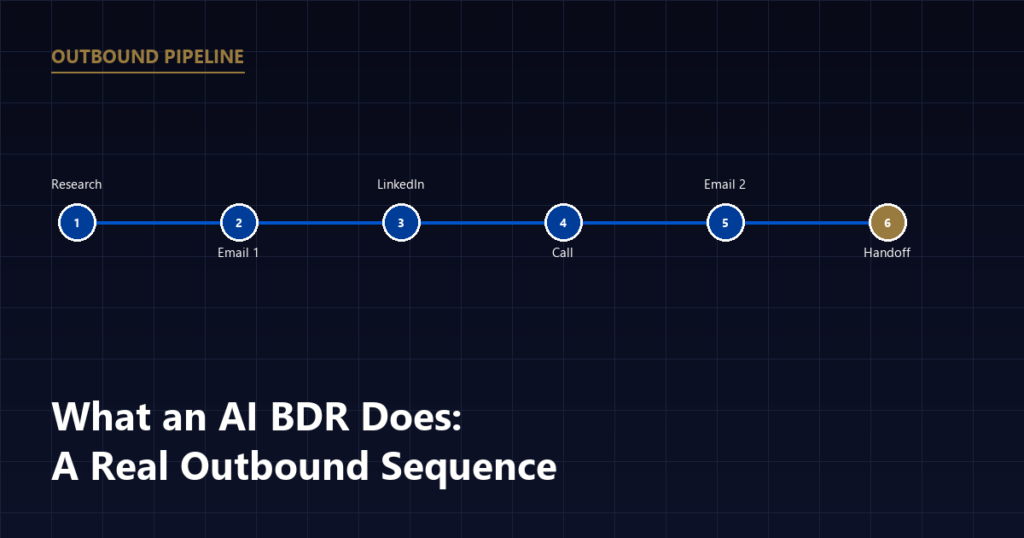
- Research. The agent pulls relevant details on a prospect, company or property type, size, location, and any public signals relevant to fit, for example a commercial property manager overdue for a roof inspection.
- Initial outreach. A first email or LinkedIn message goes out, referencing something specific to that prospect rather than a generic template.
- Second channel. If there’s no response within a set window, the agent tries a different channel, a LinkedIn connection request, for instance, rather than just repeating the same email.
- Phone attempt. For businesses where phone outreach converts well, construction and lending are common examples, a call attempt gets logged into the sequence at a set point.
- Follow-up email. A short, direct follow-up goes out days later if there’s still no response.
- Handoff. The moment a prospect replies, whether positively or with a question, the agent stops the automated sequence and flags the conversation for a human rep to take over.
THE SIX-STEP SEQUENCE
Step 6 can fire after step 2 just as easily as after step 5. The sequence stops the moment a real person replies, wherever it is in the order.
That last step matters as much as the first five. An AI BDR that keeps sending automated
messages to someone who already replied looks careless, and it undoes the credibility the
outreach was trying to build.
What Makes an AI BDR Sequence Work Versus Fall Flat
- A specific, real target list. Outreach to a well-defined list of property managers in a specific service area outperforms a broad, loosely-defined list every time.
- Messaging grounded in the actual business. Generic “I hope this finds you well” openers get ignored. Messages that reference something specific to the prospect’s situation get replies.
- Realistic pacing. Sequences that space touches over one to two weeks read as persistent and professional. Sequences that fire five messages in three days read as spam and often trigger spam filters.
- A clean handoff. The agent needs a clear signal for when to stop automating and hand a live conversation to a person.
How This Fits with Inbound
An AI BDR handles the outbound side, going out and finding prospects who haven’t come to
you yet. It’s the counterpart to the inbound qualification work covered in
AI agents for sales, which handles leads that already reached
out. Businesses that run both typically see the outbound sequence feed the inbound
qualification agent once a prospect responds and becomes an active lead.
An AI BDR is also a useful concrete example of a narrowly scoped agent: one task
(research and outreach), a small set of tools (email, LinkedIn, a phone dialer), and a
clear handoff rule. How to build AI agents walks through that
same structure in more general terms, for readers who want to build something similar for a
different task.
MV3 Marketing builds AI BDR sequences as part of its
account-based marketing work, built around a business’s
actual target list and service area instead of a purchased, generic contact database.
Frequently Asked Questions
What does an AI BDR actually do?
An AI BDR researches prospects against a defined target list, sends outbound emails or LinkedIn messages, and follows up on a set schedule if there’s no response, tracking which prospects engage so a human rep can step in once someone replies or shows real interest.
Is an AI BDR the same as a cold email tool?
No. A cold email tool sends messages you write to a list you provide. An AI BDR typically handles more of the sequence itself: adjusting follow-up timing, tracking responses, and flagging or handing off qualified prospects, rather than just sending a single scheduled blast.
How many outreach touches does a typical AI BDR sequence use?
Sequences vary by business, but a common pattern is an initial email, a LinkedIn connection or message, a phone call attempt, and one or two additional follow-up emails spread over one to two weeks, mirroring how an experienced human BDR would pace outreach rather than sending everything at once.
Can an AI BDR work for a small regional business, not just enterprise sales teams?
Yes. The underlying task, researching a defined list of prospects and running a consistent outreach sequence, is the same whether the target list is enterprise software buyers or property managers in a three-county service area. The target list and messaging need to be built around the actual business, not borrowed from an unrelated industry.
If outbound prospecting is currently a task that gets done only when someone has spare
time, that inconsistency is usually the biggest gap an AI BDR closes.
Book a call to see what a sequence built for your target list
would look like.
Share this article

Jordan Reeves leads account-based marketing and outbound pipeline strategy at MV3 Marketing, specializing in account selection, intent-signal targeting, and multi-channel orchestration for B2B companies.
Ready to audit your organic growth opportunity?
$2,500 flat. 5 business days. Six deliverables tied to pipeline , not rankings. No retainer required.
Get the Organic Growth Audit →