What a content cluster strategy is, and what it is not
A content cluster strategy answers one question: how many pieces do you need under a given pillar, what distinct question does each one answer, and how do they link together. It is an architecture decision, made before any single piece gets written.
It does not answer a separate question: which buying committee role, at which stage of a deal, should read which piece. We cover that audience-mapping question on its own in our guide to mapping B2B content to the buying committee. Use that guide to decide who each piece is written for. Use this one to decide how many pieces to build, on what, and how to keep them from overlapping.
| Question | Where it is answered |
|---|---|
| How many pieces, on what, linked how | This guide: the pillar and cluster architecture |
| Who reads which piece, at which deal stage | Our buying committee mapping guide, linked above |
Before you start
You need access to two things before step one: your own Search Console property, so you can see what already gets impressions, and a rough list of the five or six topics your sales team actually gets asked about. Guessing at topics without either input produces a strategy built on vibes.
| Input | Where to get it | Time to pull |
|---|---|---|
| Current impressions by query | Google Search Console | 10 minutes |
| Questions sales hears most | A short conversation with 2 to 3 reps | 20 minutes |
| A list of your own existing posts | Your CMS or sitemap | 10 minutes |
Step 1: Pick one pillar you can actually support
A pillar topic is the one subject you are willing to own. For a B2B SaaS marketing team, that is usually a core workflow your product touches, not your product category itself. Pick the topic you could write ten genuinely different posts about without repeating yourself.
Reject any pillar you cannot support with a real finding. If the only thing you can say about the topic is what every other vendor already says, it is not your pillar yet.
Step 2: Map three to five supporting clusters
Each cluster should answer a distinct question under the pillar, not a rephrased version of the same question. If two cluster topics would use almost the same outline, merge them into one piece instead of publishing both.
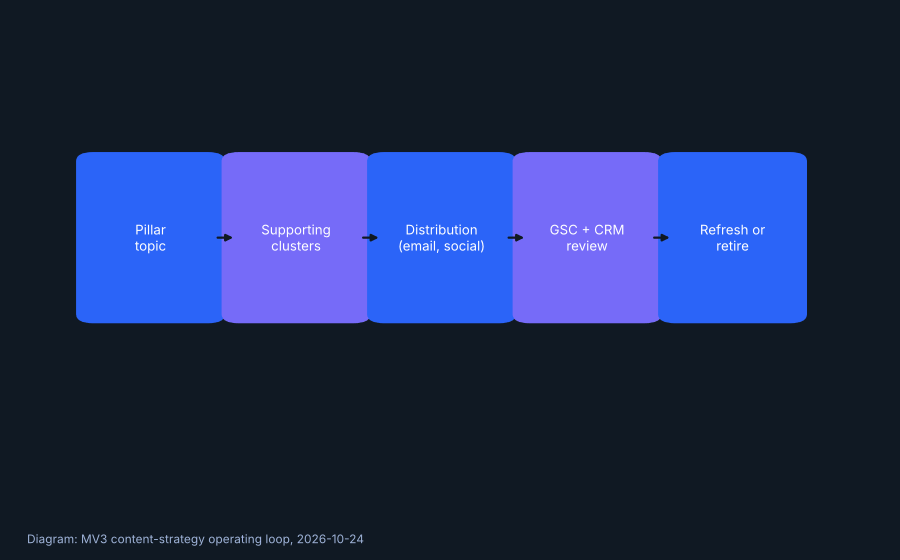
Link every cluster piece back to the pillar page, and link the pillar page out to each cluster. That internal structure is what turns a folder of blog posts into something a search engine, and a reader, can actually navigate.
Picking which cluster topics are worth the slot is easier with real demand data in front of you, rather than guessing from the pillar alone. The table below shows search volume for five specific, narrower queries that sit under the kind of content-cluster pillar this guide describes.
| Query | Monthly US volume | Competition |
|---|---|---|
| what is a content pillar | 210 | Low |
| b2b content strategy | 110 | Low |
| seo topic clusters | 90 | Low |
| omni channel content strategy | 50 | Low |
| content marketing operations | 40 | Low |
Source: seo_keywords table (DataForSEO), pulled 2026-11-04, n=5 cluster-level queries.
Step 3: Build the structure competitors skip
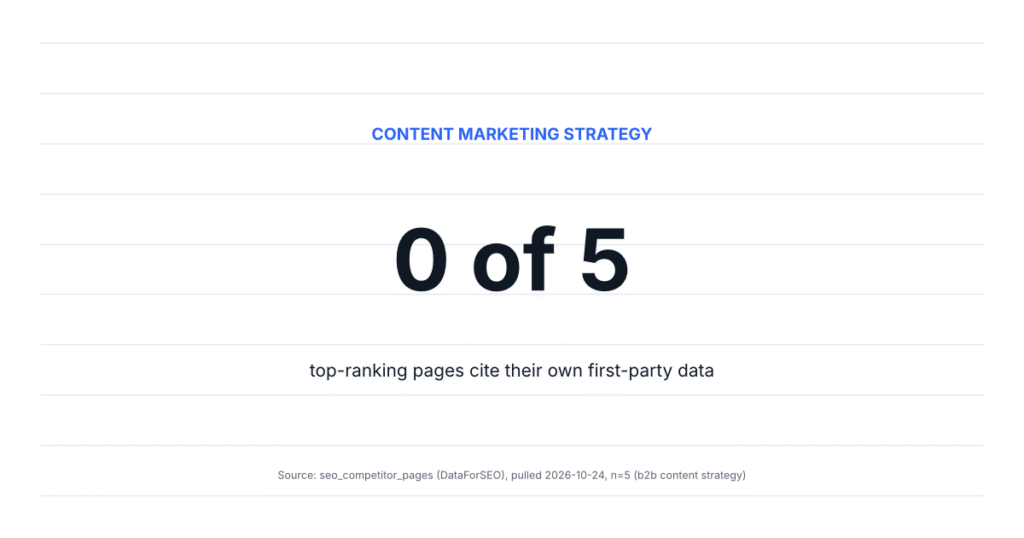
We pulled the five pages ranking for the closely related query b2b content strategy and counted their structure. Two of five use a table. One of five uses FAQ schema. None of the five cite a first party data point anywhere in the piece.
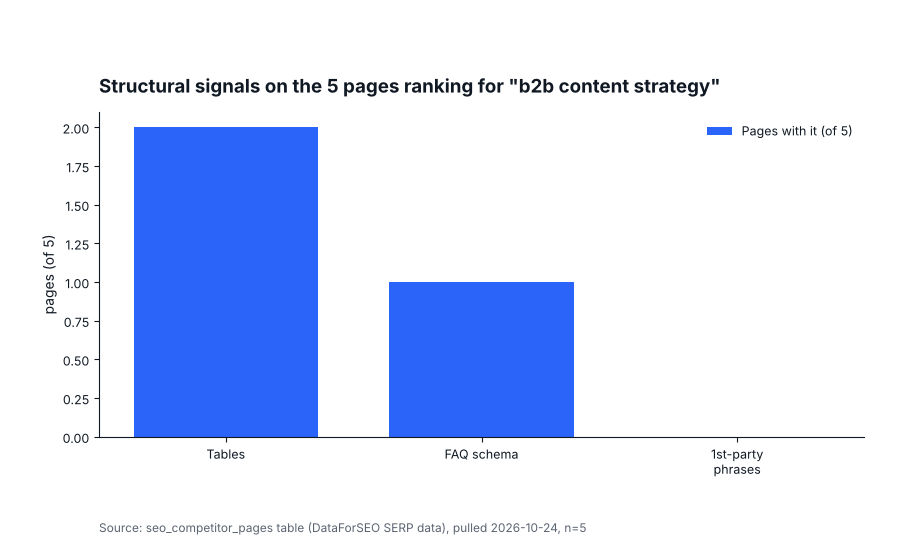
That is the gap worth building into every piece you publish: a real table, a short FAQ block, and at least one number that comes from your own data instead of a rephrased industry claim.
Source: seo_competitor_pages table (DataForSEO SERP data), pulled 2026-10-24, n=5 ranking pages for the query b2b content strategy.
Step 4: Set one distribution channel per piece
Every piece needs a home beyond the blog archive: an email send, a specific internal link from a higher traffic page, or a short social post written for the platform it lands on. A piece with no distribution plan quietly becomes invisible the day after it publishes.
Write the distribution channel into the plan before the piece is written, not after. Deciding distribution as an afterthought is how good pieces get zero promotion.
| Piece type | Typical channel |
|---|---|
| Pillar page | Resources hub link plus a dedicated email send |
| Cluster piece, high search intent | Internal link from the pillar and from one higher traffic page |
| Cluster piece, thought leadership | A social post written for the platform, plus newsletter inclusion |
Step 5: Review monthly and retire what does not work
Pull impressions and clicks by page once a month. A piece with real impressions and almost no clicks usually has a title or meta description problem, which is a cheap fix. A piece with neither impressions nor clicks after six months is a candidate to merge into a stronger page or retire.
Pair that with a CRM check, if your team tracks source on inbound leads: which pillar or cluster topics actually show up before a form fill. Not every team has this data clean enough to use yet, and that gap is worth naming out loud rather than guessing.
Troubleshooting
| Symptom | Likely cause | What to check first |
|---|---|---|
| Clusters read almost identically | No distinct question per cluster | Re-map each cluster to one specific question |
| Impressions climb but clicks stay flat | Weak title or meta description | Rewrite the title to match the actual search intent |
| Nothing links back to the pillar | Internal linking skipped at publish time | Add the link now, do not wait for the next review |
Checklist recap
| Step | Done when |
|---|---|
| 1. Pillar chosen | One sentence a new hire could repeat back |
| 2. Clusters mapped | 3 to 5 distinct questions, no overlap |
| 3. Structure built | Table and FAQ block in the template |
| 4. Distribution set | Named channel per piece before it is written |
| 5. Review scheduled | Monthly GSC pull on the calendar |
What we found
The structural gap in the pages ranking for b2b content strategy was consistent across nearly all five: length without evidence. That pattern matches what we see across several keyword clusters we track, not just this one.
We sell content strategy and production services at MV3, so the recommendation to add real tables and first party data is a disclosed, interested opinion about what we think works, not a neutral academic finding.
We did not target the broad keyword content marketing strategy for this piece. DataForSEO shows 5,400 monthly U.S. searches for that broad phrase, pulled from the seo_keywords table on 2026-10-24, but our own site already has a live, ranking page built around that exact phrase and a buying-committee angle, so a second page competing for the same term would cannibalize our own result rather than earn new traffic. This guide instead targets the narrower cluster-architecture queries in the table above, which that existing page does not cover.
| Keyword | Monthly US volume | Already ranking on our site |
|---|---|---|
| content marketing strategy | 5,400 | Yes, via our buying-committee guide |
| what is a content pillar | 210 | No |
| b2b content strategy | 110 | No |
Source: seo_keywords table (DataForSEO), pulled 2026-10-24 and 2026-11-04, n=3 keywords.
FAQ
How many pillar topics should a B2B SaaS team run at once?
One at a time in most cases. A small team spreading itself across three pillars usually ends up with three shallow pillars instead of one strong one.
How often should the strategy be reviewed?
Monthly for traffic and clicks, and roughly once a quarter for whether the pillar itself still matches what the product and the market actually need.
Does every cluster piece need its own data point?
Not every single one, but most should. A cluster built entirely from secondary sources with no first party finding is easy for a competitor to match.
For the step before this one, see our guide on keyword research for B2B SaaS. Once the pillar is chosen, our guide on product positioning covers how to keep the pillar’s messaging consistent across the site. If you want MV3 to build this plan with your team, book a call.
Share this article

Vance Moore is Chief Growth Officer at MV3 Marketing and leads its team of SEO professionals, engineers and auditors.
Ready to audit your organic growth opportunity?
$2,500 flat. 5 business days. Six deliverables tied to pipeline , not rankings. No retainer required.
Get the Organic Growth Audit →