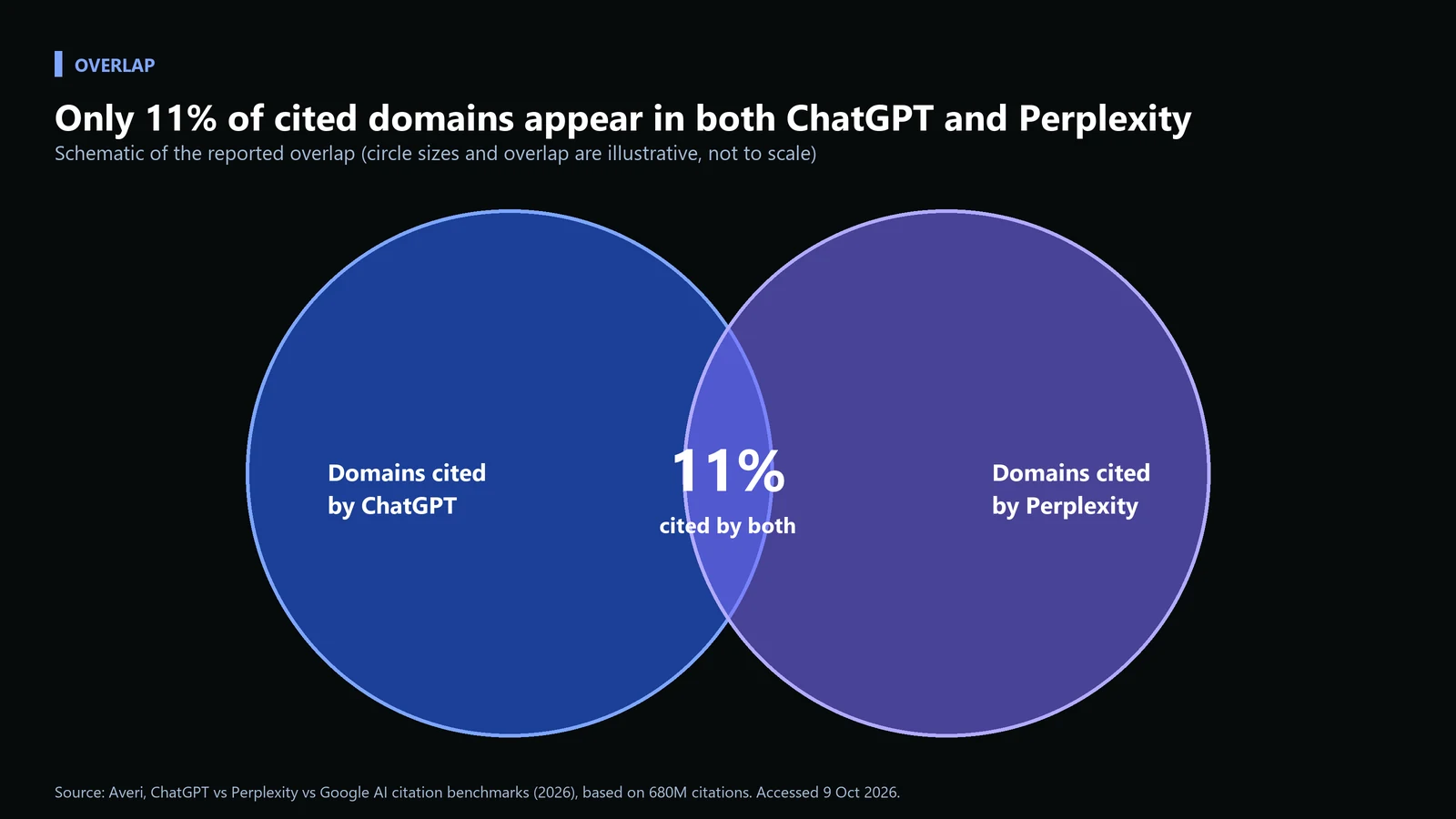
ChatGPT, Google AI Overviews, and Perplexity each pull citations from almost entirely different pools of websites. Only 11% of the domains ChatGPT cites also show up in Perplexity’s answers, according to Averi’s 2026 analysis of 680 million AI citations. If you are optimizing for one platform, you are largely invisible on the others.
That single number breaks a lot of GEO strategies. Most teams still treat getting cited by AI as one problem with one fix: publish authoritative content, mark it up with schema, wait for citations to show up. The citation data says each engine has a distinct, measurable preference for source type, and those preferences barely overlap.
This post breaks down what the published research shows about how ChatGPT, Google AI Overviews, Perplexity, Gemini, and Claude select sources, then gives a platform-by-platform playbook and a five-step method (with tested code) to measure your own citation overlap. All figures were re-checked against the original sources on 9 October 2026. For a baseline read on where your brand stands, our GEO audit checks citation visibility across all five platforms individually rather than blended into one score.
Once you know where you stand, the next question is whether your Google ranking is protecting your AI citations. Our Rank-Cite Gap Framework shows how to find the queries where you outrank a competitor on Google but they still win the AI citation.
Why does platform-specific GEO matter now?
Buyer behavior has moved faster than most marketing roadmaps. Responsive’s October 2025 buyer study found that generative AI has overtaken traditional search for a quarter of B2B buyers, and that nearly two thirds use generative AI as much as or more than search when researching vendors. The same release notes that trust, industry expertise, and response quality still decide the final purchase, so AI answers shape the shortlist rather than the signature.
If a quarter of your buyers start in an AI answer, the question is which answer. The case for treating each platform separately comes from the citation research below.
What does the research say about citation sources?
The most detailed public dataset is Profound’s citation pattern study, which analyzed 680 million citations across ChatGPT, Google AI Overviews, and Perplexity between August 2024 and June 2025. Averi’s 2026 benchmark report, which cites an analysis of the same 680 million citations, reports that only 11% of domains are cited by both ChatGPT and Perplexity. Two other pieces of evidence sit alongside it, summarized here so you can see what each one measured.
| Study | What it measured | Window | Figure used in this post |
|---|---|---|---|
| Profound, AI Platform Citation Patterns | Share of citations by source, per platform (680M citations) | Aug 2024 to Jun 2025 | Top-source shares for ChatGPT, Google AI Overviews, Perplexity; ChatGPT TLD split |
| Averi, B2B SaaS citation benchmarks | Cross-platform comparison built on the Profound data and other trackers | Published 2026 | 11% of domains cited by both ChatGPT and Perplexity |
| DerivateX, State of AI Visibility in B2B SaaS | Brand mention rate across 50 B2B SaaS companies and 1,400 buyer-intent prompts | April 2026 | Mention rate by platform |
In practical terms, getting cited consistently by ChatGPT tells you almost nothing about whether Perplexity will mention your brand. The platforms draw on different libraries of source material and different retrieval logic. A content strategy tuned for one will, at best, accidentally help with another.
Platform citation fingerprint
| Platform | Top source, share of all citations | Top source, share of top-10 citations | Write like |
|---|---|---|---|
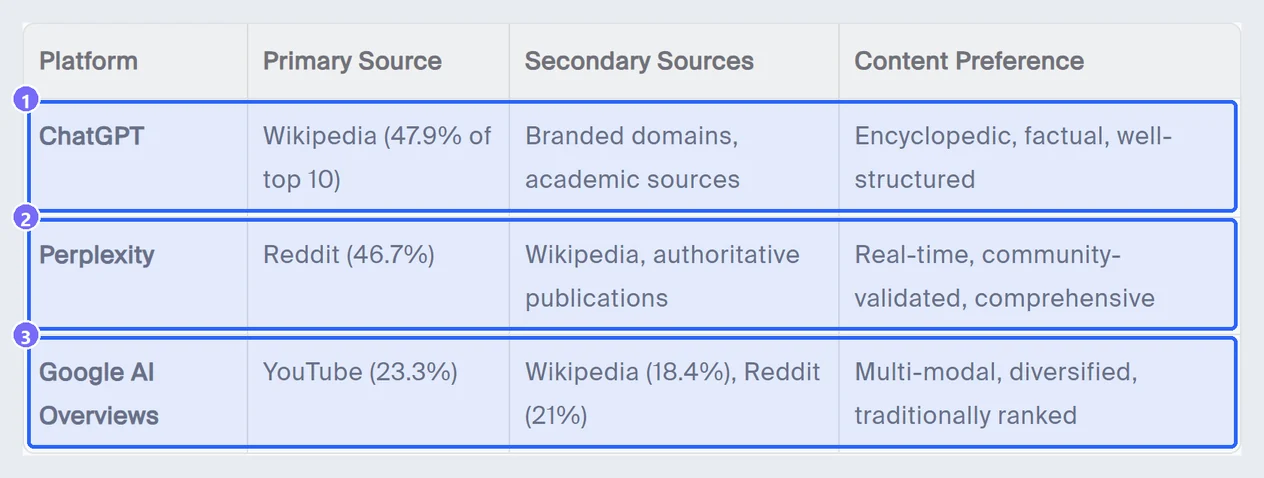
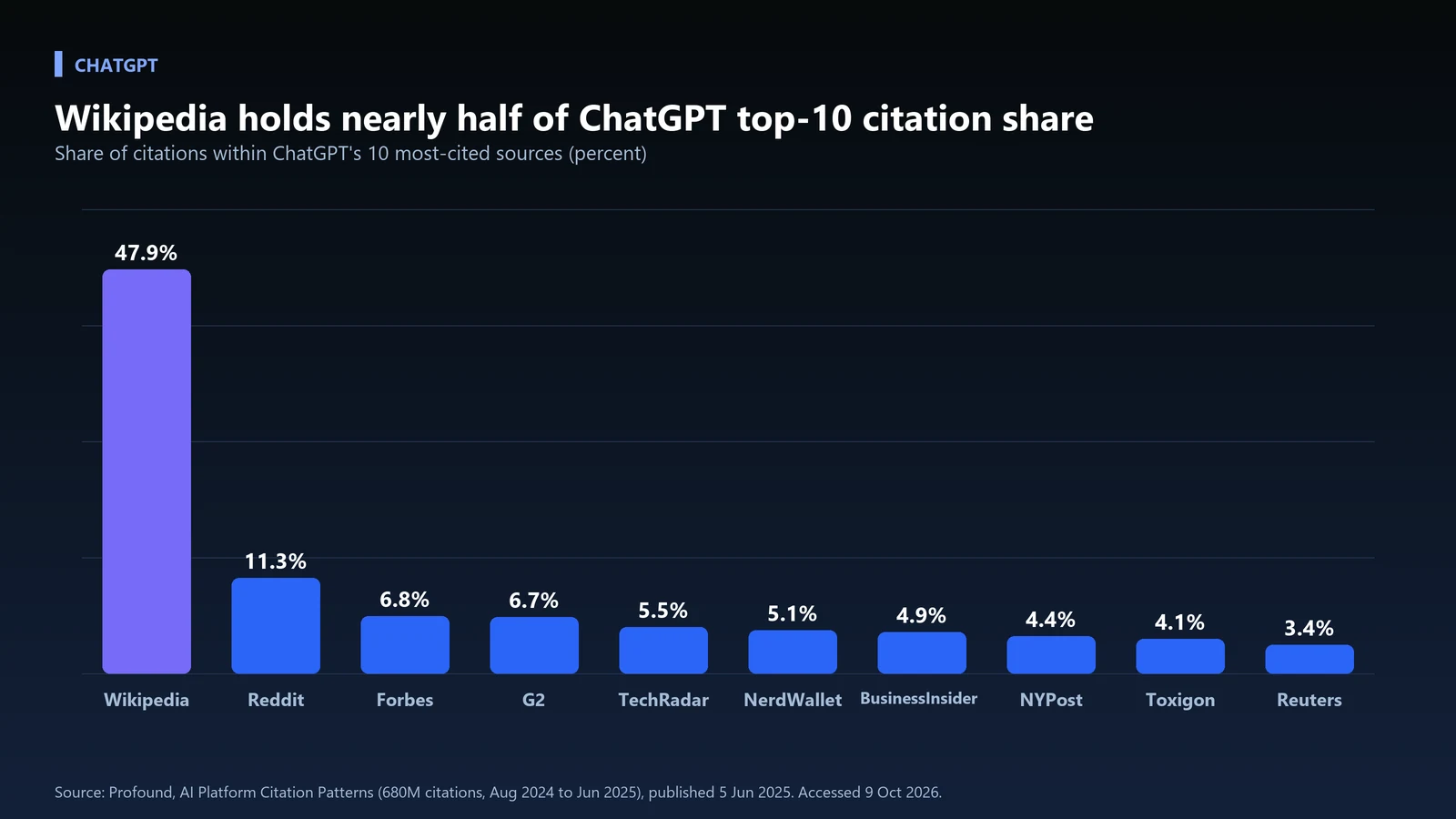
| ChatGPT | Wikipedia, 7.8% | Wikipedia, 47.9% | A reference entry |
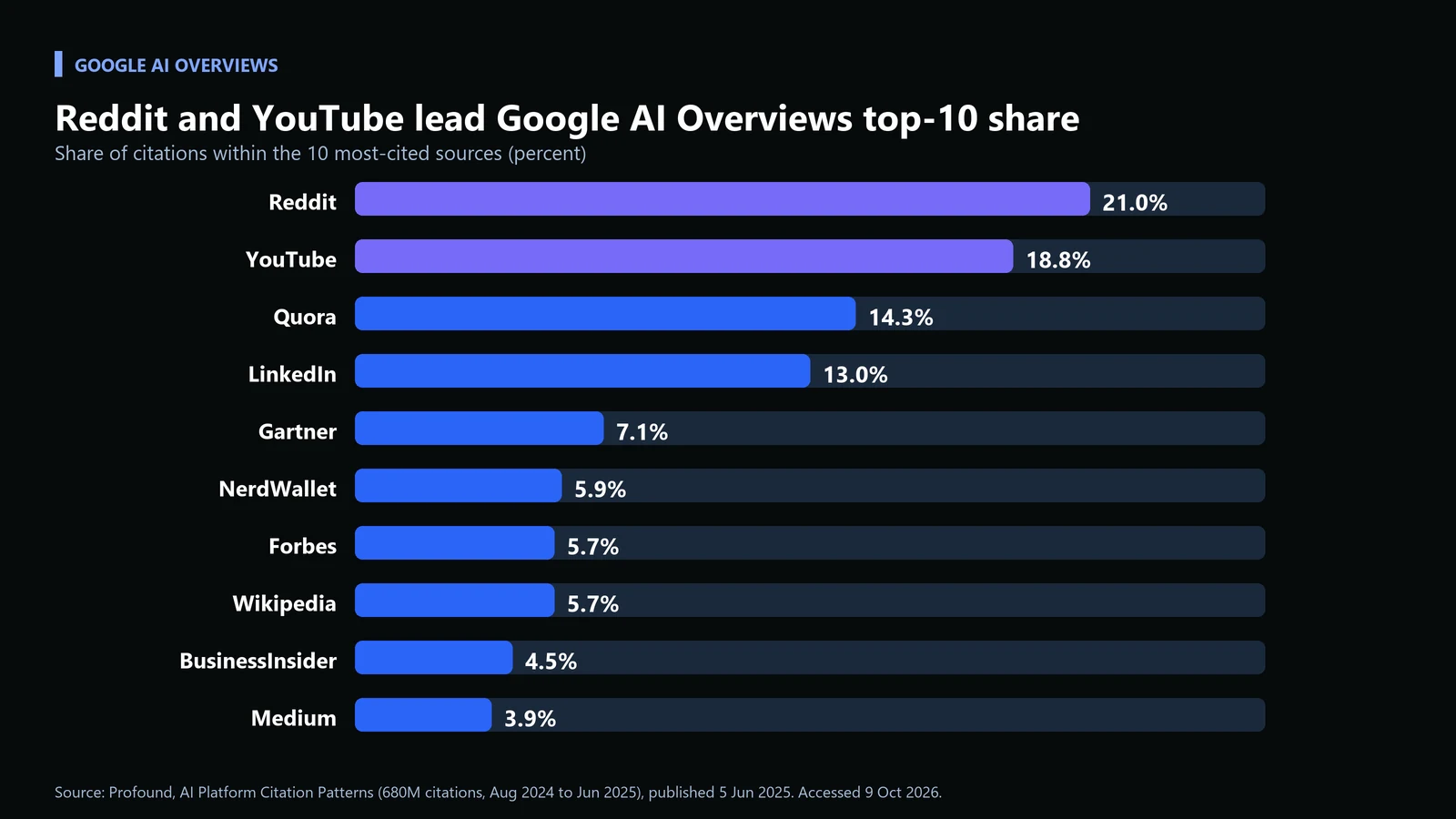
| Google AI Overviews | Reddit, 2.2% (YouTube 1.9%) | Reddit, 21.0% (YouTube 18.8%) | A direct, sourced 40 to 60 word answer |
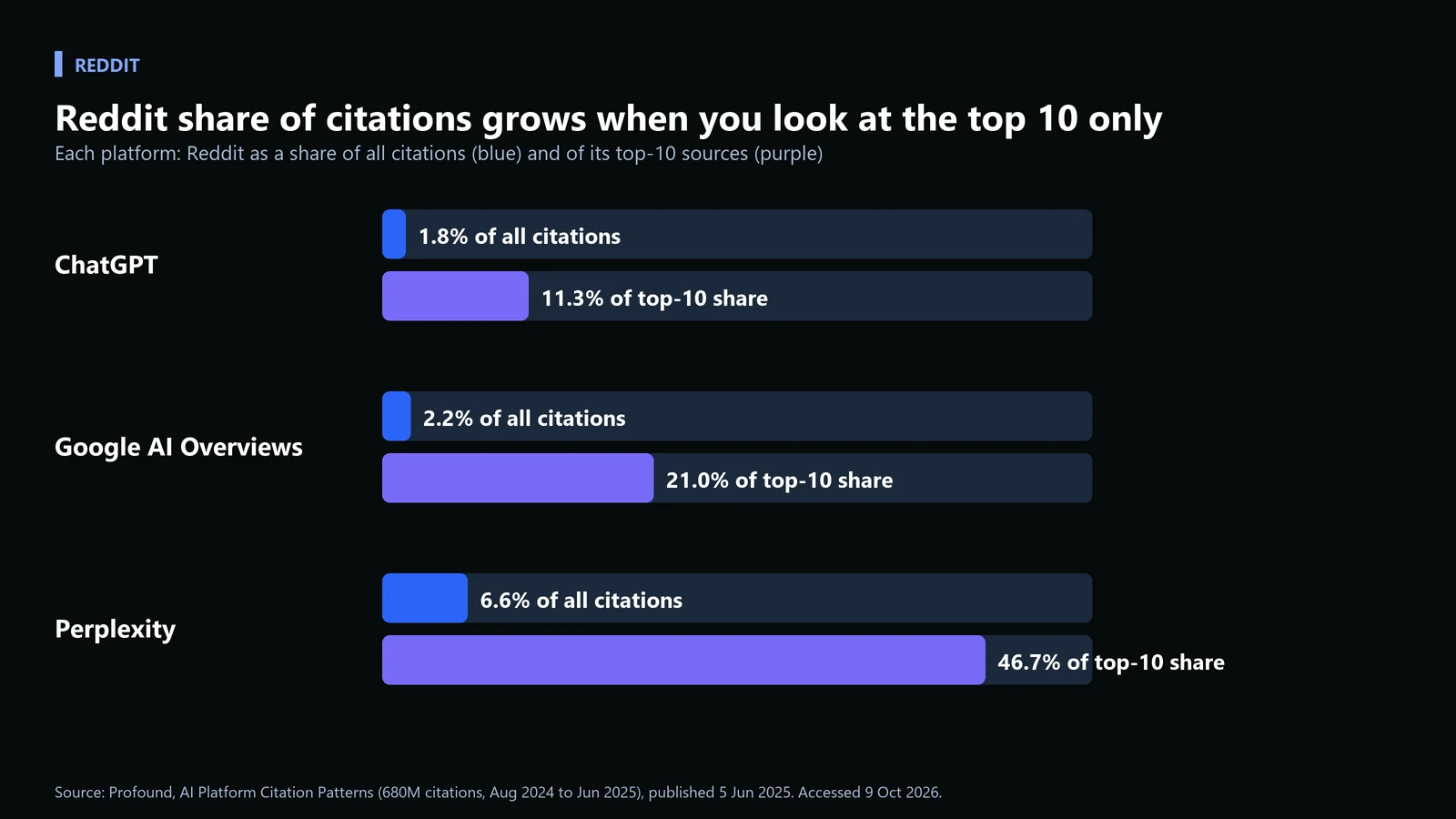
| Perplexity | Reddit, 6.6% | Reddit, 46.7% | A fair, multi-angle discussion |
| Gemini and Claude | No comparable public dataset | No comparable public dataset | Google-style answers with Claude-style sourcing |
Source: Profound (Aug 2024 to Jun 2025). The “write like” column is MV3’s interpretation of the data, not a finding from the study.
How does ChatGPT pick sources?
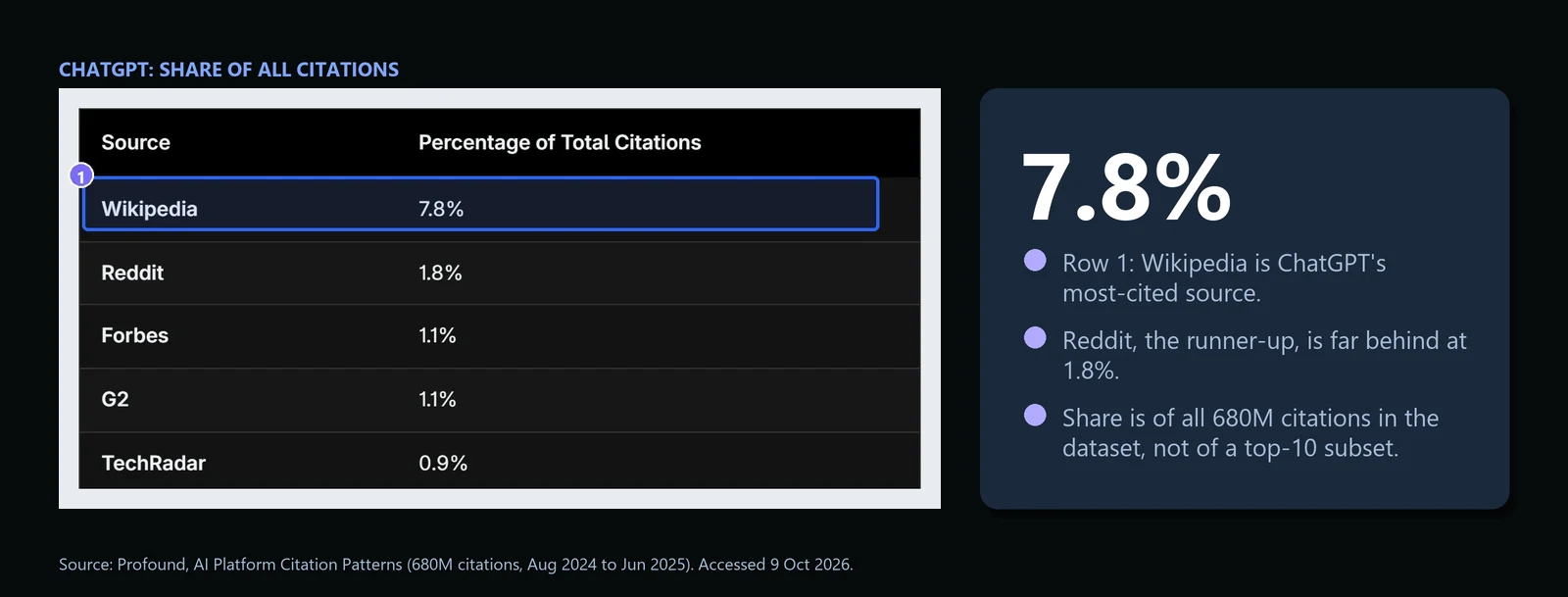
ChatGPT leans on established, encyclopedic sources. In the Profound dataset, Wikipedia was ChatGPT’s most-cited source at 7.8% of all citations, followed by Reddit at 1.8%. Within ChatGPT’s top 10 sources, Wikipedia accounts for 47.9% of the volume. The rest of that top 10 is reference media and long-established editorial outlets such as Forbes, G2, TechRadar, and Reuters.
Our reading of that pattern: ChatGPT rewards content that reads like a reference entry rather than a sales page. Clear definitions, stable terminology used consistently across your site, a neutral explanatory tone, and an encyclopedia-style order (definition, context, mechanics, comparison, caveats) fit what it cites most. Getting your category described correctly on reference-style properties, where that is earned and appropriate, probably matters more here than on Perplexity. Our GEO glossary is written in exactly this format for that reason.
Not sure where your content stands with ChatGPT specifically? A GEO audit checks your citation rate platform by platform, not as one blended score.
How do Google AI Overviews pick sources?
Google AI Overviews are the most mixed of the three. In Profound’s data, Reddit was the top overall source at 2.2% of citations, followed by YouTube at 1.9%, Quora at 1.5%, and LinkedIn at 1.3%. Within the top 10 sources, the split is more concentrated: Reddit holds 21.0% of the top-10 share and YouTube 18.8%, so close to 40% of the highest-volume citations go to two platforms built on user-generated content rather than brand-published pages.
Averi’s write-up cites a different tracker for Google AI Overviews, based on 36 million AI Overviews from March to August 2025, in which YouTube is first at about 23% and Reddit second at about 21%. The two datasets disagree on the order but agree on the pattern: community and video platforms dominate what Google’s summaries cite, with Quora and LinkedIn also in Profound’s top four.

Two moves follow for AI Overviews. First, take part credibly in the Reddit, YouTube, Quora, and LinkedIn conversations around your category, since those sources carry disproportionate weight and most B2B strategies ignore them in favor of owned-channel publishing. Second, put a direct, quotable answer near the top of every page you want cited, with sourced numbers beside it, so no system has to infer the answer from several paragraphs of context.
The studies above do not test why a given page is chosen, so treat ranking as a signal you still need but cannot assume is sufficient. The only way to know is to log citations for your own queries, which the measurement section below walks through.
How does Perplexity pick sources?
Perplexity shows the most concentration. Reddit was its top source at 6.6% of all citations, followed by YouTube at 2.0%, Gartner at 1.0%, and Yelp at 0.8%. Within the top 10, Reddit alone holds 46.7% of the share, close to Wikipedia’s concentration in ChatGPT but pointed at an entirely different kind of source.

The studies measure what gets cited, not why. A reasonable reading is that discussion threads put several viewpoints on one URL: arguments, counterarguments, edge cases, and follow-up questions. Content that acknowledges tradeoffs and alternatives, structured the way a well-moderated thread would cover a topic, is therefore a sensible thing to test for Perplexity, even though no study proves the mechanism.
Does your top-level domain matter?
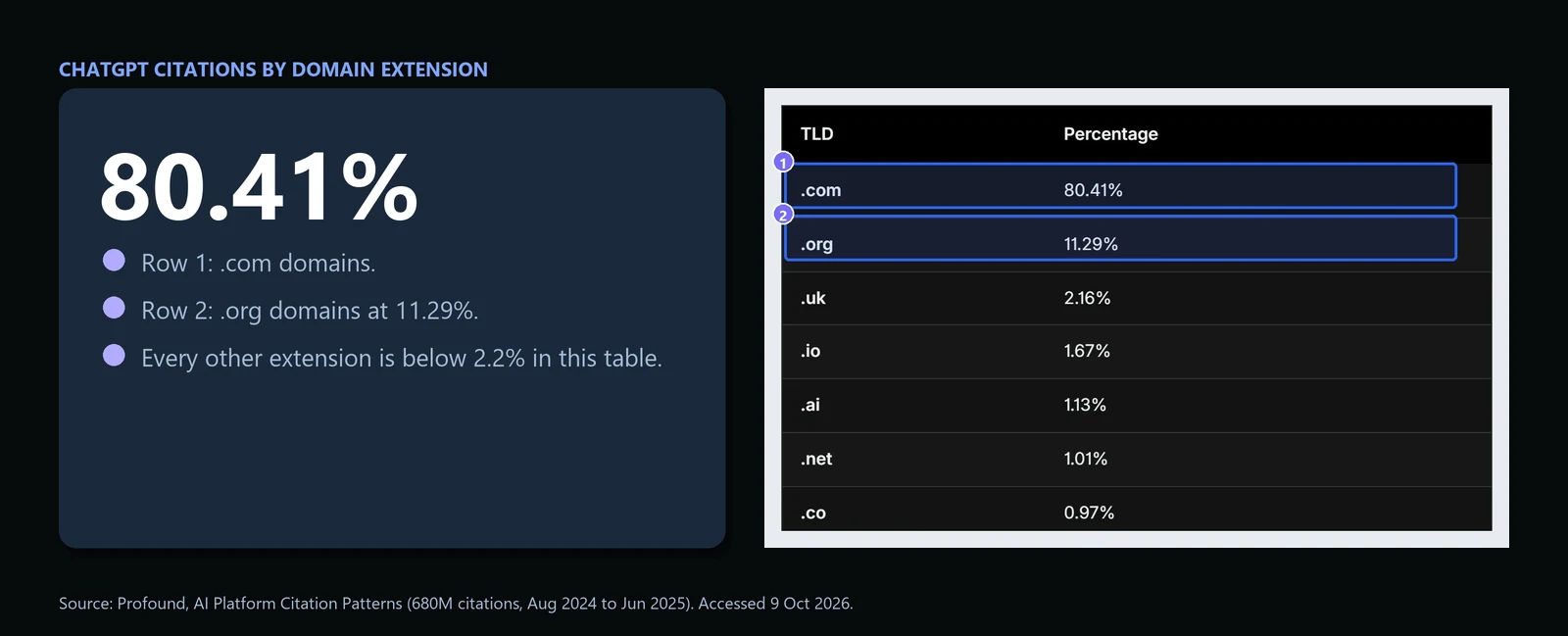
For ChatGPT, Profound also split citations by top-level domain: .com domains accounted for 80.41% and .org for 11.29%, with every other extension below 2.2%. That is a measured preference in one platform’s citations, so hosting your GEO content on an unusual extension or a disconnected microsite is working against the data, not just against style. Profound did not publish the same split for the other two platforms.
Where do Gemini and Claude fit?
Public citation-pattern data on Gemini and Claude is thinner. Brand-mention data gives a rough proxy. DerivateX’s 2026 benchmark tested 50 B2B SaaS companies with 1,400 buyer-intent prompts in total and found mention rates of 100% for ChatGPT, 100% for Gemini, 90% for Perplexity, and 88% for Claude.
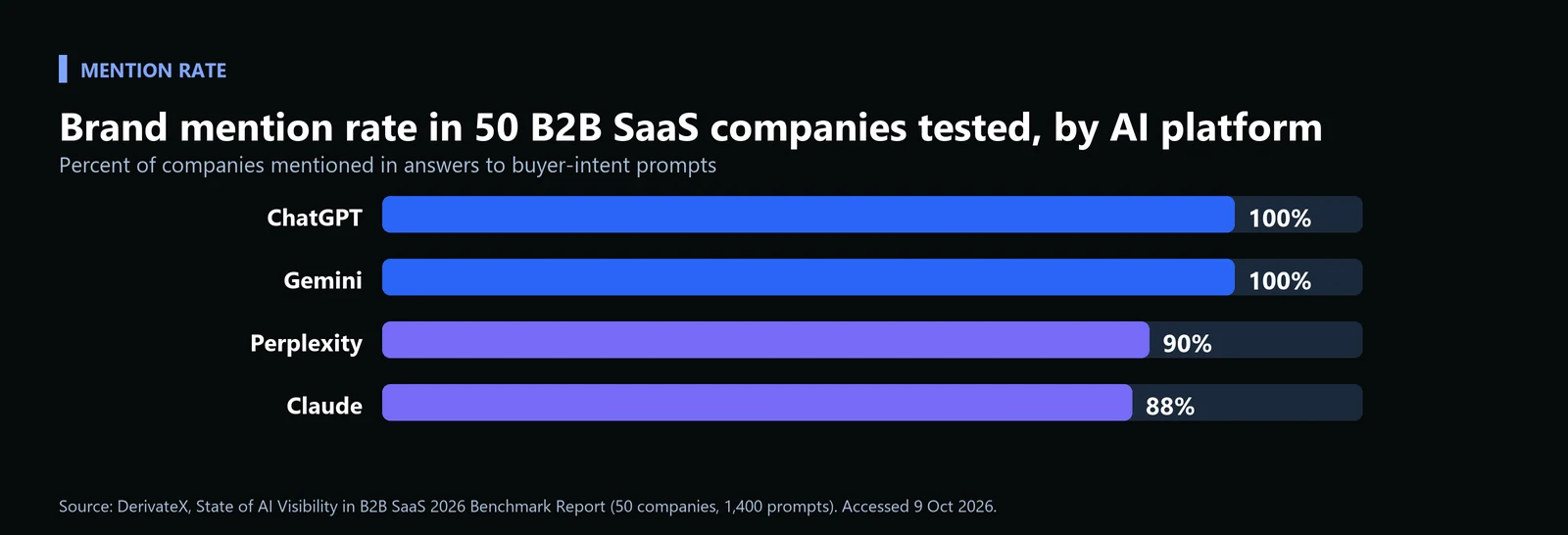
Mention rate is not citation rate. A platform can name your brand without linking to your site, which is a weaker form of visibility. The gap between a high mention rate and your actual linked citations is worth tracking separately.

Because Gemini is Google’s own model, it is reasonable to test the AI Overviews tactics there first. Claude had the lowest mention rate of the four, so the safest assumption is that unsupported claims will not earn it. Cite your own numbers, attribute your own claims, and avoid vague superlatives. Treat both as hypotheses and check them in your log.
What mistakes come from ignoring platform differences?
| Mistake | Why it fails | Fix |
|---|---|---|
| One blended GEO checklist for every platform | ChatGPT and Perplexity share only 11% of cited domains, so a tactic that earns one rarely earns the other | Write a short plan per platform (see the playbook below) |
| Ignoring Reddit, YouTube, and forums because they do not look like B2B channels | Reddit holds 21.0% of the Google AI Overviews top-10 share and 46.7% of Perplexity’s | Participate with real expertise and disclose affiliation; do not post promotion |
| Reporting one blended visibility score | A strong ChatGPT result can hide a zero on Perplexity | Report citations and mentions per platform, per prompt |
| Treating schema markup as a universal fix | None of the studies cited here tested schema; it does not change which sites dominate the top 10 | Keep schema as hygiene and test its effect in your own log |
| Hosting GEO content on a separate subdomain or unusual extension | ChatGPT citations were 80.41% .com in Profound’s data | Publish on your primary .com domain |
Each platform needs its own tactics, not one generic GEO checklist. A GEO audit shows which platforms cite you today and which do not.
What does a platform-by-platform playbook look like?
The research points to a specific set of moves per platform rather than one tactic list. The diagram summarizes them, and the table below adds where to show up and what to measure.
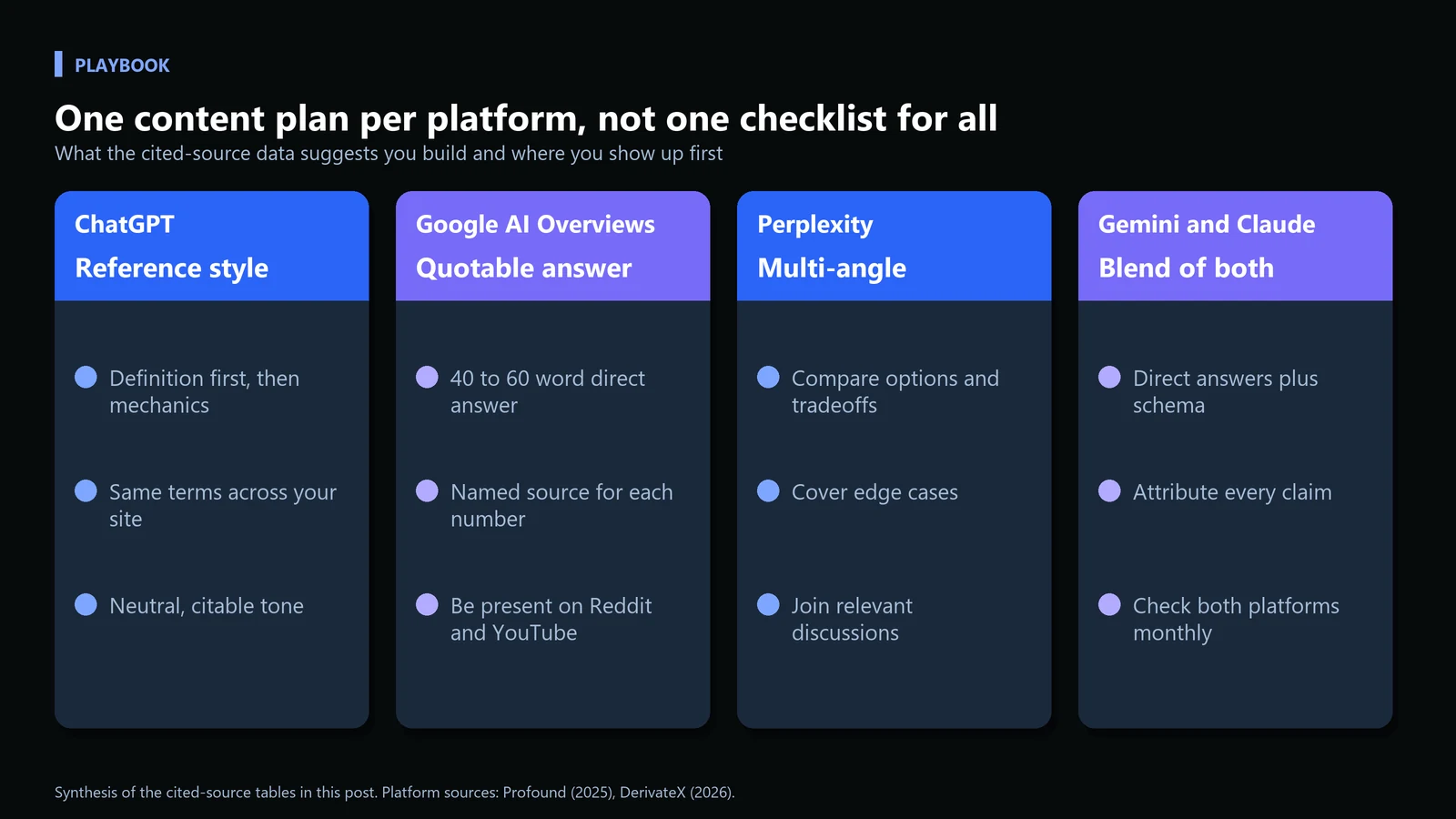
| Platform | Content format to publish | Where to be present | What to log |
|---|---|---|---|
| ChatGPT | Definition first, then context, mechanics, comparison, caveats; consistent terminology | Your own .com glossary and reference-style properties where earned | Is your domain cited? Which Wikipedia-style pages are cited instead? |
| Google AI Overviews | A 40 to 60 word direct answer at the top, each number with a visible source | Reddit, YouTube, Quora, LinkedIn threads about your category | Which community or video sources are cited for your query? |
| Perplexity | Comparison and tradeoff content that covers more than one angle | Relevant discussion threads, with real participation | Is a thread, a comparison, or your page cited? |
| Gemini and Claude | Direct answers with schema, plus attributed claims | Same as above | Mention versus linked citation |
Across all of it, host GEO-focused content on your primary .com domain and measure each platform separately. For the foundations behind this playbook, see our full 2026 guide to generative engine optimization, and for the service side, our AI SEO agency team builds these platform-specific programs.
How do you measure your own citation overlap? (5 steps)
Industry averages show the pattern. Your own log shows your position. This method takes about two hours for a first pass and needs a spreadsheet, Python 3, and access to each AI platform. Skill level: comfortable running a script. At the end you will have a per-platform citation log and an overlap report.
Step 1: Check that each AI crawler can reach your site
Open /robots.txt on your domain and look for rules that name GPTBot, OAI-SearchBot, PerplexityBot, ClaudeBot, or Google-Extended. A blanket Disallow: / under any of them stops that platform from fetching your pages. Here is the live file for mv3marketing.com on 9 October 2026.

To check this programmatically, run the script below. It reads the live robots.txt and reports whether each bot may fetch your blog.
check_ai_crawlers.py (needs pip install requests; replace SITE with your domain)
from urllib import robotparser
import requests  # pip install requests

SITE = "https://www.mv3marketing.com"
BOTS = ["GPTBot", "OAI-SearchBot", "ChatGPT-User", "PerplexityBot", "ClaudeBot", "Google-Extended"]

rp = robotparser.RobotFileParser()
resp = requests.get(SITE + "/robots.txt", timeout=20, headers={"User-Agent": "robots-check/1.0"})
resp.raise_for_status()
rp.parse(resp.text.splitlines())

for bot in BOTS:
    allowed = rp.can_fetch(bot, SITE + "/blog/")
    print(f"{bot:16s} {'allowed' if allowed else 'BLOCKED'}")
Output on mv3marketing.com, 9 October 2026:
GPTBot           allowed
OAI-SearchBot    allowed
ChatGPT-User     allowed
PerplexityBot    allowed
ClaudeBot        allowed
Google-Extended  allowed
Common error: Python’s built-in robotparser.read() fails on some Windows installs with a certificate error, which is why the script fetches the file with requests and passes the text to parse(). If a bot shows BLOCKED, remove or narrow the matching Disallow line.
Step 2: Build a fixed prompt set
Write 20 to 30 buyer-intent prompts that your target customers would actually type, and keep them identical across platforms and months. Use the template below as a starting structure. The prompts shown are examples.
| Prompt ID | Buyer stage | Example prompt (replace with your own) |
|---|---|---|
| P1 | Problem aware | Why is our trial-to-paid conversion low? |
| P2 | Solution aware | What tools help reduce SaaS churn? |
| P3 | Comparison | [Your category] software compared for mid-size teams |
| P4 | Vendor shortlist | Best [your category] vendors for B2B SaaS |
Step 3: Run the prompts and log every cited domain
Run each prompt on ChatGPT, Perplexity, and Google (AI Overviews), once a month, from a logged-out or clean session where possible. For every answer, record each domain it cites, one row per citation. Download the starter files at the end of this section. The format is four columns:
Log format (illustrative rows)
date,platform,prompt_id,cited_domain
2026-10-09,ChatGPT,P1,wikipedia.org
2026-10-09,Perplexity,P1,reddit.com
2026-10-09,Google AIO,P1,youtube.com
Step 4: Compute per-platform shares and cross-platform overlap
The script counts citations per platform, shows each platform’s most-cited domain and how often your domain appears, then computes the Jaccard overlap (shared domains divided by combined unique domains) between every pair of platforms.
citation_overlap.py (set OUR_DOMAIN to your domain; run as python citation_overlap.py log.csv)
import csv, sys
from collections import Counter, defaultdict
from itertools import combinations

OUR_DOMAIN = "example-saas.com"

rows = list(csv.DictReader(open(sys.argv[1], newline="")))
by_platform = defaultdict(list)
for r in rows:
    by_platform[r["platform"]].append(r["cited_domain"].lower().strip())

print("Citations logged per platform")
for p, doms in sorted(by_platform.items()):
    top = Counter(doms).most_common(1)[0]
    ours = doms.count(OUR_DOMAIN)
    print(f"  {p:12s} total={len(doms):3d}  unique={len(set(doms)):3d}  top={top[0]} ({top[1]})  ours={ours}")

print("\nDomain overlap between platforms (Jaccard = shared / combined unique domains)")
for a, b in combinations(sorted(by_platform), 2):
    sa, sb = set(by_platform[a]), set(by_platform[b])
    j = len(sa & sb) / len(sa | sb)
    print(f"  {a} vs {b}: {len(sa & sb)} shared of {len(sa | sb)} -> {j:.0%}")
Output on the 72-row illustrative sample log (generated for this post; not real measurements):
Citations logged per platform
  ChatGPT      total= 24  unique=  6  top=wikipedia.org (11)  ours=0
  Google AIO   total= 24  unique=  8  top=linkedin.com (7)  ours=1
  Perplexity   total= 24  unique=  6  top=reddit.com (11)  ours=0

Domain overlap between platforms (Jaccard = shared / combined unique domains)
  ChatGPT vs Google AIO: 1 shared of 13 -> 8%
  ChatGPT vs Perplexity: 1 shared of 11 -> 9%
  Google AIO vs Perplexity: 4 shared of 10 -> 40%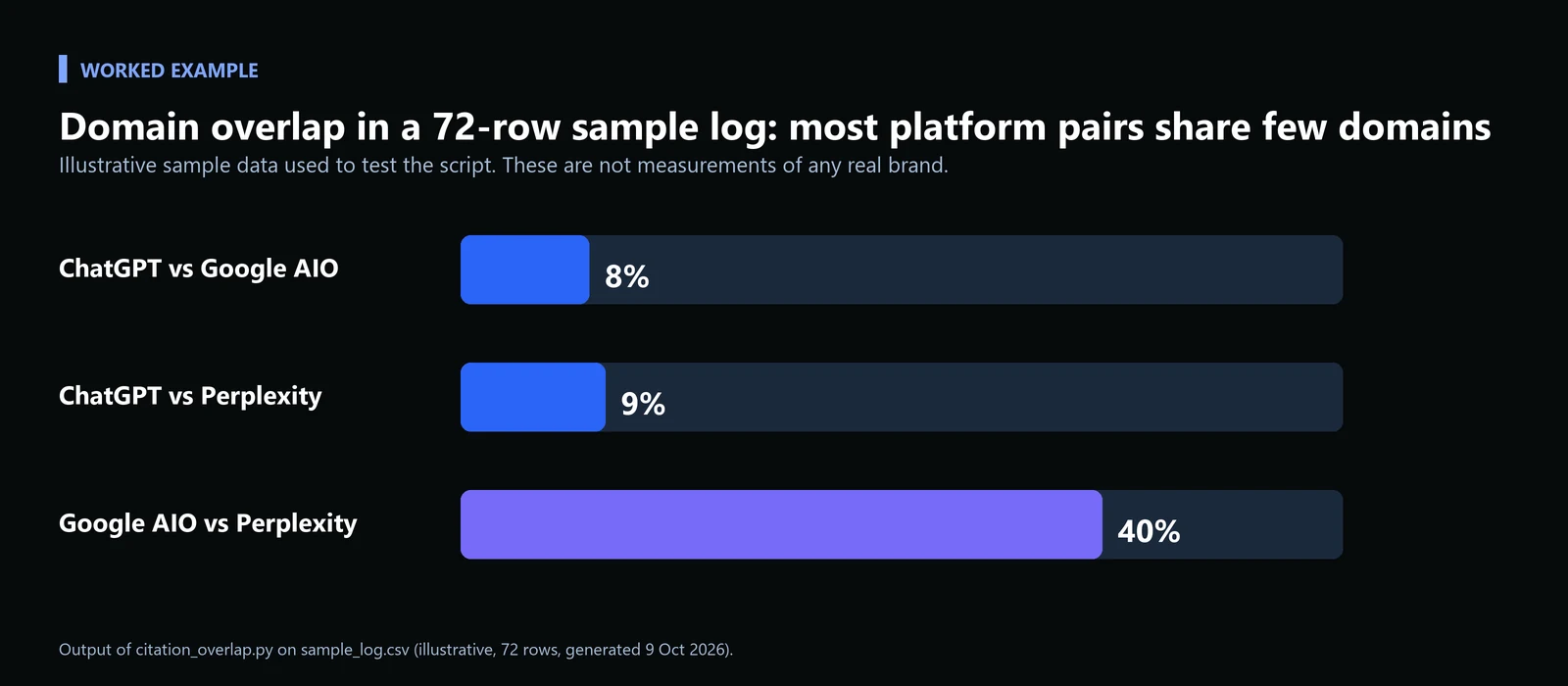
Step 5: Read the result and pick one fix per platform
Look at three numbers for each platform: how often your domain is cited, which domains are cited instead, and what format those pages use. If a platform cites Reddit threads where you have no presence, the fix is participation. If it cites reference pages, the fix is a definitive page on your own domain. Pick one change per platform, ship it, and compare next month’s log. A single audit gives you the map; the monthly log tells you whether the changes moved the number on the platform they targeted.
Troubleshooting
| Symptom | Likely cause | Fix |
|---|---|---|
| A platform shows BLOCKED in the crawler check | A Disallow rule under that bot name or under User-agent: * | Remove or narrow the rule, then re-run the script |
| Overlap is 0% between two platforms | Too few citations logged, or one platform returned no sources | Log at least 20 prompts per platform and note answers with no citations |
| Your domain never appears | The platform cites other formats for your prompts | Compare the cited pages’ formats with yours, then rebuild one page to match |
| Results change from one run to the next | AI answers vary between sessions | Re-run each prompt on three days and keep domains cited at least twice |
Checklist
- Each AI crawler is allowed in robots.txt
- A fixed set of 20 to 30 buyer-intent prompts is saved
- Every cited domain is logged per platform, per prompt, per month
- Overlap and your own citation count are computed per platform, not blended
- One change is chosen per platform and re-measured next month
Downloads: AI citation log template (CSV) and AI citation tracking checklist (PDF).
Frequently asked questions
Do ChatGPT and Perplexity cite the same websites?
Mostly no. Averi's 2026 analysis of 680 million citations found that only 11% of domains are cited by both ChatGPT and Perplexity.
Which source does ChatGPT cite most?
Wikipedia. In Profound's 680-million-citation dataset it was 7.8% of all ChatGPT citations and 47.9% of the top-10 share.
Why does Reddit matter for GEO?
Reddit is the top source for Perplexity (6.6% of all citations, 46.7% of top-10 share) and for Google AI Overviews in Profound's data (2.2% of all citations, 21.0% of top-10 share).
Should I track mentions or citations?
Both, separately. A platform can mention your brand without linking to your site. DerivateX measured mention rates of 100% for ChatGPT and Gemini, 90% for Perplexity, and 88% for Claude.
How often should I re-run my citation log?
Monthly is a practical cadence. Platforms update retrieval and ranking behavior over time, so treat any published figure as a snapshot and your own log as the trend line.
Where does this data come from?
| Statistic | Source |
|---|---|
| 680 million citations analyzed, Aug 2024 to Jun 2025 | Profound, AI Platform Citation Patterns |
| ChatGPT: Wikipedia 7.8% of all citations, 47.9% of top-10 share; Reddit 1.8% / 11.3% | Profound (same study) |
| Google AI Overviews: Reddit 2.2% / 21.0%; YouTube 1.9% / 18.8% | Profound (same study) |
| Perplexity: Reddit 6.6% / 46.7%; YouTube 2.0% / 13.9% | Profound (same study) |
| ChatGPT citations by TLD: .com 80.41%, .org 11.29% | Profound (same study) |
| 11% of domains cited by both ChatGPT and Perplexity; Surfer tracker figures for AI Overviews | Averi, B2B SaaS citation benchmarks (2026) |
| Mention rates: ChatGPT 100%, Gemini 100%, Perplexity 90%, Claude 88% (50 companies, 1,400 prompts) | DerivateX, State of AI Visibility in B2B SaaS 2026 |
| GenAI has overtaken search for a quarter of B2B buyers | Responsive, Oct 2025 buyer study |
| robots.txt rules for mv3marketing.com | MV3 first-party, checked 9 Oct 2026 |
None of these numbers stay fixed. Citation patterns shift as each platform updates its retrieval and ranking approach, so treat this as a snapshot as of October 2026. The durable takeaway is that these platforms are not interchangeable and a single blended tactic list will keep leaving citation volume on the table.
If you want to see where your own domain sits on each platform individually rather than guessing from industry averages, our GEO audit runs that comparison against your site and named competitors, or book a call and we will walk through your log with you.
Share this article

Vance Moore is Chief Growth Officer at MV3 Marketing and leads its team of SEO professionals, engineers and auditors.
Ready to audit your organic growth opportunity?
$2,500 flat. 5 business days. Six deliverables tied to pipeline , not rankings. No retainer required.
Get the Organic Growth Audit →