What are ABM marketing strategies?
Wikipedia describes account-based marketing as “a business-to-business (B2B) marketing strategy in which companies focus resources on a defined set of high-value accounts, treating each as a distinct market rather than pursuing broad-based outreach” (Wikipedia, Account-based marketing). The strategies are the different ways you spend that focus. Most differ in one variable: how many accounts share each program.
MV3 Marketing sells ABM programs, so we have a commercial interest in this topic. We also run ABM on ourselves, and the numbers below come from that early, small effort. For the wider framework, see our ABM playbook for AI and SaaS companies.
Which three ABM strategies should you know?
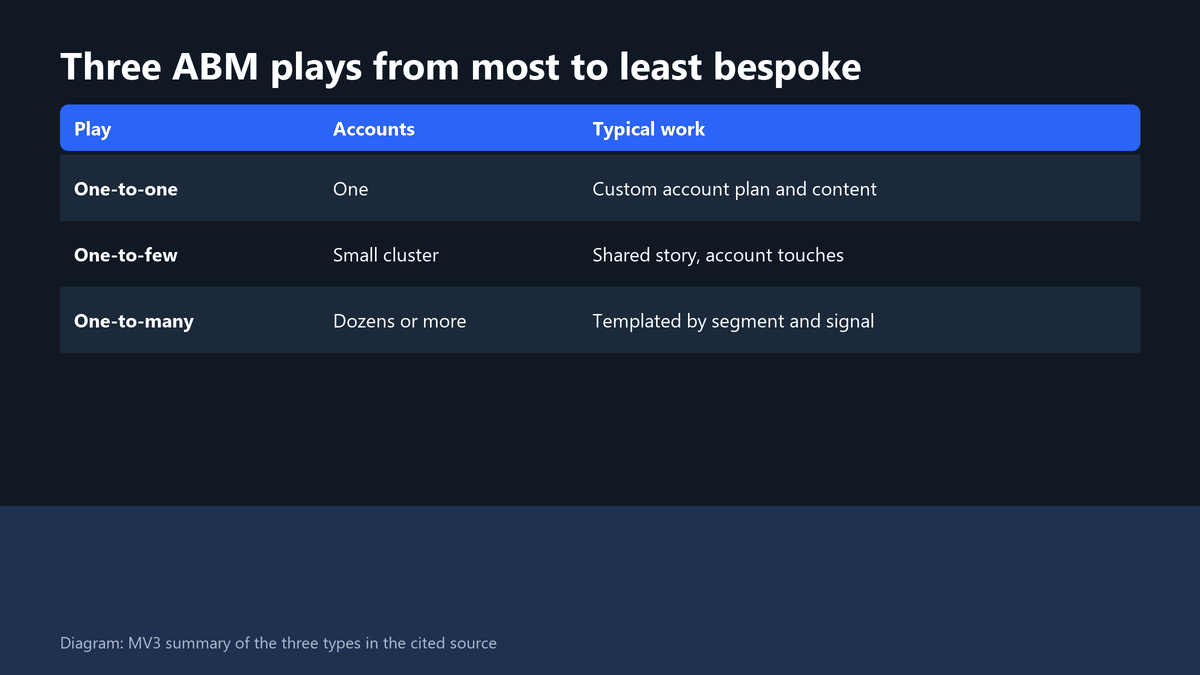
The same Wikipedia page, citing Bev Burgess, lists three main types. “Strategic ABM (one-to-one): Customized programs for individual accounts, built with deep sales collaboration.” “ABM Lite (one-to-few): Tailored initiatives for small clusters of accounts with similar issues.” And “Programmatic ABM (one-to-many): Scalable campaigns using technology and data to personalize marketing for dozens or hundreds of accounts.”
| Strategy | Accounts per program | What the work looks like | Main risk |
|---|---|---|---|
| One-to-one | One | Custom research, content and sales plan per account | High effort per account |
| One-to-few | A small cluster | Shared problem story with account-level touches | Cluster is not really similar |
| One-to-many | Dozens or more | Templated campaigns tuned by segment and signal | Feels like broad outreach |
Rule of thumb. Match the depth of the play to the value of the account and to the people you have. A play your team cannot sustain is worse than a lighter one it can.
Strategy 1: One-to-one ABM
Use it for the few accounts where a single deal would change your year. Build a short account plan: the buying committee, the problem each member owns, the content that speaks to each, and the sales steps that follow. Sales and marketing share the plan and meet on it weekly.
Expected result: each account has a named owner, a mapped committee and a dated next step. Common mistake: running one-to-one for twenty accounts and delivering a template to each. If you cannot do real research for an account, move it down a tier.
Strategy 2: One-to-few ABM
Group accounts by a shared problem, trigger or industry, then write one strong story per cluster. Add small account-specific touches, such as a named reference or a relevant data point. Clusters of about four to eight work for a small team, but that is a working rule, not a measured benchmark.
The hard part is the grouping. Accounts need to share a pain, not just an industry label. Our guide to ABM segmentation shows how to match investment to buying committee size.
Expected result: a cluster brief that names the shared problem and the proof you hold. Common mistake: clustering by company size alone.
Strategy 3: One-to-many ABM
This play uses data and automation to reach a larger list with messages tuned by segment and buying signal. It is the entry point for most small teams because it scales. It is also where the line between ABM and broad outreach blurs, so keep the list tied to a written profile.
For what to automate and what to keep human, read ABM tools and tactics. Expected result: a list with a score and a signal for every account. Common mistake: adding accounts to hit a number instead of a fit.
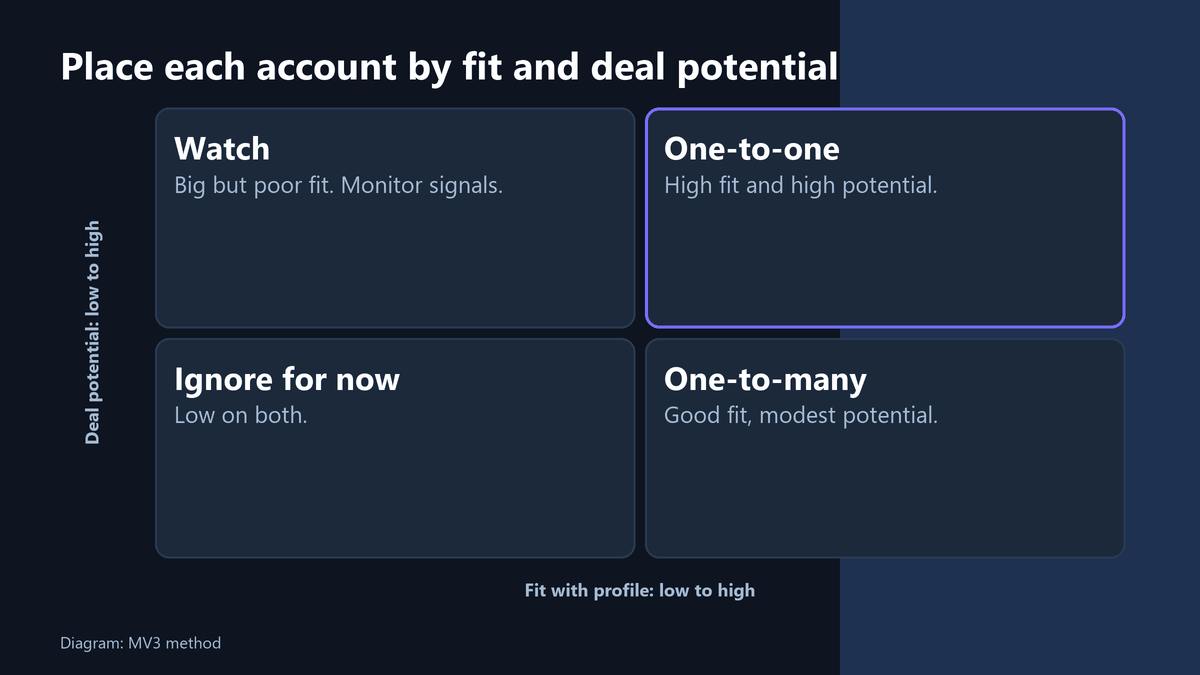
How do you decide which accounts get which play?
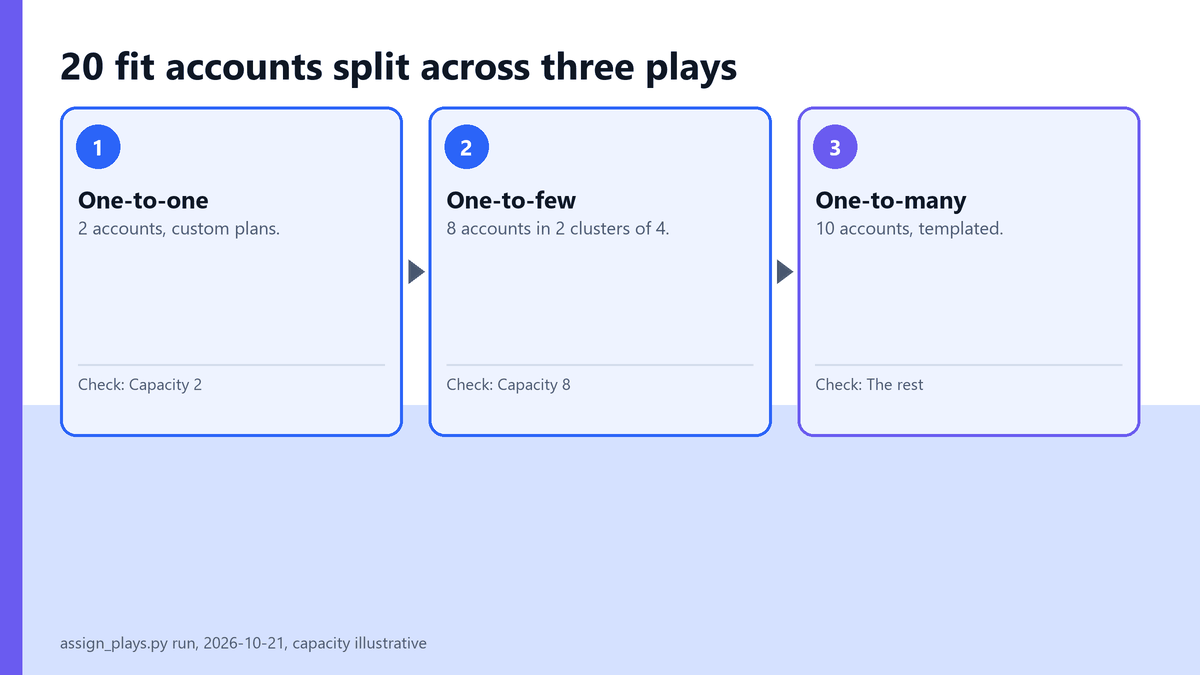
Score accounts against your profile first, then assign plays from the top of the list down until capacity runs out. We wrote a small script to do this. The tier counts are real: 16 of our staged companies are in tier B and 4 in tier C, so 20 fit our profile (MEASURED, crm_companies, queried 2026-10-21). The capacity limits are an ILLUSTRATIVE assumption about a small team.
# Assign ABM plays to scored accounts. Account counts per tier are real (our CRM, 2026-10-21);
# the capacity limits are an ILLUSTRATIVE assumption about a small team.
tiers = [("B", 16), ("C", 4)]          # best tier first
capacity = {"one-to-one": 2, "one-to-few": 8}   # accounts the team can serve deeply; the rest get one-to-many
cluster_size = 4

accounts = [f"{t}{i:02d}" for t, n in tiers for i in range(1, n + 1)]
plan = {"one-to-one": accounts[:capacity["one-to-one"]]}
start = capacity["one-to-one"]
plan["one-to-few"] = accounts[start:start + capacity["one-to-few"]]
plan["one-to-many"] = accounts[start + capacity["one-to-few"]:]

for play, accts in plan.items():
    extra = f", {len(accts) // cluster_size} clusters of {cluster_size}" if play == "one-to-few" else ""
    print(f"{play}: {len(accts)} accounts{extra}")
print("total:", sum(len(a) for a in plan.values()), "of", len(accounts))
What this does: it ranks accounts by tier, gives the first two a one-to-one play, the next eight a one-to-few play, and puts the rest in a one-to-many program. Output from our run on 2026-10-21:
one-to-one: 2 accounts
one-to-few: 8 accounts, 2 clusters of 4
one-to-many: 10 accounts
total: 20 of 20
A common error is to let the one-to-one tier grow without checking capacity. Change the capacity numbers in the script and the split changes at once, which makes the trade-off visible before you commit.
How do you build the account list first?
Every ABM strategy depends on the list underneath it. Build it in three passes. First, write the profile: industry, company size, funding stage, the roles that buy, and the trigger events that make them ready. Second, pull candidates from at least two sources and tag each with its source on the day it enters the CRM. Third, score each candidate against the profile and remove the ones that fail before anyone writes a message.
Tagging matters because it is the only way to learn which source earns its keep. Without it you end up with a list that looks large and tells you nothing. We learned this on our own data, as the next section shows. If you are still sizing the market behind the list, start with our guide to TAM, SAM and SOM.
Checklist. Written profile, two sources, a source tag on every account, a score, and a refuse list.
What does our own account list show?
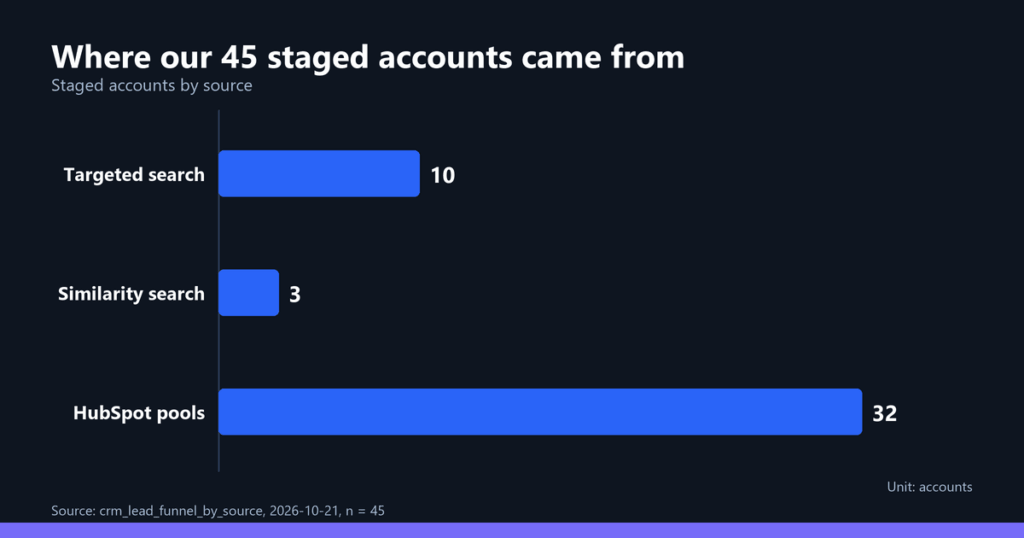
We staged 45 companies in our CRM. Where they came from matters more than how many there are. A targeted search against our profile produced 10 of them, and we found a buyer contact at 3 of those 10. A similarity search produced 3 companies and no buyer. Our HubSpot pools produced the other 32, and none of those has a buyer contact (MEASURED, crm_lead_funnel_by_source, queried 2026-10-21, n = 45).
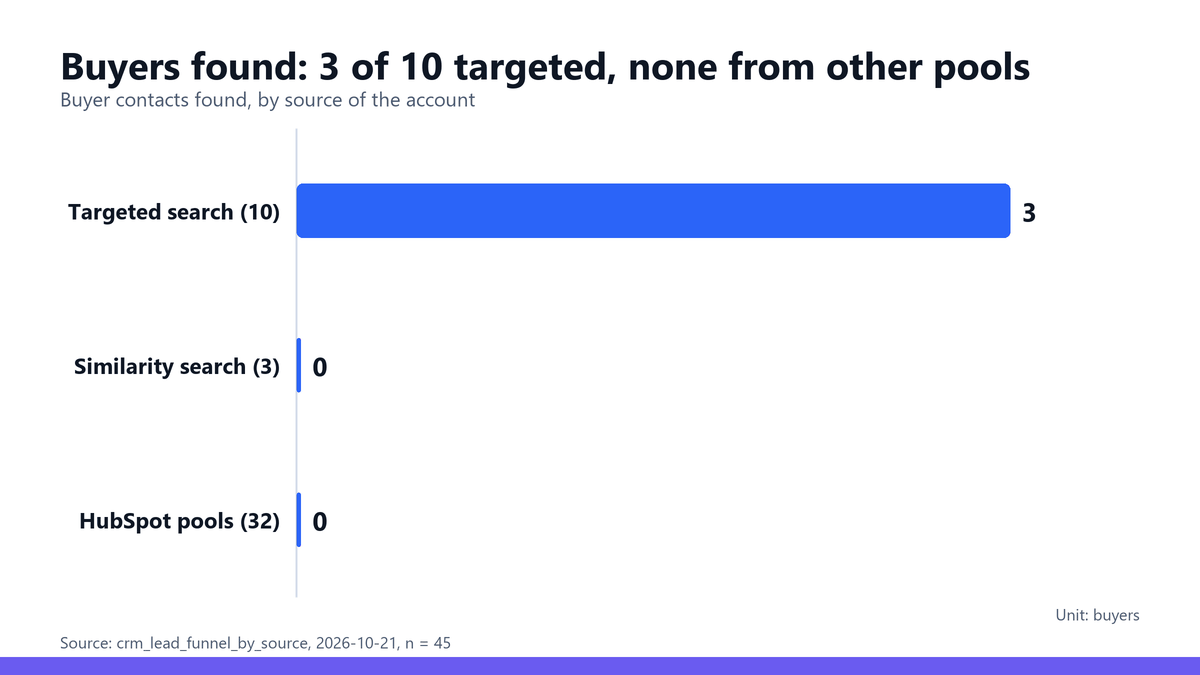
This is small. Three contacts cannot support a claim about which source is better. What it does show is that ABM needs a buying committee, and ours is far from one. With one named buyer at 3 accounts and none at the other 42, we cannot run a real one-to-one play yet. We have contacted none of the 45, so we report no reply or meeting rate. The next step is to find more contacts at the accounts that fit.
What does the ranking content look like?
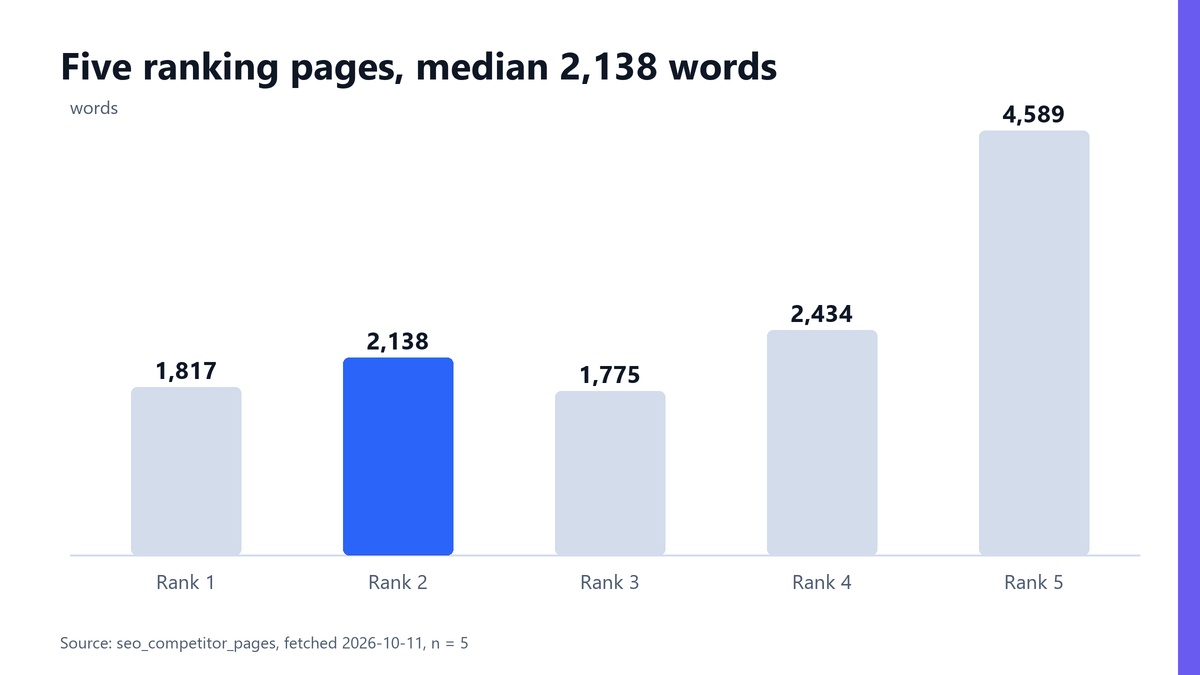
Five pages rank for this keyword and our crawler read all five. They ran 1,817, 2,138, 1,775, 2,434 and 4,589 words, with 5, 16, 1, 3 and 22 images. None of the five had an HTML table, three carried FAQ schema, and two used a first-party phrase, such as “our data” or “we found” (MEASURED, seo_competitor_pages, fetched 2026-10-11, n = 5).
Most results explain the three types and stop. Few show how many accounts a team can really cover, or how its own list performed. For measuring results once programs run, see how to measure ABM ROI.
A 30-day plan to start
- Week one: write the profile and a refuse list, then pull two candidate lists and tag each source.
- Week two: score the accounts, run the allocation script with your real capacity, and choose how many accounts get each play.
- Week three: map the buying committee for every one-to-one account and write one problem story for each one-to-few cluster.
- Week four: launch the one-to-many program for the rest, and set the weekly review that compares engagement by account.
Expect the first month to produce a working system, not pipeline. Buying committees take time to move, so judge the early weeks on coverage and engagement and judge pipeline later.
Common ABM strategy mistakes
| Mistake | Symptom | Fix |
|---|---|---|
| Too many one-to-one accounts | Templates dressed as custom work | Cap the tier at what the team can research |
| Clusters by label | Message fits nobody | Cluster by shared problem |
| No buying committee | One contact per account | Map three to five roles before outreach |
| No profile | List full of poor fits | Score first, then assign a play |
If you want a team to run this with you, book a call with MV3 Marketing. You can also see our ABM agency service.
FAQ
What is the difference between ABM and demand generation?
Demand generation draws a broad audience and qualifies the ones who respond. ABM starts with a chosen list of accounts and aims work at them. Many teams run both.
How many accounts should an ABM program include?
It depends on capacity. A small team can serve a few accounts deeply and a larger list lightly. Use a script like the one above to see the split before you commit.
Which ABM strategy is best for a small SaaS team?
Start with one-to-many for fit accounts and add one-to-few clusters once you have a shared problem story and proof. Add one-to-one only for accounts you can research properly.
How do you measure ABM strategies?
Track account-level engagement, meetings by account, pipeline from target accounts and cost per account. Tag each account’s source at entry so you can compare.
Do you need intent data for ABM?
No, but signals help you order the list. A written profile and a buying committee map matter more at the start.
Share this article

Vance Moore is Chief Growth Officer at MV3 Marketing and leads its team of SEO professionals, engineers and auditors.
Ready to audit your organic growth opportunity?
$2,500 flat. 5 business days. Six deliverables tied to pipeline , not rankings. No retainer required.
Get the Organic Growth Audit →