
An ABM playbook for AI and SaaS companies replaces broad demand generation with a defined target account list, intent-signal-based timing, and coordinated email, LinkedIn, and ad-retargeting sequences that scale personalization by account tier instead of by individual prospect. Success is measured by pipeline influenced and account engagement, not marketing-qualified leads.
That is the model in one paragraph. The rest of this playbook covers how to select and tier accounts, which intent signals actually predict a buying window, how to sequence channels so outbound does not read as spam, how personalization scales without a content team the size of a publisher’s, and how to measure the program on pipeline instead of the vanity metrics that make ABM look busy without making it work.
This is written for B2B AI and SaaS marketing teams with a defined ICP, a sales team that will work a target list, and contract values large enough to justify account-level effort. For the broader strategic context on how AI search and generative engines are reshaping how these accounts research vendors before a rep ever talks to them, read our pillar guide, What Is GEO? The Full 2026 Guide to Generative Engine Optimization, alongside this one. ABM and GEO work the same accounts from different angles: one earns visibility when a buying committee researches a category, the other earns pipeline once that committee is named and in motion.
Why Standard Demand Gen Breaks Down for AI and SaaS Sales Cycles
Broad demand generation optimizes for volume: more form fills, more webinar signups, more inbound leads for sales to chase. That model works when the buying group is one person with a credit card. It works less well once your product requires sign-off from a technical evaluator, a security or compliance reviewer, an economic buyer, and often a legal team reviewing a data processing agreement, which describes most mid-market and enterprise AI and SaaS sales cycles.
A lead-volume program treats each of those four people as a separate, unrelated lead. It has no way to recognize that the security reviewer who downloaded your SOC 2 whitepaper on Tuesday and the VP of Engineering who requested a demo on Thursday are evaluating the same deal. Marketing reports two leads; sales works one, ignores the other, and the deal closes despite the marketing motion rather than because of it.
ABM inverts the unit of measurement from lead to account. Every signal, every touch, and every piece of content gets attributed to the account and the buying committee inside it, not to an anonymous form fill. That single change is what makes the rest of this playbook possible: you cannot orchestrate multi-channel outreach, personalize content, or measure pipeline influence if your system does not know that five different contacts belong to one deal. If your sales motion runs on a single self-serve buyer with no procurement process, ABM is the wrong investment; put the budget into conversion optimization and product-led growth instead. If you sell into buying committees with contract values that justify dedicated account effort, the rest of this framework applies directly.
Step 1: Build the Account Selection Model
Account selection is the highest-leverage decision in the program, and where most ABM programs quietly fail before the first email ever sends. Selecting the wrong 500 accounts and running a flawless multi-channel motion against them produces a flawless report on a program that was never going to close anything.
Score every candidate account on two axes that matter independently: fit and intent. Fit is static and describes whether the account could ever become a good customer, built from firmographic data (employee count, industry, funding stage), technographic data (what is already in their stack), and, for AI and SaaS specifically, whether they already run the category of workflow your product replaces or augments. Intent is dynamic and describes whether the account is showing buying behavior right now, covered in the next section.
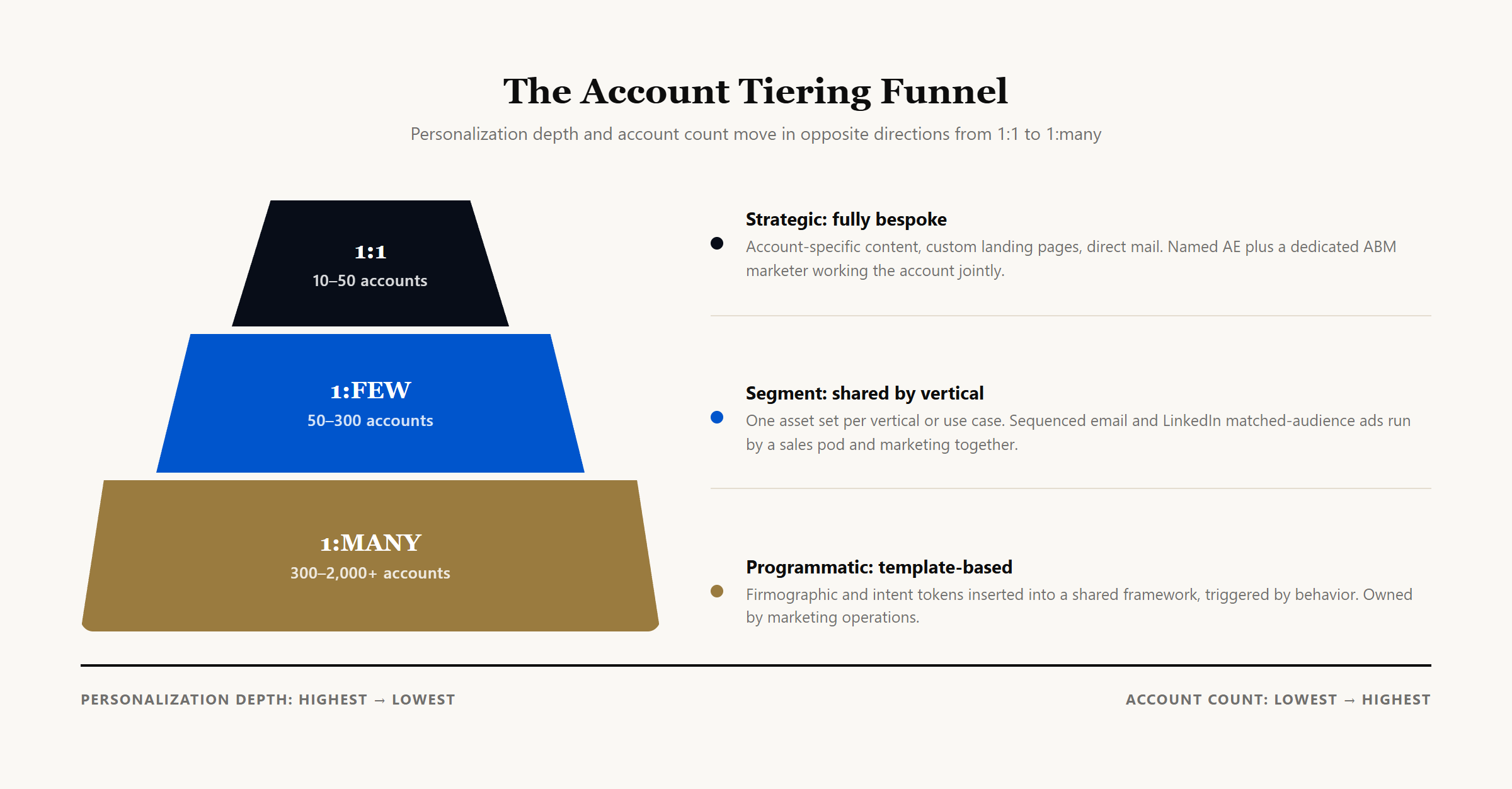
Once accounts are scored, sort them into tiers. Most mature ABM programs converge on some version of a three-tier model, usually called 1:1, 1:few, and 1:many, and the tier an account sits in determines everything downstream: how much personalization it gets, which channels are in play, and who on your team owns it.
| Tier | Typical account count | Personalization depth | Primary channels | Owner |
|---|---|---|---|---|
| 1:1 (Strategic) | 10-50 named accounts | Fully bespoke: account-specific content, custom landing pages, personalized outreach referencing the account’s actual stack and initiatives | Direct mail, executive LinkedIn outreach, custom email, targeted display retargeting | Named AE plus a dedicated ABM marketer, working the account jointly |
| 1:few (Segment) | 50-300 accounts grouped by vertical or use case | Shared messaging built per segment: one asset set addresses the segment’s common pain points and buying triggers | Sequenced email, LinkedIn matched-audience ads, segment-specific landing pages | A sales pod or territory team, marketing builds the segment plays |
| 1:many (Programmatic) | 300-2,000+ accounts meeting a broad fit threshold | Template personalization: firmographic and intent-based tokens inserted into a shared framework, triggered by behavior | Automated email sequences, programmatic display, retargeting | Marketing operations, minimal individual sales involvement until an account engages |
The mistake we see most often is building a 1:many list of two thousand accounts and calling the whole thing ABM, then wondering why it performs like the outbound email program it actually is. Programmatic ABM at the 1:many tier is legitimate, but only if accounts were selected against a real fit model and the content still speaks to a shared, specific problem rather than generic category messaging. If every account in your 1:many tier could swap places with a competitor’s ICP without changing a single message, you have built a list, not an account tier.
Growth AI clients on our own account-based program work from exactly this three-tier structure, built around 500 named accounts sequenced monthly with the channel mix mapped out below. Our ABM services page walks through how we build and run that structure end to end, or you can book a strategy call and we will look at your list together.
Step 2: Layer In Intent Signals
Fit tells you an account could buy. Intent tells you when. Running a 1:1 motion against a perfectly-fit account with zero active buying behavior wastes your most expensive personalization on an account that is not in market yet. Intent data sequences your effort so outreach lands when a buying window is actually open, not on a fixed calendar.
Useful intent signals for AI and SaaS accounts fall into a few categories, and no single one is reliable alone. Combine at least two before treating an account as active:
- Third-party research behavior. Activity on review platforms like G2, Capterra, and TrustRadius, including comparison page views, is one of the strongest available signals because it indicates active vendor evaluation rather than passive interest.
- Hiring signals. Job postings for roles tied to your product category (an account hiring for “AI implementation lead” or “revenue operations manager”) often precede a buying decision by weeks, since the org is staffing up around the initiative your product supports.
- Technographic change. New tools appearing in an account’s stack, or a tool your product integrates with or replaces getting adopted more broadly, signals a moment the account is actively reconfiguring systems your product touches.
- First-party engagement. Website visits to pricing or comparison pages, content downloads, and email engagement are signals you own directly and can tie to an account with the least ambiguity.
- Competitive displacement signals. Mentions of a competitor in job postings, public complaints on communities like Reddit or G2 review threads, or a known contract renewal date, indicate a window where an account may be reconsidering its current vendor.
Build an intent score that combines these signals rather than acting on any single one alone; an account showing G2 research activity plus a relevant new job posting is a materially stronger signal than either alone. Combining signals also reduces the false positives that erode sales trust fastest: if sales works three “hot” accounts that show no real buying behavior when they call, they stop trusting the list, and no amount of channel sophistication downstream recovers that quickly. Set a re-scoring cadence, not a one-time snapshot: weekly for 1:1 accounts, at minimum monthly for 1:few and 1:many segments, since intent decays and an account that spiked three months ago is a different account than one spiking this week. Intent scoring only gets you to the right account, though; it does not tell you whether you can actually reach the people inside it who will decide. For a deeper look at combining intent data with buying committee mapping, especially for regulated ICPs like fintech and cybersecurity where a compliance or security reviewer has real veto power, see our framework on B2B intent data and buying committee mapping.
Step 3: Orchestrate Multi-Channel Outreach Without Overwhelming Buyers
A single channel, run alone, reads as noise. Five channels fired at once against the same account in the same week reads as harassment and burns the account faster than doing nothing. Orchestration means each channel plays a distinct role in a deliberate sequence, not that every channel fires simultaneously at maximum volume.
Email carries the specific, relevant message tied to a signal you observed. LinkedIn organic outreach from the rep builds familiarity before an email lands, so the name is not cold, while paid matched-audience campaigns build broad awareness across the buying committee, including contacts you have not identified individually. Display and social retargeting keeps your brand present around an account that engaged once but did not convert, without a rep manually following up on every micro-signal. Direct mail and gifting, reserved for the 1:1 tier, break through when digital channels alone have not gotten a response.
| Channel | Best tier | Role in the sequence |
|---|---|---|
| All tiers, depth varies | Carries the specific point of view or offer, tied to an observed signal | |
| LinkedIn organic | 1:1, 1:few | Builds familiarity with named contacts before or alongside email |
| LinkedIn matched-audience ads | All tiers | Reaches the full buying committee, including unidentified contacts |
| Display and social retargeting | 1:few, 1:many | Sustains presence with accounts that engaged once but have not converted |
| Direct mail and gifting | 1:1 only | Breaks through with high-value accounts where digital alone has stalled |
Sequence matters more than channel count. A workable default for a 1:few segment: paid social awareness begins two weeks before the first email, the first email references a specific observed signal, LinkedIn outreach follows within a few days, and retargeting stays live in the background throughout. Adjust cadence to your sales cycle length, but keep the principle: awareness before the ask.
Step 4: Personalization at Scale
Personalization scales the same way account selection does, by tier, not by pretending every account gets the 1:1 treatment. Trying to write bespoke content for two thousand accounts is how ABM programs collapse under their own ambition within a quarter.
At the 1:1 tier, personalization means content built for the specific account: a landing page referencing their actual initiatives, an outreach sequence citing their tech stack and a real, observed trigger. This is expensive per account and only justified where deal size supports it. At the 1:few tier, personalization happens at the segment level: one strong asset set per vertical or use case, not per account. A fintech-specific case study or a healthcare-specific compliance angle feels relevant to every account in that segment without individual authorship. At the 1:many tier, personalization is template-based: firmographic and behavioral tokens inserted into a shared framework, with the trigger itself doing most of the work. An email that says “since your team looked at our SOC 2 documentation” feels personal because it is accurate and timely, even though the surrounding template is shared across three hundred accounts.
AI-assisted content tools have made 1:few and 1:many personalization meaningfully faster to produce than two years ago. Use that speed to support more well-targeted segments, not to skip segmentation and generate generic variants that differ only in the company name token. A personalized-sounding email that is not actually relevant is worse than a plainly generic one, because it signals pattern-matching rather than attention, which is the exact perception ABM exists to avoid.
Step 5: Get Sales and Marketing Genuinely Aligned, Not Just Meeting Regularly
Momentum ITSMA and the ABM Leadership Alliance’s sixth annual benchmark study, a survey of 279 ABM heads and practitioners globally, found that 66% of respondents said ABM was significantly improving sales and marketing alignment. That number describes programs where alignment was built structurally, not programs that simply added a recurring meeting to the calendar.
Structural alignment means three things exist before the first sequence launches: a shared account scoring model both teams agree on, so “hot account” means the same thing to a marketer and a rep; a service-level agreement covering both directions, where marketing commits to a defined volume and quality of engaged accounts and sales commits to working every handoff within a defined window rather than cherry-picking; and joint ownership of the 1:1 tier, where the named AE and the ABM marketer plan outreach together rather than marketing generating leads sales works in isolation. A weekly pipeline review focused on the target account list, not the full sales pipeline, is the single highest-leverage recurring meeting in the program: which accounts moved stage, which signals fired, what the next touch is for each. This is a working session, not a status report, and it is where marketing learns which content and signals actually convert to sales conversations, information no dashboard captures on its own.
Measuring ABM: Pipeline Influenced, Not Just MQLs
Marketing-qualified leads are the wrong primary metric for ABM because the unit of the program is the account: an account can be fully engaged, with three stakeholders consuming content and attending calls, while generating zero net-new MQLs because none of them ever filled out a form. An MQL-only dashboard reports that account as invisible while sales is deep in an active deal with it.
Build your measurement stack around account-level metrics instead. Account engagement score is a composite of content consumption, email engagement, ad interaction, and meeting activity, rolled up to the account rather than tracked per contact; it is your leading indicator and should move weeks before pipeline metrics do. Pipeline influenced is the dollar value of opportunities where the account received meaningful marketing touches before or during the sales process, distinct from pipeline sourced, since in ABM sales frequently opens the account while marketing’s multi-channel work influences it through the cycle rather than starting it. Win rate delta compares win rate on accounts that received the full ABM treatment against comparable accounts that did not; Forrester’s research into regional deal-size uplift from ABM programs found that roughly one-third of surveyed organizations reported an 11% to 20% increase in average deal size on ABM-driven accounts, and just under one-third reported a 21% to 50% increase, varying by region. Track your own delta rather than assuming these figures transfer directly, but expect a real gap once your program has enough closed deals to compare. Sales cycle length delta should also move: ABM accounts with an aligned buying committee engaged move through your sales cycle faster than accounts sales works cold, because the technical and economic buyers are already informed by the time a rep reaches them.
The same ITSMA benchmark study cited above reported 84% pipeline growth and 77% revenue growth among the programs surveyed, alongside 72% of respondents saying ABM delivered higher ROI than their other marketing programs, with organizations in the study dedicating an average of 28% of their marketing budget to ABM as a result. Those are program-level, cross-company survey results, not a guarantee for any individual company; build your own baseline before and after launch rather than importing someone else’s benchmark as a target. What the data does support is the underlying premise of this playbook: measured properly, ABM produces attributable pipeline movement that a lead-volume program structurally cannot show for the same accounts. Notably, only 52% of the organizations in that same study reported actually measuring ABM ROI at all, despite the high reported satisfaction. Build your measurement stack before launch, not after your first quarterly review, when leadership asks for numbers and marketing has to reconstruct attribution from memory.
A 90-Day Rollout for a Lean AI or SaaS Marketing Team
You do not need a ten-person team to run a real program. A lean team, often one dedicated ABM marketer working with a sales pod, can stand up a functioning program in a quarter if the sequence is disciplined.
Days 1-30: Foundation. Build the fit model and score your total addressable account universe. Pull in whatever intent data sources you can access; even a basic combination of G2 intent and website visitor identification is a real start. Sort accounts into the three tiers, and get sales sign-off on the list before building anything else; a list sales does not believe in will not get worked.
Days 31-60: Build and launch the 1:few tier. This tier offers the best ratio of effort to coverage for a first launch. Build segment-specific content, set up email sequences and matched-audience LinkedIn campaigns, and establish the weekly pipeline review rhythm with sales while it generates real data to discuss.
Days 61-90: Launch 1:1 for your top accounts and start 1:many. With the 1:few tier running and the alignment rhythm proven, add the highest-touch tier for your 10 to 50 most strategic accounts, where the AE and ABM marketer plan outreach jointly. Simultaneously stand up the lighter-weight 1:many motion, since the infrastructure built for 1:few mostly transfers down. By day 90, review engagement and pipeline influence data across all three tiers and adjust tiering criteria based on what you are actually seeing, not what you assumed at day one.
If your team lacks the bandwidth to build and run this in-house, this exact structure is what our Growth AI account-based program builds and runs for clients directly. Book a strategy call if you want to compare notes on your account list before deciding whether to build this internally or hand it off.
Common Mistakes AI and SaaS Companies Make With ABM
Treating ABM as email at bigger scale. If the only thing that changed is that emails now include the company name, it is not ABM; personalization has to reflect an actual signal or segment insight, not a mail-merge token in an otherwise generic template.
Selecting accounts on fit alone, with no intent layer. A perfectly-fit account with zero active buying behavior is not ready for outreach. Without intent scoring, teams either spray effort across the entire list at once or guess at sequencing, wasting the program’s limited personalization budget.
Launching without sales buy-in on the account list. Marketing building a list in isolation and handing it to sales after the fact produces a list sales does not trust and will not prioritize. Account selection needs to be a joint exercise, or at minimum a joint sign-off, before any outreach begins.
Ignoring existing customers. ABM is not only a new-logo motion. Expansion and cross-sell within current accounts, especially for AI and SaaS companies with usage-based pricing where growth inside an account is a major revenue lever, deserves its own tiering and intent model built on product usage data rather than the third-party signals that drive net-new selection.
FAQ
What is the difference between ABM and standard demand generation?
Demand generation optimizes for lead volume across an undefined audience and measures success in form fills. ABM starts from a defined list of target accounts, treats every contact within an account as part of one buying committee rather than a separate lead, and measures success on account engagement and pipeline influence rather than individual conversions.
How many accounts should be in an ABM program?
It depends on the tier: 1:1 typically runs 10 to 50 accounts since personalization depth is expensive per account; 1:few can run 50 to 300 grouped by vertical or use case; 1:many can extend to several hundred or low thousands, provided accounts were selected against a real fit model rather than a broad category list. The right count is whatever your team can genuinely support at each tier’s personalization depth.
What intent data sources work best for B2B SaaS ABM?
No single source is reliable alone. Combine third-party research signals (review platform activity on sites like G2 or TrustRadius), first-party engagement you already own (website visits, content downloads, email engagement), hiring signals tied to your product category, and technographic signals about an account’s current stack. Accounts showing two or more of these signals together are a meaningfully stronger indicator than any one signal alone.
Does ABM work for early-stage SaaS companies, or only enterprise?
ABM works wherever the sales motion involves a real buying committee and a deal size that justifies account-level effort, which is not exclusively an enterprise trait. A Series A or B company selling into mid-market accounts with a defined ICP can run a lean 1:few program effectively. What does not work at any stage is running ABM against a self-serve, single-buyer motion with low contract value; that budget is better spent on conversion optimization and product-led growth. And no, ABM should not replace inbound marketing: organic and AI search visibility (covered in our GEO guide) build the category awareness that makes an account recognize your brand when ABM outreach eventually reaches them, so the two work best run together rather than in isolation.
Every term used in this playbook, tiering, intent data, pipeline influenced, and the rest, is defined in more depth in our marketing glossary if you want the shorter reference version alongside this full framework.
Share this article

Jordan Reeves leads account-based marketing and outbound pipeline strategy at MV3 Marketing, specializing in account selection, intent-signal targeting, and multi-channel orchestration for B2B companies.
Ready to audit your organic growth opportunity?
$2,500 flat. 5 business days. Six deliverables tied to pipeline , not rankings. No retainer required.
Get the Organic Growth Audit →