Why “low competition” does not mean “low value”
Most keyword advice treats low competition and low volume as the same thing. They are not the same thing. A keyword can have a crowded top ten and still be easy to outrank. A keyword can also have almost no ranking pages and still pull real monthly search traffic. We track competition and volume as two separate columns in our own keyword table. In our data the two barely move together. Treating them as one signal is the single most common mistake we see in keyword planning, and it is the reason a lot of good opportunities get skipped over for the wrong reason.
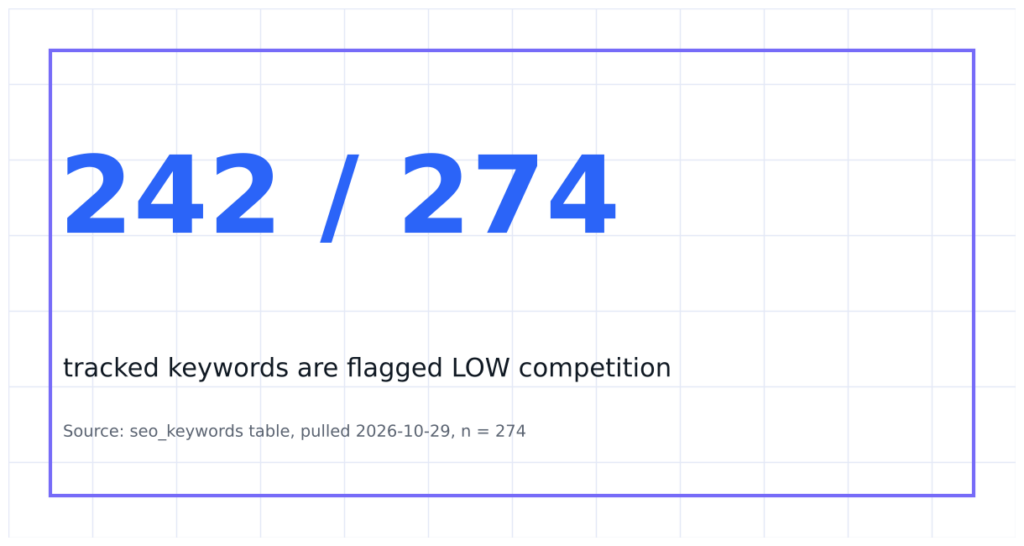
Out of 274 keywords we track for our own content plan, 272 have a competition rating. Of those, 242 are rated low and 30 are rated medium. None are rated high. That alone tells us something about this slice of the market. B2B SaaS marketing terms are, on the whole, winnable territory. The opening is there for a site willing to publish real research instead of recycled definitions.
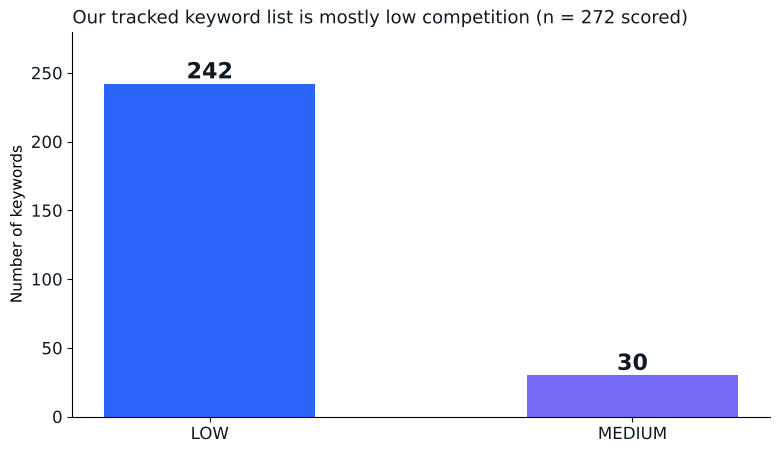
Source: seo_keywords table (Supabase), pulled 2026-10-29, n = 272 scored keywords.
The volume trade-off low competition keywords actually carry
We did expect low competition keywords to skew toward lower search volume. The data backs that up, just not by much. The average monthly volume for our low competition keywords is 426. For medium competition keywords it is 897, roughly 2.1 times higher. Average cost per click follows the same pattern: 17.69 for low competition terms against 33.65 for medium.
That gap is real, but it is not the kind of gap that should scare a content team away from the low competition pool. A term that pulls 426 average monthly searches at a fraction of the competitive pressure is still a reasonable bet, especially stacked twenty or thirty terms deep across one topic.
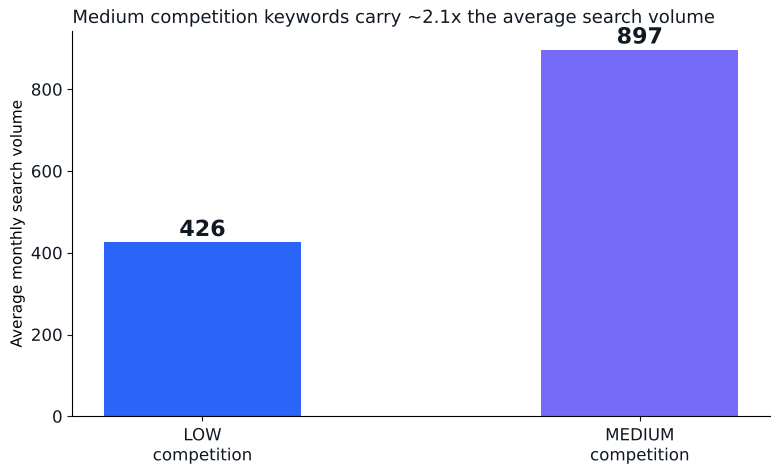
Source: seo_keywords table (Supabase), pulled 2026-10-29, n = 272 scored keywords.
How to Find Low Competition Keywords: A 5-Step Process
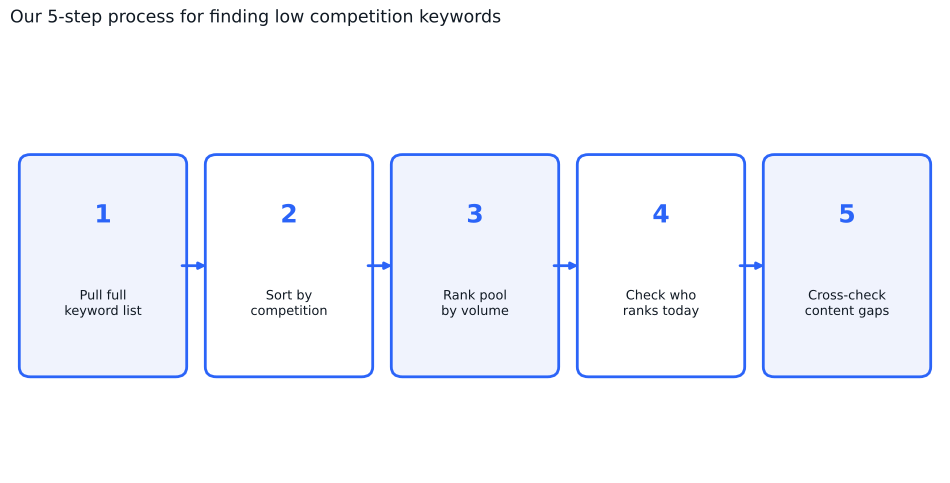
Our own five-step sequence, pulled 2026-10-29.
Step 1: Pull your full keyword list into one table
Before you can filter for low competition, you need every keyword you are tracking in one place, with volume, competition, and CPC as columns rather than scattered across exports. We keep ours in a single Supabase table so every later query is one line of SQL instead of a spreadsheet hunt. If your list lives across several tools today, this consolidation step is worth doing once properly rather than rebuilding it by hand every time someone asks for a fresh cut.
Step 2: Sort by competition rating first, not volume
The common mistake is sorting by volume first and then eyeballing competition. Sort by competition rating first. In our table that single sort turns 274 keywords into a clean pool of 242 low competition candidates before volume even enters the decision.
Step 3: Rank the low competition pool by volume
Once you have the low competition pool isolated, rank it by volume. In our data, 25 of the 242 low competition keywords, about one in ten, have monthly volume of 1,000 or higher. That smaller group is where we focus first.
Step 4: Check who is actually ranking today
A low competition score from a keyword tool is an estimate, not a guarantee. Before committing, we pull the current ranking pages for each candidate. We look at real signals: word count, whether the page cites any original data, and whether it answers the question in the first few sentences. A thin, dated page at position one is a stronger signal than the tool’s competition score alone. One common mistake here is trusting the score and skipping this check entirely, then finding out after publishing that every top result already has the exact data table you planned to build.
Step 5: Pressure-test with your own content gap work
Finally, cross-check each shortlisted keyword against your own published and queued content. The goal is making sure you are not duplicating a topic you already cover under a different phrase. We run this check against our live site and our content queue before any keyword gets greenlit. It is the same discipline behind the content gap analysis we run on a rolling basis, and it has saved us from publishing near-duplicate briefs more than once.
| Keyword | Monthly volume | CPC (USD) | Topic cluster |
|---|---|---|---|
| tam sam som | 9,900 | 13.33 | market-sizing |
| funnel marketing | 9,900 | 19.04 | demand-gen |
| content marketing strategy | 5,400 | 6.09 | content |
| customer acquisition cost | 4,400 | 16.87 | b2b-marketing |
| b2b marketing | 4,400 | 31.79 | b2b-marketing |
| marketing automation | 2,400 | 51.10 | marketing-ops |
| sales enablement | 2,400 | 70.43 | sales-enablement |
| answer engine optimization | 2,400 | 21.31 | ai-search |
| conversion rate optimization | 2,400 | 25.50 | b2b-marketing |
| total addressable market | 2,400 | 13.51 | market-sizing |
Source: seo_keywords table (Supabase), pulled 2026-10-29. Several of these terms already have published content against them; the table illustrates the volume and CPC range inside a low competition pool rather than a current open list.
What we found
Three things stood out once we ran the numbers. First, the low and medium competition split in our list is lopsided toward low, 242 against 30, with zero keywords rated high. For a B2B SaaS content team, that is a wider runway than the usual advice about “finding one golden keyword” implies. Second, the volume gap between bands is real but moderate, about 2.1 times. A disciplined low competition strategy does not require sacrificing much reach to get there. Third, and this is the part worth repeating to any writer on the team, a competition score is a starting filter, not a final answer. We still open the top ranking pages for every shortlisted term before committing a brief. That extra step is the same habit behind our keyword research process for B2B SaaS.
This is also where our own commercial interest is relevant to say plainly: MV3 sells SEO and content strategy work, and a process like this one is part of what we deliver for clients. We are showing our own table, not a hypothetical, because that is the standard we hold the work to.
FAQ
Does low competition always mean low difficulty to rank?
No. Competition ratings are modeled estimates based on paid and organic signals. We treat a low rating as a reason to look closer, not as a guarantee, and we still check the actual ranking pages before writing.
How many low competition keywords should a B2B SaaS site target at once?
There is no fixed number. We work from a pool, in our case 242 low competition candidates, and prioritize by volume and topical fit to our content plan rather than committing to all of them at once.
Is a high CPC a useful signal when picking low competition keywords?
Yes, directionally. In our data, medium competition keywords average a higher CPC than low competition ones, 33.65 against 17.69, which tracks with commercial intent. We use CPC as a secondary filter alongside volume, not a replacement for either.
Want this run against your own keyword list? Book time with us and we will walk through it live.
Share this article

Vance Moore is Chief Growth Officer at MV3 Marketing and leads its team of SEO professionals, engineers and auditors.
Ready to audit your organic growth opportunity?
$2,500 flat. 5 business days. Six deliverables tied to pipeline , not rankings. No retainer required.
Get the Organic Growth Audit →