Quick answer: “Agentic SEO” is a real, specific category now, not just a buzzword: Ahrefs shipped an AI agent workspace called Letaido in May 2026, Frase gave its agents a read-write connection into your CMS, and companies like Ramp are using AI-assisted, agent-adjacent workflows in production. But having an agentic SEO tool is not, by itself, proof it moves traffic. We checked live traffic data for the two companies building these tools and the one company most often cited as using similar practices well. The results are not the clean win-story the category’s own marketing suggests.
What we mean by “proof of impact”
Most “AI SEO case study” content is a vendor’s own case-studies page: a named client, a percentage, no date the number was pulled, no way to check it. We don’t do that here. Every traffic figure in this article was pulled live from Ahrefs Site Explorer on 2026-09-21, independent of any company’s own reporting, the same way we checked the pSEO case studies in our last data-first breakdown. Where we cite a company’s own claim about its product, we say so explicitly and don’t present it as verified.
Case 1: Ahrefs built an agentic SEO product. Its own traffic kept declining after launch.
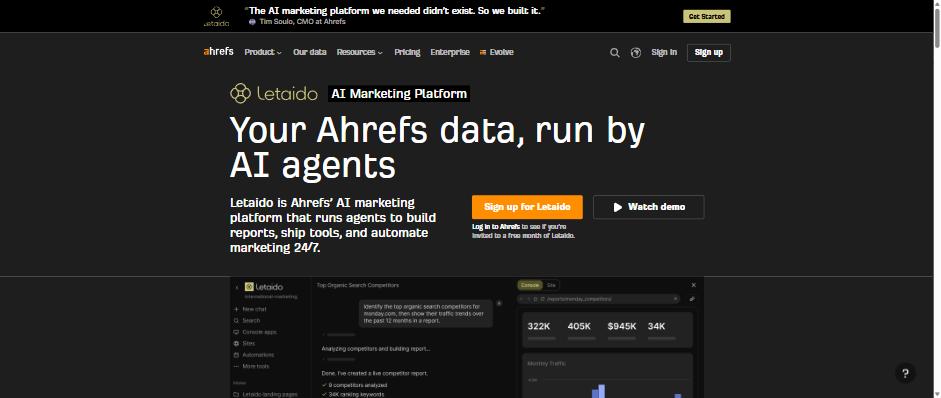
Ahrefs’ agent product (first previewed as “Agent A,” now shipped as Letaido) launched publicly on Product Hunt on May 29, 2026, where it finished #4 on the daily leaderboard with 239 upvotes. It gives an AI agent full access to Ahrefs’ own dataset, including 101 Site Explorer endpoints, and named skills including Site Audit Discovery, a Blog Freshness tool, an automated Update Pipeline, and an 11-stage Blog Pipeline that goes from keyword to a publish-ready, internally-linked draft. Ahrefs’ CMO Tim Soulo is quoted on the product page: “The AI marketing platform we needed didn’t exist. So we built it.”
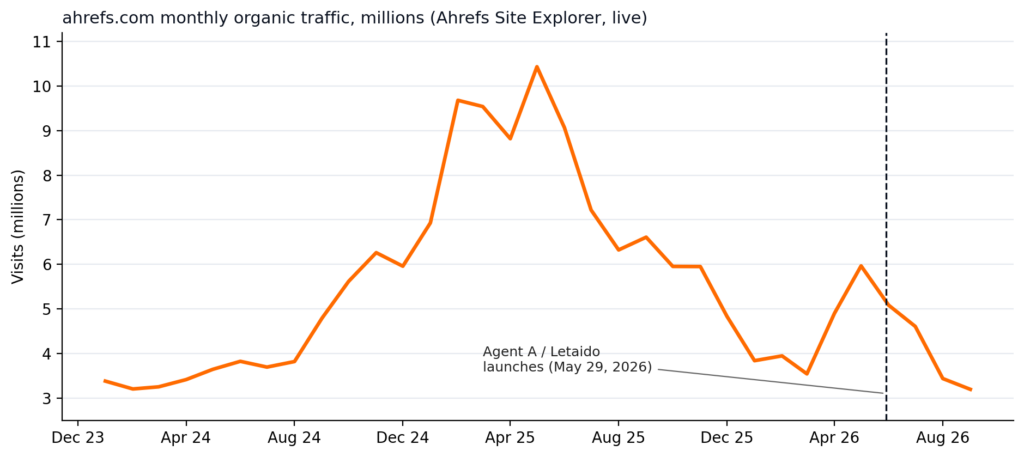
Here’s ahrefs.com’s own organic traffic, pulled live from Ahrefs’ own tool:
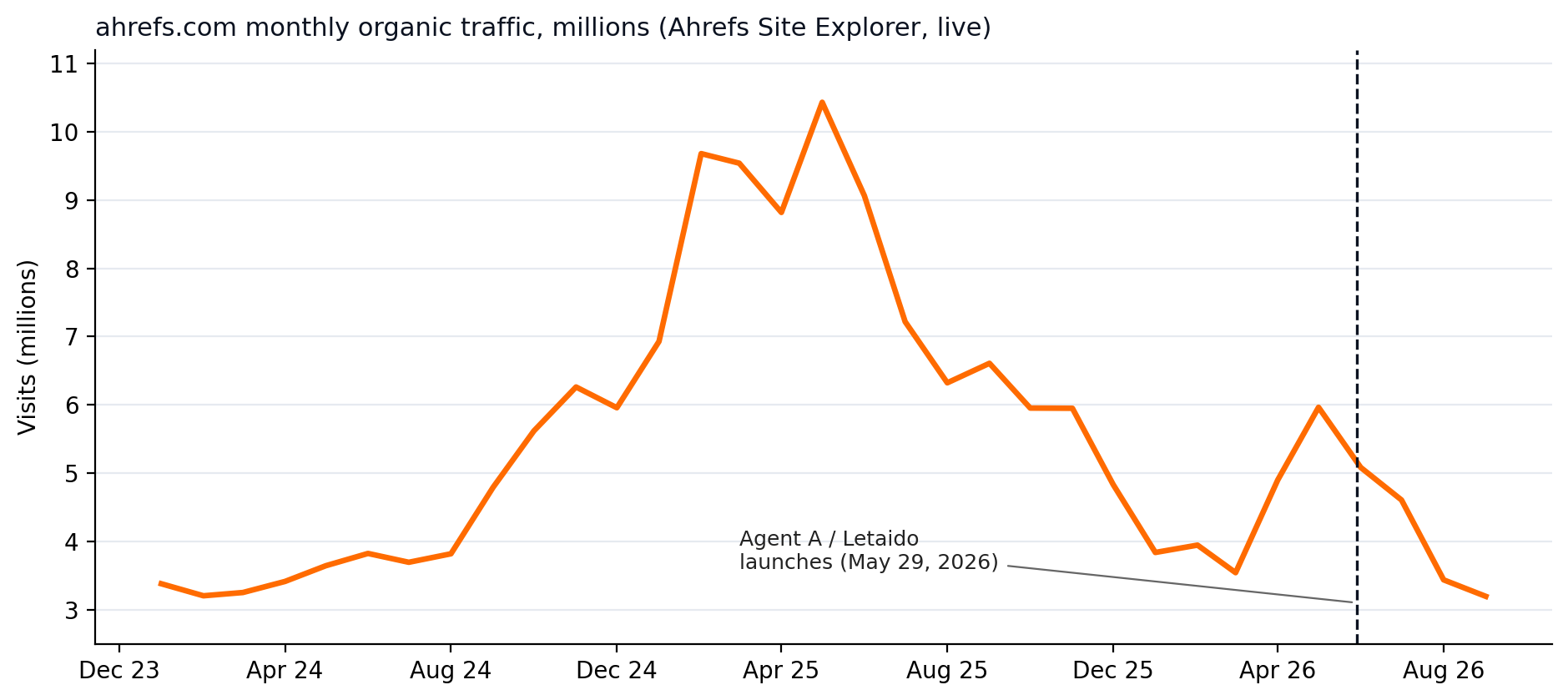
ahrefs.com peaked at 10.4M monthly organic visits in May 2025, a full year before Letaido shipped. By the launch month (May 2026) traffic had already fallen to 5.96M. Four months after launch, September 2026, it’s down to 3.19M, the lowest point in the entire two-and-a-half-year window we pulled, and below where the site started in January 2024.
What this does and doesn’t prove: a single company’s total organic traffic is affected by hundreds of variables, algorithm updates, competitive shifts, AI Overviews eating informational clicks, product changes, none of which we can isolate from this chart alone. This is not evidence that Letaido doesn’t work as a tool. It is direct evidence that “we built and use an agentic SEO product” is not, on its own, proof of traffic impact, for the same reason a vendor’s own case study isn’t: you need the same specificity from the company selling the shovel that you’d demand from anyone else.
Case 2: Frase’s agents can now write back to your site, not just read from it
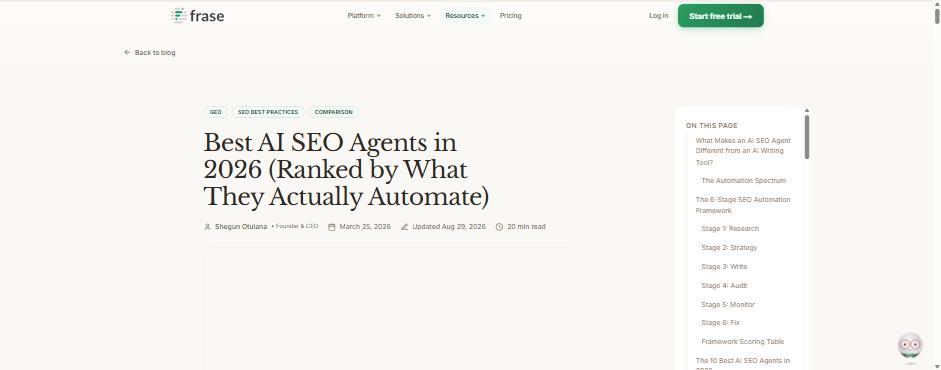
Frase’s specific, checkable claim is architectural, not a traffic number: its Model Context Protocol (MCP) connection is read-write, meaning an AI assistant running inside Claude, Cursor, Windsurf, Lovable, or Replit can create briefs, generate content, run audits, and publish articles through that one connection. Frase’s own comparison states that Semrush and SE Ranking, by contrast, offer read-only MCP connections, data retrieval only, no write-back. We haven’t independently tested either claim; it’s presented here as Frase’s own stated product difference, worth verifying yourself before you build a workflow around it.
What “agentic” actually replaces: the 6-stage framework
Frase frames the difference between an AI writing tool and an AI SEO agent as a six-stage pipeline, and it’s a useful map for evaluating any tool in this category, including ones that don’t use the word “agentic” at all:
| Stage | What it covers | What changes when an agent runs it |
|---|---|---|
| 1. Research | Keyword and topic discovery | Agent pulls live search-volume and SERP data instead of a static keyword list |
| 2. Strategy | Deciding what to build and why | Agent compares against current top-ranking pages and existing site content before recommending a page |
| 3. Write | Drafting | Agent produces a full draft against the brief, not just an outline |
| 4. Audit | Checking the draft or a live page | Agent flags dated claims, missing schema, and competitor gaps automatically |
| 5. Monitor | Tracking what shipped | Agent watches ranking and traffic on a schedule instead of a human pulling a monthly report |
| 6. Fix | Acting on what monitoring finds | Agent proposes or, with approval, applies the fix directly, the step most tools still stop short of |
Stage 6 is the real dividing line in this category right now. Every tool we looked at, Ahrefs’ Letaido included (“nothing ships until you approve,” per Ahrefs’ own product page), stops at proposing the fix and routes final publish through a human approval gate. That’s the honest current state of “autonomous” SEO: agents that draft and recommend at machine speed, with a person still deciding what goes live.
Case 3: Ramp, the smaller and newer example, shows the clearer real gain
We covered Ramp’s traffic curve in detail in the pSEO breakdown, so we won’t repeat the full chart here, but it’s the most relevant comparison for “proof of impact”: Ramp grew from 76,182 to 394,510 monthly organic visits between January 2024 and April 2026, a real 5.2x increase, verified the same way as the numbers above. What’s different about Ramp is that the gain is tied to specific, named, checkable practices, not the mere presence of an AI agent: state-and-city calculator pages built on real rate data, a monthly proprietary spend-data report that earns links from the New York Times and The Atlantic, and case studies tagged by the specific pain point they solve so an AI answer engine’s retrieval step can match the phrase. That last practice is the actual, concrete version of “structuring content for agents” that the broader agentic SEO category talks about in the abstract.
How to demand the same proof from any agentic SEO vendor
Before you adopt an agentic SEO tool or pay an agency running one, ask for the same thing we pulled here: a live traffic-history chart for the account they’re claiming credit for, covering a window that includes real time before and after the tool went live. Here’s the exact query, using the Ahrefs API, that produced every chart in this article:
import requests

ENDPOINT = "https://api.ahrefs.com/v3/site-explorer/metrics-history"
params = {
    "target": "example.com",
    "mode": "subdomains",
    "date_from": "2024-01-01",
    "date_to": "2026-09-21",
    "history_grouping": "monthly",
    "select": "date,org_traffic",
}
headers = {"Authorization": "Bearer YOUR_API_KEY"}

r = requests.get(ENDPOINT, headers=headers, params=params)
for row in r.json()["metrics"]:
    print(row["date"][:7], row["org_traffic"])
A five-point checklist for evaluating any “agentic SEO” claim, vendor or agency:
- Ask for the exact date the tool or workflow went live, not just “recently.” Ahrefs’ own launch date (May 29, 2026) came from a Product Hunt listing, not a press release; find the equivalent for whoever you’re evaluating.
- Pull the traffic history yourself, independent of their dashboard, the same way we did here. If they won’t give you the domain to check, that’s the answer.
- Separate the architecture claim from the impact claim. “Our agent has a read-write MCP connection” is a true or false statement about software. “Our agent grew our traffic” is a causal claim that needs a before/after chart to back it up. Vendors routinely let the first one imply the second.
- Look for a specific, named practice, not just “we use AI.” Ramp’s calculators and pain-point-tagged case studies are checkable practices. “We use an AI agent” is not.
- Read the trend, not the peak. A single all-time-high number, cited without a date, is the same weak evidence whether it’s about a pSEO case study or an agentic SEO one.
Where this leaves your 2026 content plan
Agentic SEO tooling is real and worth using. Ahrefs’ Letaido and Frase’s MCP connection are genuine capability upgrades over last year’s read-only dashboards. But the traffic proof for the category right now comes from what specific teams build with these tools, checkable case by case, not from the existence of the tools themselves. If you want your own agentic or AI-assisted content program audited against live data before you scale it, not just against vendor claims, book a strategy call with MV3 Marketing.
FAQ
Does using an agentic SEO tool guarantee more organic traffic?
No. Ahrefs’ own site traffic continued declining for four months after its Letaido agent platform launched, based on Ahrefs’ own Site Explorer data pulled live for this article. A tool’s existence is not evidence of its impact on any specific account, including the vendor’s own.
What’s the difference between an AI writing tool and an agentic SEO tool?
Based on Frase’s own framework, an AI writing tool typically covers stage 3 (Write) alone. An agentic SEO tool covers some or all of Research, Strategy, Write, Audit, Monitor, and Fix, with the “Fix” stage, acting on what monitoring finds, being the step most current tools still route through human approval rather than doing autonomously.
Is any agentic SEO tool actually publishing changes without human approval?
Not among the tools we reviewed here. Ahrefs states directly that nothing ships from its agent without approval. Treat any vendor claiming fully unsupervised publishing as the exception to verify carefully, not the default to assume.
Share this article

Ryan Brooks leads technical SEO at MV3 Marketing, specializing in schema architecture, entity graphs, crawlability, and the structural signals that determine whether AI answer engines cite a page.
Ready to audit your organic growth opportunity?
$2,500 flat. 5 business days. Six deliverables tied to pipeline , not rankings. No retainer required.
Get the Organic Growth Audit →