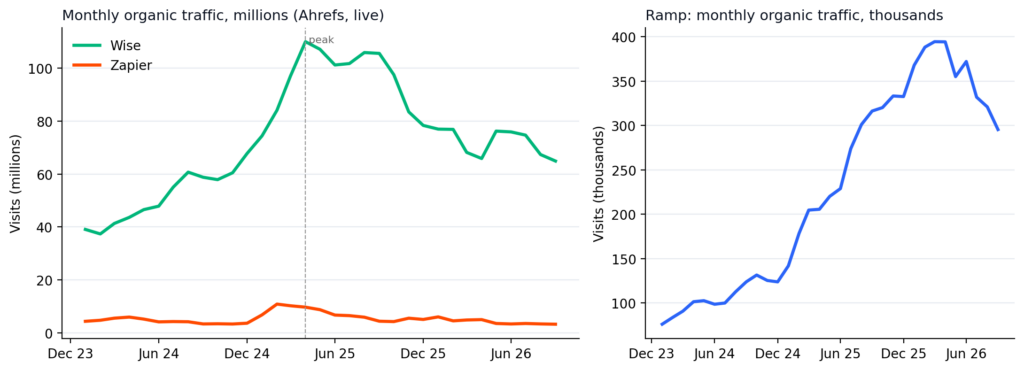
Quick answer: Zapier, Wise, and Ramp are the three programmatic SEO case studies that show up in nearly every “how to scale content” article. We pulled live traffic data on all three. Wise’s organic traffic is down about 40% from its April 2025 peak. Zapier’s is down roughly 70% from its own February 2025 peak, and is now lower than where it started in January 2024. Ramp, the newest and smallest of the three, grew steadily through 2025 and has pulled back about 25% since April 2026. The pSEO playbook that made these sites famous is not the same playbook keeping them visible now.
Why we checked instead of citing the usual numbers
Search any combination of “programmatic SEO case study” and “Zapier” or “Wise,” and you’ll find the same secondary sources repeating different traffic figures for the same sites: one agency blog says Zapier gets 2.6 million visits, another says 5.8 million, a third says 16 million. Wise gets quoted anywhere from 16 million to 100 million. None of these posts show a date the number was pulled, and most are selling a service.
So instead of repeating any of those numbers, we pulled our own, live, from Ahrefs Site Explorer, on 2026-09-21. Here’s what changes when you look at a trend line instead of a single cited figure.
Wise: 65.8M monthly visits today, down from a 110M peak
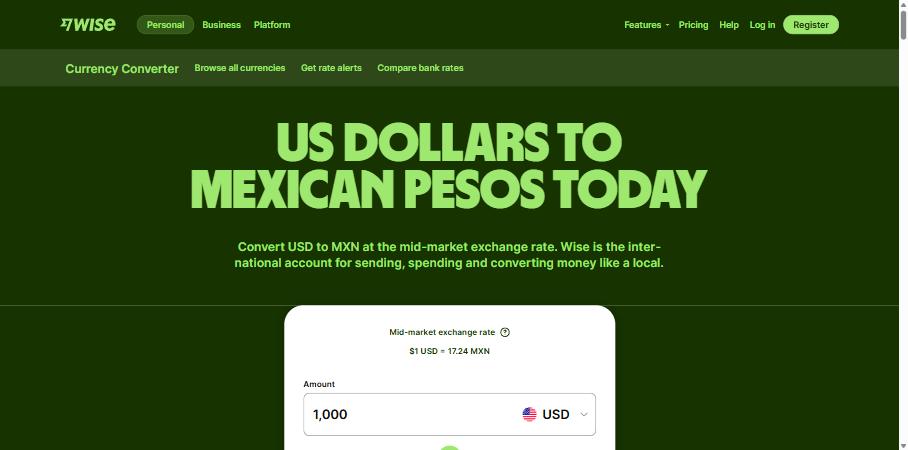
Wise runs the best-known currency-converter pSEO operation on the internet: a template for “[Currency A] to [Currency B] today,” repeated across roughly 180 currencies, then re-templated again per receiving country, per amount, and per language. Ahrefs currently counts 1,526,488 organic keywords ranking for wise.com.
The top pages by traffic are almost entirely currency-pair pages, not the homepage:
| Page | Monthly traffic (Ahrefs) | Top keyword |
|---|---|---|
| wise.com/ (homepage) | 1,112,517 | wise |
| /br/currency-converter/dolar-hoje | 1,063,867 | dolar hoje |
| /id/currency-converter/usd-to-idr-rate | 818,977 | usd to idr |
| /currency-converter/usd-to-mxn-rate | 748,364 | dolares a pesos |
| /vn/currency-converter/jpy-to-vnd-rate | 774,165 | tỷ giá yên nhật vnd |
The scale is real. But the current trend line is not the growth story most articles describe:
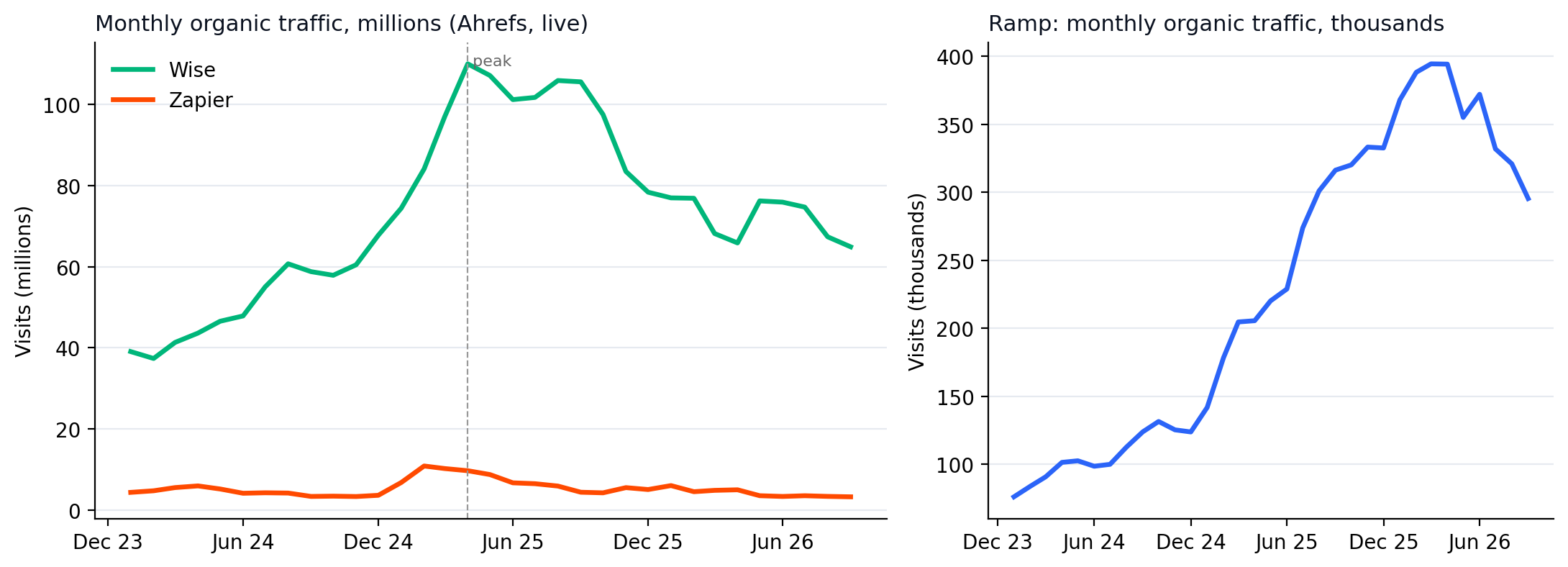
Wise’s organic traffic climbed from 39.1M (Jan 2024) to a peak of 109.9M (Apr 2025), then fell to 64.9M by Sep 2026, a decline of about 41% from the peak. It’s still far above where it started, but the curve bent down more than 16 months ago and hasn’t recovered.
Zapier: below its own January 2024 starting point
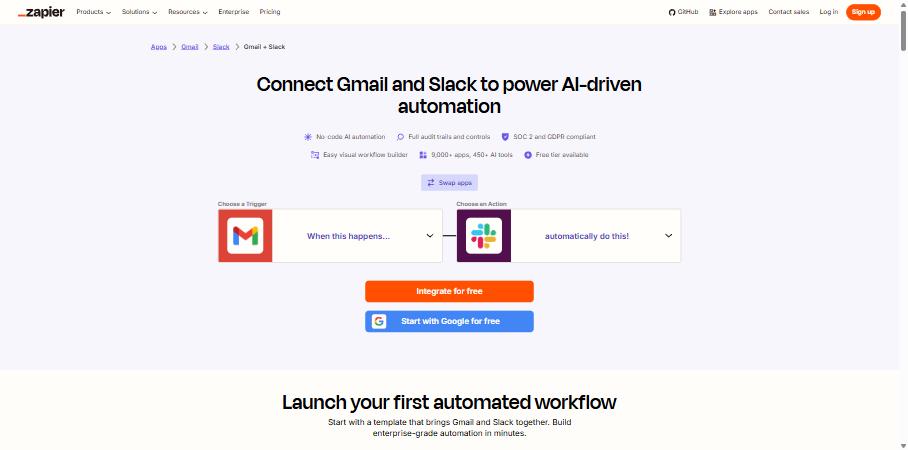
Zapier’s integration pages are the textbook programmatic SEO example: a page for every app-to-app pair (“Connect Gmail and Slack”), generated in three tiers (app landing pages, pair pages, and use-case pages) from a shared template across thousands of supported apps.
Ahrefs currently shows 123,353 organic keywords and 3,485,720 monthly organic visits for zapier.com. That’s real traffic. It’s also less than a third of where Zapier stood in February 2025 (10.9M), and lower than where Zapier started this data window in January 2024 (4.4M). Two full years of visible pSEO investment, and the trend is currently negative.
Looking at what’s actually driving Zapier’s current traffic is telling: its top pages by traffic today aren’t integration pair pages at all. They’re blog “best of” roundups (“best cloud storage apps,” “best keyword research tool,” “best AI image generator”) and the app directory. The integration-pair template that made Zapier the case study everyone cites is not what’s carrying the site’s current top-line traffic.
Ramp: smaller, newer, and still mostly working (with one clear pullback)

Ramp is a useful third data point because it’s smaller (313,685 organic keywords, 313,685 monthly visits per Ahrefs, roughly a hundredth of Wise’s scale) and its pSEO buildout is more recent, which makes the trend line easier to read cleanly.
Ramp grew steadily from 76,182 monthly visits in January 2024 to a peak of 394,510 in April 2026, a 5.2x increase over 27 months. Since then it’s pulled back to 295,476, about 25% off the peak, a smaller retreat than Wise’s or Zapier’s, and it’s still nearly four times its January 2024 level.
What Ramp is doing differently, based on its own published pages and third-party analysis of its content structure:
- Calculators over converters. Ramp’s mileage and per-diem calculators are re-published per state and per city (46 state variations on the mileage calculator alone), the same template-per-variable pattern as Wise’s currency pages, but aimed at a narrower, higher-intent audience: finance professionals doing a specific task, not anyone checking an exchange rate.
- Proprietary data as the link magnet. Ramp publishes a monthly “AI Index” (enterprise AI spending, built from its own card-transaction data) and a “SaaS Vendors Leaderboard” (trending and fastest-growing vendors, built from Ramp Rate spend data across 50,000+ businesses). Both have been cited by outlets including the New York Times and The Atlantic. That’s a backlink strategy no template can substitute for: data nobody else has.
- Structured for AI retrieval, not just search rank. Ramp tags its customer case studies by the pain point they solve (“lack of visibility into spend,” “inefficiencies from multiple systems”) and writes headlines around measurable outcomes (“From 2 months to 2 days”) rather than the product name. The stated goal is to be the passage an AI answer engine pulls when a query matches that phrase, not only to rank a blue link.
What this means if you’re planning a pSEO build
None of this means programmatic SEO stopped working. Wise still gets more organic traffic in a month than most companies will see in a decade, and Ramp’s five-year-equivalent growth in 27 months came directly from its calculator pages. But the pattern across all three sites points at something specific:
- Pure template-and-scale pages are the ones losing ground. Zapier’s integration-pair pages and Wise’s currency-pair pages are the most template-driven, least differentiated pages on either site, and they’re the layer where the decline is concentrated.
- Pages built on data nobody else has are holding up better. Ramp’s calculators pull from real state/city rate tables. Its highest-authority backlinks come from proprietary spend data, not the templated pages at all.
- “Agentic” is doing less work than the term implies. None of the three companies has published a technical account of running autonomous agents to manage their SEO operation. What Ramp has published is disciplined structure: pain-point tagging, outcome-based headlines, and a repeatable process for testing a new programmatic bet for about three months before deciding whether to scale it. That’s a workflow a small team runs with AI-assisted drafting and review, not a fully autonomous system.
What’s likely driving the decline, and what we can’t confirm
We can verify the traffic curves directly. We can’t verify the cause with the same certainty, because that would require each company’s own Google Search Console data, not just Ahrefs’ independent crawl-based estimate. With that caveat stated plainly, two changes line up with the timing well enough to be the leading explanation across the SEO industry right now:
- Google AI Overviews expanded into exactly the query types these pages target. “USD to MXN,” “best cloud storage apps,” and similar high-volume informational queries are the queries AI Overviews answers directly in the search results, before a user clicks anything. Wise’s and Zapier’s traffic peaks (April 2025 and February 2025) both land close to widely-reported periods of AI Overview expansion. A user who gets their exchange rate or their “best of” list answered on the results page never reaches the page at all, and that shows up as declining traffic even if the page’s ranking position hasn’t moved.
- Google’s scaled-content-abuse enforcement, which explicitly names low-effort templated pages. Google’s own spam policy documentation calls out “using automated tools to generate many pages that add little-to-no value” as a specific enforcement target. A currency-pair page or an app-pair page that differs from its siblings only by two swapped strings is close to that definition, even when the underlying company is legitimate and the calculator itself works correctly.
What argues against reading too much into either explanation on its own: Ramp’s pullback is real but proportionally smaller, and Ramp’s least-templated pages (the proprietary data reports) are the ones still pulling backlinks from major outlets. That’s more consistent with the AI Overview explanation, which hits informational template pages hardest, than with the enforcement explanation, which should hit any thin page regardless of topic.
Limitations of this analysis
This is a traffic-trend read on three companies, not a controlled experiment, and it has real limits worth stating rather than glossing over:
- Ahrefs’ organic traffic figure is a modeled estimate from its own keyword-ranking data, not first-party analytics from Wise, Zapier, or Ramp. Directional trends are reliable; the exact monthly totals are an estimate.
- We looked at three companies. That’s enough to see a pattern, not enough to call it universal. A pSEO program in a less AI-Overview-saturated vertical could show a different curve entirely.
- We did not have access to any of the three companies’ internal analytics, Search Console data, or content-production process. Everything above the fold on causation is a hypothesis with reasoning shown, not a confirmed root cause.
How to run this audit on your own site or a competitor’s
You don’t need a scraping project to check whether a pSEO strategy is actually working right now. Ahrefs’ Site Explorer API returns monthly organic traffic history for any domain:
import requests

ENDPOINT = "https://api.ahrefs.com/v3/site-explorer/metrics-history"
params = {
    "target": "example.com",
    "mode": "subdomains",
    "date_from": "2024-01-01",
    "date_to": "2026-09-21",
    "history_grouping": "monthly",
    "select": "date,org_traffic",
}
headers = {"Authorization": "Bearer YOUR_API_KEY"}

r = requests.get(ENDPOINT, headers=headers, params=params)
for row in r.json()["metrics"]:
    print(row["date"][:7], row["org_traffic"])
Plot the output and look for the same three things we looked for here: where’s the peak, how far off the peak is the current number, and which specific pages (via the top-pages endpoint) are carrying today’s traffic versus which ones carried it a year ago. If the pages carrying traffic today are different from the pages the case study is famous for, that’s the signal that matters more than the total.
Where this leaves your content plan
If you’re scaling a pSEO or AI-assisted content program in 2026, the data above argues for a specific split: keep using templates to cover ground efficiently, but put your real investment into the pages built on data your competitors can’t copy, and treat any single-page-template layer as something to monitor monthly, not something to publish once and leave alone.
If you want a second set of eyes on whether your own programmatic or AI-assisted content is trending like Ramp’s or like Zapier’s, book a strategy call with MV3 Marketing and we’ll pull the live numbers together.
FAQ
Is programmatic SEO dead in 2026?
No. Wise and Zapier both still get far more organic traffic than the overwhelming majority of B2B and consumer sites, even after their declines. What’s changed is that the purest template-and-scale layer of their pages is the layer under the most pressure, while pages built on proprietary data are holding up.
Is “agentic SEO” a real, distinct discipline from AI-assisted content?
Based on what Ramp, Wise, and Zapier have actually published about their own process, the clearest public examples look like disciplined, AI-assisted workflows with human review and a defined testing cadence, not fully autonomous agents running SEO end to end. Treat “agentic SEO” marketing claims from vendors as unverified until the company names its actual process.
What should replace a pure template-per-variable page?
A template that pulls from data your competitors don’t have access to: your own product usage data, transaction data, or survey data, the way Ramp’s spend-data reports work, rather than a template that only swaps two variables into otherwise identical copy.
Share this article

Ryan Brooks leads technical SEO at MV3 Marketing, specializing in schema architecture, entity graphs, crawlability, and the structural signals that determine whether AI answer engines cite a page.
Ready to audit your organic growth opportunity?
$2,500 flat. 5 business days. Six deliverables tied to pipeline , not rankings. No retainer required.
Get the Organic Growth Audit →