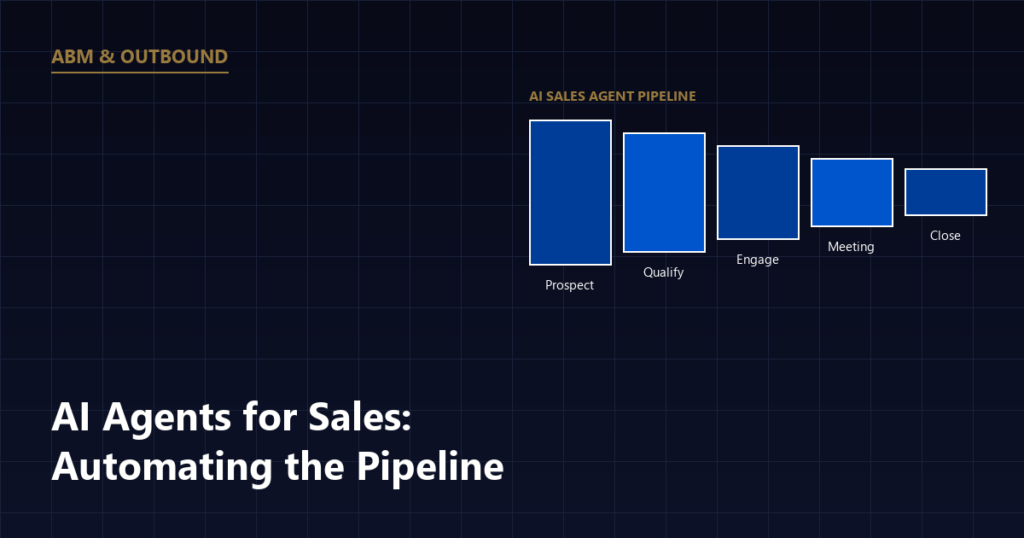
AI agents for sales are software tools that handle specific parts of the sales process on their own, qualifying inbound leads, sending follow-up messages, booking meetings, without a rep manually doing each step. For most B2B SaaS teams, they typically work the early pipeline stages so sales reps only spend time on leads that are actually ready to talk.
Where AI Agents Fit in a Real Sales Pipeline
For a fintech company, a manufacturing firm, or a SaaS startup, a slow response is
one of the more common reasons a lead is lost, not because the offer was wrong, but because a
competitor got back to that prospect first. A prospect who fills out a form at 9pm and does
not hear back until the next afternoon has often already called someone else by then.
AI agents for sales are built to close that specific gap. They do not replace a sales
conversation, they make sure a lead does not go cold before that conversation can happen.
What These Agents Actually Do, Task by Task
- Instant response. When a lead comes in through a form, call, or chat, an agent sends an immediate acknowledgment so the prospect knows they were heard, rather than waiting hours for a human reply.
- Qualification. The agent asks a small set of relevant questions, project size, timeline, service area, loan amount, and checks the answers against criteria the business has set, so reps aren’t spending time on leads outside their service area or budget.
- Scheduling. Once a lead is qualified, the agent offers real calendar availability and books the appointment directly, removing the back-and-forth of finding a time that works.
- Follow-up on stalled leads. If a prospect goes quiet after an initial quote or estimate, an agent can send a scheduled follow-up at set intervals, something reps rarely have time to do consistently on their own.
A Concrete Example: A B2B SaaS Inbound Demo Request
A prospect requests a demo through a website form at 7pm on a
Friday. An AI sales agent replies within minutes confirming receipt, asks two or three
qualifying questions (company size, current tooling, timeline), and, once those are
answered, offers three open calendar slots for a discovery call. By Monday morning,
the AE has a scheduled call with the details already in the CRM, instead of a
generic lead to cold-call.
THIS LEAD’S ACTUAL TIMELINE
Nobody on the team touches this lead until the AE joins the call already knowing what the prospect needs.
What Good Qualification Criteria Look Like
The agent is only as useful as the criteria it is given. Vague criteria produce vague
qualification. Specific, business-relevant criteria work better:
- Service area (a specific radius or list of counties/cities, not “local”)
- Minimum project size or loan amount, if the business has one
- Timeline (is the prospect ready to move in the next 30 days, or just researching)
- Budget range, when it’s reasonable to ask directly
These criteria should mirror how an experienced rep already screens leads by phone. The
agent is automating that judgment, not inventing new judgment on its own.
How This Connects to AI BDR Work
Inbound qualification, described above, is one half of the picture. The other half is
outbound: agents that proactively research and reach prospects rather than waiting for them
to fill out a form. That’s covered in detail in
what an AI BDR actually does day to day. The two typically run
together: outbound generates the lead, inbound agents qualify and schedule it.
Both of these are individual touchpoints inside a longer path a prospect follows from
first contact to closed deal. Customer journey automation
covers how to map that full path and decide where an agent like this should sit in it.
MV3 Marketing builds and manages these agents as part of its
account-based marketing and sales pipeline work, tuned to a
specific business’s real qualification criteria and service area rather than a generic
script.
Frequently Asked Questions
What is an AI agent for sales?
An AI agent for sales is a tool that autonomously performs a defined sales task, such as responding to an inbound inquiry, qualifying a lead against set criteria, or following up with a prospect who has gone quiet, based on rules and data rather than requiring a person to do it manually each time.
Will an AI sales agent replace my sales team?
No. AI sales agents are best suited to repetitive, high-volume tasks at the top of the pipeline, initial response, qualification, scheduling, so your sales team spends their time on conversations that actually require a person: negotiating, handling objections, and closing.
What’s the difference between an AI sales agent and a chatbot?
A chatbot typically answers questions within a single conversation. An AI sales agent takes action across a sequence, updating a CRM record, sending a scheduled follow-up days later, or notifying a rep when a lead meets qualification criteria, tying multiple steps together rather than responding once and stopping.
How long does it take to see results from AI sales agents?
Most B2B SaaS teams see the clearest early impact in response time: leads get a reply within minutes instead of hours or days. Faster response is widely regarded as one of the more controllable factors in whether a lead converts, since it removes the delay that lets a prospect move on to a competitor.
If leads are sitting unanswered for more than a few hours, that delay is likely costing
more deals than any change to your sales pitch would recover.
Book a call to look at your current response times.
Share this article

Jordan Reeves leads account-based marketing and outbound pipeline strategy at MV3 Marketing, specializing in account selection, intent-signal targeting, and multi-channel orchestration for B2B companies.
Ready to audit your organic growth opportunity?
$2,500 flat. 5 business days. Six deliverables tied to pipeline , not rankings. No retainer required.
Get the Organic Growth Audit →