Affiliate disclosure: This article contains an affiliate link. If you sign up through it, MV3 Marketing may earn a commission at no extra cost to you. We only recommend tools we’ve actually researched and used in our own agency operations.
If you run a B2B SaaS company or a small agency, you already know the math on missed calls. A prospect calls, nobody picks up, and they call the next name on their list. You can’t staff a full-time receptionist for the volume you get, but voicemail isn’t a real answer either. Most people just hang up. Ruby is built to close that gap: a virtual receptionist and live chat service where real, trained humans answer your calls and your website chat, backed by AI tools that speed them up rather than replace them.
This guide walks through what Ruby actually does, what its live call answering, call routing, and live chat features look like in practice, what the plans cost based on what’s published on ruby.com right now, and who it isn’t a great fit for. We tested this from the lens of a small agency or SaaS team that needs a professional front line without adding headcount.
What is Ruby, and who is it for?
Ruby (formerly Ruby Receptionists) is a virtual receptionist company with more than 20 years in the business of answering phones for small businesses. According to Ruby’s own numbers, the company captures more than 1.6 million leads per year for its customers, handles over 1.1 million conversations every month, and answers calls in under 10 seconds on average. More than 15,000 businesses currently use the service.
The core idea is simple: instead of a call going to voicemail, an automated phone tree, or an overworked team member who’s supposed to be doing something else, it goes to a live Ruby receptionist who answers in your business’s name, follows the call-handling instructions you set up, and either helps the caller directly or routes the call and the details to you.
For a B2B SaaS company or a marketing/growth agency, the practical use cases look like:
- A live person answering your main sales line so inbound calls from marketing campaigns, referrals, or your website don’t go to voicemail during a demo, a client call, or after hours.
- Live chat on your marketing site that’s staffed by real people, not just a chatbot, so visitors who aren’t ready to fill out a form still get engaged.
- A professional-sounding front desk for a business that doesn’t have, and doesn’t want, a full-time in-house receptionist.
- Lead qualification and intake on the first call, so what lands in your CRM is a real, vetted lead instead of a raw phone number.
What Ruby actually does: the core feature set
One thing that’s genuinely different about Ruby’s pricing model, which we’ll get into below, is that every plan, from the smallest to the largest, includes the same feature set. You’re not paying more per month to unlock features; you’re paying for more receptionist minutes or more live chats. Per Ruby’s own plan comparison, the features included on every tier are:
- 24/7 live answering, including after-hours, weekends, and holidays
- 24/7 Spanish and bilingual call handling
- AI-powered transcripts and sentiment analysis on every call
- Personalized call handling based on your instructions
- Appointment scheduling
- Outbound call assistance
- Phone service hosting (Ruby can host your business line so you don’t need a separate phone bill)
- Customizable, flexible call forwarding
- AI-assistant-supported call flows
- Payment collection
- Lead qualification and intake
Ruby also explicitly states there are no hidden fees for activation, onboarding, setup, or customization: a detail worth knowing if you’ve been burned by “starting at” pricing elsewhere that balloons once setup and integration fees get added.
Feature deep dive: 24/7 live call answering
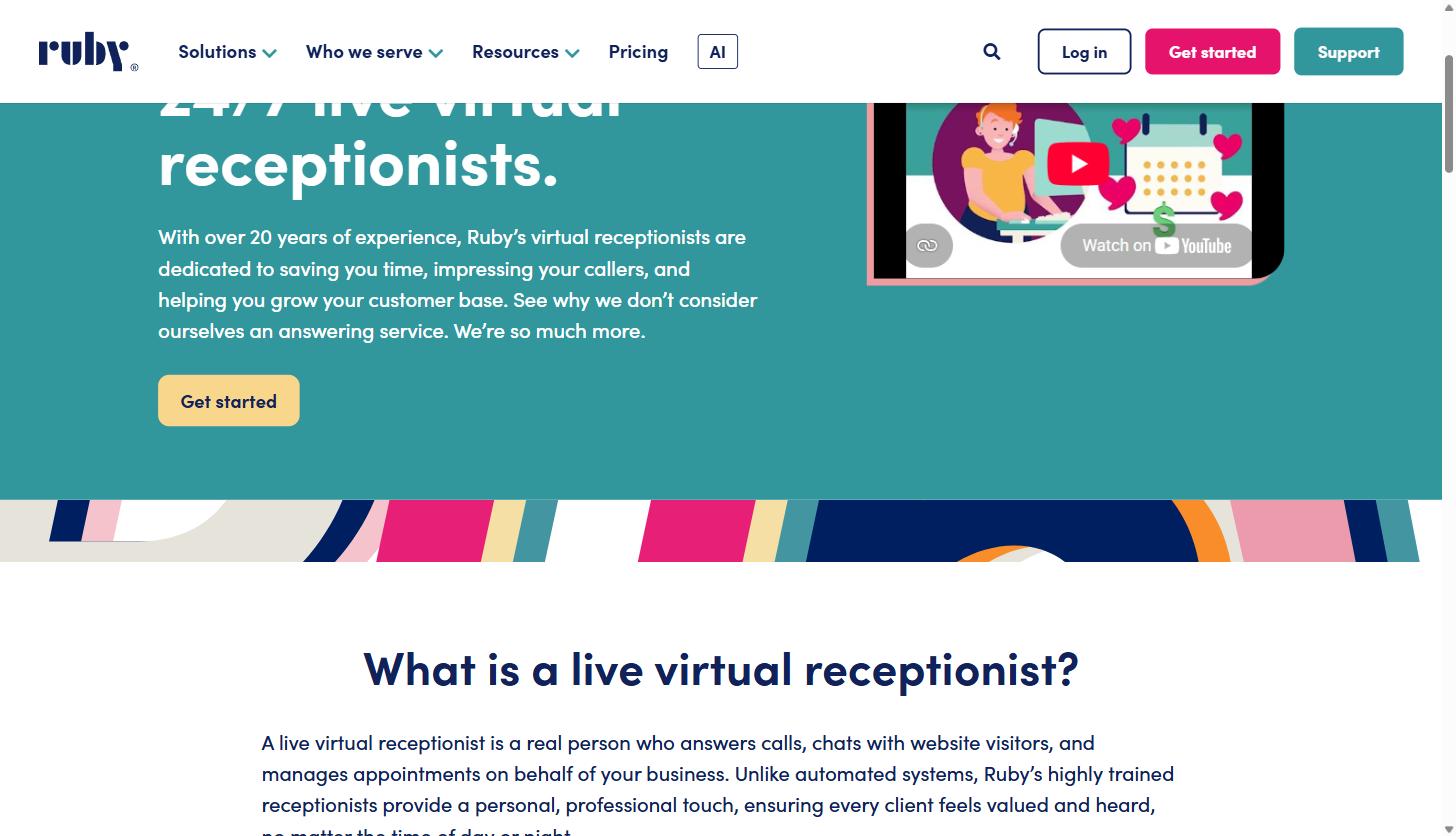
Ruby draws a specific line between what it does and what a traditional answering service does. On its virtual receptionist page, Ruby is explicit: “We don’t consider ourselves an answering service. We’re so much more.” A live virtual receptionist, per Ruby’s own definition, is “a real person who answers calls, chats with website visitors, and manages appointments on behalf of your business.”
In practice, this means a Ruby receptionist isn’t just taking a message and hanging up. Depending on how you configure your account, they can:
- Answer in your company’s name, following a script and call-handling rules you set
- Ask qualifying questions to screen leads before they ever reach you
- Transfer the call live to your cell phone or office line if you’re available
- Schedule or reschedule an appointment directly during the call
- Take a detailed message and get it to you immediately if you’re not reachable
- Screen out robocalls and spam: Ruby reports filtering roughly 20,000 robocalls per month across its customer base using AI screening
For an agency or SaaS company, the most useful part of this is flexible call forwarding. You can set Ruby to only pick up calls you miss (so it acts as a safety net), or to answer every call and only forward the ones that meet your criteria. Either way, the caller always reaches a human, not a phone tree.
Feature deep dive: 24/7 live chat
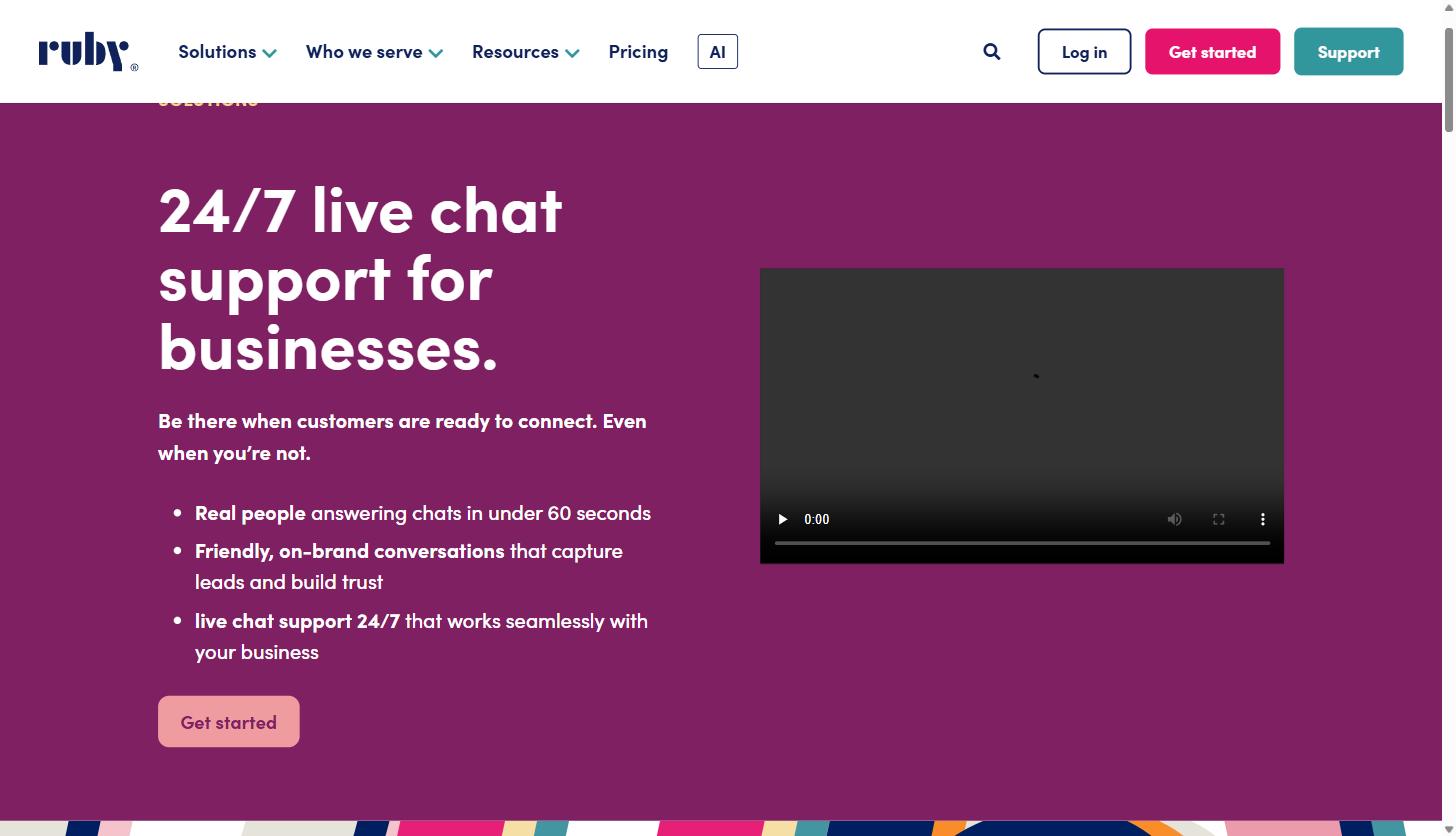
This is the feature that’s most directly relevant if your primary goal is capturing more marketing-qualified leads off your website rather than answering the phone. Ruby’s live chat product puts a real person, not a bot, behind the chat widget on your site. Per Ruby’s own copy, the pitch is: “Be there when customers are ready to connect. Even when you’re not.”
The specifics Ruby publishes for live chat:
- Real people answering chats in under 60 seconds
- Friendly, on-brand conversations designed to capture leads and build trust, rather than generic scripted responses
- 24/7 coverage that Ruby says works seamlessly alongside your existing site and workflow
For a SaaS marketing site, this matters because a chat widget staffed by a bot alone tends to frustrate visitors who have a specific question a script can’t answer, and a lot of visitors simply won’t fill out a demo request form on their first visit. A live, on-brand chat conversation is a lower-commitment way to capture and qualify that same visitor before they bounce. Live chat is priced and sold separately from the voice/receptionist plans (more on that below), so you can add it without necessarily paying for a large receptionist minutes plan, or bundle both together.
Feature deep dive: AI enhancements (without losing the human)
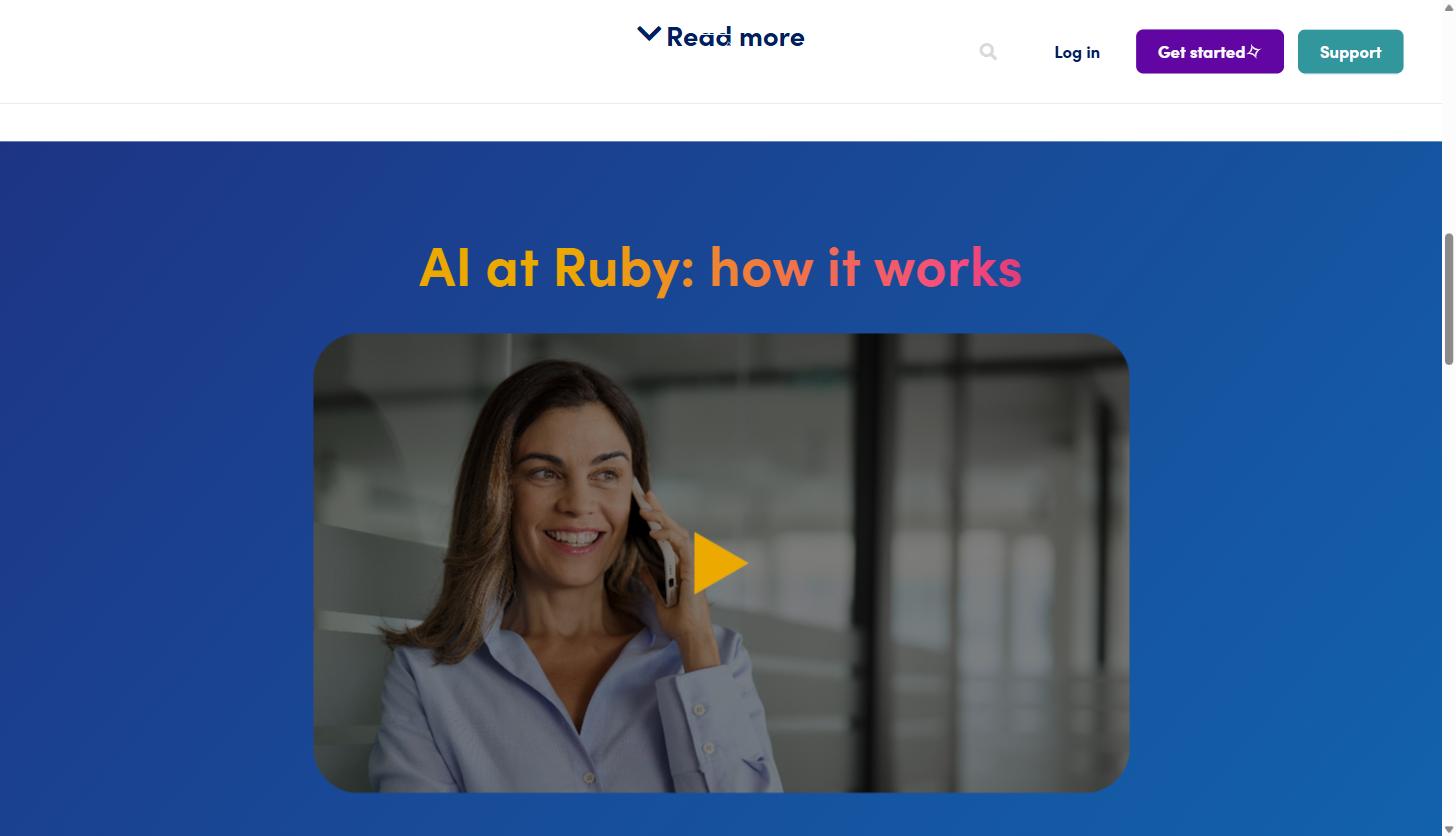
Ruby’s positioning on AI is worth calling out specifically, because it’s the opposite of most “AI receptionist” products currently being marketed to small businesses. Ruby’s AI page headline reads: “AI can make customer service more human,” with the company’s stated philosophy being that “artificial intelligence should help people connect faster, better, and more meaningfully, while delivering transparency and efficiency for small businesses.”
Concretely, that means the AI isn’t the thing answering your phone. A trained human receptionist is. The AI layer works behind the scenes to help that receptionist do the job faster and more accurately:
- AI-powered transcription of every call, so you get a written record without anyone taking manual notes
- Sentiment analysis that flags how a caller is feeling, which can matter a lot for support-adjacent calls
- AI-assisted information lookup: Ruby’s messaging specifically calls out that receptionists otherwise have to “search through a large data set for information, take detailed notes, perform intake, and practice active listening all at the same time.” The AI layer is built to take some of that cognitive load off the human so the conversation itself stays natural
- AI robocall screening, filtering spam and junk calls before they ever reach a live receptionist or you
If you’ve evaluated fully autonomous “AI voice agent” tools that use a synthetic voice to handle the entire call with no human involved, this is a fundamentally different model. Ruby’s bet is that most small businesses and their customers still want a real person on the other end of a sales or support call, with AI used to make that person faster and more consistent, not to replace them.
Ruby pricing: what it actually costs
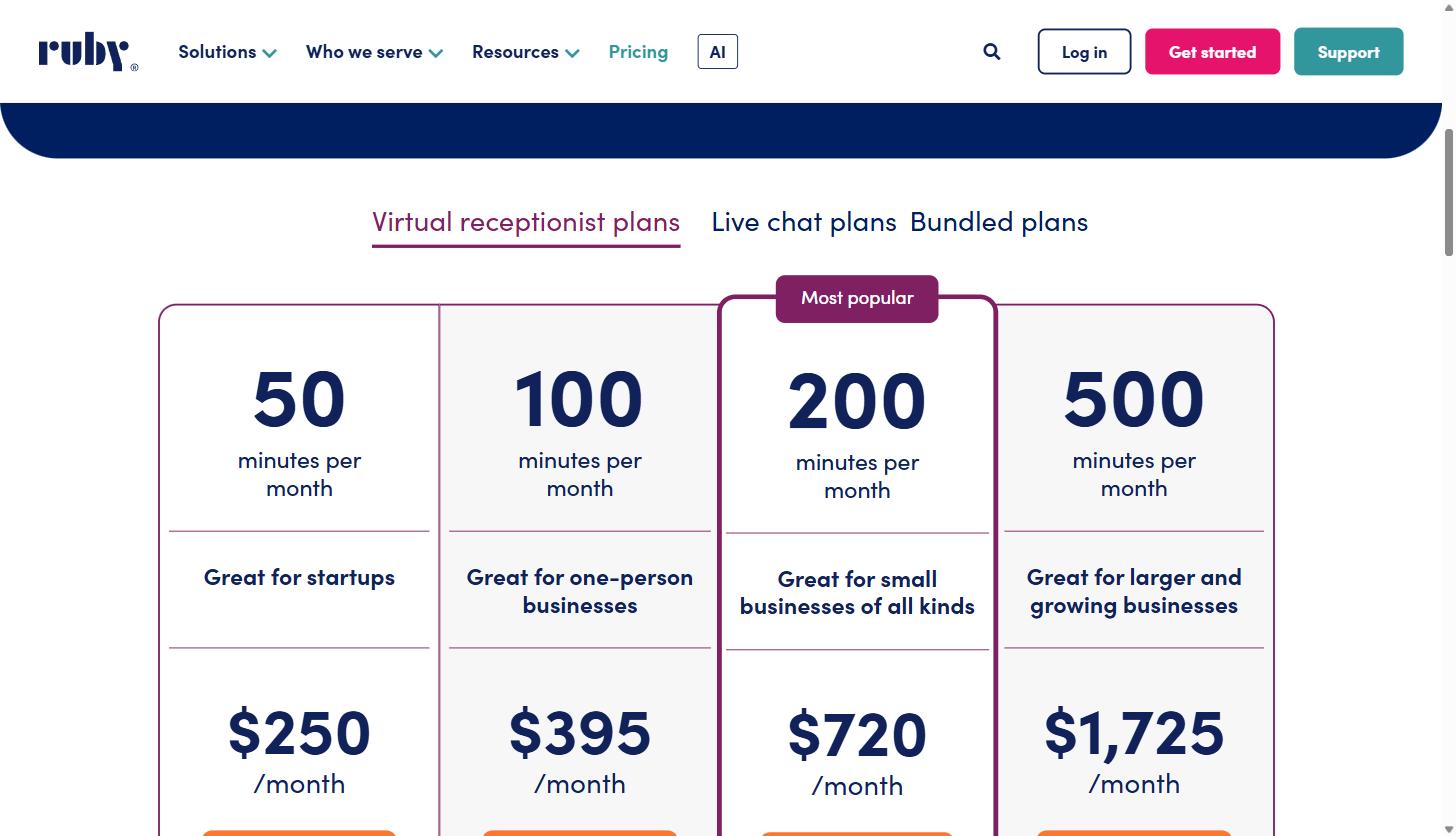
Ruby’s pricing is minutes-based for voice and chats-based for live chat: it is not a single flat monthly fee, and any article that tells you otherwise isn’t looking at the actual current pricing page. Here’s what’s published on ruby.com/plans-and-pricing right now:
Virtual receptionist plans (priced per month, billed on receptionist minutes)
| Plan | Minutes / month | Price / month | Ruby’s stated fit |
|---|---|---|---|
| Starter | 50 | $250 | Great for startups |
| Solo | 100 | $395 | Great for one-person businesses |
| Most popular | 200 | $720 | Great for small businesses of all kinds |
| Growth | 500 | $1,725 | Great for larger and growing businesses |
Live chat plans (priced per month, billed on chats handled)
| Plan | Chats / month | Price / month | Ruby’s stated fit |
|---|---|---|---|
| Starter | 10 | $143 | Great for startups |
| Solo | 30 | $335 | Great for solo practices and one-person businesses |
| Most popular | 50 | $520 | Great for organizations of all kinds |
Ruby also offers bundled plans that combine voice and chat minutes under one subscription, and larger custom offerings for businesses whose volume exceeds the published tiers: you have to talk to sales for those. As noted above, the feature set doesn’t change between tiers; you’re purchasing capacity, not functionality. If you’re not sure how many minutes or chats you’ll actually use, it’s worth knowing that receptionist “minutes” are billed based on time spent on your account’s calls (talk time plus related account work like messages and scheduling), so a business with a lot of short, simple calls will use its minutes differently than one with fewer, longer calls.
Where Ruby fits, and where it doesn’t
The most useful lens for evaluating Ruby honestly is the one Ruby uses on itself: it’s people-powered, AI-enhanced, not AI-powered with people as a backup. That’s a real, meaningful distinction from the current wave of fully autonomous AI phone agents that use synthetic voices to handle entire conversations with no human involved.
Ruby is likely a strong fit if:
- You’re a small agency, SaaS company, or professional services business that gets a real but not massive volume of inbound calls and chats, and you’d rather not hire and manage an in-house receptionist
- You want callers and site visitors to reach an actual human, not an IVR menu or a synthetic voice, especially for a first sales touch
- You need bilingual (English/Spanish) coverage without hiring for it directly
- You want call handling that integrates with tools you may already use, like Clio, Calendly, or Zapier-connected apps, rather than a closed system
Ruby is probably not the right fit if:
- You have very high call volume where even the 500-minute plan ($1,725/month) wouldn’t cover a full month, and you need enterprise-scale call center capacity: that’s a different category of vendor entirely
- You specifically want a fully autonomous AI voice agent with no human receptionist in the loop, for cost or scale reasons: Ruby’s whole model is built around live people
- You need phone support in languages beyond English and Spanish
- Your call volume is so unpredictable that minutes-based billing makes budgeting difficult: in that case it’s worth a conversation with Ruby’s sales team about a custom or bundled plan before signing up for a standard tier
Who Ruby actually serves
Ruby doesn’t build its service around one narrow niche. On its own site, Ruby groups its customer base into six segments: legal (attorneys and small firms), home services (roofers, plumbers, HVAC, landscapers, and contractors), business services (marketing firms, IT, insurance agents, designers, and agencies), finance (CPAs, business consultants, and financial advisors), healthcare, and small business generally (freelancers, solopreneurs, small teams, and startups). The “business services” bucket is the one most relevant to an agency or SaaS reader: Ruby is explicitly marketed to firms that look a lot like MV3’s own audience, not just to law offices and home-service contractors, which is the stereotype people often default to when they hear “answering service.”
That breadth matters practically: it means Ruby’s receptionists are trained to handle the kind of call-flow variety an agency actually deals with: a mix of new-business inquiries, existing client questions, vendor calls, and internal team members trying to reach someone, rather than a single rigid script built for one industry.
Getting started
Signing up starts with picking a plan (or talking to sales if your volume doesn’t fit the published tiers) and then building out your call-handling instructions: who should be forwarded which calls, when Ruby should just take a message, how appointments should be scheduled, and what your receptionists should say when they answer. Ruby’s own messaging emphasizes that this setup, along with onboarding and customization, comes with no additional or hidden fees regardless of which plan you’re on. For a small team, the practical rollout usually means starting narrow, routing only your main sales or support line to Ruby first, and expanding once you’ve seen how call handling and lead quality perform in practice.
Integrations
Ruby publishes native integrations with practice- and case-management tools like Clio and 8am MyCase, along with Grasshopper for phone service, and Calendly for scheduling (Ruby notes it also works with 20+ other scheduling tools). Beyond the native list, Ruby connects through Zapier, which opens it up to automating call and chat data into thousands of other apps, useful if you want new leads captured by a Ruby receptionist to land directly in your CRM or a Slack channel rather than requiring manual entry.
FAQ
What is a “live virtual receptionist,” exactly?
Per Ruby’s own definition, it’s a real person who answers your calls, chats with your website visitors, and manages appointments on your behalf, as opposed to an automated system or a bare-bones answering service that just takes a message.
Does Ruby offer service in Spanish?
Yes. 24/7 Spanish and bilingual call handling is included on every plan tier at no additional cost, per Ruby’s published feature list.
What’s the difference between an answering service and what Ruby does?
Ruby explicitly positions itself against the “answering service” label on its own site, stating “we don’t consider ourselves an answering service. We’re so much more.” The distinction Ruby draws is that its receptionists handle live call flows, scheduling, lead qualification, and AI-supported transcription and sentiment analysis, rather than just relaying messages.
Can Ruby connect to the CRM or scheduling tools my team already uses?
Ruby has native integrations including Clio, 8am MyCase, Grasshopper, and Calendly, plus Zapier connectivity for a much broader range of apps. If you’re on a niche stack, it’s worth checking Ruby’s integrations page directly or asking sales before you commit to a plan.
Does Ruby only answer phone calls, or does it also handle live chat?
Both, and they’re sold as separate product lines that can be bundled. Virtual receptionist plans are billed on receptionist minutes and cover phone answering, call routing, scheduling, and lead intake. Live chat plans are billed separately on the number of chats handled per month and cover real-time chat with your website visitors. Ruby also offers bundled plans that combine both under one subscription if you want coverage across phone and chat without managing two separate accounts.
Bottom line
For a small agency or B2B SaaS team that’s tired of losing leads to voicemail but isn’t ready to hire a full-time receptionist, Ruby is a genuinely different product than the generic AI-answering-bot pitch you’ve probably seen elsewhere: real, trained humans answering your calls and chats, with AI used to make those humans faster and more accurate rather than to replace them. The pricing is transparent and minutes-based rather than hidden behind a “starting at” number, and the feature set doesn’t change no matter which tier you’re on.
If you’re weighing Ruby against building out your own answering workflow, or you want a second opinion on how a tool like this fits into a broader lead-capture and marketing system, that’s exactly the kind of gap MV3 Marketing helps B2B SaaS teams close. Book a strategy call with MV3 Marketing and we’ll help you figure out where a service like Ruby fits into your funnel, and where it doesn’t.
Share this article

Vance Moore is Chief Growth Officer at MV3 Marketing and leads its team of SEO professionals, engineers and auditors.
Ready to audit your organic growth opportunity?
$2,500 flat. 5 business days. Six deliverables tied to pipeline , not rankings. No retainer required.
Get the Organic Growth Audit →