
What revenue operations actually covers
RevOps owns three things. It owns the CRM and its data model. It owns the reporting layer sitting on top of that CRM. It owns the process definitions for how a record moves from lead to customer to renewal.
It is a systems function first. It is not a strategy function, even though good systems work ends up shaping strategy by showing leaders what the data actually says.
In a small B2B SaaS company, one person often holds this role part time. They split hours across HubSpot or Salesforce administration, dashboard maintenance, and a monthly data quality pass. In a larger company, RevOps becomes a full team with its own reporting line, often into the CRO or the CFO rather than the CMO.
What the five ranking pages actually show
We pulled the five pages currently ranking for revenue operations and counted their structure directly, page by page, instead of describing the gap in general terms. One of the five uses FAQ schema. Two of the five use any table at all. None cite a first party data point.
| Rank | Domain | Words | Tables | FAQ schema |
|---|---|---|---|---|
| 1 | croclub.com | 1,316 | 0 | No |
| 2 | billingplatform.com | 2,522 | 1 | No |
| 3 | remotereps.com | 3,307 | 2 | Yes |
| 4 | abacum.ai | 2,718 | 0 | No |
| 5 | everstage.com | 2,128 | 0 | No |
Source: seo_competitor_pages table (DataForSEO SERP data), pulled 2026-10-24, n=5 pages ranking for revenue operations.
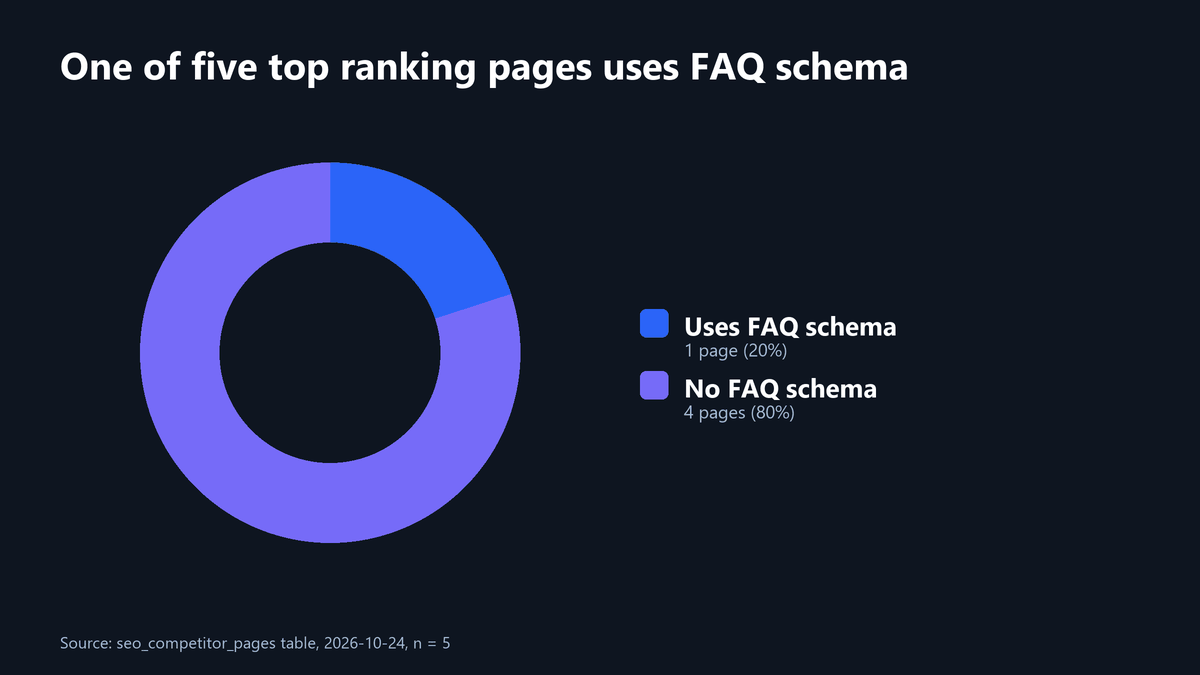
Source: seo_competitor_pages table (DataForSEO SERP data), pulled 2026-10-24, n=5 pages ranking for revenue operations.
Signs your team needs this now
Three signals tend to show up together. Marketing reports one pipeline number. Sales reports a different one for the same period. Nobody can say, without a side conversation, whose number is right.
A second signal: customer success data sits in a tool marketing never sees. Churn reasons never make it back into messaging or targeting. A third: every monthly report takes a half day of manual spreadsheet work instead of an automatic pull.
Any one of these alone is annoying. All three together is usually the point where a dedicated RevOps function starts paying for itself.
How it differs from marketing ops and sales ops
Marketing ops owns the campaign tools, the lead scoring rules, and the marketing automation platform. Sales ops owns territory design, quota setting, and the sales side of the CRM. RevOps sits above both. It owns the parts that have to stay consistent across the handoff between them: field definitions, stage definitions, and the single source of truth both teams report from.
Without RevOps, marketing and sales often define a qualified lead differently. That single gap means every pipeline report is already wrong before anyone looks at it. It is the most common reason companies stand up a RevOps function at all, more than any grand strategic plan.
The structural gap in current guides
The shortest of the five ranking pages ran 1,316 words and the longest 3,307, and none of them cited a first party data point. The table below lays out the marketing ops, sales ops, and RevOps split in one place, which most long, generic pages like these skip.
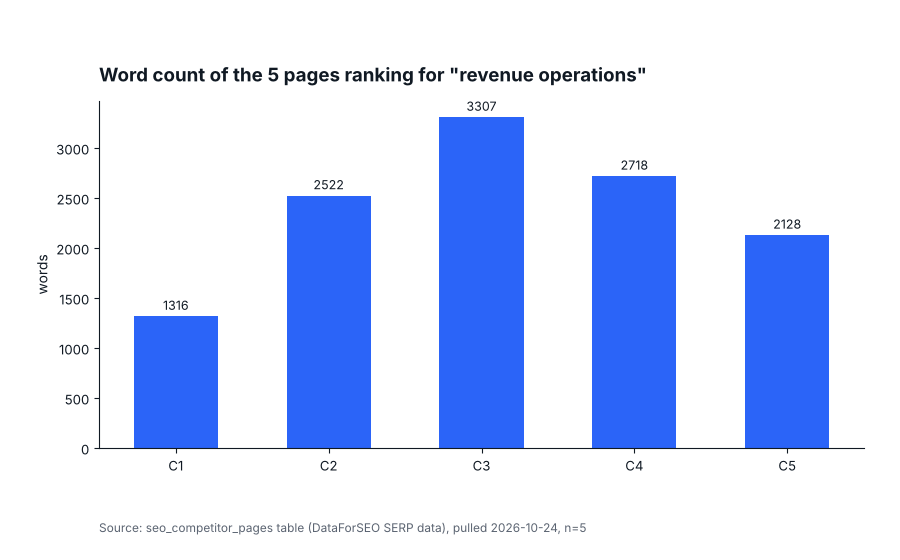
Source: seo_competitor_pages table (DataForSEO SERP data), pulled 2026-10-24, n=5 ranking pages for the query revenue operations.
| Function | Primary owner | What it does not own |
|---|---|---|
| Marketing ops | Marketing automation platform, lead scoring | Sales territory or quota design |
| Sales ops | Territory design, quota, CRM sales side | Campaign execution |
| RevOps | Shared field definitions, cross team reporting | Day to day campaign or deal execution |
What a working RevOps setup includes
At minimum, a working setup has one shared definition of a qualified lead, one CRM instance that marketing, sales, and customer success all write to, and one dashboard that all three teams pull their numbers from instead of three separate exports.
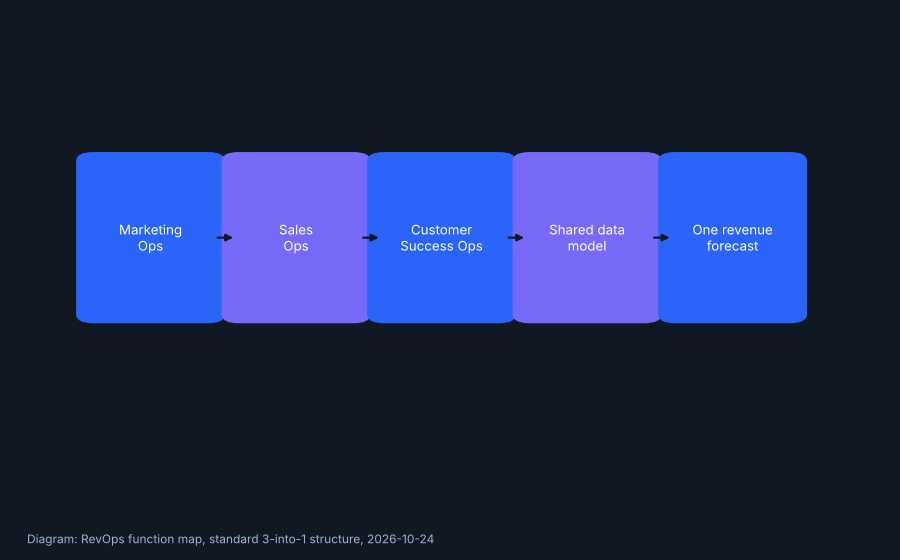
The diagram above is the standard shape of the function: three operational teams feeding a shared data model, which then produces one forecast instead of three competing ones.
None of this requires an enterprise tool budget to start. A shared spreadsheet with locked field definitions can do this job for a small team. The tool matters far less than everyone agreeing to use the same definitions and write to the same place.
Common pitfalls
| Pitfall | Likely cause | What to check first |
|---|---|---|
| Marketing and sales report different pipeline totals | No shared stage or lead definition | Audit the CRM field definitions both teams use |
| RevOps hire spends all their time firefighting tickets | No process ownership, only tool administration | Separate the admin queue from strategic process work |
| Customer success data never reaches marketing | Renewal and churn data lives in a separate system | Connect or export the customer success data into the shared model |
| Metric | Value |
|---|---|
| Monthly US search volume | 1,600 |
| Competition level | Low |
| CPC | USD 17.15 |
| Keyword class | Alpha |
Source: seo_keywords table (DataForSEO), pulled 2026-10-24, n=1 keyword (revenue operations).
What we found
The pattern across the five pages we reviewed for this topic was length without a clear visual structure for the one distinction, marketing ops versus sales ops versus RevOps, that readers searching this term are most often trying to understand. A table does that job better than another paragraph.
We advise on RevOps structure and CRM setup as part of our services at MV3, so the recommendation to formalize field definitions before hiring a dedicated RevOps role is a disclosed, interested opinion, not neutral research.
DataForSEO recorded 1,600 monthly U.S. searches for revenue operations with low keyword competition and a CPC of USD 17.15, pulled from the seo_keywords table on 2026-10-24. That volume sits well above most of the narrower terms in this space, which is one reason the ranking pages skew long and generic rather than specific.
A long generic page can still rank. It just leaves an opening for a shorter page that actually shows the function split in a table instead of three more paragraphs describing it in prose.
| Item | Done when |
|---|---|
| Shared lead definition | Marketing and sales agree on one definition, written down |
| One CRM instance | Marketing, sales, and customer success all write to it |
| One shared dashboard | All three teams pull their numbers from the same report |
| Field definitions before tooling | Agreed before any new platform purchase |
FAQ
Does a small B2B SaaS company need a dedicated RevOps hire?
Not usually before it has real handoff pain between marketing and sales. Below roughly ten people on the go to market team, a shared process document and a clean CRM often cover the same ground.
Who should RevOps report to?
Most commonly the CRO or CFO once the company has one, since RevOps spans functions that a single department head cannot fairly own. Earlier on, it often sits wherever the CRM administrator already reports.
What is the first thing a new RevOps hire should fix?
Field and stage definitions, almost always. Reporting problems are nearly always a symptom of inconsistent data entry rules, not a dashboard problem. Fix the input before touching the output.
Can marketing ops and RevOps be the same person?
Yes, early on. Many startups have one operations hire wearing both hats until the team is large enough to need a dedicated marketing ops seat and a dedicated RevOps seat separately.
For the marketing specific half of this split, see our guide on what marketing ops actually covers. For a deeper look at auditing the CRM data this function depends on, see our piece on auditing CRM data quality with the HubSpot API. If your team needs help standing up this structure, book a call.
Share this article

Vance Moore is Chief Growth Officer at MV3 Marketing and leads its team of SEO professionals, engineers and auditors.
Ready to audit your organic growth opportunity?
$2,500 flat. 5 business days. Six deliverables tied to pipeline , not rankings. No retainer required.
Get the Organic Growth Audit →