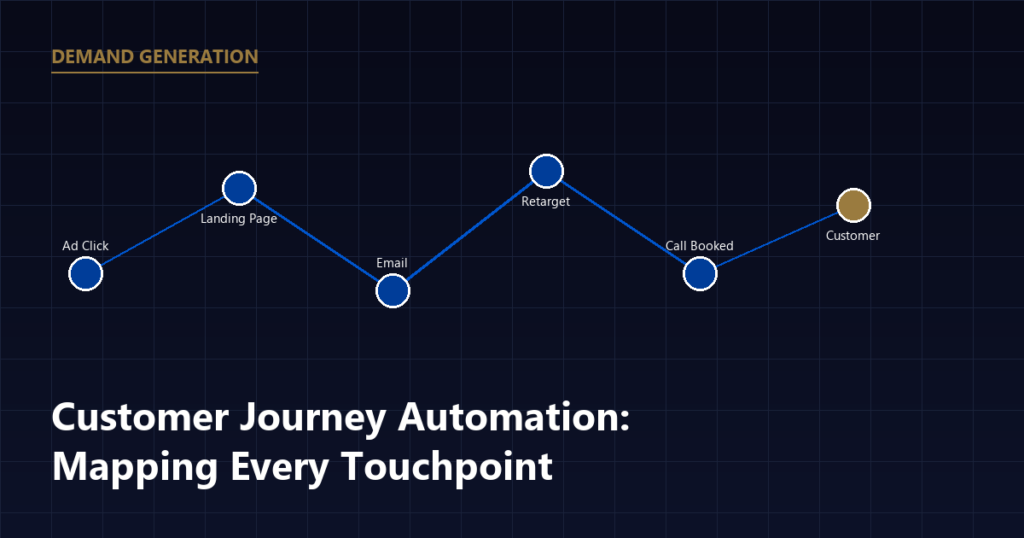
Customer journey automation connects the touchpoints a prospect moves through, an ad click, a landing page visit, an email, a call booked, so each step triggers the next one automatically based on what the prospect actually does. For a regional service business, it means a lead who goes quiet gets a relevant follow-up instead of falling out of the pipeline unnoticed.
Why Most Regional Service Businesses Have an Incomplete Journey
Most local and regional service businesses can describe their customer journey in
general terms: someone finds us, they reach out, we follow up, they book. What’s usually
missing is what happens at each specific gap, the three days between a first inquiry and
a scheduled estimate, or the two weeks between an estimate and a decision.
Those gaps are where leads are lost. Not because the business did anything wrong, but
because following up consistently, at the right time, with the right message, is hard to do
by hand across dozens or hundreds of leads a month.
Mapping a Real Journey Before Automating It
Before building any automation, it helps to write out an actual journey a real customer
went through recently. For a construction company, that might look like:
- Sees a Google or Facebook ad for kitchen remodels
- Clicks through to a landing page and fills out a request-a-quote form
- Gets a confirmation email (sometimes)
- Waits for a callback, which may take one to three days
- Has an estimate scheduled
- Receives a written estimate
- Goes quiet for two to three weeks while deciding
- Either books the job or the lead goes cold with no further contact
Written out this way, the gaps are obvious: the inconsistent confirmation, the one-to-three
day callback delay, and the total silence after the estimate is delivered. Each of those is a
specific point where automation can close the gap, not with a vague “improve follow-up”
initiative, but with a defined trigger and action.
THE SAME JOURNEY, WITH THE THREE GAPS MARKED
Every gold marker is a point where the next step depends entirely on a person remembering to act. That’s exactly what the triggers below replace.
Turning the Gaps into Automated Triggers
- Form submitted → immediate confirmation. An automated message goes out within minutes, every time, regardless of who’s available to respond manually.
- No callback within 24 hours → internal alert. Rather than relying on someone remembering to check, the system flags the lead so it doesn’t sit untouched.
- Estimate delivered → scheduled follow-up sequence. Instead of one follow-up call that may or may not happen, a short sequence of check-ins goes out at set intervals (three days, ten days, three weeks) until the prospect responds or the job is booked.
- Prospect responds → sequence stops. Once a person engages, the automated sequence ends and a rep takes over the conversation directly.
Where This Connects to AI Agents and Orchestration
Journey automation is the strategy layer: which touchpoints exist, and what should happen
at each one. The execution of those triggers is where
AI orchestration and dedicated
AI agents for sales come in, they’re what actually sends the
message, updates the record, or books the appointment when a trigger fires. Journey mapping
without that execution layer is just a diagram; the automation is what makes the diagram
run on its own.
MV3 Marketing builds these journeys as part of its
demand generation work, starting from a
business’s actual customer path rather than a generic funnel template.
Frequently Asked Questions
What is customer journey automation?
Customer journey automation is the practice of connecting the individual touchpoints a prospect experiences, ads, website visits, emails, calls, so that each one can trigger an appropriate next action automatically, based on what the prospect did, rather than requiring a person to track and follow up on every lead manually.
How is this different from email marketing automation?
Email automation is one channel within the journey. Customer journey automation coordinates across channels, ads, website behavior, email, SMS, and calls, so the follow-up a prospect gets reflects everything they’ve done, not just whether they opened an email.
Where should a regional service business start mapping their journey?
Start with the actual path a real customer took recently, from first contact to signed job or closed loan, and write down every touchpoint and every gap where follow-up depended on someone remembering to do it. Those gaps are where automation has the most immediate impact.
Does journey automation require a large marketing team to manage?
No. Once the journey is mapped and the automated triggers are built, it runs continuously without daily manual oversight. The setup work is front-loaded; ongoing management is mostly monitoring and periodic adjustment.
If you’ve never mapped out where your leads actually go quiet, that’s the fastest place
to start. Book a call and we’ll map it with you.
Share this article

Alex Carter leads SEO and content strategy at MV3 Marketing, specializing in generative engine optimization, technical SEO, and AI-driven content systems for B2B companies.
Ready to audit your organic growth opportunity?
$2,500 flat. 5 business days. Six deliverables tied to pipeline , not rankings. No retainer required.
Get the Organic Growth Audit →