Before You Start
You need a source of raw company records, a short list of ICP criteria such as industry, employee count, and vertical, and a place to record the tier each company lands in. We used our own CRM company table for this walkthrough, built from inbound form fills and prospecting pulls. Expect the first pass to take an afternoon for a few dozen companies, and plan to revisit tiers as new data comes in.
You do not need enterprise ABM software to start. A spreadsheet with company name, industry, employee count, and a tier column is enough for the first few hundred accounts.
Step 1: Stage Every Company You Have a Record Of
Pull every company record you have, regardless of quality, into one staging table. Do not pre-filter at this point. In our own data, 56 companies were staged across 11 separate sources, including inbound form fills and several prospecting pulls.
Expected result: one combined list of every company record, with its source noted. Common mistake: filtering out “obviously bad” records before staging, which hides where your sourcing is actually weak.
Step 2: Score Each Company Against Your ICP Criteria
Define a short set of criteria that actually predicts fit, such as industry vertical, employee count band, and funding stage. Score each staged company against those criteria. Companies missing the data you need to score them should be marked separately rather than guessed at.

Source: crm_companies table, pulled 2026-11-02, n = 56 staged companies.
Expected result: every company has a tier or an explicit “needs enrichment” flag. Common mistake: scoring companies with missing fields anyway, which produces a tier that looks precise but is really a guess.
Step 3: Sort Into Tiers
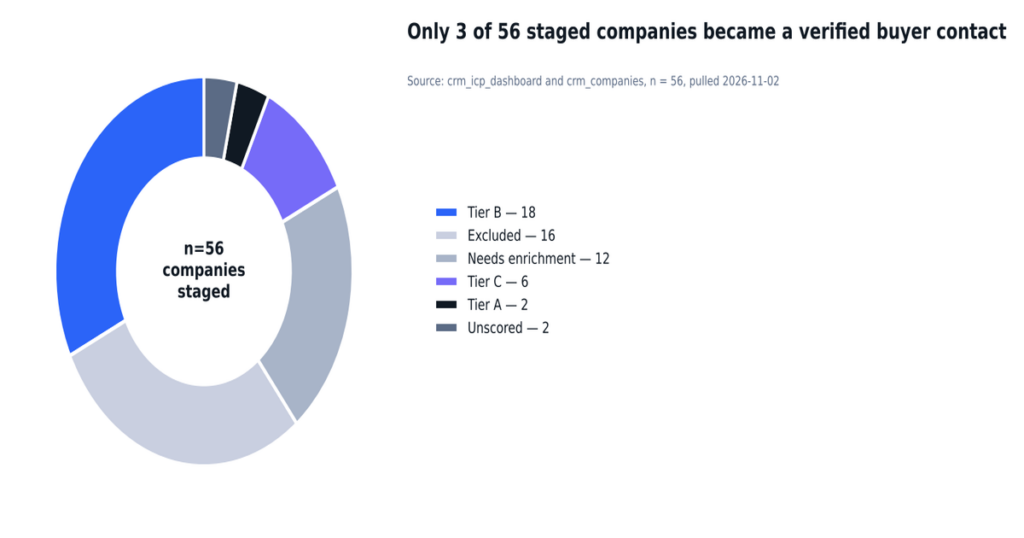
Once scored, sort companies into tiers. We use A, B, C, excluded, and needs enrichment. In our own staged set, tier B was the largest single group at 18 companies, followed by excluded at 16, needs enrichment at 12, tier C at 6, tier A at 2, and 2 companies still unscored.
The tiering step is where a raw list becomes a target account list. A spreadsheet of 56 company names is not a target list. The same 56 companies sorted into tiers, with 18 of them clearly worth sales time and 16 clearly excluded, is.
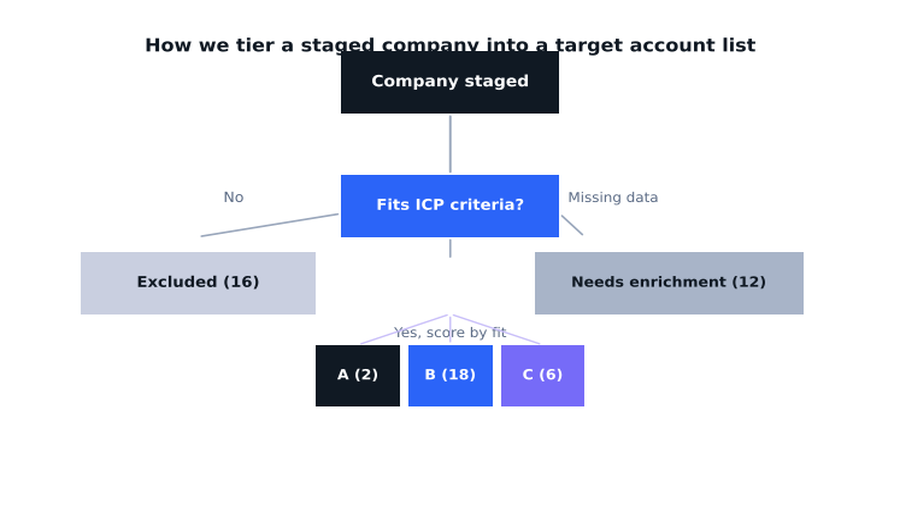
Decision flow used to sort staged companies into the tiers shown in the bar chart above.
Expected result: a tier assigned to every company, visible to both sales and marketing. Common mistake: leaving tiering as an unwritten judgment call instead of a documented set of criteria, which means two people tier the same company differently.
Step 4: Route Each Tier to the Right Motion
Tier A and B companies are worth direct outbound and sales time. Tier C companies are worth lighter-touch nurture. Excluded companies should leave the active list entirely so they stop consuming attention. Needs-enrichment companies should go back through data enrichment before they get a tier at all.
Expected result: each tier has a defined next action, not just a label. Common mistake: treating every tier the same way once scoring is done, which wastes outbound effort on tier C and excluded companies.
Routing is also where a target account list earns its keep over a flat spreadsheet. A flat list treats a well-funded, right-sized tier A company the same as a 16-person company your ICP criteria already exclude. Routing by tier is what stops that from happening in practice, not just on paper.
What We Found
Pulling our own crm_companies and crm_icp_dashboard tables on 2026-11-02 showed 56 staged companies total. Tier B was the largest group at 18 companies, averaging 301 employees. Excluded was the second largest at 16 companies, averaging 221 employees. Needs enrichment held 12 companies with an average employee count of only 12, which tells us those records came in with very little firmographic detail attached. Tier C held 6 companies averaging 317 employees, and tier A held 2 companies with employee count not yet recorded.
The most useful number for us was not inside the tiers, it was upstream of them. Across all 56 staged companies and 11 sources, only 3 ever reached a verified buyer contact, a 5 percent yield from staged record to confirmed buyer. That gap is exactly why tiering exists: without it, every one of those 56 records gets treated as equally worth pursuing, when our own data shows most of them are not.
This is a small sample at n = 56, and we are not presenting it as a benchmark for what another company should expect. We are showing it as a real, current snapshot of our own pipeline, including the parts that are still messy.
Common Mistakes and Fixes
| Symptom | Likely cause | Fix |
|---|---|---|
| Sales ignores the list | Tiers were assigned without sales input on criteria | Build the ICP criteria with sales, not just marketing |
| Every company ends up tier B | Criteria are too broad to separate companies meaningfully | Tighten criteria until tiers actually spread out |
| Large needs-enrichment pile | Source data is missing firmographic fields | Add an enrichment step before scoring, not after |
| List never shrinks | Excluded companies are not removed from active view | Move excluded companies out of the working list entirely |
Checklist Recap
Stage every company record you have without pre-filtering. Score each company against a short, specific set of ICP criteria. Sort scored companies into tiers, marking incomplete records as needs enrichment instead of guessing. Give each tier a defined next action for sales and marketing. Revisit the tiers as new data comes in instead of treating the list as fixed.
FAQ
How is a target account list different from a lead list?
A lead list is usually individual contacts. A target account list is companies, tiered by fit, that you then find the right contacts inside once you decide to pursue them.
How often should tiers be updated?
Whenever new firmographic data comes in for a company, or on a set cadence such as monthly. In our own set, 12 of 56 companies were still marked needs enrichment, which is a sign tiers need a refresh as that data arrives.
What should happen to excluded companies?
They should leave the active target list so they stop taking up sales and marketing attention. Keep the record for reference, but do not include it in outbound planning.
MV3 Marketing builds ABM and demand programs, including target account tiering like the one shown here, for B2B SaaS and service businesses. If you want help building or auditing your own tier criteria, book time with us. For related reading, see our tier-fit framework for matching account investment to buying committee size and our guide to auditing firmographic data coverage in your CRM.
Share this article

Vance Moore is Chief Growth Officer at MV3 Marketing and leads its team of SEO professionals, engineers and auditors.
Ready to audit your organic growth opportunity?
$2,500 flat. 5 business days. Six deliverables tied to pipeline , not rankings. No retainer required.
Get the Organic Growth Audit →