Why most LinkedIn marketing tactics guides are templates, not evidence
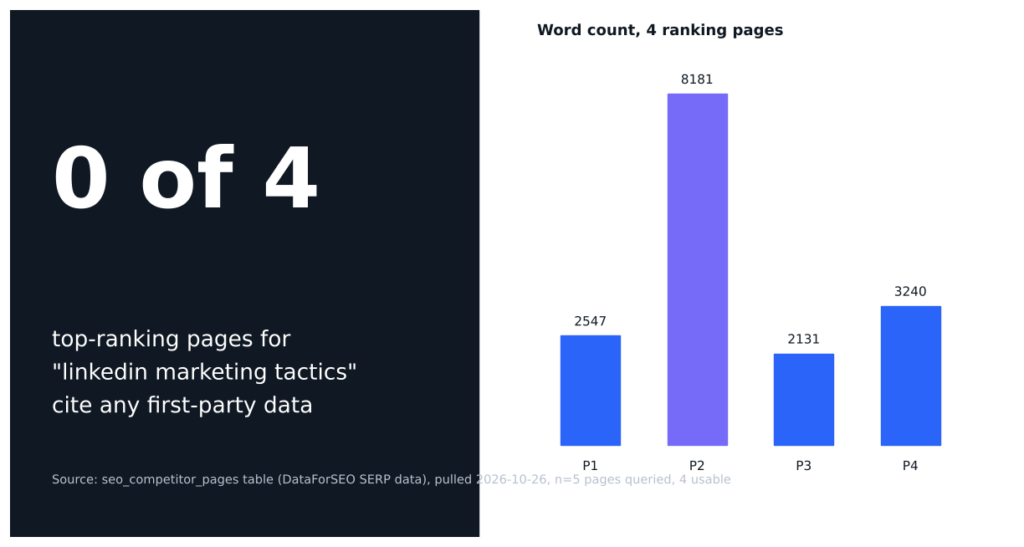
Search for linkedin marketing tactics and you will find long guides with checklists, screenshots, and advice that could apply to almost any platform. We pulled structural data on the top five ranking pages for this exact phrase and found a consistent pattern: one page returned no usable structural data at all, and of the four we could measure, zero used a data table and zero cited any first-party finding of their own.
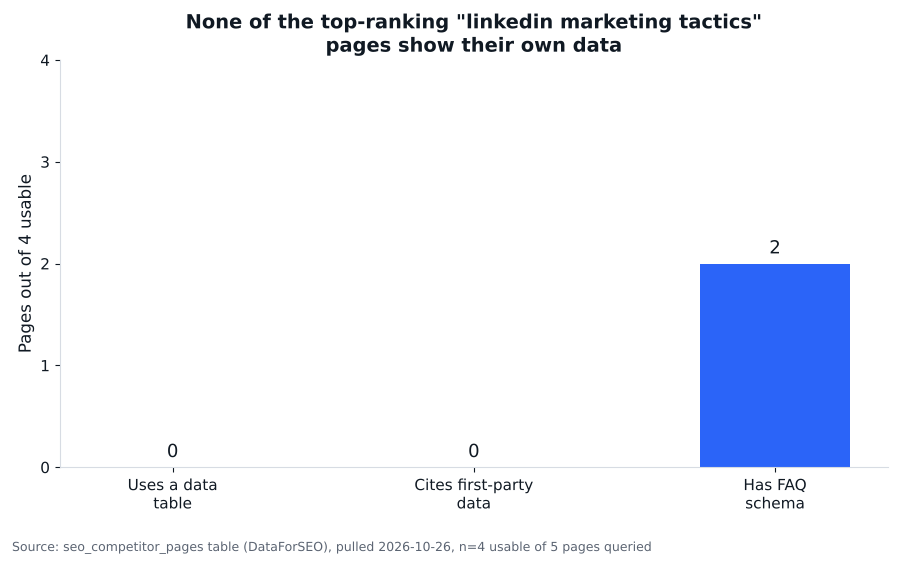
Source: seo_competitor_pages table (DataForSEO SERP data), pulled 2026-10-26, n=5 pages queried, 4 usable
That gap is the opening. Two of the four usable pages carry FAQ schema markup, so structured answers are rewarded by the pages that already rank. None of them, though, show a reader what actually happened when a real account tried the tactics. This guide is built around five steps, a troubleshooting table, and a checklist, and every number in it is sourced below.
Before you start
| Item | Why it matters |
|---|---|
| A founder or senior seller willing to post under their own name | Company pages reach far fewer people per post than personal profiles on LinkedIn’s current feed ranking |
| A list of 3 to 5 real buyer questions from sales calls or support tickets | Content pillars built from real questions outperform generic industry commentary |
| 2 to 4 weeks before judging results | LinkedIn’s organic reach for a new posting cadence takes several posts to stabilize |
| One place to log post date, pillar, and one engagement number | A spreadsheet or the table in Step 5 is enough; do not skip this step |
Step 1: Split organic tactics from paid and AI SDR outreach
Treat organic LinkedIn posting, paid LinkedIn ads, and AI-assisted SDR outreach on LinkedIn as three different motions with three different owners. Mixing them is the most common reason a LinkedIn effort stalls: the person writing posts is not the person running ads, and neither owns the automated connection requests a sales tool is sending in the background.
If your SaaS company is already running or considering LinkedIn ads paired with AI SDR agents, we cover that combination in a separate guide rather than here, since the budget, tooling, and risk profile are different from organic posting. This guide is scoped to the organic, content-led motion only, and it sits alongside channels like cold email, which we cover in how to write cold emails for B2B SaaS, rather than replacing them.
Expected result: one named owner for organic posting, separate from whoever owns paid spend or outreach tooling.
Common mistake: letting the same person own all three motions part time, which means organic posting is the first thing dropped when a quarter gets busy.
Step 2: Pick three content pillars tied to buyer problems
Write down the three questions prospects ask most often on discovery calls. Those become your pillars. A pillar is not a topic like “SaaS trends”; it is a specific, recurring problem such as “why our trial users stop after week one” or “how we price against a cheaper competitor.”
Three pillars, not ten, because a small team cannot sustain original thinking across ten themes every week. Rotate through the same three for three to four weeks before adding a fourth, so each pillar gets enough posts to show whether it resonates.
Expected result: three pillar statements, each one sentence, each tied to a real buyer problem you can name a specific deal or ticket for.
Common mistake: writing pillars as company topics (“our product,” “our culture”) instead of buyer problems, which produces posts that read like press releases.
Step 3: Put a posting cadence on the calendar
Pick a number you can actually sustain. Three posts a week from one consistent voice beats a daily posting goal that collapses after two weeks. Block the writing time on a calendar the same way you would block a client call, because LinkedIn posting is the task most likely to be bumped when something else is urgent.
Expected result: a recurring calendar block, not just a goal written in a planning document.
Common mistake: committing to daily posting in week one, missing four of the first seven days, and treating that as proof the channel does not work.
Step 4: Make the founder or seller profile the primary publishing account
Post from a person, not only the company page. LinkedIn’s own creator tools and feed behavior favor individual profiles with a consistent posting history, and company pages typically see a smaller share of their followers’ feeds per post than an active personal profile does. The founder or the seller closest to the buyer conversation is the right choice, not whoever on the team is most comfortable writing.
Comments matter as much as the post itself. Budget 15 minutes after each post specifically to reply to every comment in the first hour, since early engagement is what determines how far LinkedIn’s algorithm distributes a post beyond the author’s direct network.
Expected result: a named individual profile posting on the fixed cadence from Step 3, with a standing 15-minute comment-reply block after each post.
Common mistake: posting from the company page because it feels more official, then wondering why reach is flat.
Step 5: Build one measurement habit before you scale
Pick a single number to track every week: profile views, post engagement rate, or inbound connection requests from people matching your ideal customer profile. Resist tracking five metrics in week one. The point is to build the habit of checking a number weekly, not to build a dashboard before you have enough posts to read it.
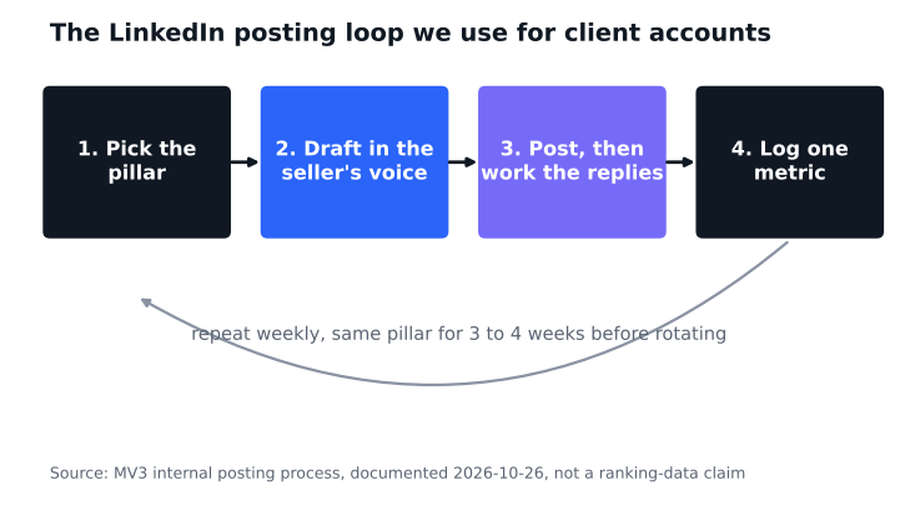
MV3’s own posting sequence for client LinkedIn accounts, documented 2026-10-26
This loop repeats weekly. After four weeks on one pillar, look at the logged numbers before rotating to the next pillar, so the rotation is based on what the log shows rather than a guess.
Expected result: a running log with at least four weeks of the same metric, reviewed before any pillar rotation.
Common mistake: changing the metric being tracked every week, which makes it impossible to tell whether anything actually improved.
Troubleshooting
| Symptom | Likely cause | What to check first |
|---|---|---|
| Posts get views but no comments | The post asks nothing of the reader | End the post with a specific, answerable question instead of a general call to engage |
| Reach drops after a few weeks | Posting stopped being consistent | Compare the posting log against the Step 3 cadence; gaps longer than one week often explain a reach drop |
| Connection requests are not from the target buyer | Pillars drifted toward broad industry commentary | Re-read the last five posts against the three pillar statements from Step 2 |
| The founder stops posting after a month | Writing time was never blocked on a calendar | Rebuild the Step 3 calendar block and shorten posts rather than dropping the cadence |
Checklist recap
| Step | Done when |
|---|---|
| 1. Split the motions | Organic posting has one named owner, separate from ads and outreach |
| 2. Pick three pillars | Three one-sentence buyer-problem statements are written down |
| 3. Set the cadence | A recurring calendar block exists for writing time |
| 4. Publish from a person | A named profile is posting, with a comment-reply block after each post |
| 5. Track one metric | Four weeks of the same number are logged before rotating pillars |
Where MV3 fits in
We build and run organic LinkedIn programs like this one for B2B SaaS clients, including the content pillars, the posting cadence, and the weekly measurement habit described above. We do not run LinkedIn ads or AI SDR outreach as part of this specific service; if you are evaluating that combination instead, our separate guide on LinkedIn ads and AI SDR agents covers that territory. This section exists so the commercial angle is visible rather than folded into neutral-sounding advice. If you want help setting up the pillars, cadence, and tracking above for your own team, book a call with us.
| Motion | Typical owner | Covered in this guide |
|---|---|---|
| Organic posting and content pillars | Founder or senior seller | Yes, Steps 1 through 5 above |
| Paid LinkedIn ads | Demand generation or paid media owner | No, see our LinkedIn ads and AI SDR guide |
| AI SDR outreach and connection requests | Sales operations or SDR lead | No, see our LinkedIn ads and AI SDR guide |
FAQ
How often should a B2B SaaS founder post on LinkedIn?
Three times a week is a sustainable starting cadence for most small teams. A cadence you keep for two months beats a daily goal you abandon after two weeks.
Should a company page or a personal profile lead the posting?
A personal profile, usually the founder or the seller closest to the buyer, since LinkedIn’s feed distribution has consistently favored active individual profiles over company pages in recent years.
What is the first metric to track?
Pick one: profile views, post engagement rate, or inbound connections matching your ideal customer profile. Track that one number weekly for at least four weeks before adding a second metric.
Share this article

Vance Moore is Chief Growth Officer at MV3 Marketing and leads its team of SEO professionals, engineers and auditors.
Ready to audit your organic growth opportunity?
$2,500 flat. 5 business days. Six deliverables tied to pipeline , not rankings. No retainer required.
Get the Organic Growth Audit →