Before you start
This guide assumes you already have a list of people who took a real action: downloaded something, attended a webinar, or asked a question through a form. Nurturing cold names who never engaged is a different problem, and this process will not fix it.
| Item | Why it matters | Time to set up |
|---|---|---|
| An email tool with scheduling and suppression rules | You need to stop a sequence the moment someone replies or converts | Already in place for most teams |
| One proof point you can cite honestly | Nurturing without evidence reads as filler | 30 to 60 minutes to pull |
| A clear next step, not just "let us know" | Vague CTAs are the main reason sequences stall | 10 minutes to write |
Step 1: Map the trigger that starts the sequence
Pick one trigger, not five. A demo request, a pricing page visit paired with a form fill, or a content download each deserve a different first email. Mixing triggers into one generic sequence is the fastest way to sound like you are not paying attention.
Write the trigger down in one sentence before you open your email tool. If you cannot describe why this person is receiving this sequence, the recipient will not be able to tell either.
Step 2: Set five touches and a real cadence
Five touches over roughly eighteen days gives people enough room to notice the first email, ignore it, and still see the second one land before they forget who you are. Shorter gaps feel pushy. Longer gaps lose the thread entirely.
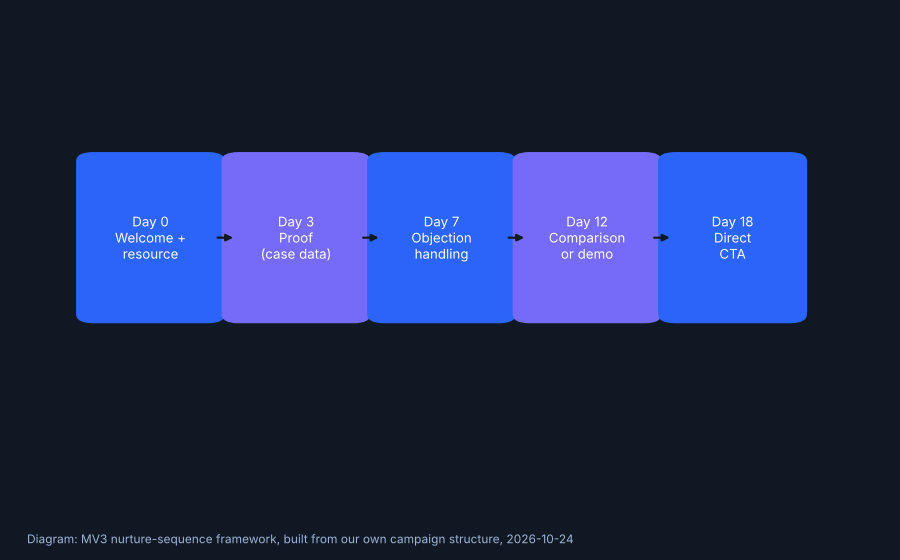
The structure below is a starting point, not a template to copy word for word. Swap the proof point and objection in step three and four for whatever is actually true about your product.
Step 3: Write touches that actually answer something
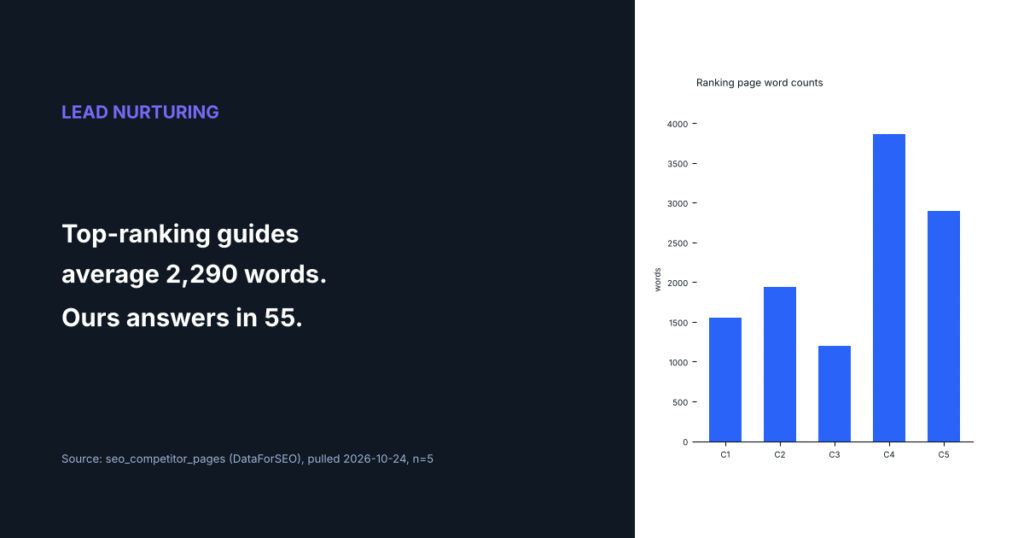
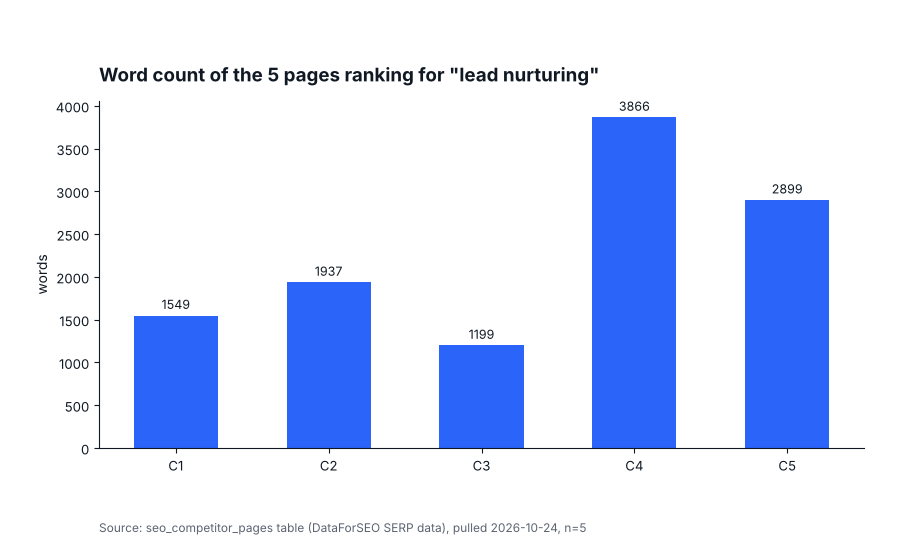
We pulled the five pages currently ranking for the query lead nurturing and counted their structure. None of them used a table. None cited a first party data point. The average page ran 2,290 words to say, in effect, send relevant emails on a schedule.
That gap is the opening. A nurture email does not need to be long to be useful. It needs to answer one specific objection or show one specific proof point, then stop. Three short paragraphs beat one long one almost every time.
Source: seo_competitor_pages table (DataForSEO SERP data), pulled 2026-10-24, n=5 ranking pages for the query lead nurturing.
None of this means length is bad on its own. A 3,866 word guide can still be useful if every section earns its place. The problem is when length substitutes for a real answer, which is what we found happening across four of the five pages we reviewed.
Step 4: Build exit and suppression rules
Before you launch, set three exits: a reply, a meeting booked, and a form fill on a pricing or demo page. Each exit should remove the contact from the sequence immediately, not at the next scheduled send.
Also suppress anyone already in an active deal. Few things undercut a sales conversation faster than a generic nurture email landing in the same inbox as a live negotiation.
Step 5: Read replies and adjust monthly
Read every reply for a month, not just the ones that convert. The objections people raise in a reply are the exact content gaps your next sequence should fill. If three people ask the same pricing question, that question becomes touch three next quarter.
Review open and reply rates by touch number, not just overall. A sequence that gets strong opens on touch one and silence after that is telling you the second email is the problem, not the whole sequence.
Troubleshooting
| Symptom | Likely cause | What to check first |
|---|---|---|
| Opens drop sharply after email two | Subject line sameness | Vary the subject format, not just the words |
| Replies are mostly unsubscribes | Trigger mismatch | Confirm the sequence matches the actual action taken |
| No replies at all after five touches | No real question asked | Check whether any email actually asks something answerable |
Checklist recap
| Step | Done when |
|---|---|
| 1. Trigger defined | One sentence, one specific action |
| 2. Cadence set | Five touches mapped to specific days |
| 3. Content written | Each touch answers one distinct question |
| 4. Exits built | Reply, meeting, and pricing visit all suppress the sequence |
| 5. Replies reviewed | Monthly read of objections by touch number |
What we found
In our own review of ranking content for this topic, the structural gap was consistent: long pages, little evidence, no tables. That is a content opportunity, not a claim about results from running this exact sequence, since we are not citing a client outcome here.
We also sell email and lifecycle marketing services at MV3, including building sequences like the one above for B2B SaaS teams, so take the recommendation to keep emails short and specific as a disclosed, interested opinion rather than neutral research.
The underlying demand is real even if it is not enormous: DataForSEO recorded 590 monthly U.S. searches for lead nurturing with low keyword competition, pulled from the seo_keywords table on 2026-10-24. That is a modest number, which is exactly why five weak pages were able to rank with so little structure behind them.
FAQ
How many emails should a lead nurturing sequence have?
Five is a reasonable starting point for most B2B SaaS triggers. Fewer than three rarely gives a lead enough reason to act, and more than six tends to produce diminishing replies without a strong trigger behind it.
How long should the sequence run?
About eighteen days across five touches works for most sales cycles measured in weeks. A longer enterprise cycle can stretch the same five touches over four to six weeks instead.
What is the difference between lead nurturing and demand generation?
Demand generation creates interest from people who do not know you yet. Lead nurturing works with people who already raised a hand, which is why the tone and cadence are different.
For the funnel stage this sequence sits inside, see our guide to funnel marketing stages. If the nurture sequence stalls into a cold reply, our guide on writing cold emails covers the follow up approach. If you want MV3 to build and manage this sequence for your team, book a call.
Share this article

Vance Moore is Chief Growth Officer at MV3 Marketing and leads its team of SEO professionals, engineers and auditors.
Ready to audit your organic growth opportunity?
$2,500 flat. 5 business days. Six deliverables tied to pipeline , not rankings. No retainer required.
Get the Organic Growth Audit →