What does an example brand positioning statement look like?
Wikipedia’s entry on marketing positioning gives a basic template: “For (target customer) who (statement of the need or opportunity), the (product name) is a (product category) that (statement of key benefit),” followed by a clause that begins “Unlike (primary competitive alternative)” and names the main difference (Wikipedia, Positioning (marketing)). The same page works through a real example for Volvo. Its target customer is “upper income car buyers who currently own another brand and are looking to switch.” Its category is “a differentiated brand of prestige automobiles.” Its key benefit is “the benefits of safety as well as prestige.”
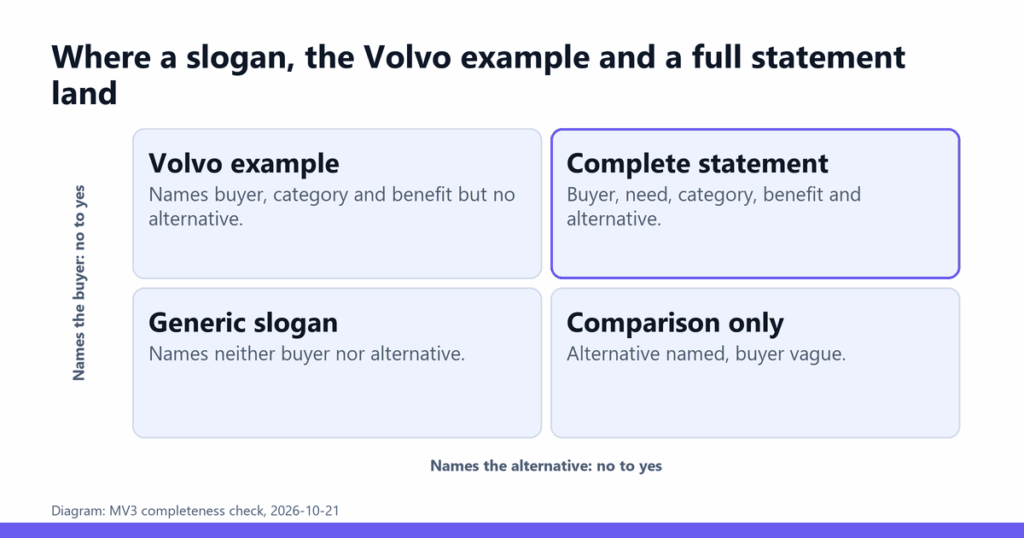
That is the sourced example. Notice what it leaves out. The Volvo version names a buyer, a category and a benefit, but no competitive alternative. We checked this with the script later in this guide, and the result is on screen below.
Disclosure. MV3 Marketing sells positioning and messaging work to B2B companies, so we have a commercial interest in this topic. The draft statement for MV3 below is a teaching example, not final brand copy.
Which positioning statement formats can you use?
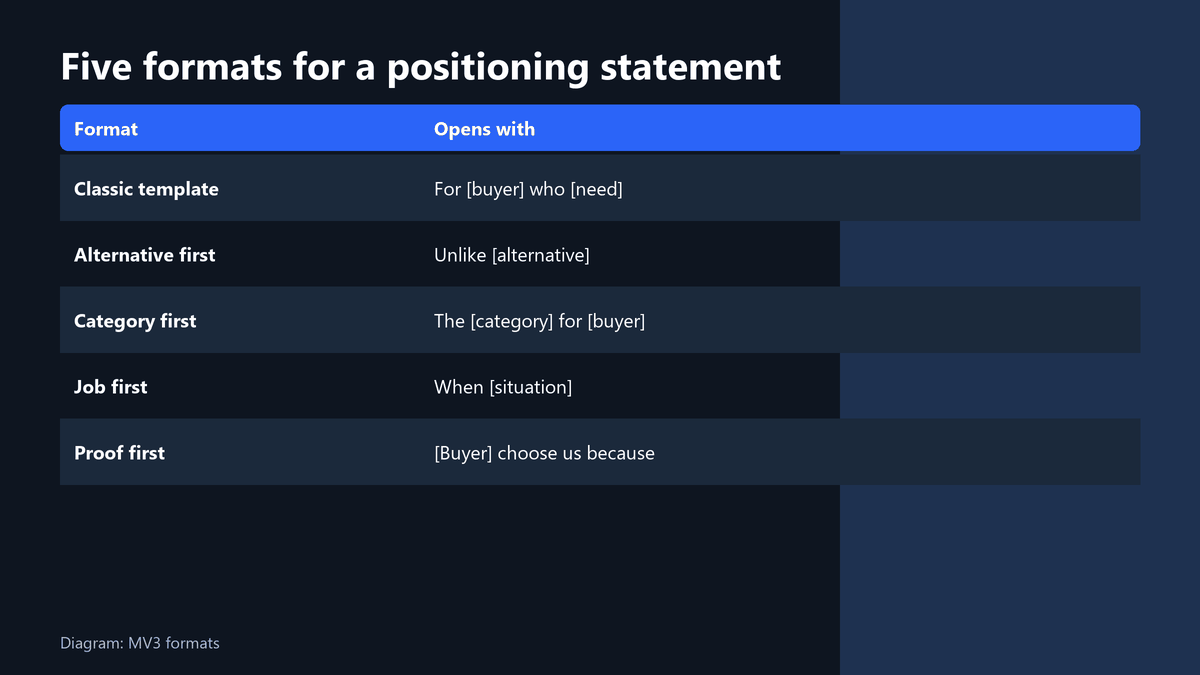
April Dunford, a B2B positioning consultant, puts the job in one sentence: “Positioning defines how our product is different and better than alternatives for a particular set of customers” (April Dunford, positioning for B2B tech companies). Any format that does that work is a fair choice. These are the five we use most.
| Format | Shape | Best when |
|---|---|---|
| Classic template | For [buyer] who [need], [product] is a [category] that [benefit] | You need a one-page internal anchor |
| Alternative first | Unlike [alternative], we [difference] for [buyer] | Buyers compare you to one known option |
| Category first | The [category] for [buyer] who [need] | You are creating or reframing a category |
| Job first | When [situation], [buyer] wants to [job], and we [way] | You have interview data on the job |
| Proof first | [Buyer] choose us because [evidence] | You hold real, citable results |
Pick one format and write three versions. Then test each version with the checks further down. For the job-first format, our guide to the jobs to be done framework shows how to write the job from interview notes.
How does the Volvo example score on completeness?
We wrote a small Python script that checks a statement for five parts: target, category, benefit, alternative and difference. We ran it on three inputs: the Volvo example from Wikipedia, our own draft statement, and a generic slogan. Here is the exact code we ran.
import re

PARTS = [
    ("target", r"^Fors+.+?s+whos"),
    ("category", r"bis an?s+.+?s+thats"),
    ("benefit", r"bthats+.+?(?:.s|.$)"),
    ("alternative", r"Unlikes+.+?,s"),
    ("difference", r"Unlikes+.+?,s+w+"),
]

def missing_parts(text):
    return [name for name, rx in PARTS if not re.search(rx, text.strip())]

tests = {
    "Volvo": "For upper income car buyers who currently own another brand and are looking to switch, Volvo is a differentiated brand of prestige automobiles that offers the benefits of safety as well as prestige.",
    "MV3 draft": "For B2B SaaS marketing leads who need pipeline they can trace to a source, MV3 is a growth agency that builds search, outbound and analytics as one system. Unlike agencies that sell channels one at a time, we tag every account at entry so results can be traced.",
    "Slogan": "We help companies grow faster with smart marketing.",
}
for name, text in tests.items():
    m = missing_parts(text)
    print(f"{name:10} | " + ("PASS" if not m else "missing: " + ", ".join(m)))
What this does: each rule is a regular expression for one part of the template, and the function lists the parts it cannot find. Output from our run on 2026-10-21:
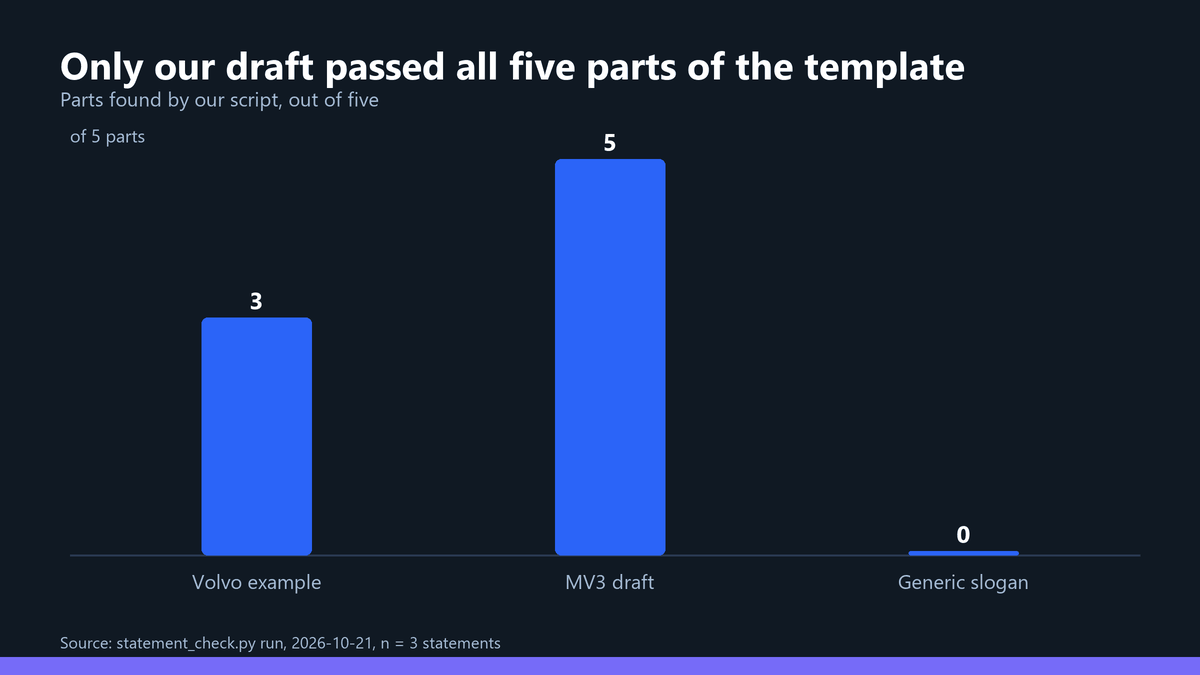
Volvo      | missing: alternative, difference
MV3 draft  | PASS
Slogan     | missing: target, category, benefit, alternative, difference
The Volvo example passes three of five parts, our draft passes all five, and the slogan passes none. A common error is writing a statement that sounds fluent but fails the check, because the competitive alternative is missing. A script cannot judge whether the claim is true. It only tells you when a part is absent.
What is a good example brand positioning statement for a B2B SaaS agency?
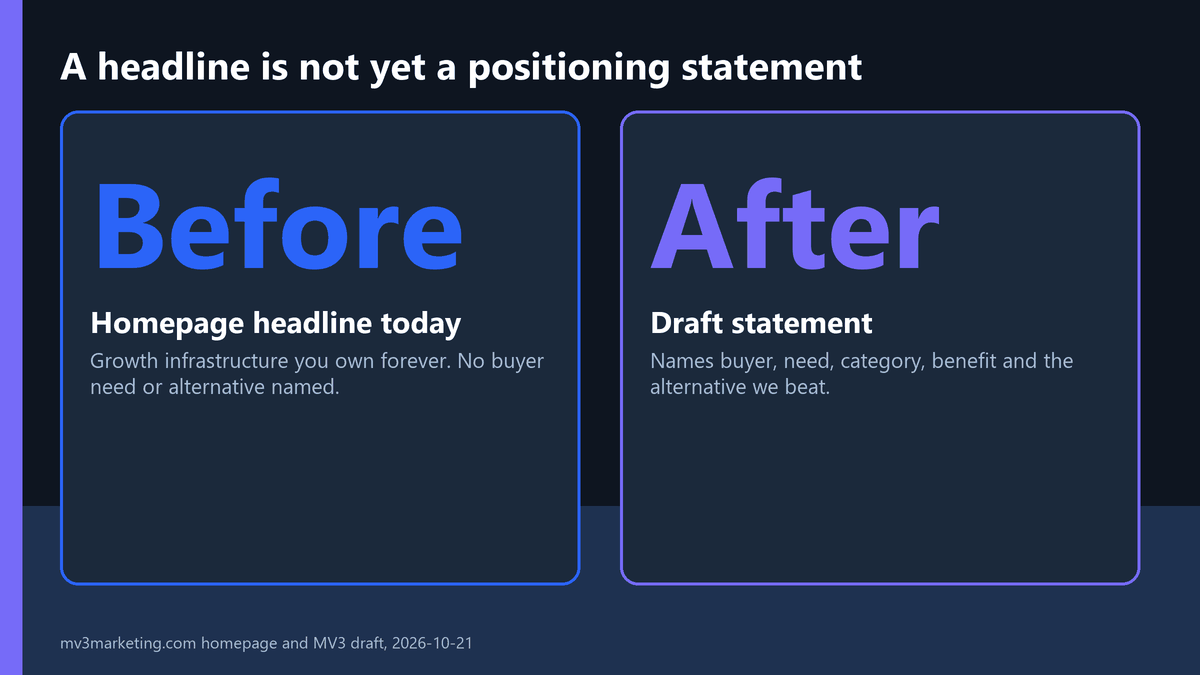
We will use ourselves, since we have the facts. Our homepage headline today reads, “The Growth Infrastructure Your B2B Company Owns Forever” (our own site, fetched 2026-10-21). It is a strong line, but it is a headline, not a positioning statement. It does not name the buyer’s need or an alternative.
Here is a draft in the classic format: “For B2B SaaS marketing leads who need pipeline they can trace to a source, MV3 is a growth agency that builds search, outbound and analytics as one system. Unlike agencies that sell channels one at a time, we tag every account at entry so results can be traced.” It passes the script. Whether it is right is a different question, and we have not tested it with buyers.
The draft rests on a fact we can support from our own data. Every one of the 45 companies in our CRM carries the label “unattributed” and no acquisition cost, which is the problem the draft promises to solve (MEASURED, crm_cac_by_channel, queried 2026-10-21). We would rather build the proof first, then claim it.
Illustrative examples you can adapt
These two are invented for teaching and are labelled ILLUSTRATIVE. They are not client results and the products do not exist.
| Product idea | Statement |
|---|---|
| Invoice matching tool | For finance leads at mid-size SaaS firms who close their books late, Matchbook is an invoice matching tool that flags mismatches before month end. Unlike spreadsheets, it checks every invoice as it arrives. |
| Status page service | For engineering managers who answer outage emails by hand, Statusly is a status page service that posts updates from your alerting tools. Unlike a static page, it updates itself. |
Each one names a buyer with a pain, a category the buyer already understands, one benefit, and a concrete alternative. If you are not sure who your buyer is, see our post on buyer persona vs ICP first.
How do you test a positioning statement?
Run five tests before you publish the statement anywhere. Each takes minutes.
- One-breath test. Read it aloud. If you need a second breath, cut it.
- Swap-the-name test. Put a competitor’s name in place of yours. If the statement still reads true, it is too vague.
- Alternative test. Name the thing a buyer would use instead of you, including a spreadsheet or doing nothing.
- Proof test. For each claim, write down the evidence you could show. If there is none, soften the claim.
- Refuse test. Name a company type the statement excludes.
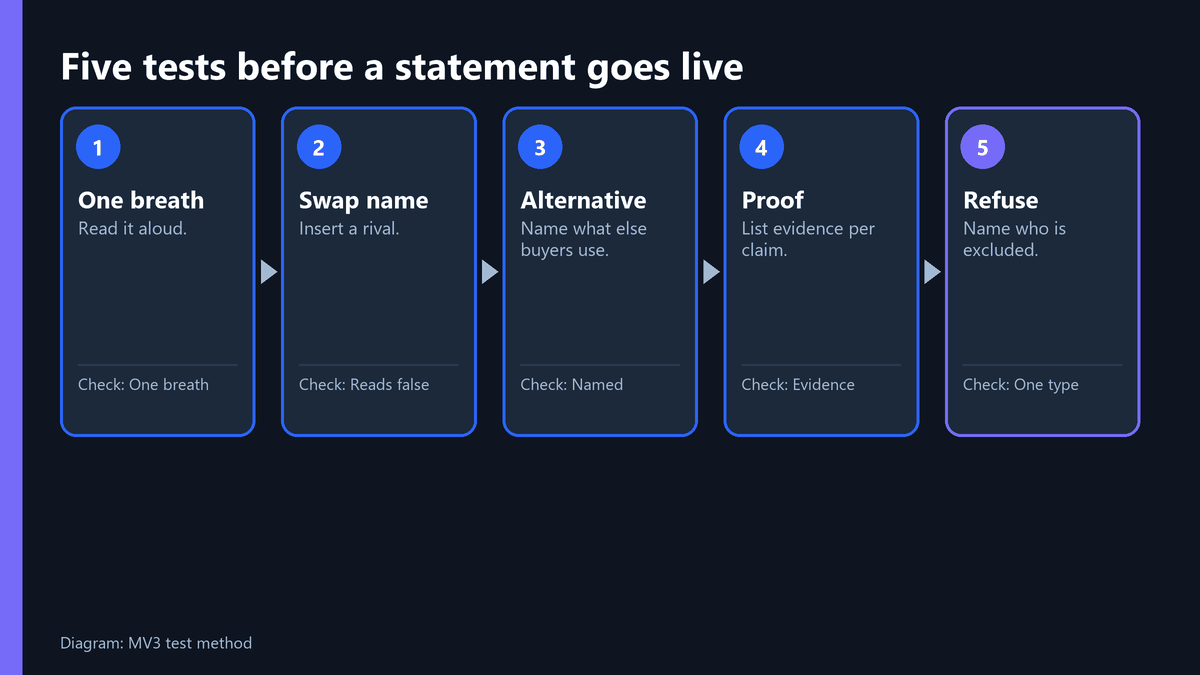
The refuse test is the one most teams skip. We ran it on our own list. Of 45 staged companies, 16 were excluded because they did not fit the profile (MEASURED, crm_companies, queried 2026-10-21, n = 45). A statement that excludes nobody cannot guide targeting. For more on tiering a list, read our ABM segmentation framework.
How do you write your own statement in four steps?
Step 1: list your best-fit buyers. Use the customers who stay and the lost deals you wish you had won, and write the role and company size for each. Step 2: write the alternative each buyer used before you, even if it was a spreadsheet or a hire. Step 3: pick the one benefit that the alternative cannot match, and write it as a change for the buyer, not as a feature of the product. Step 4: fill the classic template and run the script above.
Expect the first version to be wordy. Cut every adjective that you cannot back with evidence, then read the statement to someone outside your company. If they can say back who it is for and why it beats the alternative, it works. If they cannot, the problem is almost always a missing alternative or a vague buyer, and the script will point to the first one.
Keep a dated copy of each version. When sales calls start to use different words from your statement, that is a signal to revise it, and the old copies show what changed.
What does the ranking content look like?
We pulled the pages that rank for this keyword. Five ranked, and four could be read by our crawler. They ran 2,763, 3,181, 2,824 and 3,620 words, with 10, 62, 20 and 14 images. None of the four contained an HTML table, and one of the four had FAQ schema (MEASURED, seo_competitor_pages, fetched 2026-10-11, n = 4 readable pages of 5).

Most of what ranks is long text with many stock images. A tested script and a labelled rewrite of a real company’s statement are rare. We also kept all dollar figures and made-up statistics out of this guide.
Mistakes that weaken a statement
| Mistake | What it looks like | Fix |
|---|---|---|
| No named alternative | Benefits with no comparison | Add an “Unlike” clause with a real alternative |
| Buyer is everyone | “Companies of all sizes” | Name a size band and a role |
| Feature list | Three nouns and a verb | Turn each feature into a benefit for the buyer |
| Unprovable claim | “The best” with no evidence | Cite a fact or drop the claim |
Once the statement holds up, use it in your messaging, your sales pitch and your pages. If you want a team to build it with you, book a call with MV3 Marketing. You can also read how we think about B2B content marketing strategy once the positioning is set.
FAQ
What is the difference between a positioning statement and a tagline?
A positioning statement is an internal anchor for your team. A tagline is a short public line that comes from it. The statement can be long and plain, and the tagline should be short.
How long should a brand positioning statement be?
Two sentences is enough. If you cannot read it in one breath, trim it until you can.
Should a positioning statement name competitors?
Name the alternative type, such as spreadsheets or in-house builds, in the statement. You do not need to put a competitor brand in public copy.
How often should you update a positioning statement?
Review it after every ten sales conversations or when your market changes. Update it only when evidence shows that buyers describe you differently.
Can a positioning statement be wrong?
Yes. It is a hypothesis about buyers. Test it with real prospects and revise it when they describe the problem in other words.
Share this article

Vance Moore is Chief Growth Officer at MV3 Marketing and leads its team of SEO professionals, engineers and auditors.
Ready to audit your organic growth opportunity?
$2,500 flat. 5 business days. Six deliverables tied to pipeline , not rankings. No retainer required.
Get the Organic Growth Audit →