
What are jobs to be done, in plain terms?
Jobs to be done starts from a reframe. Buyers do not simply pick a product. The Christensen Institute puts it this way: people “hire” products or services when “jobs” arise in their lives (Christensen Institute, Jobs to Be Done). Strategyn, the firm built around Tony Ulwick’s version of the theory, defines a job as “the task, goal, or objective a customer is trying to accomplish in a given situation” (Strategyn).
A sales team does not want a CRM for its own sake. It wants to stop losing track of a deal when a rep leaves. That is the job. The software is one candidate for the role.
The reframe matters because conventional marketing leans on demographics and product attributes. The Christensen Institute contrasts its lens with exactly that approach. Two companies with the same headcount and industry can hire the same product for different jobs, so a segment-based message can be accurate on targeting and still miss.
| Dimension | Traditional segmentation | Jobs to be done |
|---|---|---|
| Starting question | Who is the buyer? | What progress is the buyer trying to make? |
| Main input | Firmographic and demographic data | Interviews about one real switch |
| Language it produces | Industry and job-title terms | The buyer’s own words for the frustration |
| Typical output | A persona or segment slide | Job statements, force maps, rewritten pages |
Where the idea came from. Clayton Christensen, Taddy Hall, Karen Dillon and David Duncan wrote “Know Your Customers’ Jobs to Be Done” for the September 2016 issue of Harvard Business Review. We could not read the full article without a subscription, so we cite only its authors and date here.
What does the current search result for “jobs to be done” look like?
We checked the pages that rank for this term in our own SEO data. The top five pages are uneven. The number one result is 331 words with no images. The number two result is 579 words, also with no images. One page is 2,015 words and carries 8 images, and another is 1,403 words with 18 images. The fifth entry in our table records only 9 words, which looks like a course landing page that did not render for our crawler, so we treat it as missing data, not as a real page length.
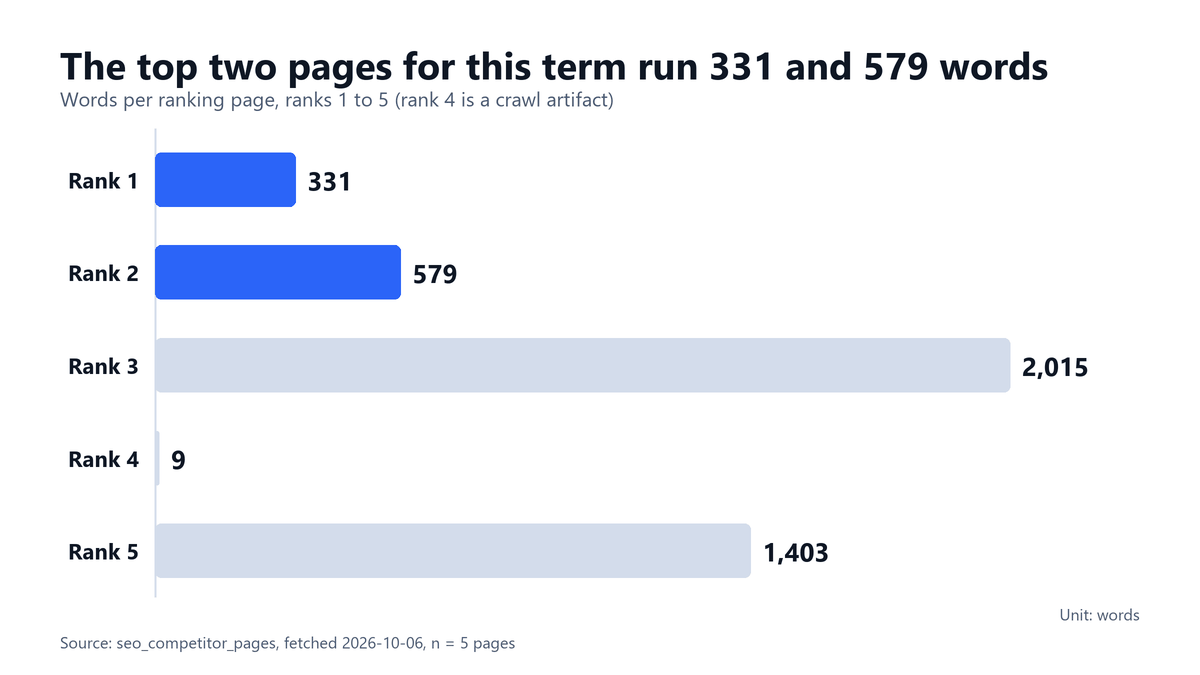
The median is 579 words. That is a thin bar for a topic with 2,400 estimated monthly searches (seo_keywords, DataForSEO, updated 2026-10-19, estimate). Only one of the five pages carries FAQ schema, and none contains a table.

We read this as a gap in practical, runnable guidance, not as proof that a longer page will rank. Length alone does not win. What the thin pages lack is something a team can do on Monday: a job statement format, an interview script, and a way to turn answers into copy. The rest of this post supplies those.
What are the four forces behind a switch?
The forces model comes from Bob Moesta, who teaches the method at jobstobedone.org. His summary is short: “Two forces drive change: the push of the current situation and the pull of the new solution.” Then: “Two forces resist it: the anxiety of the new solution and the habit of the present.” (Jobs to Be Done, Unpacking the Progress Making Forces Diagram).
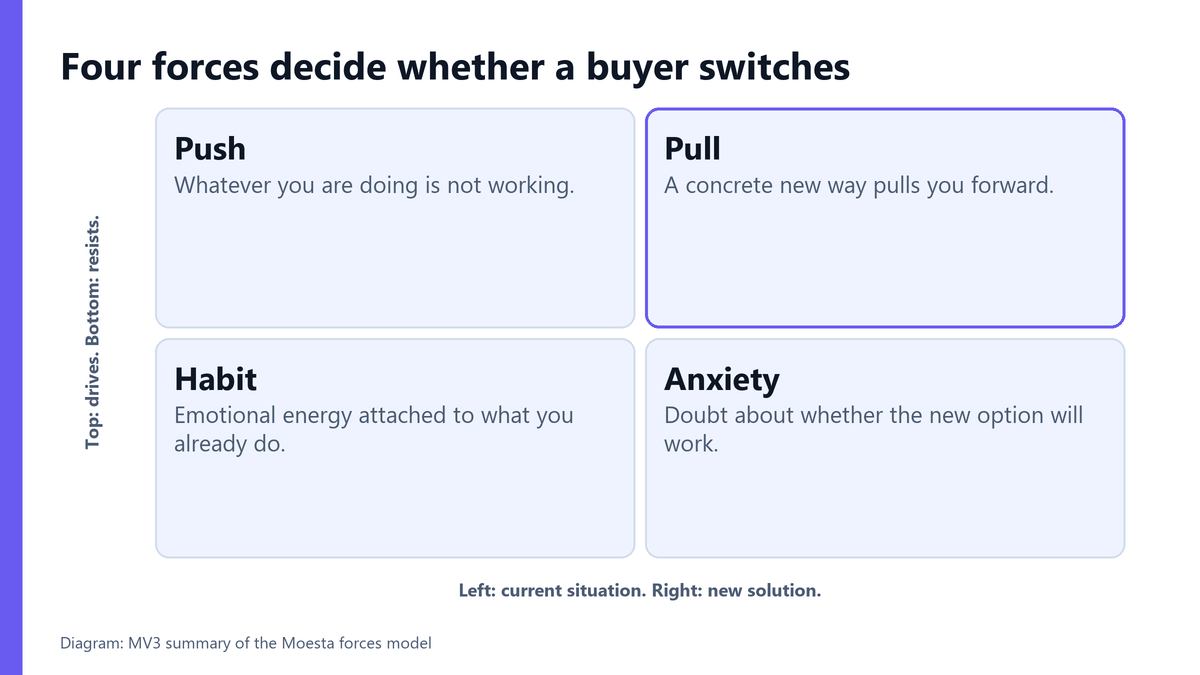
Moesta describes push as “whatever you’re doing isn’t working.” He ties anxiety to the new option: showing someone something new can “create anxiety which would be a hindering force.” And habit is “the emotional energy attached to what they already do.”
Read the forces in order. Ask about push first, then pull. Anxiety and habit usually surface only after the buyer has told you the story of the decision.
He also makes a point that most discovery calls miss: knowing you need to change is not enough. The buyer needs a concrete new way that pulls them forward. Push without pull stalls. Pull without a believable answer to anxiety stalls too.
In a B2B deal the forces sound like this. Push: a spreadsheet broke the week of a board meeting. Pull: a peer showed a dashboard that answered the question in one click. Anxiety: will the team actually adopt it, and how long will migration take? Habit: the old process technically still works. Most content speaks only to pull. The deals that die quietly usually die on anxiety or habit.
Why this matters for marketers. Feature pages answer pull. Switch interviews tell you what to write about anxiety and habit, which is where competitors’ pages are usually silent.
How do you write a job statement?
Strategyn advises defining the core functional job “in a single, solution-free statement” and gives two examples: “cut a piece of wood in a straight line” and “monitor a patient’s vital signs.” The statement names the task, not the product. That keeps it stable when tools change.
Here is how we write one for a B2B SaaS buyer. The example below is illustrative. It is not a customer quote or a client result.
| Part | Illustrative content |
|---|---|
| Situation | A revenue lead preparing a quarterly pipeline review |
| Solution-free job | Keep track of every open deal as it moves between people |
| Struggle | Deals lose an owner when a rep leaves, and nobody notices until the review |
| Wrong framing | “Buy CRM software” (names the solution) |
| Right framing | “Show me which deals have no owner before the review starts” |
Check each statement against three tests. It should contain no product name. It should describe a situation a buyer could recognize. And a competitor, or a spreadsheet, should be able to claim they do the same job. If your statement only fits your own product, you have written a feature description.
How to run a switch interview, step by step
Before you start. Line up buyers who purchased, or cancelled, in the last quarter. Plan 45 to 60 minutes per call (our planning estimate). Record the call with permission so you can pull exact phrases later. You will finish with a timeline and a pile of quotes sorted by force.
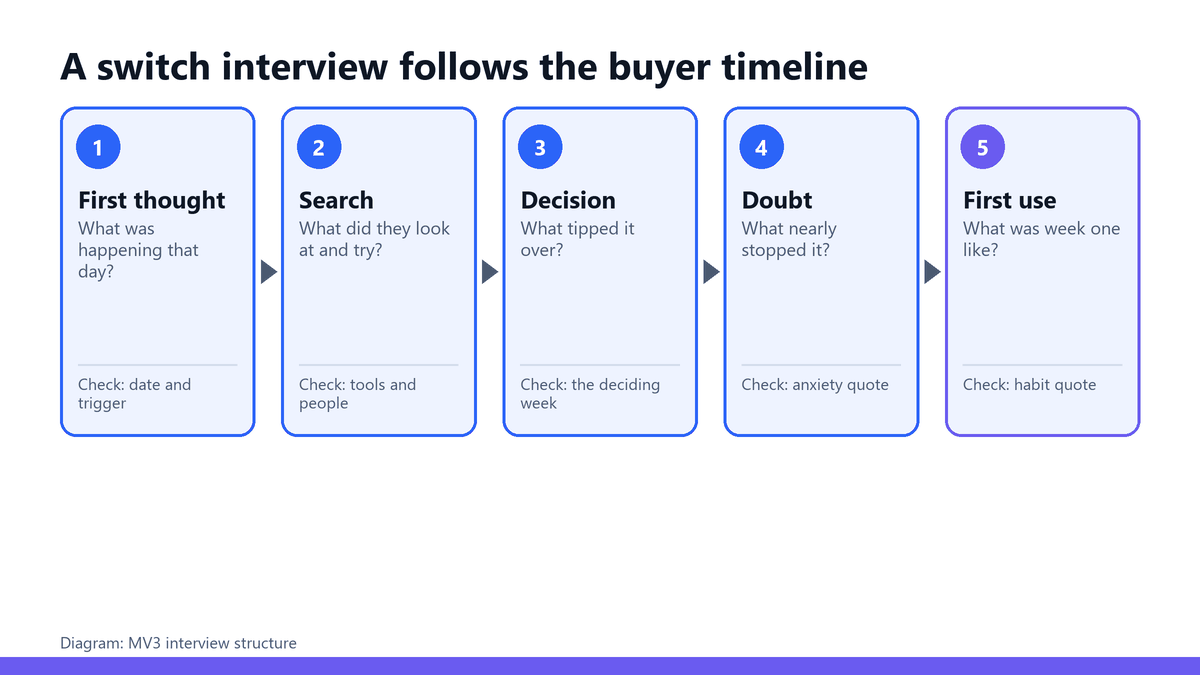
Step 1: Anchor on a real, recent purchase. Ask about the specific purchase, not the category. Memory of a real event is more specific than opinion about a market. Expected result: a date and a trigger for the first moment they considered a change.
Step 2: Walk the timeline in order. Move from first thought to active search, to decision, to first use. At each stage ask what changed. Expected result: a timeline you can sketch on one page.
Tip. Keep a blank copy of the timeline open during the call and fill it in as the buyer talks, so you can see which stage you have not covered.
Step 3: Ask how and what questions. “What were you using before?” works better than “Why did you switch?” The second invites a tidy, after-the-fact story. Expected result: details such as tools, people and dates.
Step 4: Probe each force. Ask what was not working, what pulled them toward the new option, what worried them, and what they almost kept doing. Expected result: at least one quote for each of the four forces.
Common mistake: asking buyers to rate features on a satisfaction scale. It produces neat numbers and almost no insight into the job.
Use this script as a starting template. Edit the wording to fit your product and keep the order.
OPENING
- Thank you. We are learning how people decide, not testing you.
- Is it fine to record? We will keep names out of anything we publish.

TIMELINE
1. Take me back to the first moment you thought about changing how you handle [job].
   What was happening that day?
2. What were you using at that point? Who else was involved?
3. What did you try or look at before you decided?
4. What was the moment you decided to go ahead? What happened that week?
5. What nearly stopped you? Who or what raised a doubt?
6. What was the first week of using it like?

FORCES (fill in as you listen)
Push: what was not working?   Pull: what drew you in?
Anxiety: what worried you?    Habit: what did you almost keep doing?

CLOSE
- If you had to describe the job you hired this for in one sentence, what would you say?
- Who else should we talk to?
What this does: it forces the conversation into a timeline and gives you a quote slot for each force. Common error: filling the forces list before the buyer has finished their story, which leads you to ask leading questions.
How do you turn interview answers into positioning?
After a handful of interviews, do not average the answers into one persona. Sort every sentence into one of the four piles and keep the buyer’s wording attached. Patterns tend to show up fastest in the anxiety pile, because buyers are usually more specific about what almost stopped them than about what convinced them.
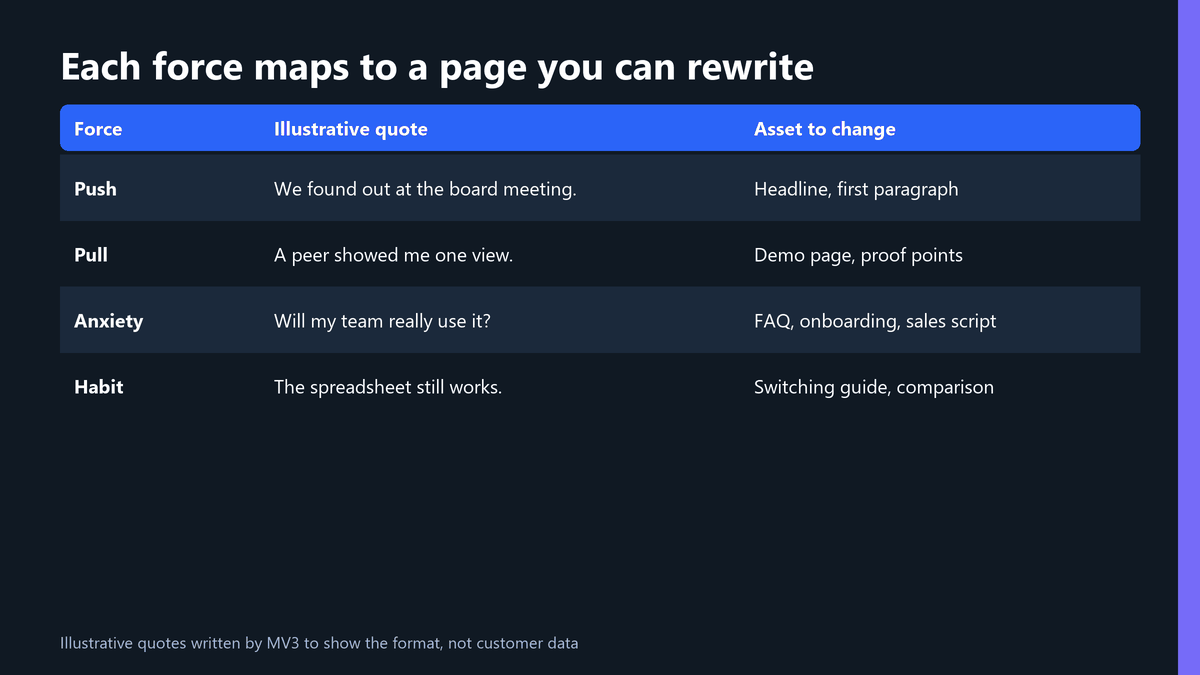
| Force | Illustrative quote | Asset it should change |
|---|---|---|
| Push | “We found out at the board meeting.” | Headline and first paragraph |
| Pull | “A peer showed me one view.” | Demo page and proof points |
| Anxiety | “Will my team really use it?” | FAQ, onboarding page, sales script |
| Habit | “The spreadsheet still works.” | Switching guide, comparison page |
Write one sentence per force in the buyer’s language, not yours. Those sentences become headlines, objection-handling scripts and FAQ entries. That is a more durable use of the research than a persona document nobody opens after the kickoff.
Check the result against the pages that already exist. If your headline still describes a feature and the interviews said the real struggle was an owner-less deal, rewrite the headline. Then re-interview a few new buyers and see if the language holds.
Where does this fit in a B2B content plan?
This method sits between research and content. Persona and account definitions say who you sell to; our guide to buyer persona versus ICP covers that split. The interview output then feeds content mapped to the buying committee and the material in our guide to sales enablement content.
MV3 Marketing sells research and content services, so we have a commercial interest in this method. We run these interviews in our own positioning work, which is why the post shows a script and not only a definition. If you want help turning interview notes into pages your buyers already search for, book time with our team.
Checklist recap. Pick recent buyers, follow the timeline, ask how and what questions, capture one quote per force, write solution-free job statements, then rewrite the page each force points to.
FAQ
Is jobs to be done the same as a buyer persona?
No. A persona describes who a buyer is. Jobs to be done describes the progress the buyer is trying to make, which can differ between buyers who look identical on paper.
How many interviews do you need before patterns appear?
There is no fixed number. Most teams hear repeated language after the first handful of calls, but it depends on how varied your buyers are. Treat early patterns as hypotheses and test them on new interviews.
Can you use jobs to be done for a self-serve product?
Yes. Replace the sales call with short calls or written questions to recent signups and recent cancellations. Ask the same timeline questions about the moment they started looking and the moment they decided.
What is the difference between Moesta’s forces and Ulwick’s approach?
They are separate methods under the same theory. Moesta’s model centers on the forces behind a switch, as described above. Strategyn describes Outcome-Driven Innovation, which it says “ties customer-defined metrics (desired outcomes) to the job-to-be-done.”
Should the job statement name our product category?
No. Keep it solution-free, as Strategyn advises, so the statement still holds if the category changes.
Share this article

Vance Moore is Chief Growth Officer at MV3 Marketing and leads its team of SEO professionals, engineers and auditors.
Ready to audit your organic growth opportunity?
$2,500 flat. 5 business days. Six deliverables tied to pipeline , not rankings. No retainer required.
Get the Organic Growth Audit →