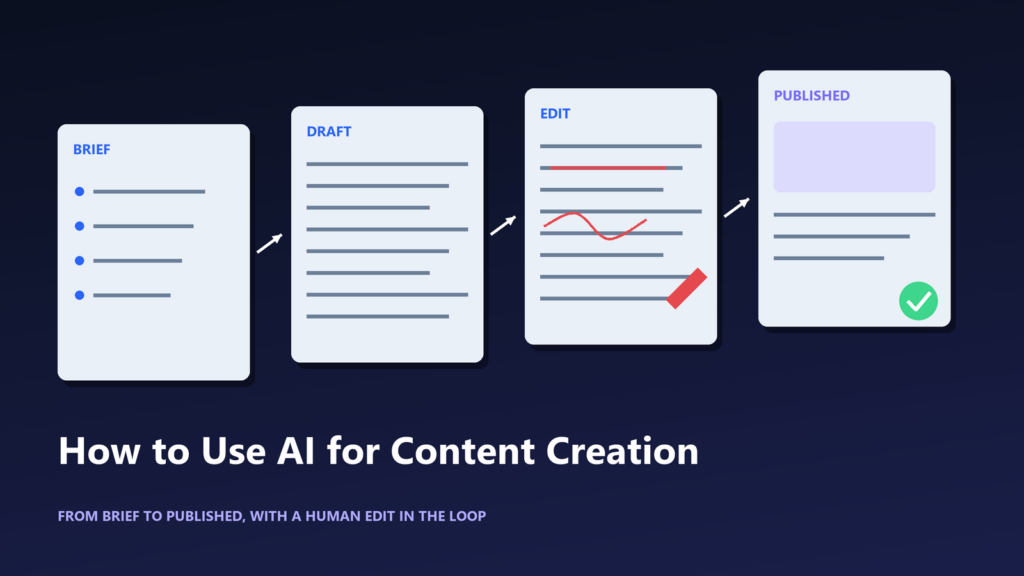
Using AI for content creation means letting a model produce the first draft of a blog post, ad, or email from a detailed brief, then having a person edit, fact-check, and approve it before it ships. The AI’s job is the blank page. The editor’s job is everything that makes the piece trustworthy and actually yours.
Where AI actually helps in the content pipeline
Content production breaks into six stages: brief, research, draft, edit and fact-check, optimize, publish. AI is genuinely useful in three of them, drafting, research summarization, and on-page optimization, and weak or risky in the other three.
- Brief, still a person’s job. A vague brief produces a generic draft no matter how good the model is.
- Research, AI can summarize a source or pull together a rough outline fast, but every specific claim, a statistic, a study, a pricing figure, still needs to be checked against the original source before it goes in the piece.
- Draft, this is where AI saves the most real time. A structured brief in, a full first draft out, in minutes instead of hours.
- Edit and fact-check, non-negotiable, and not a job AI should do unsupervised. This is where brand voice, accuracy, and originality get enforced.
- Optimize, AI can flag missing headings, thin sections, or a weak title tag quickly once a draft exists.
- Publish, scheduling and formatting, low-risk automation territory.
Per HubSpot’s AI Trends for Marketers report (1,000+ marketing professionals surveyed), the same study found marketers save an average of one to two hours a day using AI, mostly at the drafting stage, not the editing stage.
Why unedited AI drafts fail, even when the writing is technically fine
An AI draft built from a thin brief tends to read as generically correct and specifically useless. It restates the topic instead of taking a position, hedges instead of giving a direct answer, and reaches for the same handful of phrases every other AI-assisted post reaches for. None of that shows up as a grammar error. It shows up as a piece that doesn’t actually help the reader more than the ten other pages already ranking for the same query, which is the exact standard Google’s own quality guidance uses to separate helpful content from filler.
The fix isn’t avoiding AI drafting. It’s treating the draft as a first pass that a person with real subject knowledge rewrites for specifics, a named example, an actual number, a genuine opinion, not a synonym-swap edit.
A working brief format
| Brief element | Why it matters |
|---|---|
| Target query and searcher intent | Without this, the draft answers a generic version of the question instead of the specific one being asked |
| Required facts and sources | Forces citation of real, checkable claims instead of plausible-sounding invented ones |
| A specific example or case to include | This is usually the one thing that makes a piece feel like it was written by someone who’s actually done the work |
| What NOT to say | Competitor claims, pricing figures, or guarantees that need separate verification before they can be published |
| Internal links to include | Keeps the piece connected to the rest of the site instead of shipping as an orphan page |
Fact-checking is the step most teams skip, and it’s the one that matters most
Generative models produce fluent, confident text whether or not the underlying claim is true. A statistic, a named source, a specific dollar figure, or a claimed study result all need to be checked against a real, live source before publishing, not assumed correct because it reads naturally. This matters more for topics that touch a reader’s spending decisions. For a deeper look at how this applies to search visibility specifically, see what actually makes an SEO agency an AI SEO agency.
Where this fits into a broader AI marketing setup
Content creation is one piece of a larger system. If your team is still deciding where to start, our maturity model for using AI in marketing covers the full sequence, and the practical rollout guide walks through a phased plan you can apply to content specifically. For teams that want a managed content pipeline rather than building the process in-house, our content marketing services page covers what that looks like.
Will Google penalize AI-generated content?
Google’s guidance targets low-effort, unedited content produced at scale to manipulate rankings, not the use of AI as a drafting tool. A well-edited, fact-checked, genuinely useful piece that happened to start as an AI draft is treated the same as any other helpful content. An unedited, generic AI draft published purely to occupy a keyword is the pattern that gets flagged.
How much editing does an AI draft actually need?
Enough that a knowledgeable reader would believe a person who understands the topic wrote or reviewed it. That usually means adding a specific example, verifying every factual claim against a real source, cutting generic filler sentences, and rewriting the opening to give a direct answer instead of a warm-up paragraph.
Can AI replace a content writer entirely?
Not for anything meant to build trust or rank well over time. AI removes the blank-page problem, but the judgment calls, what’s true, what’s worth saying, what the brand’s actual point of view is, still require a person with real knowledge of the topic.
If you’d rather hand the editorial pipeline to a team that already fact-checks and QAs every piece before it ships, book a conversation with MV3 to see what that looks like for your content calendar.
Share this article

Alex Carter leads SEO and content strategy at MV3 Marketing, specializing in generative engine optimization, technical SEO, and AI-driven content systems for B2B companies.
Ready to audit your organic growth opportunity?
$2,500 flat. 5 business days. Six deliverables tied to pipeline , not rankings. No retainer required.
Get the Organic Growth Audit →