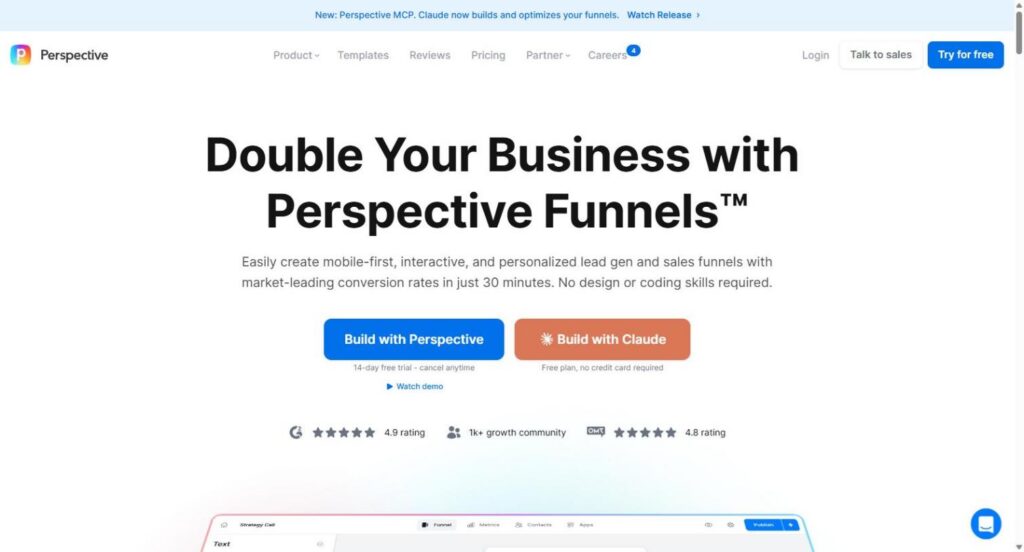
Perspective is a mobile-first funnel, form, and landing page builder built for interactive lead generation: quizzes, personalized qualification flows, and appointment funnels instead of static pages. It’s aimed at B2B SaaS marketers, agencies, and lead-gen teams who need a multi-step, mobile-optimized funnel live in under an hour without a developer.
Disclosure: MV3 Marketing participates in affiliate and partner programs, including Perspective’s. This post contains affiliate links, and if you sign up through one of them, we may earn a commission at no additional cost to you. We only recommend tools we’ve researched directly and would suggest to our own clients.
The static landing page problem
Most B2B SaaS teams still run demo requests, gated content, and qualification through a single static page: a headline, a form, a submit button. It works, technically. But a static page treats every visitor the same regardless of their role, their use case, or how ready they are to buy, and on mobile, where the majority of paid social and search traffic now lands, a long static form is exactly the kind of friction that makes people bounce before they finish it.
Perspective takes a different approach. Instead of one page with one form, you build a short sequence of interactive steps, a quiz, a set of qualifying questions, a personalized path, that adapts based on what the visitor tells you along the way. The output at the end is a lead who has already told you their budget range, their use case, or their team size, instead of a name and email you have to qualify manually after the fact.
Perspective’s own homepage puts the case plainly: the platform is built for a mobile-first reality, where the majority of social traffic arrives on a phone screen, and a funnel that isn’t designed for that experience loses visitors before it has a chance to convert them. Whether or not you buy the specific framing, the underlying point holds for any SaaS or agency team running paid social or paid search into a landing page: if the experience doesn’t match how people are actually browsing, you’re leaving qualified leads on the table.
What Perspective actually is
Perspective is a drag-and-drop builder for funnels, forms, and landing pages that live on their own hosted, mobile-optimized pages (or embed into an existing site). The platform is organized around six core areas you’ll use for any campaign:
- Funnel, the actual builder: drag-and-drop editing, 20+ proven templates, personalization logic, and a library of interactive blocks (quizzes, sliders, video, upload fields, payment blocks)
- Messages, for automated follow-up: email sequences, WhatsApp messaging, and conditional automations triggered by how someone answered inside the funnel
- Metrics, for optimization: A/B testing on the first page, time-on-page tracking, and UTM parameter capture
- Contacts, a built-in CRM for managing and tracking leads as they move through your pipeline
- Workspaces, for agencies managing multiple clients or teams managing multiple brands under one account
- Apps, the integration layer connecting to your existing marketing and sales stack
According to Perspective’s own site, the platform is used daily by more than 8,000 small and large businesses, and holds a 4.9 rating on G2 and a 4.8 rating on OMR. None of that replaces doing your own evaluation, but it’s a reasonable signal that the tool has real, sustained usage beyond a launch spike.
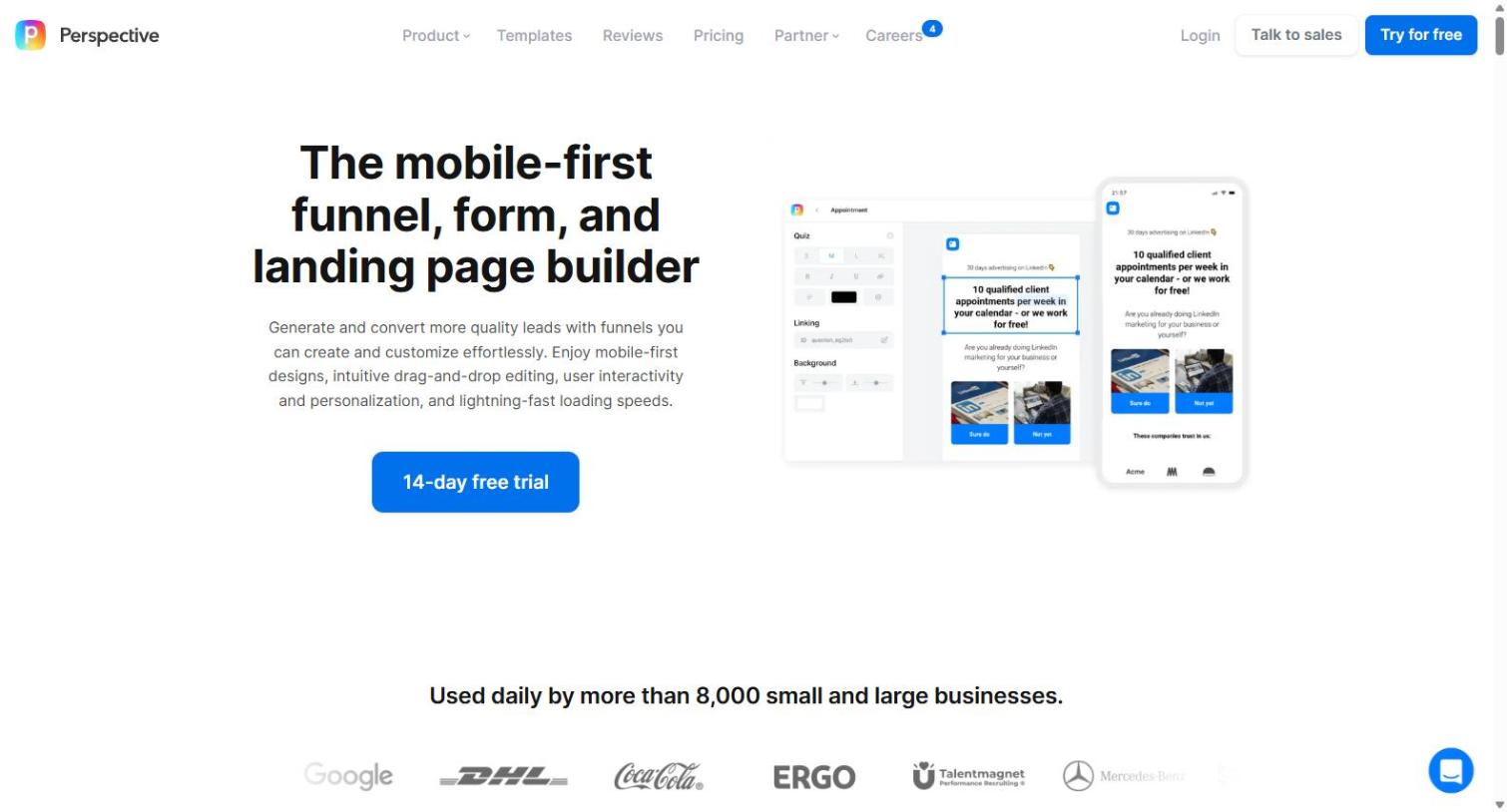
If you’re currently running a single static form as your primary conversion point and want to see what a genuinely interactive alternative looks like, you can start a 14-day free trial here and build a first version against your own offer before deciding whether it’s worth switching.
Building a quiz funnel: the core service business lead-gen use case
The use case that matters most for B2B SaaS and agency lead gen is the quiz or qualification funnel. Instead of a static “book a demo” form, you build a short sequence of questions, company size, current tooling, primary pain point, timeline, and route the visitor to a tailored result: a specific demo booking link, a recommended plan tier, or a relevant case study, based on how they answered.
Perspective’s template library includes several templates built specifically for this pattern: a general “Quiz” template for knowledge tests and personality-style questions, a “Health Quiz” template for tailored results and recommendations, a “Product finder” template that lets a prospect configure their own product or plan, and a “Recruiting Quiz” template that gamifies the qualification step for job applicants. The underlying mechanics are the same ones you’d use for a SaaS buyer-fit quiz: conditional logic, individual result pages, and dynamic content based on prior answers.
The platform’s “Individual paths” and “Smart personalization” features are what make this work in practice. Individual paths let you branch the funnel logic so different answer combinations lead to genuinely different next steps, not just a different headline. Smart personalization lets you echo back what a visitor already told you later in the funnel, the same way a good sales rep would reference something a prospect said earlier in a call. Combined with “Individual result pages,” you can show a different final screen depending on how someone answered, which is exactly what a buyer-fit or ICP-qualification quiz needs.
For a SaaS company selling into multiple segments (say, both mid-market and enterprise, or multiple verticals), this replaces what used to require either a generic one-size-fits-all landing page or multiple separate landing pages per segment. One funnel handles the branching instead.
Personalized product recommendation flows
A close cousin of the qualification quiz is the recommendation flow: instead of asking “which plan is right for you” as a single dropdown on a pricing page, you walk the visitor through a short sequence (team size, primary use case, integration needs) and land them on a specific plan recommendation or a tailored comparison. This is the same mechanic Perspective uses on its own pricing page’s FAQ, where it walks prospective customers through which of its four plans fits their situation based on stated needs, rather than making them self-select from a static comparison table alone.
For SaaS teams, this pattern works well for freemium-to-paid conversion (recommend a plan based on stated usage), for agencies pitching multiple service tiers, or for any product with enough plan complexity that a static pricing page under-serves buyers who don’t know which tier applies to them.
Qualification flows for demo requests and sales calls
The third practical use case is the one Perspective’s own template library leans on heavily: the appointment or strategy-call funnel. Instead of a “book a demo” button that opens a scheduling widget cold, the funnel walks the visitor through a short value proposition, asks two or three qualifying questions, and only then presents the booking step, pre-filled with whatever the visitor already entered.
Perspective supports this directly with native embeds for GoHighLevel, HubSpot Meetings, and Cal.com calendars inside the funnel itself, so the booking step doesn’t require a redirect to a separate scheduling tool. One customer testimonial on Perspective’s site, from a CEO using an application-style funnel for recruiting, reported generating over 900 applications in 10 weeks and more than 120 new hires; a separate testimonial from the CEO of a marketing agency cited scaling to reported eight-figure annual revenue using this funnel format as a core acquisition channel. These are self-reported customer results published by Perspective, not independently audited figures, so treat them as directional rather than a guarantee of what any specific campaign will produce.
Ready to test this against your own demo-request flow? Perspective’s 14-day trial gives you full access to the templates and the calendar integrations, so you can build a qualification-plus-booking funnel and compare it directly against whatever you’re running today.
Messaging, automation, and the built-in CRM
A funnel that captures a great lead is only half the job if the follow-up is generic. Perspective’s Messages module handles this natively: email sequences built inside the platform (no separate ESP required for basic nurture), conditional automations that trigger based on how someone answered inside the funnel, and native WhatsApp messaging with a shared inbox for replying to leads directly.
The CRM-status trigger feature is worth calling out specifically for SaaS and agency sales teams: you can fire different email or WhatsApp sequences depending on where a contact sits in your pipeline (new lead, qualified, booked, no-show), which means the messaging logic lives next to the funnel logic instead of in a separate marketing automation tool you have to keep in sync.
For teams already running a CRM like HubSpot, Perspective’s Contacts module is more of a lightweight lead-tracking layer than a full replacement, and the platform is built to sync out to your existing stack rather than compete with it for that role.
Metrics, integrations, and where Perspective fits your existing stack
On the analytics side, Perspective includes A/B testing on the first page of a funnel, time-on-page tracking, and UTM parameter capture across source, medium, campaign, term, and content, enough to see which entry variant and which traffic source is actually converting, without needing to stitch that together in a separate tool for basic funnel-level testing.
For integrations, Perspective connects to what it describes as 5,000+ tools through Zapier and Make, plus native, more tightly built integrations for GoHighLevel, HubSpot (both forms and the API), ActiveCampaign, Brevo, Zoho, Google Analytics 4, Google Tag Manager, the LinkedIn Insight Tag, and recruiting-specific tools like Recruitee and Personio. For a SaaS marketing team, the GA4 and Google Tag Manager integrations matter most for tying funnel performance back into your existing attribution and reporting stack, and the HubSpot and ActiveCampaign connections matter for making sure funnel leads land in the same pipeline as everything else, instead of creating a second, disconnected lead source your sales team has to check separately.
Perspective pricing: what each tier actually includes
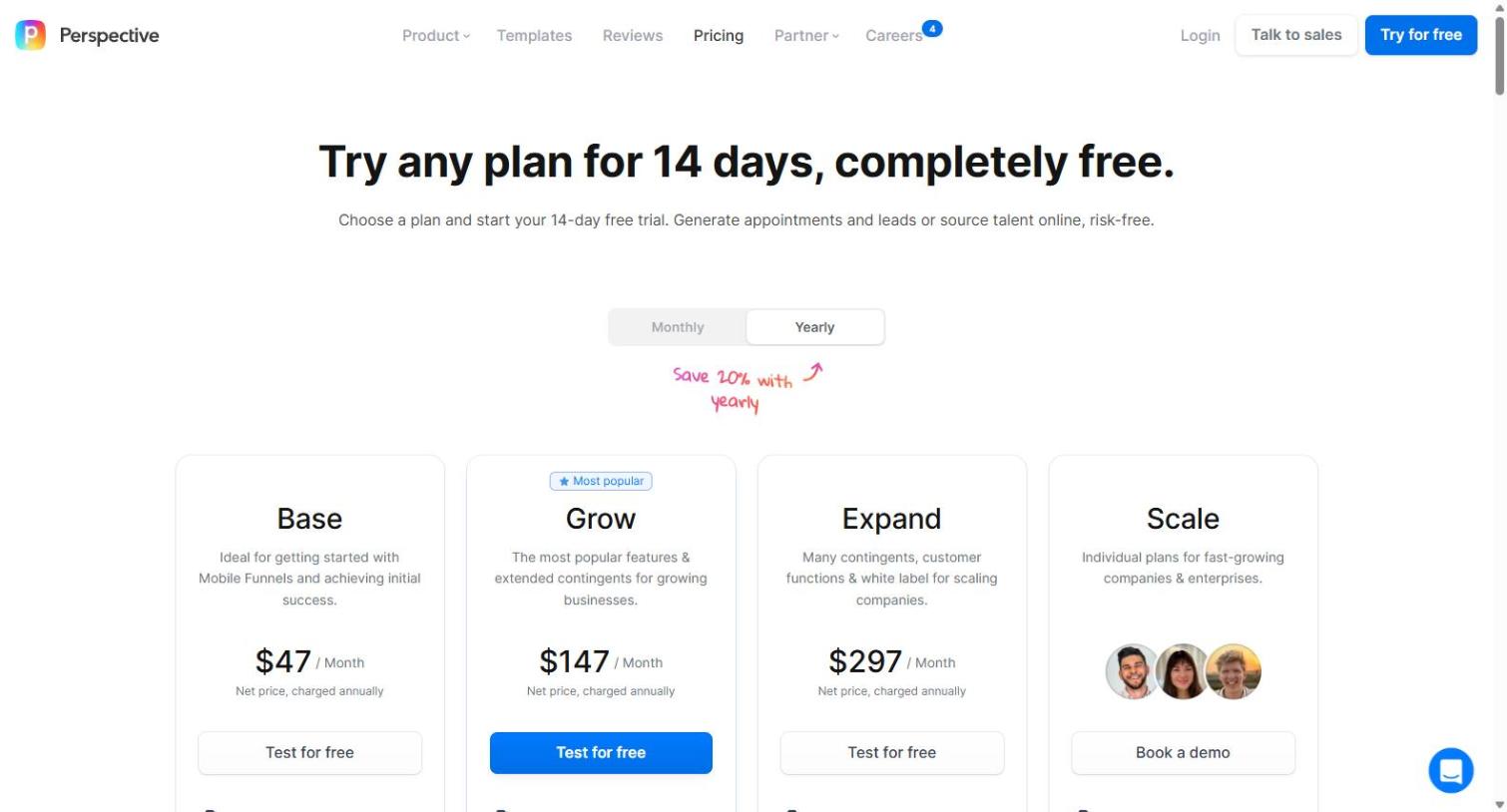
Perspective runs a modular pricing model with four core tiers, billed monthly or annually (annual billing saves 20% and is shown as the default “net” monthly price on their pricing page). Here’s what’s actually included at each level, pulled directly from Perspective’s pricing page:
| Plan | Price (annual billing) | Live funnels | Key features |
|---|---|---|---|
| Base | $47/month | 2 | Unlimited workspaces, domains, and contact managers; 50+ premium features; built-in CRM, metrics, and email; live support; GDPR-compliant; Meta Pixel, Zapier, and Make |
| Grow (most popular) | $147/month | 10 | Everything in Base, plus custom scripts, A/B testing, branding removal, and automation sequences |
| Expand | $297/month | 20 | Everything in Grow, plus multiple lead recipients, dynamic headlines, smart personalization, custom fonts, and WhatsApp messaging |
| Scale | Custom (book a demo) | 60+ | Everything in Expand, plus all Perspective add-on suites, a dedicated customer success manager, and role management |
Every plan includes a 14-day free trial with full feature access and no charge unless you continue past the trial period; Perspective sends a reminder email on day seven so the trial-to-paid transition isn’t a surprise. Beyond the included lead volume on each plan (100 leads on Base, 500 on Grow, 1,000 on Expand), additional generated leads are billed at a flat $0.25 per lead rather than a hard cap, so campaigns that outperform expectations don’t get throttled mid-month.
Perspective also sells optional add-on suites at $67/month each (Whitelabel, Premium Blocks, Personalization, Advanced Messaging, Advanced Metrics, and Premium Integrations) for teams on a lower tier who want one specific capability, like WhatsApp automation or dynamic headlines, without upgrading the entire plan.
For most B2B SaaS teams running one or two active campaigns, the Grow plan ($147/month) is the realistic starting point since it’s the first tier to include A/B testing and automation sequences. Agencies managing funnels across multiple client accounts will likely need Expand for the whitelabeling and multi-recipient lead routing. If you want to see the full breakdown against your own funnel volume, Perspective’s trial lets you test any tier for 14 days before committing.
Interactive funnels vs. static landing pages
The honest comparison isn’t “Perspective versus a specific competitor,” it’s interactive, multi-step funnels versus the static landing page most SaaS teams are already running. Both have a place.
A static landing page still makes sense for high-intent traffic that already knows what it wants, someone clicking a branded search ad for your product name doesn’t need to be walked through a quiz before hitting a demo request form. Static pages are also faster to build for a single, simple offer, and they’re easier to hand off to a designer who isn’t working inside a funnel-specific tool.
An interactive funnel earns its complexity when the traffic is less pre-qualified (cold paid social, top-of-funnel content, a broad keyword), when you’re selling to more than one buyer segment through the same channel, or when the qualifying information you collect up front genuinely changes what you show or say next. If your sales team is spending time on calls that shouldn’t have been booked in the first place because the lead wasn’t qualified, that’s usually a sign the intake process needs branching logic a static form can’t provide.
The practical approach most SaaS marketing teams land on is running both: static pages for branded and high-intent traffic, interactive funnels for paid social, content-driven traffic, and any offer where segmentation matters. If you’re building out a broader lead generation program and need help deciding where each format fits inside your funnel, that’s a conversation worth having with whoever owns your paid and organic strategy before you commit budget to either.
Getting started: what a first funnel build actually looks like
Based on Perspective’s own product walkthrough, the build process follows four steps: start from one of the 20+ proven templates rather than a blank canvas, apply your branding (custom domain, fonts, colors, logo), add qualifying logic and validation (phone and email verification, conditional branching) to filter out low-quality submissions before they hit your CRM, and publish. Perspective states funnels typically load in under 3 seconds thanks to their CDN hosting and progressive web app architecture, which matters directly for mobile conversion rates given how unforgiving mobile visitors are of slow-loading pages.
For a first build, the realistic move is picking one existing static landing page, ideally one with decent traffic but a conversion rate you’re not happy with, and rebuilding it as a funnel using one of the closest-matching templates (Lead Magnet, Strategy Call, or Appointment, depending on your offer). Run it against a portion of the same traffic for two to three weeks and compare completion rates and lead quality directly, rather than switching everything over on faith.
If you’re ready to build that first test funnel, start the 14-day free trial and pull in one of the templates closest to your current offer. There’s no charge unless you continue past the trial, so the only real cost is the time to build and run the test.
The bottom line
Perspective isn’t a replacement for your CRM, your email platform, or your paid media strategy, it’s a purpose-built layer for the specific job of turning a static, one-size-fits-all landing page into an interactive, branching experience that qualifies leads as they convert instead of after. For B2B SaaS and agency teams running paid social, content-driven, or multi-segment campaigns where a generic form is leaving quality on the table, that’s a meaningfully different tool than a standard page builder, and the 14-day trial is a low-cost way to find out whether the difference shows up in your own numbers.
Share this article

Alex Carter leads SEO and content strategy at MV3 Marketing, specializing in generative engine optimization, technical SEO, and AI-driven content systems for B2B companies.
Ready to audit your organic growth opportunity?
$2,500 flat. 5 business days. Six deliverables tied to pipeline , not rankings. No retainer required.
Get the Organic Growth Audit →