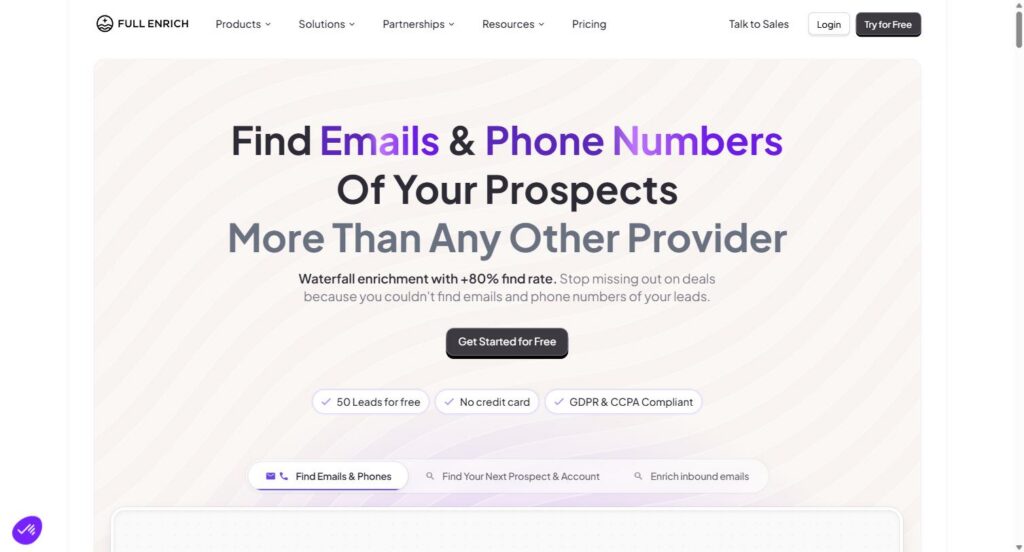
FullEnrich is a B2B contact data platform that runs each lead through 20+ data vendors in sequence, a method called waterfall enrichment, until it finds a verified work email, personal email, or mobile number. It’s built for SaaS sales and RevOps teams who need accurate contact data before an outbound campaign, not another single-source tool that comes up empty on half the list.
Affiliate Disclosure: MV3 Marketing participates in affiliate and partner programs, including FullEnrich’s. This post contains affiliate links, and we may earn a commission if you sign up through one of them, at no additional cost to you. We only recommend tools we’ve researched directly and would put in front of our own clients.
The problem with relying on one data vendor
Every SaaS sales team has run into this: you pull a list of 500 target accounts, run it through your CRM’s built-in enrichment or a single paid tool, and half the list comes back with no email, no phone number, or a work email that bounces the moment your SDR hits send. The list looks complete in your CRM. It isn’t reachable.
That gap is the reason waterfall enrichment exists as a category. A single vendor has a database with real coverage gaps by industry, company size, and region. No provider covers everyone. FullEnrich’s approach is to query more than 20 premium data providers, including names like Clearbit, Wiza, ContactOut, Anymail Finder, Hunter, and Snov, one after another for each contact, stopping as soon as a verified match is found. You’re not paying for 20 subscriptions. You’re paying once for whichever provider actually has the answer.
If your team is building outbound lists to support an account-based marketing motion, this matters even more, because ABM lives or dies on being able to reach the specific named decision-makers on your target account list, not just “someone at that company.”
How the waterfall actually works
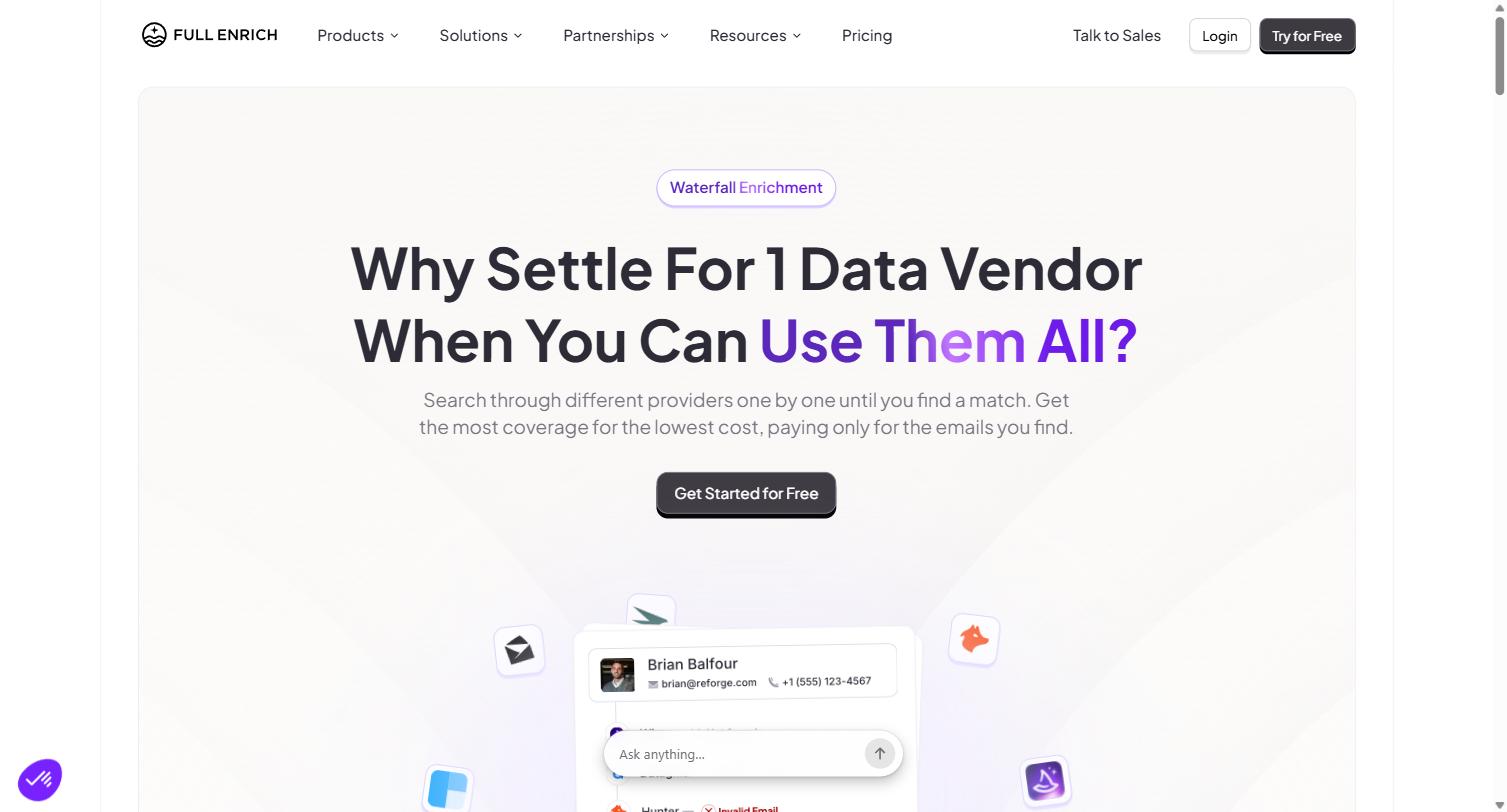
On FullEnrich’s own product page, the pitch is direct: “Why settle for one data vendor when you can use them all?” That’s the entire mechanism in one sentence. Instead of a single lookup that either hits or misses, FullEnrich searches through its provider network one by one until it finds a match, and you only pay a credit for the data point it actually finds. If the waterfall comes up empty on a contact, you’re not charged for that attempt.
The company reports an overall find rate above 80% across the waterfall, with regional breakdowns published on their site: roughly 77% for both phone and email in the US and Canada, and 71% phone / 84% email across EMEA, LATAM, and APAC. Coverage isn’t uniform everywhere, which is exactly the point of running multiple providers instead of trusting one to be equally strong in every market you sell into.
You can start an enrichment job four ways: a CSV or Excel upload, manual entry of names and companies, a synced list pulled from HubSpot or Salesforce, or a search built from FullEnrich’s own database of people and company filters. For a RevOps team cleaning up a CRM full of half-complete contact records, the CRM sync path in particular means you’re not exporting and re-importing spreadsheets every time you want fresh data on existing records.
Worth checking out the enrichment process yourself with a free FullEnrich trial, since the 50 free credits are enough to run a real test batch against your own list before committing to anything.
Verification is where the real work happens
Finding a possible email address is the easy part. Most data vendors will hand you an email that looks plausible and let you find out the hard way whether it bounces. FullEnrich’s verification layer is built to catch that before it reaches your list.
FullEnrich states it removes up to 29% of bad phone numbers returned by its data providers during verification, before that data ever reaches a customer or an invoice. That is not a small quality-control step; a meaningful share of purchased data gets filtered out before you ever see it. The verification process includes:
- Triple email verification: three independent verification engines have to agree on an email before it’s delivered; a single disagreement removes it.
- Catch-all resolution: instead of flagging catch-all domains as “risky” and moving on (which is what a lot of tools do), FullEnrich attempts to resolve the actual mailbox.
- Deliverability confidence scoring: every delivered email carries an expected bounce probability, so you can see your likely bounce rate before you launch a sequence.
- Phone verification against carrier networks: numbers are checked as active lines, dead numbers are removed, and phone ownership is matched against the lead’s name so reps aren’t cold-calling a stranger.
- Mobile-first phone billing: you’re only charged credits for mobile numbers. Landlines that turn up in the search are provided free.
For a SaaS sales team, this verification layer is the actual reason to use a waterfall tool instead of a single cheaper source. A list with a lower bounce risk protects your sender reputation and domain health on cold email, and a mobile number that’s been checked against a live carrier network is worth more to an SDR than five numbers that ring dead.
Feature walkthrough: what you’re actually working with
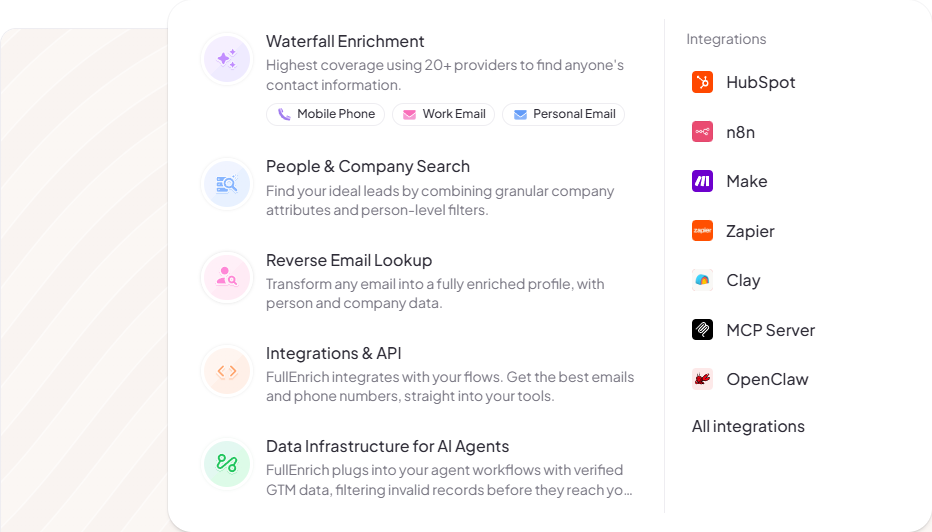
Past the core email and phone waterfall, FullEnrich’s product line breaks into a few distinct tools:
- Waterfall Enrichment – the core product covering mobile phone, work email, and personal email lookups, plus the B2B profile data (job title, tenure, work history, skills, education) and company data (headcount, industry, funding stage, social presence) that comes bundled with any enrichment.
- People & Company Search – a searchable database for building net-new prospect lists using granular filters on both the person and the company side, useful when you’re not starting from an existing list at all.
- Reverse Email Lookup – turns a bare email address into a full enriched person and company profile, which is handy for inbound leads that only give you an email on a form fill.
- Integrations & API – native connections into HubSpot and Salesforce, plus Zapier, Make, and n8n for teams building their own automation, and a documented API for anyone embedding enrichment directly into their own product or workflow.
- MCP Server – a Model Context Protocol server that lets AI agents call FullEnrich directly, which the company positions as data infrastructure for teams building AI-driven outbound workflows rather than manual list-building.
All of this sits inside a single account and subscription instead of separate contracts with each individual data vendor, which is the actual value proposition: you’re not managing 20 logins and 20 invoices to get waterfall-level coverage.
Practical use cases for service business sales and RevOps teams
Cleaning up a stale prospect list. Most CRMs accumulate contacts over years, and job titles change, people leave companies, and email domains get retired. Before running a re-engagement campaign against an old list, running it through a waterfall enrichment pass catches the contacts that have moved on and refreshes the ones that are still reachable, instead of mailing a list that’s partly dead weight.
Verifying data before a cold outbound campaign. Sending to unverified emails is one of the fastest ways to damage domain reputation and get flagged by spam filters, which then hurts deliverability on every other email your company sends, including customer-facing ones. Running a list through verification before the first send is cheaper than repairing a damaged sender reputation afterward.
Reducing bounce rates on ABM target account lists. When you’re running a named-account strategy with a short list of high-value targets, a bounced email on one of those accounts isn’t just a wasted send, it’s a missed shot at an account you specifically chose to go after. Waterfall enrichment against a small, high-priority list is a case where the per-contact credit cost is easy to justify.
Filling gaps after a CRM sync. Pushing a list from HubSpot or Salesforce into FullEnrich and pulling back only the missing data points (rather than re-enriching contacts you already have good data on) is a straightforward way to close data gaps without duplicating spend on records that are already complete.
Building net-new target lists from search. For teams expanding into a new segment or region, the People & Company Search product lets reps build a list from scratch using company and person filters rather than starting from a purchased or scraped list of uncertain quality.
If your team is short-staffed for outbound and evaluating whether to build this muscle in-house or lean on outside support, it’s worth a conversation about how FullEnrich fits into a broader pipeline stack, since the enrichment layer only pays off if the list actually gets worked afterward.
Pricing and the credit model, honestly
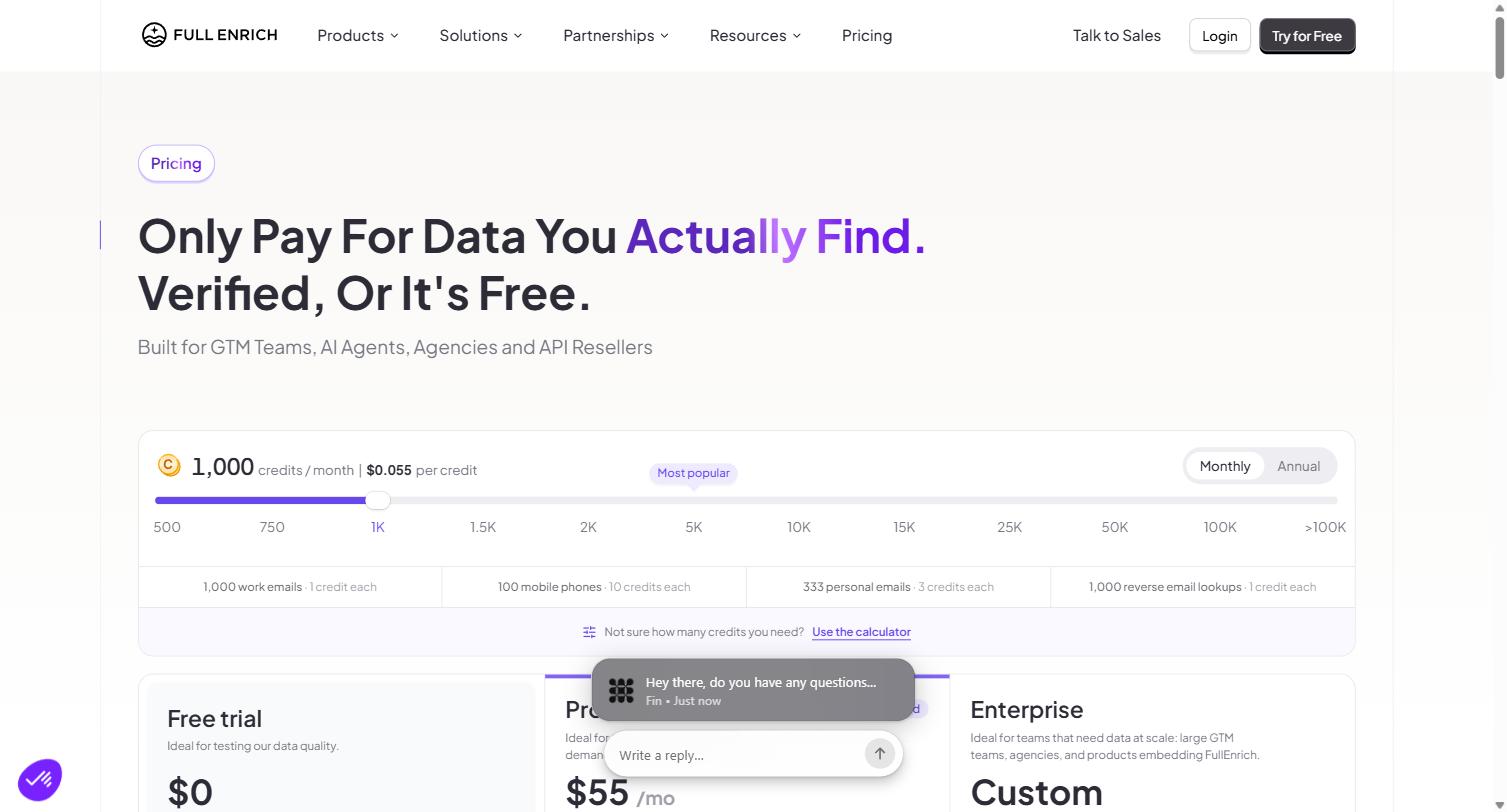
FullEnrich uses a credit system where you’re only billed for data it actually finds and verifies. As of this writing, the published plans are:
| Plan | Price | Credits | Notes |
|---|---|---|---|
| Free Trial | $0 | 50 credits | No credit card required |
| Pro | $55/mo | 1,000 credits/mo ($0.055 per credit) | Unlimited users, credit rollover, full feature set |
| Enterprise | Custom | Custom volume | Priority support, dedicated account manager, BYOK, custom SSO |
The Pro tier scales up on the same per-credit basis as your team’s volume grows, with plan sizes published up to 100K+ credits per month on FullEnrich’s pricing calculator. Credit costs by data type are published clearly rather than buried in fine print:
- Work email: 1 credit
- Personal email: 3 credits
- Mobile phone: 10 credits
- Reverse email lookup: 1 credit
- B2B profile and company data: included free with any enrichment (0.25 credit if requested on its own)
Unused credits roll over, three months on monthly billing and twelve months on annual billing, so a slower prospecting month doesn’t mean forfeiting what you paid for. Every plan, including the entry-level Pro tier, includes unlimited team seats on a shared credit pool rather than charging per user, which is a meaningfully different model than tools that price by seat and let credits sit unused on inactive logins.
Waterfall enrichment versus a single-source tool
The honest comparison here isn’t FullEnrich against a specific competitor, it’s waterfall enrichment as a category against relying on one data provider, which is still how a lot of sales teams operate by default because it’s what shipped inside their CRM or their first prospecting tool.
A single-source tool has one database, one refresh cycle, and blind spots that are specific to how that vendor built its data (which regions they cover well, which industries they’ve prioritized, how recently a given contact was verified). When that provider doesn’t have a match, you get nothing, and most reps either skip the contact or guess at a format like [email protected] and hope.
A waterfall approach doesn’t eliminate the underlying problem that contact data goes stale and coverage is uneven. It routes around it by checking multiple providers instead of one, which is a straightforward way to raise your find rate without requiring your team to hold separate accounts and separate credit balances with a dozen different vendors. The tradeoff is that you’re paying a small premium per successful match compared to the cheapest single-source option, in exchange for a meaningfully higher percentage of your list actually being reachable.
For a SaaS company where each qualified opportunity carries real deal value, the math generally favors reachability over the lowest possible per-contact cost. A verified list at an 80%+ find rate that a rep can actually work is worth more than a cheaper list where half the contacts bounce or go straight to voicemail on a dead line.
What teams using it report
FullEnrich publishes customer feedback directly on its site rather than only in third-party review aggregators, and a few of those accounts are specific enough to be useful context for a SaaS RevOps team evaluating the tool. A Global Head of Expansion at one company described piloting FullEnrich across more than 70 reps and seeing mobile number find rates roughly double, connect rates climb from single digits into the 30% range, and a sharp drop in invalid numbers reaching the phone queue. A product lead at another company described moving from roughly 200 million to 1.6 billion reachable contacts after switching their enrichment layer to FullEnrich, which they credited with winning deals in accounts where competitors simply had no usable contact data at all.
These are individual customer accounts, not independently audited benchmarks, and your own find rate will depend on your ICP, your target regions, and how clean your source list already is. That’s exactly why running your own free trial batch against a real segment of your list matters more than any published statistic, yours or anyone else’s.
Security and compliance
For a RevOps or sales ops team, the compliance posture of a data vendor is part of the buying decision, not an afterthought. FullEnrich is SOC 2 Type II compliant, publishes a GDPR compliance statement for handling EU personal data, and states CCPA compliance for California residents’ data privacy rights. The company also maintains a public trust center covering its security practices in more detail, which is worth a look if your legal or security team needs documentation before approving a new data vendor. FullEnrich also holds a 4.8 rating on G2 at the time of this writing, based on its own site’s review count display.
Quick answers on how it works
- Do I need a credit card for the free trial? No. FullEnrich’s free tier gives you 50 credits with no card required, enough to run a real test batch before you decide on a paid plan.
- What happens if the waterfall doesn’t find a match? You’re not charged. Credits are only spent when a data point is actually found and verified, which is the core mechanic that makes waterfall enrichment more cost-efficient than paying a flat fee per lookup regardless of outcome.
- Do unused credits expire right away? No. Credits roll over for three months on monthly billing and twelve months on annual billing, so they aren’t wiped out the moment a billing cycle resets.
- Is this only for outbound sales? No. FullEnrich’s site lists solutions built for sales teams, marketing teams, RevOps teams, and recruiters, and the reverse email lookup product specifically supports enriching inbound leads that only submit an email address.
Between the credit-only-on-success billing, the published verification numbers, and the option to test FullEnrich with 50 free credits before paying anything, there’s a low-risk way to find out whether waterfall enrichment actually closes the reachability gap on your specific list before committing budget to a monthly plan.
Getting set up
The onboarding path is short by design: sign up, get 50 free credits with no card required, and run a test batch against a real segment of your list, whether that’s a stale set of old MQLs, your current ABM target accounts, or a fresh list pulled from a CRM search. That gives you a real find-rate number on your own data instead of a generic marketing figure, before you decide whether the Pro plan’s volume fits your team’s monthly prospecting cadence.
If your outbound motion depends on reaching the right person with a real, working contact method, and you’ve been treating a spotty data source as just the cost of doing business, it’s worth spending twenty minutes running an actual list through FullEnrich’s free trial and comparing the results against whatever you’re using today. You’ll know within one batch whether the waterfall approach closes the gap your current tool has been leaving open.
For teams building out a broader SaaS marketing and demand generation program around better data, our marketing glossary covers related terms like ICP, TAM, and outbound sequencing if you want the fuller context on how contact data enrichment fits into pipeline strategy.
Share this article

Jordan Reeves leads account-based marketing and outbound pipeline strategy at MV3 Marketing, specializing in account selection, intent-signal targeting, and multi-channel orchestration for B2B companies.
Ready to audit your organic growth opportunity?
$2,500 flat. 5 business days. Six deliverables tied to pipeline , not rankings. No retainer required.
Get the Organic Growth Audit →