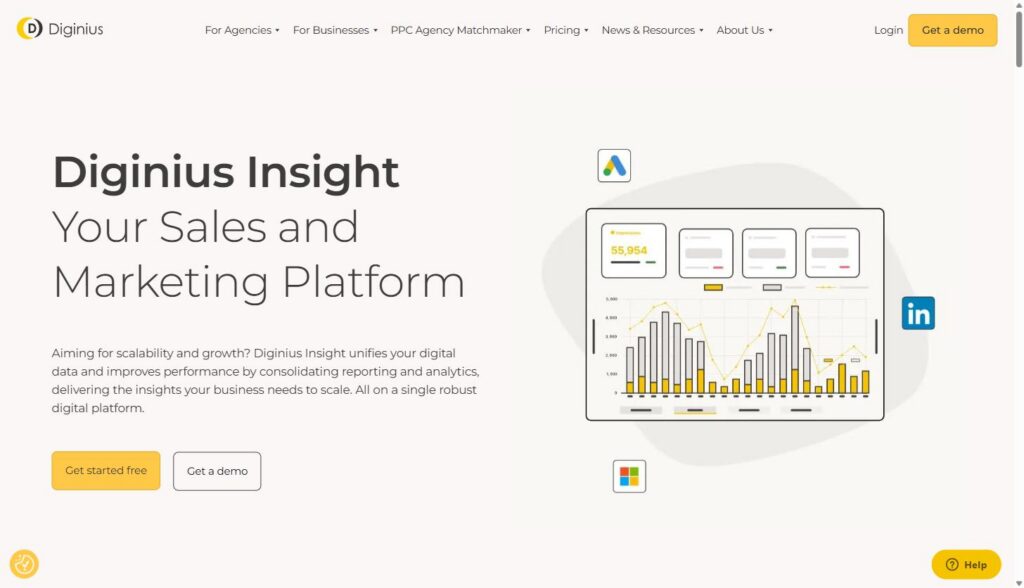
Diginius Insight is a data consolidation and reporting platform built to pull PPC, SEO, and lead data from Google, Microsoft, Facebook, and LinkedIn into one dashboard, with a separate agency-focused edition that adds white-labelled, multi-client reporting on top. It’s aimed at two audiences: in-house marketing teams juggling multiple ad channels, and digital marketing agencies managing paid campaigns and reporting across a roster of clients. For a B2B SaaS marketing agency running Google Ads and Microsoft Advertising for a dozen accounts, the pitch is straightforward: stop exporting CSVs from five different ad platforms every Monday morning and put it in one place instead.
Disclosure: MV3 Marketing participates in affiliate and partner programs, including with Diginius. This post contains an affiliate link, and if you sign up through it, we may earn a commission at no extra cost to you. Everything below reflects what we found directly on Diginius’s own site as of this writing, including the current published pricing.
What Diginius Insight actually is
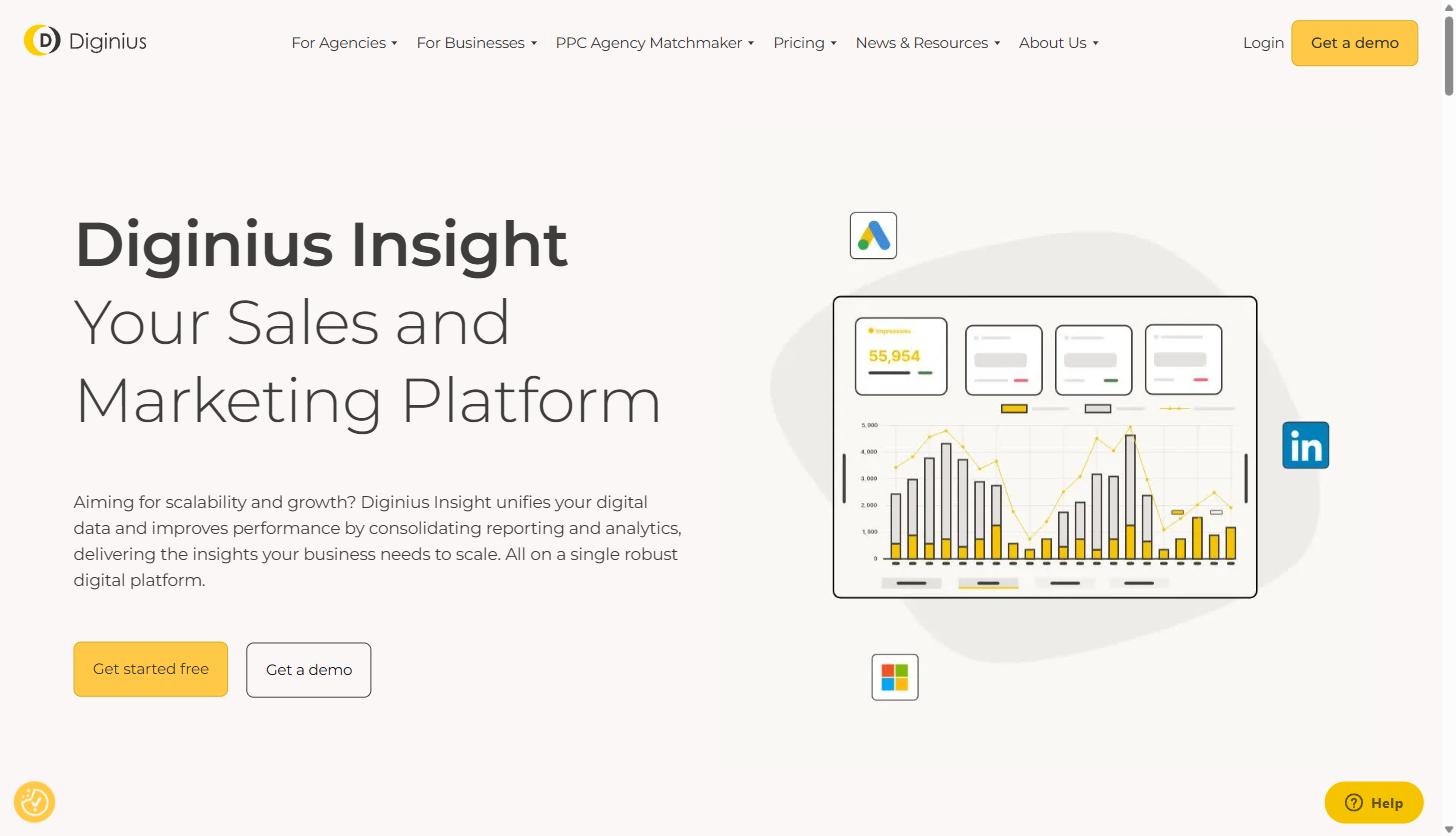
Diginius Ltd is a UK company (headquartered in London, with a New York office) that built Insight as, in its own words, a “sales and marketing platform” for scaling digital performance. The product splits into two entry points on the marketing site itself: “For Agencies” and “For Businesses,” and the feature set underneath is largely the same, aggregate reporting, lead identification, SEO tracking, campaign management, but the agency edition adds white-labelling, multi-client dashboards, and collaboration tooling on top.
The core promise is data consolidation. Rather than logging into Google Ads, Microsoft Advertising, Meta Ads Manager, and LinkedIn Campaign Manager separately to piece together how a client’s spend is performing, Diginius Insight pulls those platforms into a single reporting layer. According to the platform’s own marketing pages, the four areas it’s built around are Advertising Insights, Lead Intelligence, Reporting & Analysis, and SEO Management, each with its own dedicated section of the product rather than being bolted-on afterthoughts.
Diginius isn’t a brand-new entrant either. The company runs a live case-studies and news section, publishes client testimonials attributed to named agencies, and operates a separate “PPC Agency Matchmaker” service that connects businesses looking for a paid media agency with a roster of vetted partners, a two-sided piece of the business that only makes sense if there’s an established base of agency relationships behind it. Laura Moxham of YBA PPC is quoted on the Diginius homepage describing the company as “exceptionally valuable… responsive, on the ball and get the job done,” a second, independent data point alongside the No-Hassle Digital testimonial referenced below.
What it actually does
Stripped of marketing language, here’s what each of the four core areas covers, per Diginius’s own product pages:
- Advertising Insights aggregates performance across Google, Microsoft, Facebook, and LinkedIn, giving one view of spend, impressions, and ROI across channels instead of four separate ones.
- Reporting & Analysis consolidates organic traffic data, paid search, SEO, social, and lead intelligence into scheduled, automated reports, with the stated goal of creating “one source of truth” instead of reconciling numbers from multiple exports by hand.
- Lead Intelligence identifies and analyzes website visitors, including anonymous ones, and lets you reveal contact details for high-intent visitors to hand off to sales.
- SEO Management tracks keyword rankings, site health errors, and competitor positioning from inside the same platform rather than a separate SEO tool.
Every plan, including the entry-level tier, includes unlimited integrations and a Microsoft Publisher Network Tool, and Diginius also publishes a free standalone tool that audits a Google Ads account and forecasts how the same spend would perform on Microsoft Advertising, useful as a lightweight gut-check before committing to the full platform.
Reporting & Analysis: one dashboard instead of five tabs
This is the feature that maps most directly onto the “cut down manual reporting work” problem most agencies actually have. Diginius’s Reporting & Analysis product page frames it as unlocking “the full potential of your customer data” by pulling organic traffic, paid search, SEO, social, and lead intelligence into a single reporting surface, with automated, scheduled email reports rather than an analyst manually assembling a deck every month.
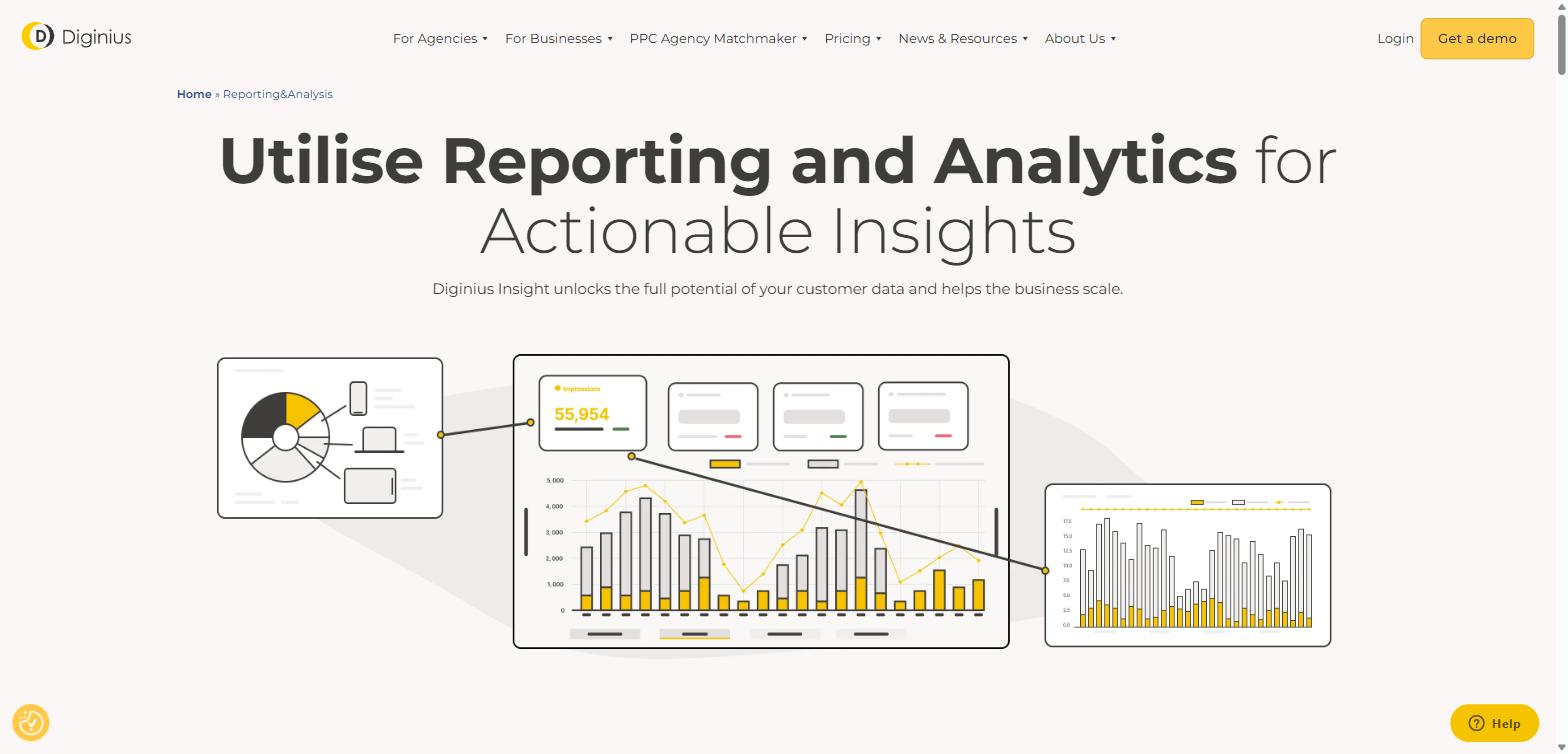
For an agency specifically, this is where the “reconcile data and create one source of truth” language on Diginius’s own site matters most. When a client asks why the number in last month’s PDF doesn’t match what they see logged into their own Google Ads account, having one reporting layer that both sides can point to removes a recurring, low-value argument. The automation angle also matters for time: scheduled reports mean the reporting cadence doesn’t depend on someone remembering to log into four platforms every Friday afternoon.
Advertising Insights: campaign and bid management across Google and Microsoft
Diginius’s Advertising Insights section is explicitly framed around PPC and shopping campaign performance, and its dedicated landing page states the goal plainly: “Increase conversion and ROI by managing Google and Microsoft campaigns on one platform.” This is also where Diginius’s proprietary bidding engine lives, referenced directly in a client testimonial on the homepage from Dragan Radivojevic at No-Hassle Digital, who called out “its proprietary bidding engine as well as the lead insight feature that’s especially useful for B2B clients” as standout features after working with a dedicated Diginius support specialist.
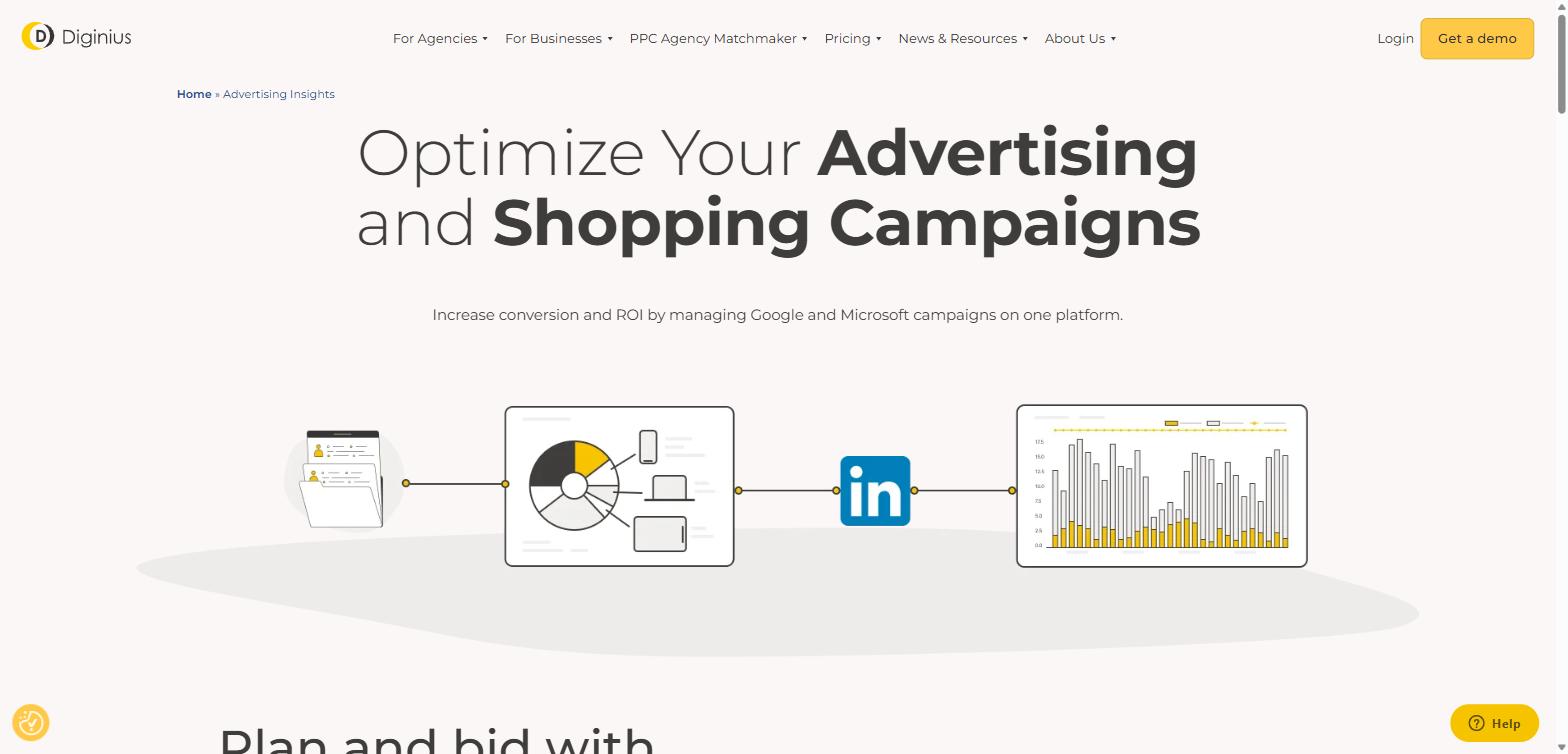
The Microsoft angle is worth calling out specifically because it’s a genuine differentiator versus most reporting tools that treat Google Ads as the default and everything else as an afterthought. Diginius runs a Microsoft Partner Program exclusive to PPC agencies, offering financial incentives and beta program access for agencies that grow their Microsoft Advertising spend through the platform. For an agency that’s historically under-invested in Microsoft Advertising because managing it meant a second, separate workflow, having Google and Microsoft campaign management, bidding, and reporting in the same tool lowers the friction to actually diversifying spend, which is also the exact pitch behind Diginius’s free Google Ads audit tool: showing what a campaign would look like reallocated toward Microsoft.
Lead Intelligence: turning anonymous visitors into named contacts
The Lead Intelligence module is a website visitor identification tool, GDPR-compliant per Diginius’s own product page, that identifies companies and individuals browsing a website and surfaces contact details for the ones worth following up on. The product page frames the goal as helping teams “understand your website traffic and the consumers’ behaviour” and “drive higher conversion rates through tailored warm messaging” rather than cold outreach with no context.
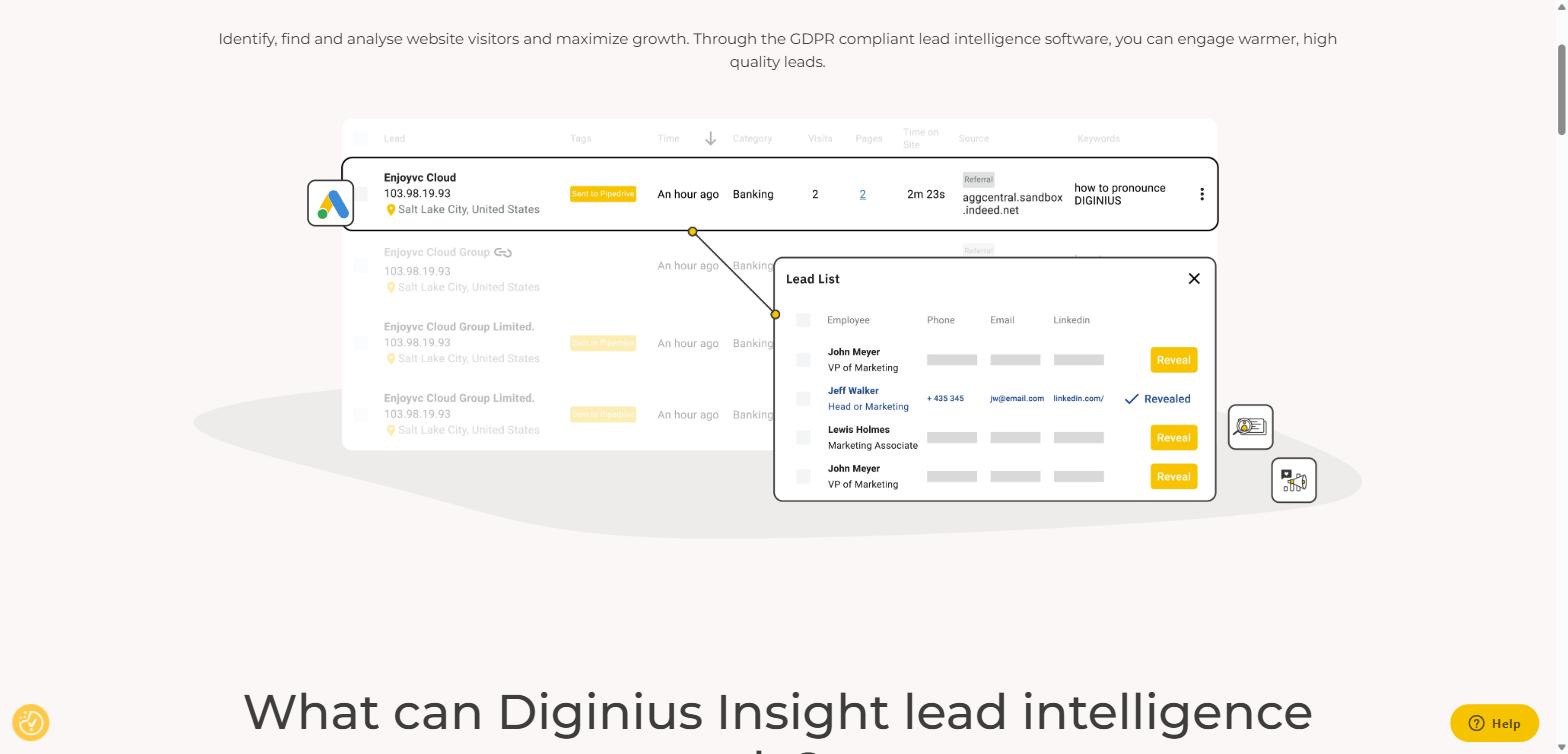
The interface shown on Diginius’s own product page is specific about what this looks like in practice: a visiting company is logged with visit count, pages viewed, time on site, referral source, and search keywords, and a “Lead List” panel lets you reveal an individual contact’s phone, email, and LinkedIn profile one record at a time. The screenshot also shows a “Sent to Pipedrive” tag, indicating CRM hand-off is part of the intended workflow rather than leads sitting inside Diginius unused. Diginius also separately lists “Intent Leads by Bombora” as a distinct, metered feature on its pricing page, layering third-party intent data from Bombora on top of its own first-party visitor identification, which is a meaningfully different (and typically more expensive) data source than on-site visitor tracking alone.
For a B2B SaaS company or an agency managing SaaS clients, this is arguably the most differentiated part of the platform relative to a pure ad-reporting tool. Most PPC dashboards stop at click and conversion data; Diginius extends into “who actually showed up on the site afterward and are they worth a sales call,” which is a genuinely different job than reporting on spend.
What it actually costs
Diginius publishes real, specific pricing on its site rather than hiding everything behind “contact sales,” which is worth noting since a lot of platforms in this category don’t. There are four tiers: Essential, Pro, Core, and Business, with the top tier requiring a custom quote. All tiers include unlimited integrations and a 30-day free trial (100 Intent Leads per week and 100 contact info credits during the trial period, reverting to plan limits afterward). Annual billing saves 20% versus paying monthly.
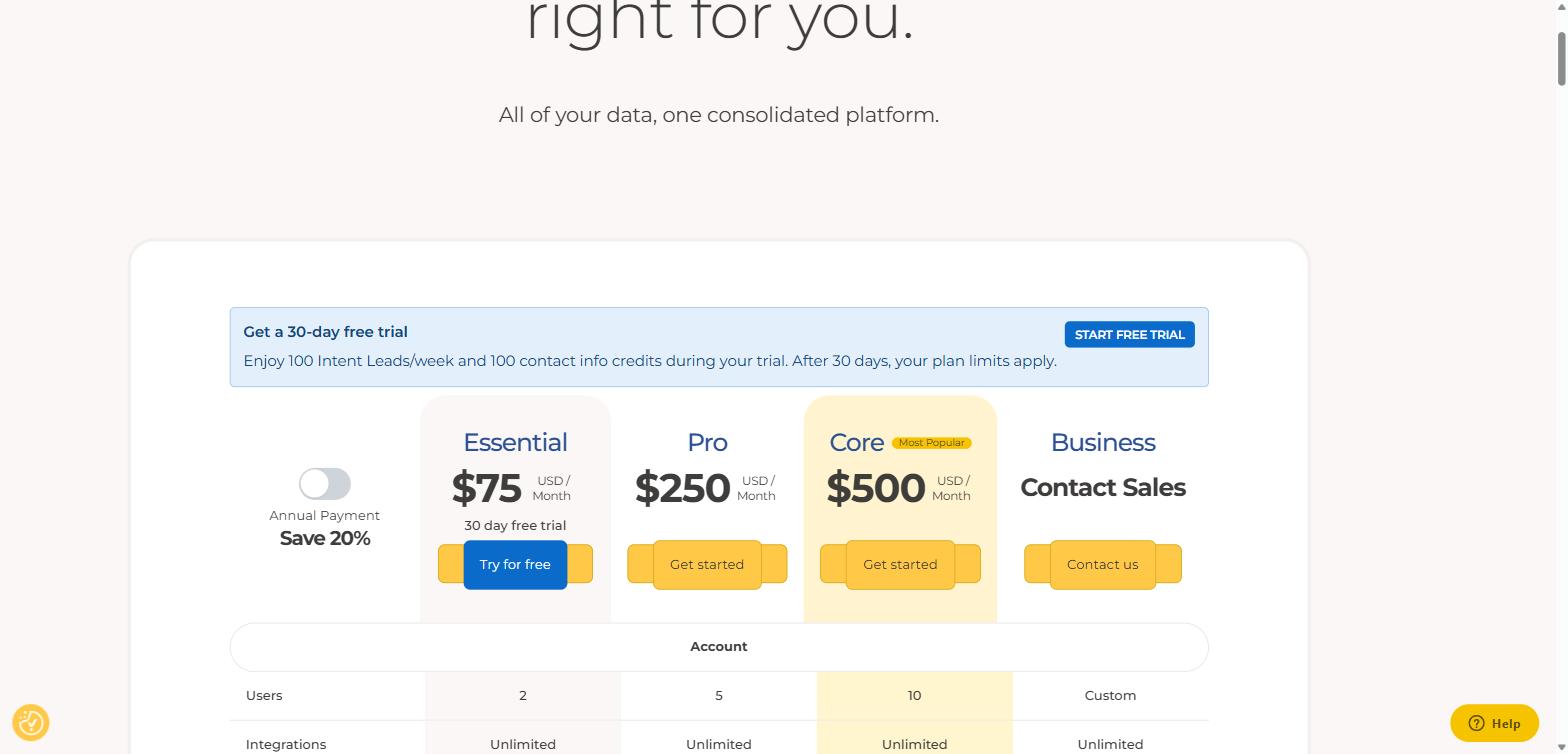
| Plan | Price | Users | SEO keywords / site pages | Lead Intelligence leads/wk | Support |
|---|---|---|---|---|---|
| Essential | $75/mo | 2 | 25 / 1,000 | 10 | Email support |
| Pro | $250/mo | 5 | 500 / 5,000 | 25 | Customer Success Rep |
| Core (Most Popular) | $500/mo | 10 | 1,000 / 10,000 | 50 | Dedicated CS Rep |
| Business | Contact Sales | Custom | Custom / Custom | Custom | Dedicated CS Rep |
A few things worth flagging directly from that pricing table. First, “unlimited integrations” applies to every tier, so an agency isn’t paying more to connect additional ad accounts or channels, the per-tier limits are on usage (SEO keywords tracked, site pages crawled, leads surfaced) rather than which platforms you can connect. Second, the user-seat jump matters for agency planning: Essential caps out at 2 users, which is workable for a solo operator or very small team but tight for an agency where account managers, a PPC lead, and a reporting analyst all need logins, making Pro (5 users) or Core (10 users) the more realistic starting point for a multi-person agency team. Third, Contact Info Credits (used to reveal an individual lead’s phone, email, and LinkedIn) and Intent Leads by Bombora are both separately metered line items on the pricing page, not included at unlimited volume on any tier, so an agency planning to lean heavily on the Lead Intelligence reveal feature should size the credit allowance against expected monthly volume rather than assuming it’s unlimited.
Who this isn’t for
Diginius Insight is built specifically around paid media reporting, SEO tracking, and lead identification, primarily for Google, Microsoft, Facebook, and LinkedIn. If your channel mix is weighted heavily toward TikTok Ads, Pinterest, or programmatic display outside those four platforms, the aggregation value drops because the tool’s core integrations don’t cover it, and you’d be back to exporting that channel’s data separately regardless.
It’s also worth being clear-eyed about scale: the entry-level Essential plan’s 2-user cap and 25-keyword SEO allowance are sized for a small account or a single client, not a full agency book of business. An agency managing 15+ client accounts across paid and organic should expect to land on Core or a custom Business quote rather than Essential, which changes the real monthly cost comparison versus a tool priced flat regardless of client count.
Finally, Diginius is a reporting, aggregation, and lead-identification layer, it is not a full replacement for a dedicated CRM, an SEO content platform, or a paid media execution team. The Lead Intelligence “Sent to Pipedrive” workflow shown on Diginius’s own product page is a good example of the intended model: Diginius identifies and qualifies, but the actual sales pipeline still lives in a CRM downstream. Teams looking for an all-in-one CRM-plus-reporting suite, rather than a reporting and lead-identification layer that sits on top of channels and hands off to existing tools, should weigh that distinction before buying.
Who it’s actually a good fit for
The clearest fit is a PPC-focused agency or an in-house B2B SaaS marketing team running active Google Ads and Microsoft Advertising campaigns for multiple clients or business units, currently stitching together reporting by hand across platforms, and wanting a white-labelled way to show clients consolidated performance without building that dashboard themselves. The combination of the proprietary bidding engine, the Microsoft Partner Program’s financial incentives for agencies, and the Lead Intelligence hand-off to a CRM makes the strongest case for agencies specifically, versus a single in-house marketer who might only need the Reporting & Analysis piece.
How the agency-specific tools fit into a real workflow
Diginius’s dedicated Agencies page breaks its agency-facing tooling into three buckets, worth understanding separately from the four core product areas above because they’re really about workflow, not new data sources. Data Consolidation covers building multiple client dashboards from a single account, with data secured in a centralized, regulation-aligned setup rather than scattered across individual platform logins per account manager. The Agency Client Management Suite is the white-labelling and multi-client reporting layer referenced earlier, built specifically to streamline campaign oversight and client-facing reporting so an account manager isn’t rebuilding a report from scratch for every client every month. Agency Support Tools is where the bidding engine and campaign optimization recommendations live alongside a dedicated Customer Success Manager, positioned as ongoing guidance rather than a one-time onboarding call.
In practice, that structure maps onto a fairly normal agency reporting cycle: an account manager sets up a branded dashboard for a client during onboarding, the bidding engine and optimization recommendations run in the background across the campaign’s lifecycle, and the Reporting & Analysis automation handles the recurring monthly (or weekly) client report without someone manually rebuilding a slide deck. The dedicated CS Rep or Customer Success Manager, included starting at the Pro tier per the pricing table above, is the support layer meant to catch issues, like a dashboard misconfiguration or an integration that silently disconnected, before a client notices something’s off in their monthly numbers.
FAQ
Does Diginius Insight integrate with Facebook and LinkedIn, or just Google and Microsoft?
Yes. Diginius’s own homepage and Advertising Insights page both list Google, Microsoft, Facebook, and LinkedIn as aggregated channels, with Google Ads, Microsoft Advertising, and LinkedIn integration icons shown directly on the product pages. The bidding engine and campaign management tooling are most explicitly built around Google and Microsoft, per the Advertising Insights page copy, while Facebook and LinkedIn data feed into the broader reporting and analytics layer.
Is there a free trial, and what happens after it ends?
Diginius offers a 30-day free trial that includes 100 Intent Leads per week and 100 contact info credits, per the current pricing page. After 30 days, the account reverts to whatever plan’s limits apply, so it’s worth deciding on a target tier (Essential, Pro, or Core) before the trial period ends rather than being surprised by a drop in lead or credit volume.
What’s the difference between Lead Intelligence leads and Intent Leads by Bombora?
They’re two separate, separately metered data sources on the same pricing page. Lead Intelligence leads come from Diginius’s own on-site visitor identification, i.e., who actually visited your website. Intent Leads by Bombora is third-party buyer-intent data layered on top, surfacing accounts showing purchase-intent signals elsewhere on the web, not necessarily visitors to your own site. Both are counted and capped separately per plan tier.
Does Diginius offer white-labelled reporting for agencies?
Yes. Diginius’s dedicated “For Agencies” section describes branded dashboards, multi-client management tools, and collaboration features built specifically for digital marketing agencies managing multiple client accounts, distinct from the standard business-facing product experience.
The bottom line
Diginius Insight is a legitimate answer to a specific, common agency problem: too much time spent manually reconciling PPC, SEO, and lead data across Google, Microsoft, Facebook, and LinkedIn instead of acting on it. The published, tiered pricing (rather than a universal “book a demo” wall), the proprietary bidding engine, the Microsoft-specific incentives for agencies, and the Lead Intelligence visitor-identification layer are all real, verifiable features on Diginius’s own site, not just marketing copy. Whether it’s the right fit comes down to channel mix (strong if you’re Google- and Microsoft-heavy, weaker outside those four platforms) and scale (Core or a custom Business quote for a real agency book of business, Essential only for a very small operation).
If the manual-reporting problem above sounds familiar and you want a second set of eyes on whether a consolidation platform like Diginius fits your actual client mix and reporting workload, or where it should sit alongside the rest of your martech stack, book a strategy call with MV3 Marketing and we’ll walk through it with you.
Ready to see the unified dashboard and bidding engine against your own campaigns? Start a free 30-day trial of Diginius Insight and connect your Google Ads or Microsoft Advertising account to see the consolidated reporting for yourself.
Share this article

Alex Carter leads SEO and content strategy at MV3 Marketing, specializing in generative engine optimization, technical SEO, and AI-driven content systems for B2B companies.
Ready to audit your organic growth opportunity?
$2,500 flat. 5 business days. Six deliverables tied to pipeline , not rankings. No retainer required.
Get the Organic Growth Audit →