
The best AI SEO setup in 2026 is a stack, not a single tool: Profound or Otterly.AI for AI citation monitoring, Ahrefs or Semrush as the data backbone, Screaming Frog for technical crawls, Surfer or Clearscope for content optimization, AccuRanker for rank tracking at scale, and WordLift or Schema App for structured data. Every price below was pulled from the vendor’s own pricing page in July 2026.
Tool roundups in this category have a padding problem. Most of them list 25 products the author has never opened, rank whoever pays the highest affiliate commission first, and quote pricing that was wrong two quarters ago. This one is shorter on purpose: 12 tools, grouped by the actual job each one does, with pricing checked against each vendor’s own published page this month. Where a vendor does not publish a number, we say so instead of guessing.
How we picked and priced these tools
Three rules shaped this list.
First, tools are grouped by job, not by marketing category. “AI SEO tool” now gets stamped on everything from a $29 citation tracker to an $879 knowledge graph platform. Those products do not compete with each other, and comparing them head to head is how buyers end up with the wrong stack. The jobs that matter in 2026: monitoring how AI engines cite you, running site-wide SEO data (keywords, backlinks, audits), crawling for technical problems, optimizing individual pages, tracking rankings, and managing structured data.
Second, every pricing claim traces to the vendor’s own pricing page, re-verified on July 28, 2026. Not a review site, not a months-old screenshot. Pricing in this space moves fast: two vendors on this list changed what their pricing pages display since we first drafted this article a few weeks ago, and third-party roundups still quote the old numbers. If a vendor’s page did not display a figure when we checked, we say “check their page” or “contact for pricing” rather than inventing one. The interface screenshots throughout this article were captured the same day, directly from each vendor’s own public pages, so what you see is what their product marketing currently shows.
Third, no affiliate links. None of the links in this article pay us anything. We use some of these tools daily in client work (Ahrefs most heavily), and where our experience colors a recommendation, we flag it.
One honest caveat before the table: a tool list is a starting point, not a strategy. If you would rather see how these tools apply to your specific site before buying anything, book a call and we will walk through it with your data on screen.
The 12 best AI SEO tools at a glance
| Tool | Job | Starts at | Best for |
|---|---|---|---|
| Profound | AI visibility monitoring | $99/mo (billed yearly) | Mid-market and enterprise brands tracking AI answers seriously |
| Otterly.AI | AI visibility monitoring | $29/mo | Small teams that want citation tracking without a big line item |
| Peec AI | AI visibility monitoring | $95/mo | Teams that want engine breadth and a dashboard non-SEOs will actually read |
| Ahrefs | All-in-one SEO platform | $29/mo (Starter) | Backlink and keyword data plus built-in AI tracking |
| Semrush | All-in-one SEO platform | $117.33/mo (annual) | Teams that want SEO and AI visibility in one contract |
| Screaming Frog | Technical crawler | Free (500 URLs) | Every technical SEO, at any budget |
| Sitebulb | Technical crawler | Desktop from $18/mo | Audit reporting and recurring scheduled crawls |
| Surfer | Content optimization | $49/mo (annual) | Content teams producing at volume |
| Clearscope | Content optimization | $129/mo | Editorial teams that care about quality over volume |
| AccuRanker | Rank tracking | $224/mo | Agencies and in-house teams tracking thousands of keywords |
| WordLift | Schema and knowledge graph | $879/mo (billed yearly) | Brands treating structured data as an AI visibility channel |
| Schema App | Schema and knowledge graph | Contact for pricing | Enterprise structured data at scale |
Now the detail, category by category, including what each tool actually does, what its interface looks like, and where it falls short.
AI visibility monitoring: Profound, Otterly.AI, Peec AI
This is the newest category on the list and the reason “AI SEO tools” became a search term at all. These products run your important prompts against AI engines (ChatGPT, Perplexity, Google AI Overviews, Copilot and others) on a schedule, then report whether you were cited, who was cited instead, and how sentiment reads. If generative engine optimization is new territory for you, our pillar guide What Is GEO? The Full 2026 Guide covers the discipline these tools serve.
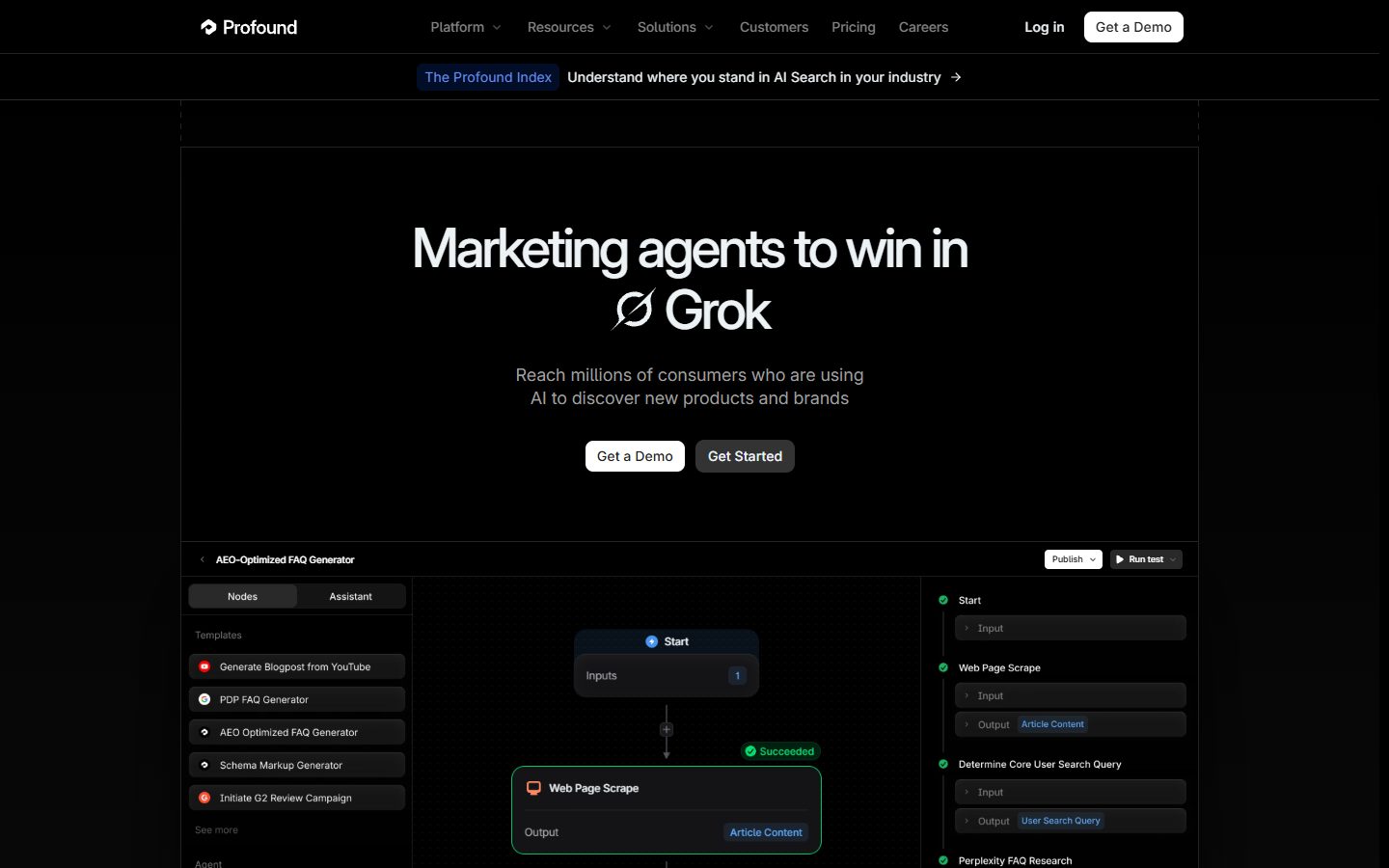
Profound is the reference product in this category. It runs daily structured prompts against AI engines, measures citations, sentiment, and competitive share, and adds agent analytics that attribute traffic arriving from AI surfaces. The engine coverage scales with the tier: Starter tracks ChatGPT only with 50 prompts (1,500 responses analyzed monthly), Growth tracks three engines (ChatGPT, Perplexity, Google AI Overviews) with 100 prompts and 9,000 monthly responses, and Enterprise extends to as many as nine engines, including Gemini, Copilot, Grok, DeepSeek, and Claude. Published pricing starts at $99/mo for Starter and $399/mo for Growth, both billed yearly, with custom Enterprise pricing above that. The product has also grown past pure monitoring: the homepage now leads with Profound Agents, a node-based workflow builder with prebuilt templates like “AEO-Optimized FAQ Generator” and “Schema Markup Generator” that chain steps such as web page scraping and Perplexity FAQ research into automated AEO content jobs. Starter includes 100 agent credits a month, Growth 400.
Otterly.AI is the budget pick, and a genuinely good one. The $29/mo Lite plan tracks 15 search prompts daily across four engines (ChatGPT, Google AI Overviews, Perplexity, Copilot), with Claude, Gemini, and Google AI Mode available as paid add-ons. Standard at $189/mo raises that to 100 prompts and adds API and MCP access; Premium at $489/mo covers 400 prompts. Every tier includes unlimited team members, which is rarer than it should be in this category. The core report is a brand coverage view: a line chart of your coverage percentage over time plotted against your top five competitors, next to running counts of brand mentions and average brand position in AI answers. Fifteen prompts sounds thin until you realize most brands have fewer than fifteen prompts that actually drive pipeline. Start here if you have never measured AI visibility before.

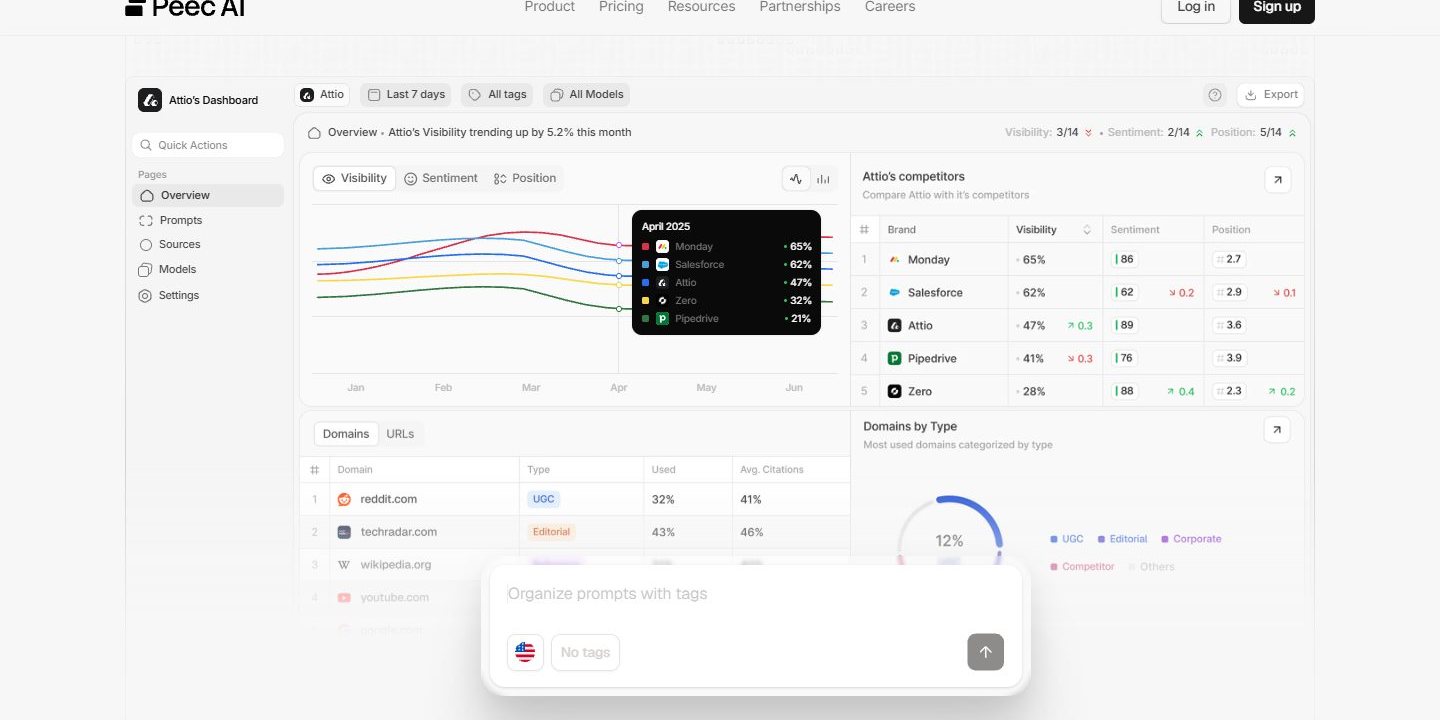
Peec AI monitors visibility, position, and sentiment across ChatGPT, Perplexity, Gemini, AI Overviews, AI Mode, and Copilot. Since our first check earlier in July, Peec’s pricing page has started displaying fixed figures: Starter at $95/mo (50 prompts, 3 models, 1 project), Pro at $245/mo (150 prompts, 2 projects), Advanced at $495/mo (350 prompts, 5 projects, multi-country, Looker Studio), and custom Enterprise with up to 11 models and API access. The dashboard is the cleanest in the category: a visibility trend line overlaid with competitors, a ranked competitor table with sentiment and position deltas, and a cited-domains table showing which sites (Reddit, Wikipedia, YouTube and so on) AI engines actually pull from when answering your prompts, broken down by type. That last view quietly answers the “where do we need coverage” question most teams pay consultants for.
Which one? If AI citations already influence your pipeline, Profound. If you are validating whether they matter for your niche, Otterly.AI at $29 is the cheapest credible answer in the industry. A citation-monitoring subscription tells you where you stand; turning weak AI visibility into strong AI visibility is content and authority work, which is the part we handle for clients under our Growth AI program.
All-in-one platforms with AI layers: Ahrefs, Semrush
The two incumbent SEO platforms both spent the last two years bolting serious AI visibility features onto their core keyword, backlink, and audit data. For most teams, one of these remains the backbone of the stack.
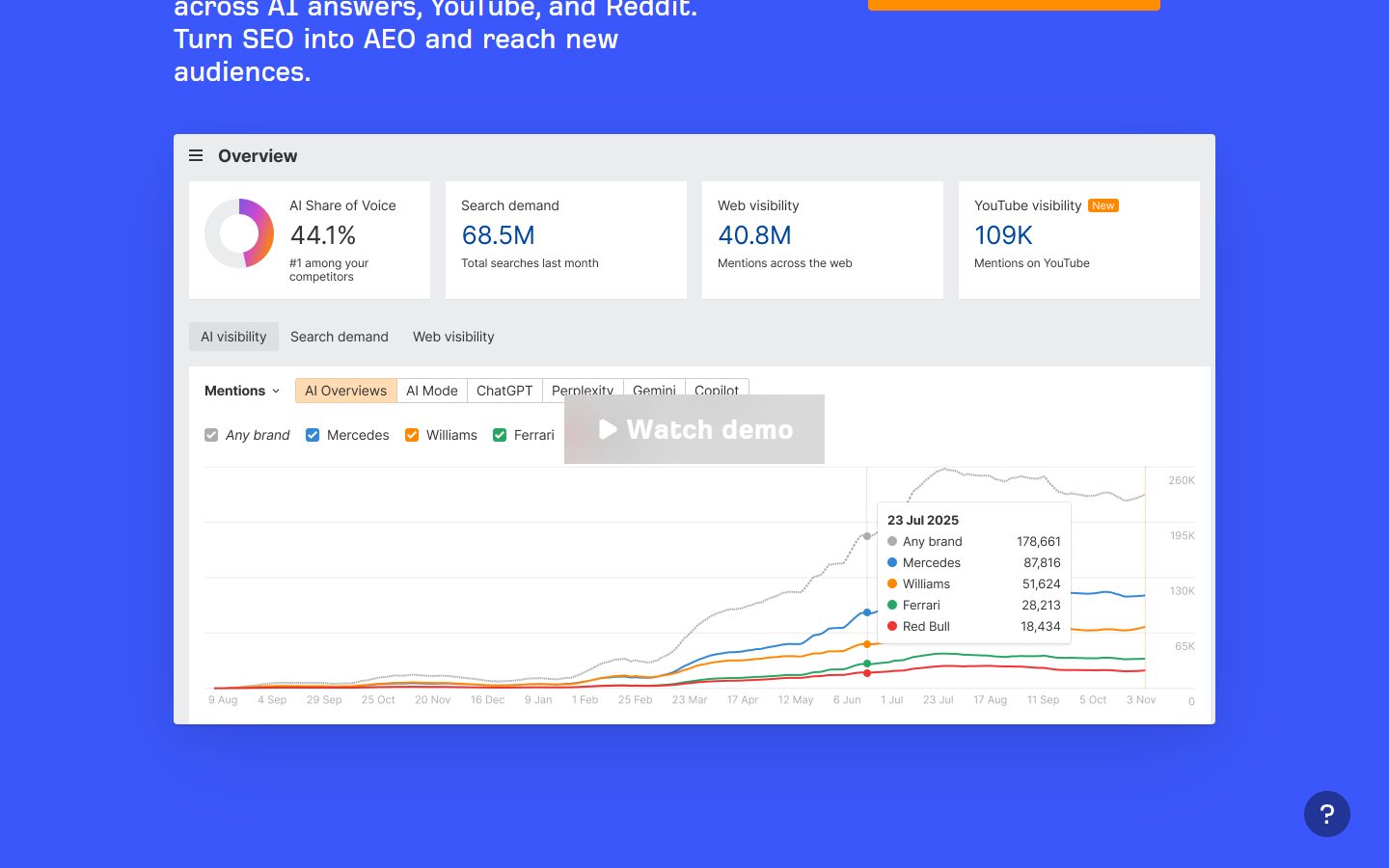
Ahrefs is what we run internally at MV3, so treat this paragraph as experienced but not neutral. The crawler-backed link index is still the best reason to pay for it: backlink analysis, site audits, keyword research, and rank tracking in one place. The 2026 wrinkle is Brand Radar, Ahrefs’ AI visibility product, now included across the main plans with tracked-prompt limits that scale by tier (5 prompts on Lite, 10 on Standard, 20 on Advanced). Its Overview screen rolls AI share of voice, search demand, web visibility, and YouTube visibility into one report, with a mentions chart you can filter by surface: AI Overviews, AI Mode, ChatGPT, Perplexity, Gemini, or Copilot. Published pricing: Starter at $29/mo, Lite at $129/mo, Standard at $249/mo, Advanced at $449/mo, Enterprise at $1,499/mo, and Brand Radar is also sold standalone from $199/mo, with custom prompt packages from $50/mo on top. In practice, the Lite plan plus its included Brand Radar prompts is the best value entry into both classic SEO data and AI tracking from a single vendor.
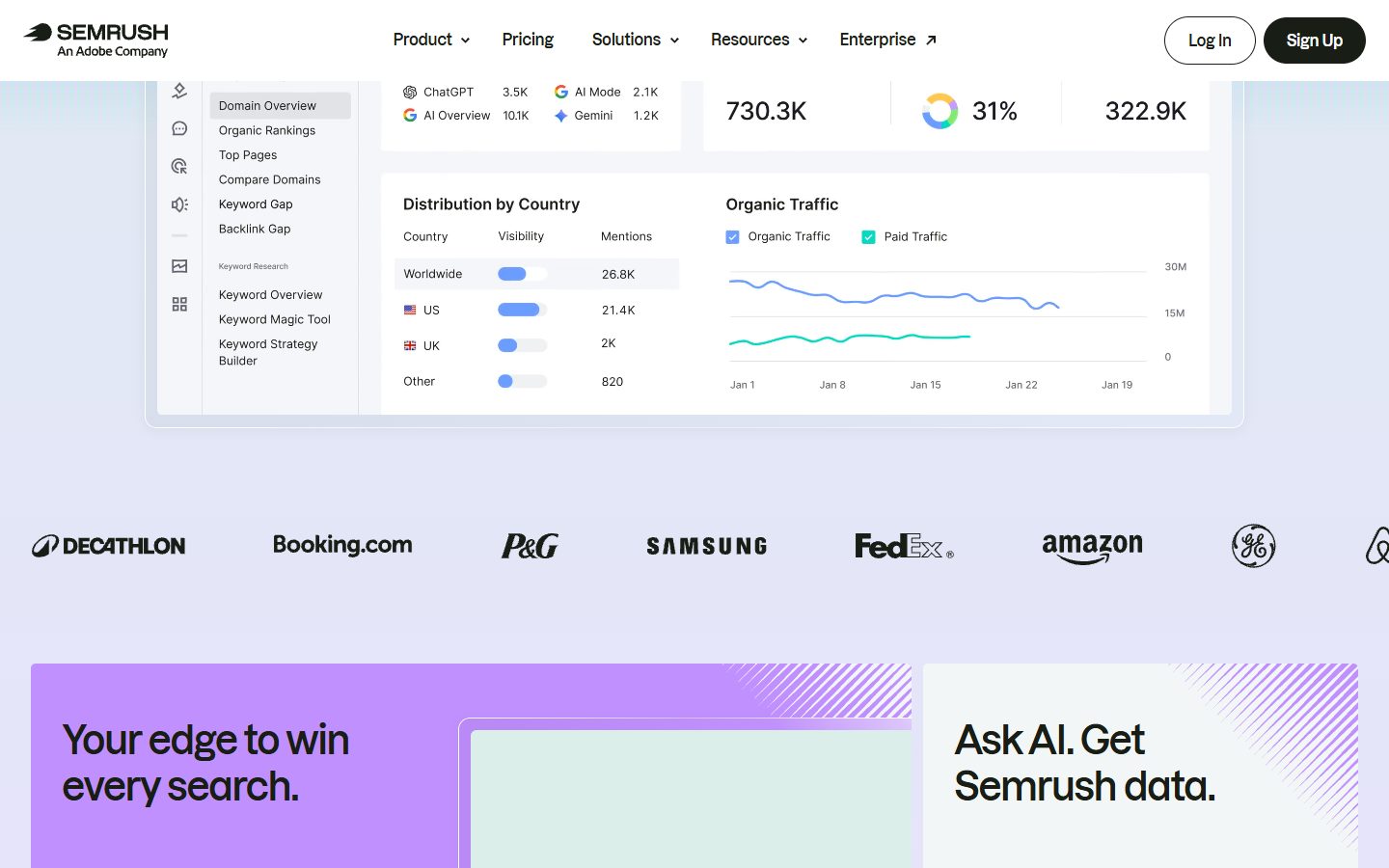
Semrush reorganized its lineup around “Semrush One,” which bundles the classic SEO toolkit with its AI visibility features. Current annual-billing pricing runs from $117.33/mo for the SEO-only plan to $165.17/mo for Starter (the cheapest tier that includes AI visibility tracking, at 50 prompts daily), $248.17/mo for Pro+ (100 prompts), and $455.67/mo for Advanced (200 prompts plus API access). The AI visibility side now gets equal billing with classic SEO in the product itself: the domain overview breaks out mentions by engine (ChatGPT, AI Overviews, AI Mode, Gemini), maps visibility by country, and sits alongside the familiar organic traffic charts in one interface. Semrush’s edge over Ahrefs is breadth: PPC data, social tooling, and content features live in the same account. Its weakness is that breadth; most teams use a fraction of what they pay for.
You do not need both. Pick Ahrefs if backlink data quality drives your decisions, Semrush if you want one invoice covering SEO, AI visibility, and paid media research.
Technical crawlers: Screaming Frog, Sitebulb
AI engines cannot cite pages they cannot fetch, so the least glamorous category on this list quietly became more important, not less. A crawler finds the broken canonicals, orphaned pages, blocked resources, and redirect chains that cap everything else you do.
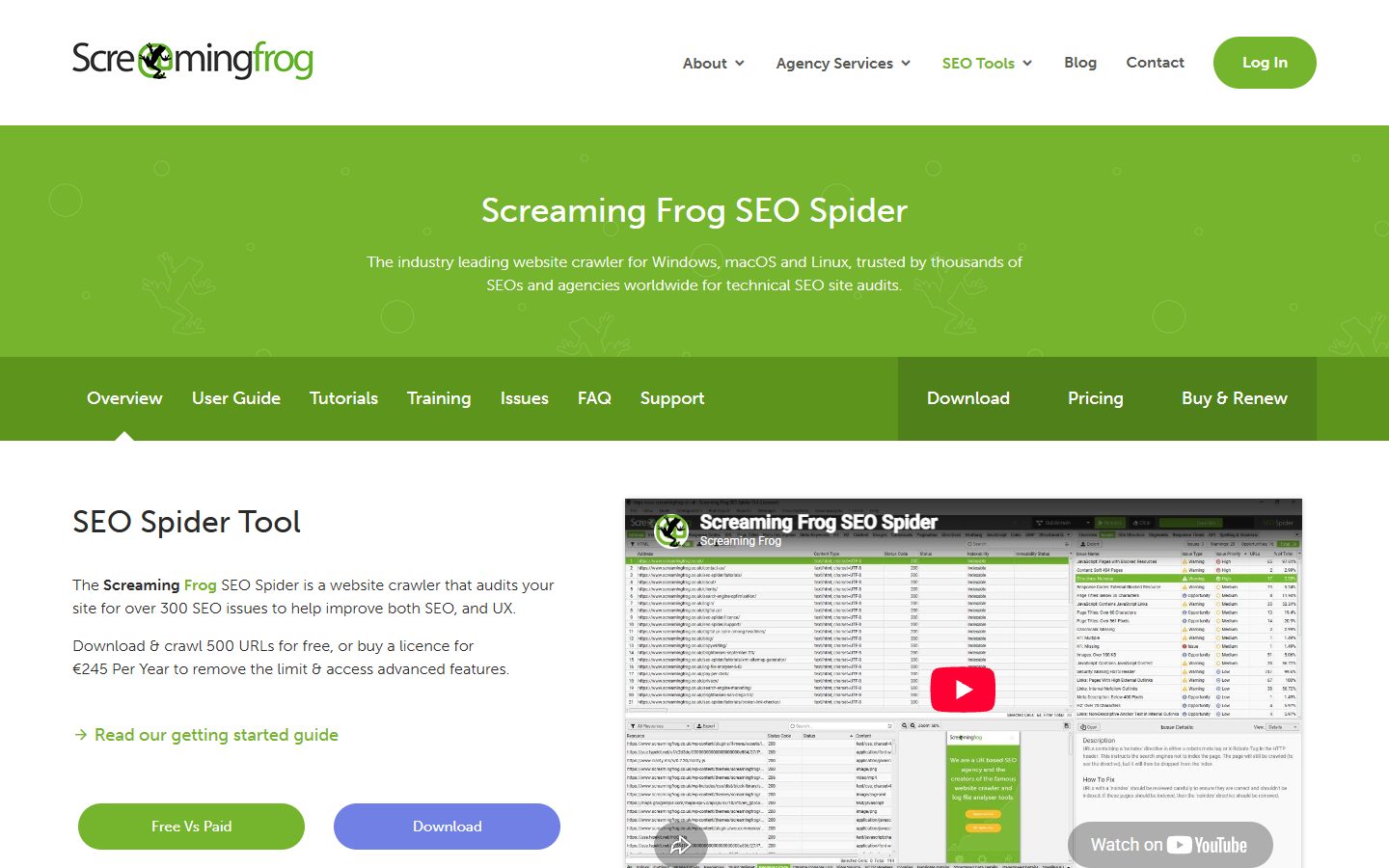
Screaming Frog SEO Spider remains the tool every working technical SEO has installed. It is desktop software, and it looks like it: a dense crawl table listing every URL with content type, status code, and indexability, flanked by an issues panel that groups warnings by priority and a detail pane explaining each issue and how to fix it. Nobody would call it pretty; everybody who does this work lives in it anyway. The free version crawls 500 URLs, which covers a surprising number of small sites; a paid licence (245 euros per year, per user, with other currencies shown on their pricing page) removes the cap and opens the advanced features. The 2026-relevant addition: paid licences can crawl with OpenAI and Gemini integrations, meaning you can run custom AI analysis (content classification, alt-text review, whatever you can prompt) against every page during the crawl. Unlimited crawling for 245 euros a year is the single best value in this entire article.
Sitebulb is the crawler you buy when humans other than you will read the audit. Instead of dumping a spreadsheet, it presents prioritized “Hints”: each issue carries a Critical, Medium, or Low severity chip with a plain-English explanation of what it is and why it matters, and an audit comparison view tracks what changed between crawls, which is exactly what a monthly client report needs. Pricing moved to clear dollar figures this year: Desktop Lite at $18/mo (10,000 URLs per audit), Desktop Pro at $42/mo per user (500,000 URLs per audit, plus scheduled audits and customized PDF reports), and Sitebulb Cloud from $125/mo for team access, recurring crawls, and audits up to 10 million URLs.

Practitioner take: run Screaming Frog for your own diagnostics and Sitebulb when you need a stakeholder-ready audit document. Agencies typically carry both; in-house teams can usually live with Screaming Frog alone.
Content optimization: Surfer, Clearscope
These tools compare your draft against what currently ranks and gets cited for a target query, then score coverage of terms, questions, and structure. Used well, they close real gaps. Used badly, they produce keyword-stuffed sludge that reads like it was written by the tool, so keep an editor in the loop.
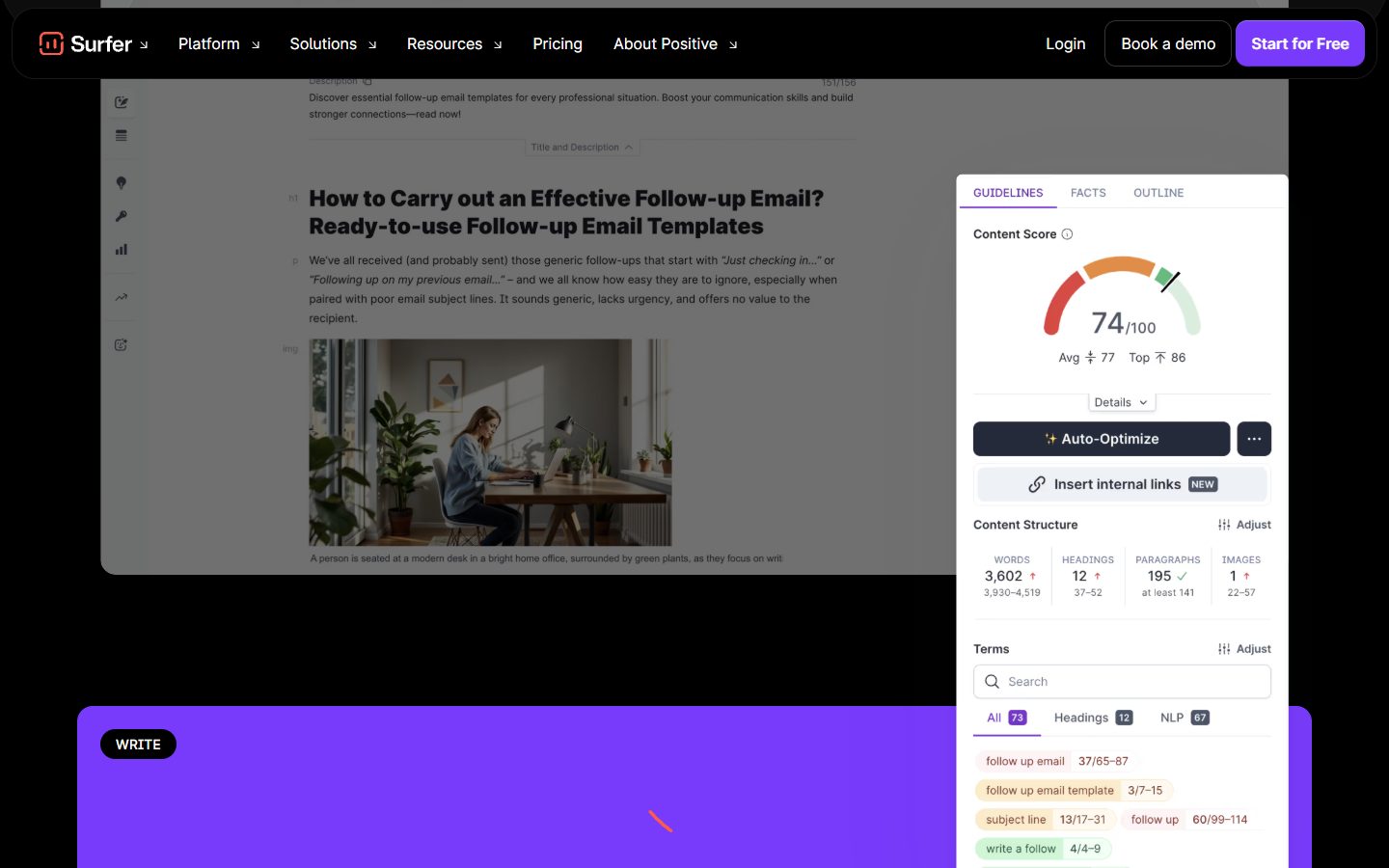
Surfer is the volume play. Annual-billing pricing runs $49/mo (Discovery), $99/mo (Standard), $182/mo (Pro), and $299/mo (Peace of Mind), with a $999/mo Enterprise tier above. The working surface is the Content Editor: your draft on the left, and a live Guidelines panel on the right showing a content score out of 100 benchmarked against the average and top competitor scores, structural targets for words, headings, paragraphs, and images, and a color-coded list of terms with usage ranges. An Auto-Optimize button and one-click internal linking sit on top for teams that want speed over deliberation. The 2026 lineup folds AI search into the core product: Standard tracks 25 AI prompts weekly, Pro tracks 50 daily, Peace of Mind 100 daily, and a standalone AI Search Analytics product runs $158/mo billed yearly. If your team ships a lot of content and wants optimization plus basic AI tracking under one login, this is the pragmatic pick.
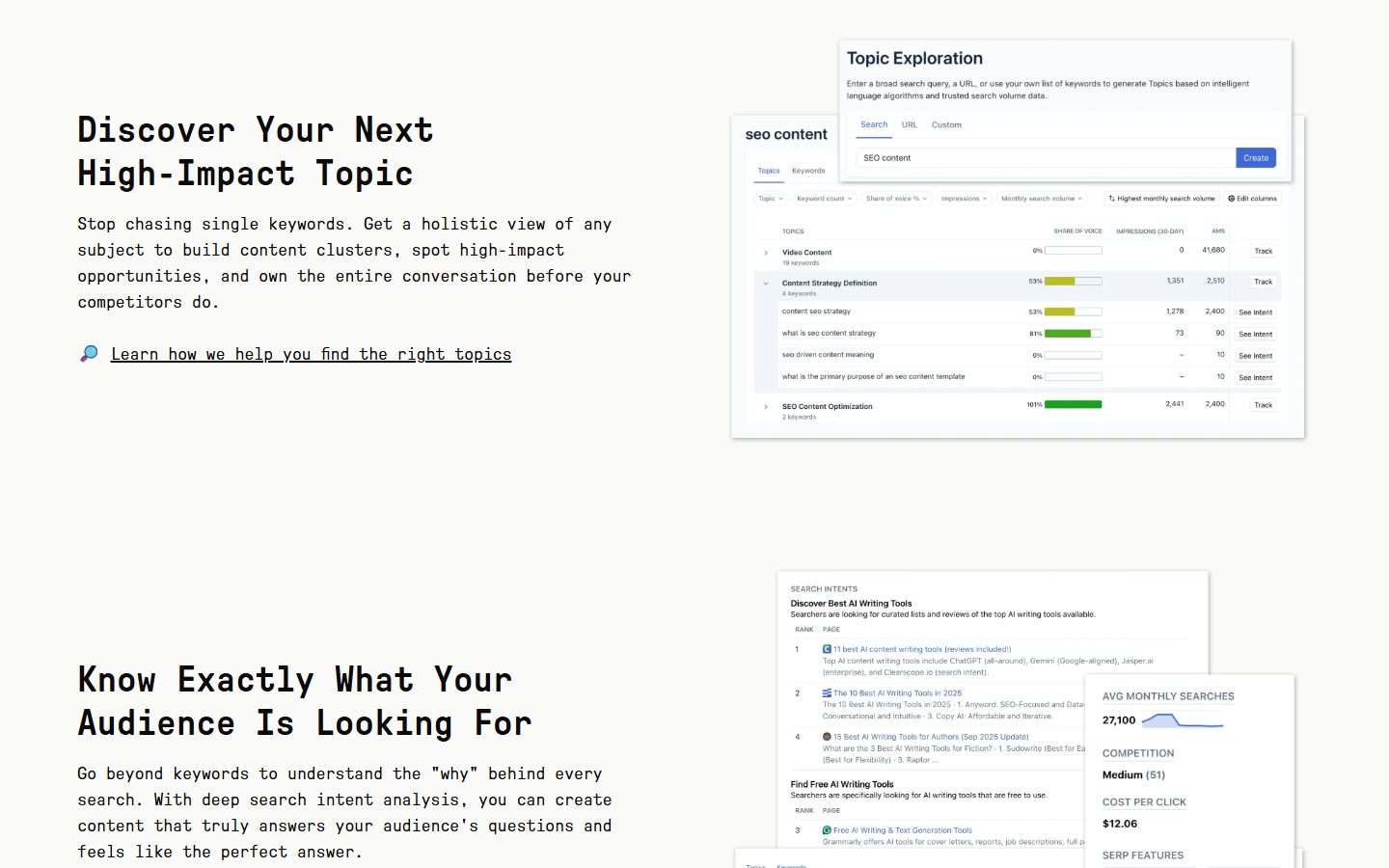
Clearscope is the editorial pick. Essentials at $129/mo covers 50 tracked prompts and 50 pages; Business at $399/mo raises that to 300 of each and adds a dedicated account manager. Clearscope’s reports are the cleanest in the category and its recommendations rarely push you toward stuffing. The 2026 feature set has widened from single keywords to topics: Topic Exploration takes a broad query or URL and returns clustered subtopics with share of voice, impressions, and search volume per cluster, and the visibility side now tracks your presence in AI chatbots (mention and citation rates in Gemini and ChatGPT responses) alongside Google. Writers tend to like it, which matters more than any feature list.
Rank tracking at scale: AccuRanker
Both all-in-one platforms include rank tracking, and for most sites that is enough. A dedicated tracker earns its keep when keyword counts climb into the thousands or when clients expect daily granularity.
AccuRanker is the category leader for speed and volume: on-demand refreshes, clean segmentation, and share-of-voice reporting. Current published pricing starts at $224/mo for the Professional tier at 2,000 keywords, scaling through Expert at $764/mo (10,000 to 25,000 keywords) and custom Enterprise above that, with a 10% discount for annual payment. The 2026 addition is AccuLLM, a second product tab that applies the same tracking discipline to AI answers: each tracked prompt gets a row per engine (ChatGPT, Perplexity, AI Overviews, AI Mode) with rank, sentiment, and visibility columns, so LLM visibility reads like a rank report instead of a novelty chart. If you track fewer than a thousand keywords, skip this line item and use what your platform already includes; below that threshold a dedicated tracker is paying for precision you will not use.

And before paying anyone to track rankings, make sure you are actually reading Google Search Console, which reports your real impressions and clicks for free. More on the free layer below.
Schema and structured data: WordLift, Schema App
Structured data used to be a rich-results tactic. In 2026 it is also how you hand AI engines machine-readable facts about your organization, products, and content, which makes it one of the few directly controllable GEO levers. If schema, knowledge graphs, or any other term in this piece is unfamiliar, our marketing glossary defines all of them in plain language.
WordLift builds and maintains a knowledge graph from your content and publishes schema markup automatically, with an AI agent layered on for SEO tasks, internal linking, and content work. Published pricing is $879/mo billed yearly for Business+, with custom Enterprise pricing above; the tier includes the WordLift Agent, knowledge graph, and AI-powered content creation, delivered with hands-on support from their team. One transparency note: WordLift’s public site shows solution pages and case studies rather than working dashboard screenshots, so the capture below is their published pricing rather than the product interface; ask for a walkthrough in their discovery session before committing. That price point puts it firmly in “the channel matters to us” territory rather than casual-experiment range.

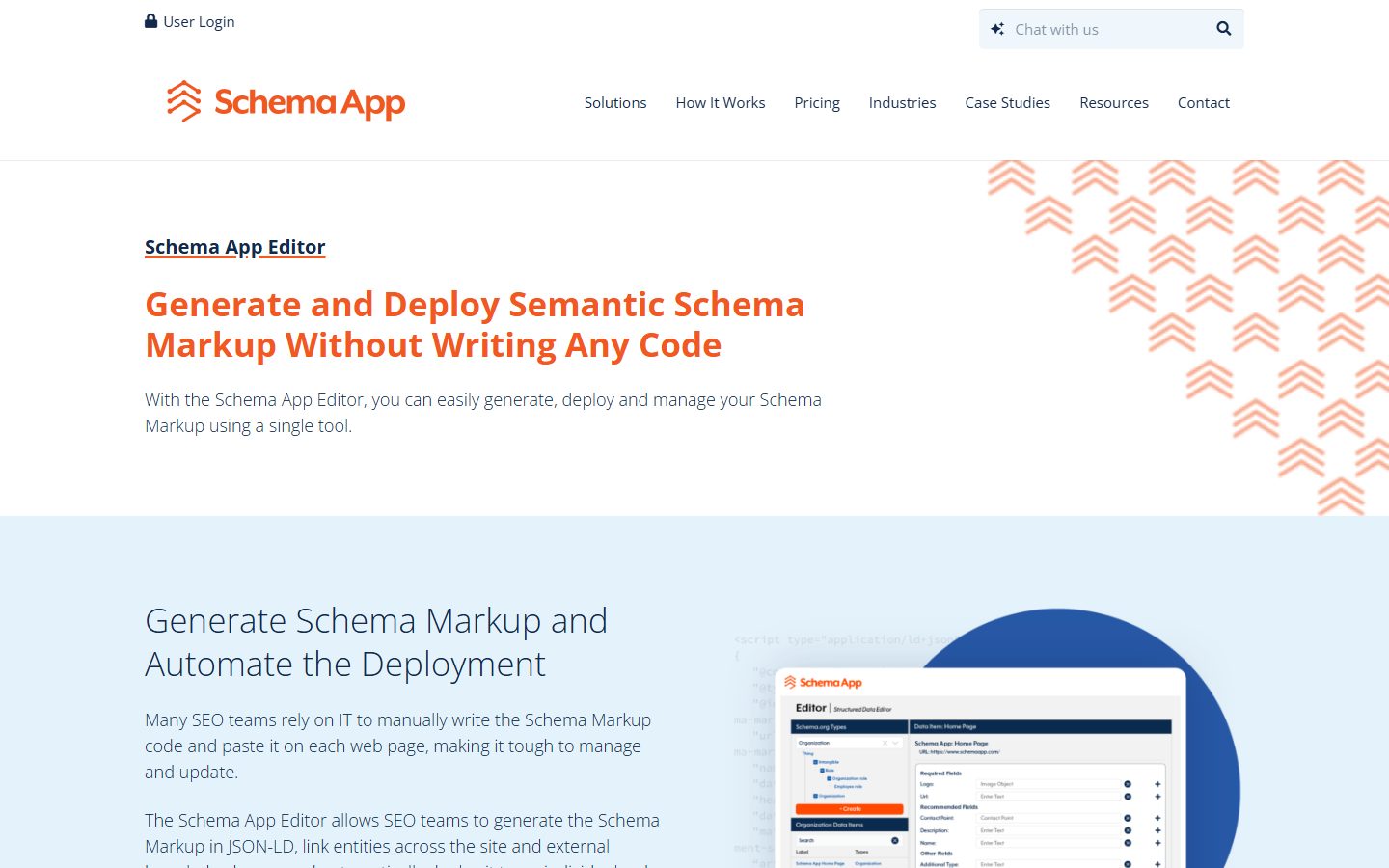
Schema App is the enterprise alternative: templated markup deployment across large sites, entity management, and analytics, with hands-on support. The core product is the Schema App Editor, a no-code interface that exposes the full schema.org vocabulary as structured forms, organizes properties into required, recommended, and other fields per Google’s guidelines, links entities out to Wikipedia, Wikidata, and Google’s Knowledge Graph, and validates the JSON-LD as you build. Pricing is not published; it is quote-based on site scope and support level, and their own pricing FAQ addresses onboarding fees and minimum subscription terms, so plan a real procurement conversation, not a credit-card signup.
Sites on WordPress with modest schema needs can get far with an SEO plugin’s built-in schema before either of these makes sense. The paid platforms earn their cost when entity relationships and markup coverage across thousands of URLs stop being manageable by hand.
The free layer nobody should skip
Four free tools belong in every stack regardless of budget, and skipping them to buy software first is the most common stack-building mistake we see in audit calls:
- Google Search Console: your actual impressions, clicks, and indexing status, straight from Google. Every paid tracker is an estimate; this is the ledger.
- Bing Webmaster Tools: Bing’s index feeds Copilot and several other AI surfaces, and almost nobody optimizes for it, which is exactly why you should register.
- Screaming Frog free tier: 500 URLs per crawl, no cost, catches the technical basics on small sites.
- Google’s Rich Results Test and the Schema.org validator: confirm your structured data parses before trusting any platform’s word for it.
How to build your stack at three budgets
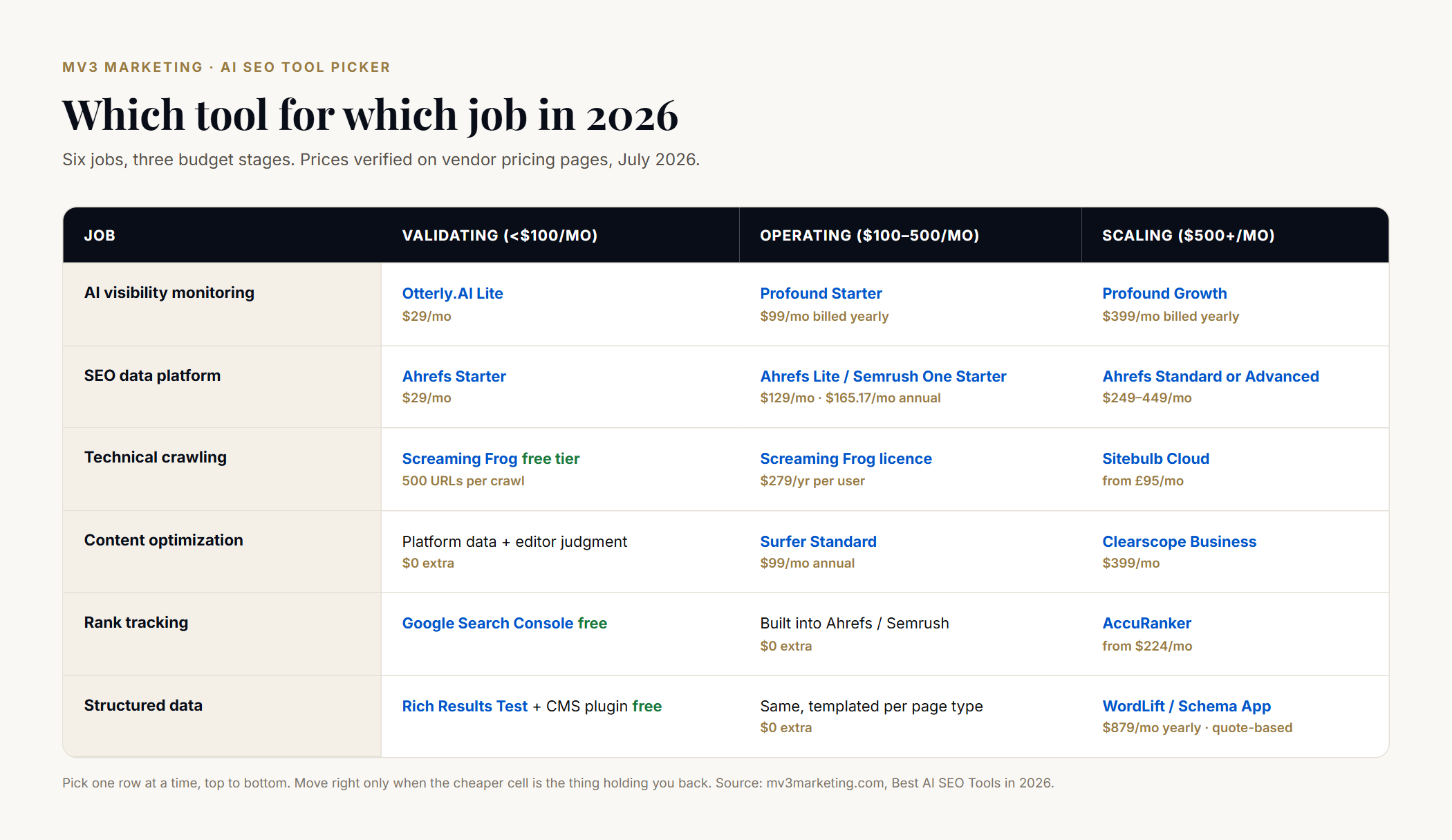
Here is how we would actually spend the money, based on the pricing verified above.
Under $100/mo (validating). Otterly.AI Lite at $29 for AI citation tracking, Ahrefs Starter at $29 for baseline keyword and competitor data, Screaming Frog free tier, Search Console and Bing Webmaster Tools. Roughly $58/mo, and you can answer the two questions that matter at this stage: does AI search send us anything, and is our site technically sound.
$100 to $500/mo (operating). Ahrefs Lite at $129 (which brings Brand Radar prompts with it) or Semrush One Starter at $165.17 annual as the backbone, a paid Screaming Frog licence at 245 euros a year, plus either Surfer Standard at $99 for volume content work or Clearscope Essentials at $129 for editorial work. Add Profound Starter at $99 once AI citations start showing up in your pipeline conversations.
$500+/mo (scaling). Ahrefs Standard or Advanced, Profound Growth at $399, Clearscope Business at $399 if content is a core channel, AccuRanker from $224 once keyword counts justify it, and a structured-data platform (WordLift, or Schema App for enterprise) when entity management becomes a real workstream. At this level the constraint is no longer tooling, it is having someone who can act on what the tools surface.
When the stack stops being the bottleneck
A pattern we see constantly: a company assembles $800/mo of excellent software, and six months later the dashboards are pristine, the backlog of flagged issues is enormous, and rankings have not moved. Tools diagnose; they do not execute. The work that moves AI visibility (publishing citable content, earning authority, fixing what the crawler found, maintaining schema) still has to be done by someone, week after week.
That execution gap is what our AI SEO agency service exists to close. Our Growth AI program at $5,997/mo pairs the tool categories in this article with the team that acts on them: full SEO and GEO execution, content production, ABM outreach at 500 accounts/mo, and weekly reporting against the same data sources named above. If you would rather see it applied to your site than read another paragraph about it, book a strategy call and bring your current stack list; we will tell you honestly which subscriptions to keep and which to cancel.
Frequently asked questions
What is the best AI SEO tool overall in 2026?
There is no single best, because the category spans six different jobs. The best value per job: Otterly.AI for entry-level AI citation monitoring at $29/mo, Ahrefs Lite for platform data at $129/mo, and Screaming Frog for technical crawling at 245 euros a year. The best stack for most mid-market B2B teams combines one tool from each of those three categories.
Are AI visibility monitoring tools worth it for small businesses?
At $29/mo (Otterly.AI Lite), the cost of finding out is low enough that guessing is the expensive option. Track your 15 most commercially important prompts for two months. If AI engines never cite anyone in your niche, pause the subscription and revisit in a year. If they cite your competitors, you have found a channel before most of your market has.
Can I do AI SEO with only free tools?
Partially. Search Console, Bing Webmaster Tools, Screaming Frog’s free tier, and manual prompt-checking in ChatGPT and Perplexity cover diagnosis on a small site. What free tools cannot do is monitor AI citations systematically across engines and over time, which is the data that turns AI visibility from anecdote into channel. That specific capability starts at $29/mo.
Do AI SEO tools replace an agency or an in-house SEO?
No, and the vendors themselves rarely claim otherwise. Tools surface problems and opportunities; strategy and execution remain human work. The honest division of labor: buy tools for measurement, buy expertise (in-house or agency) for judgment and execution. Paying for both only makes sense when someone is accountable for acting on what the tools report.
How is AI SEO tooling different from traditional SEO tooling?
Two real differences. First, a new measurement surface: citation tracking across generative engines (who gets named in AI answers) has no equivalent in the classic stack, which tracked rankings on results pages. Second, AI features inside old categories: crawlers that run LLM analysis during the crawl, and optimization tools that score citability, not just keyword coverage. The fundamentals underneath (technical health, content quality, authority) are unchanged, which is why the incumbent platforms still anchor most stacks.
Share this article

Alex Carter leads SEO and content strategy at MV3 Marketing, specializing in generative engine optimization, technical SEO, and AI-driven content systems for B2B companies.
Ready to audit your organic growth opportunity?
$2,500 flat. 5 business days. Six deliverables tied to pipeline , not rankings. No retainer required.
Get the Organic Growth Audit →