
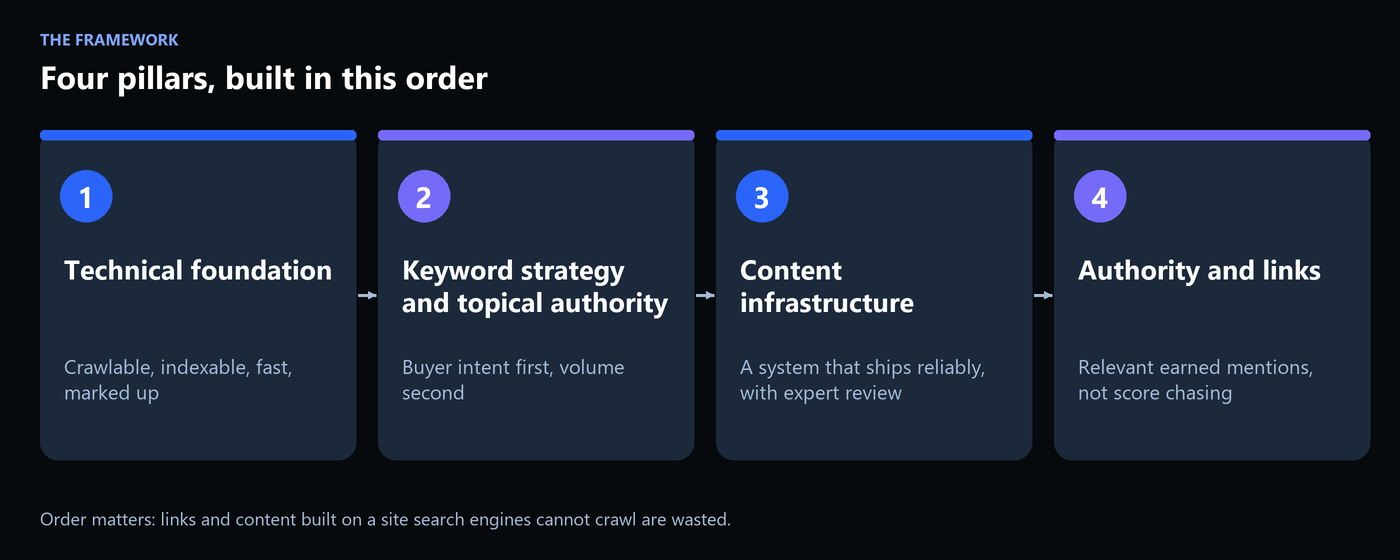
Direct answer. A B2B SEO strategy treats organic search as infrastructure, not a content calendar. It rests on four pillars built in order: a technical foundation, keyword strategy mapped to buyer intent, a content system with expert review, and relevant link acquisition. Success is measured in organic-attributed leads and pipeline, not raw traffic.
Most B2B companies treat SEO as a publishing schedule: post articles, hope for rankings, measure little. That produces blog traffic, not pipeline. This guide covers the framework we use at MV3 Marketing when a funded SaaS company wants to stop renting traffic and build an organic channel it owns. Where a claim comes from Google, the source is linked. Where a number comes from our own data, the query and date are shown. Where something is a planning assumption, it says so.
Why Do Most B2B SEO Strategies Fail?
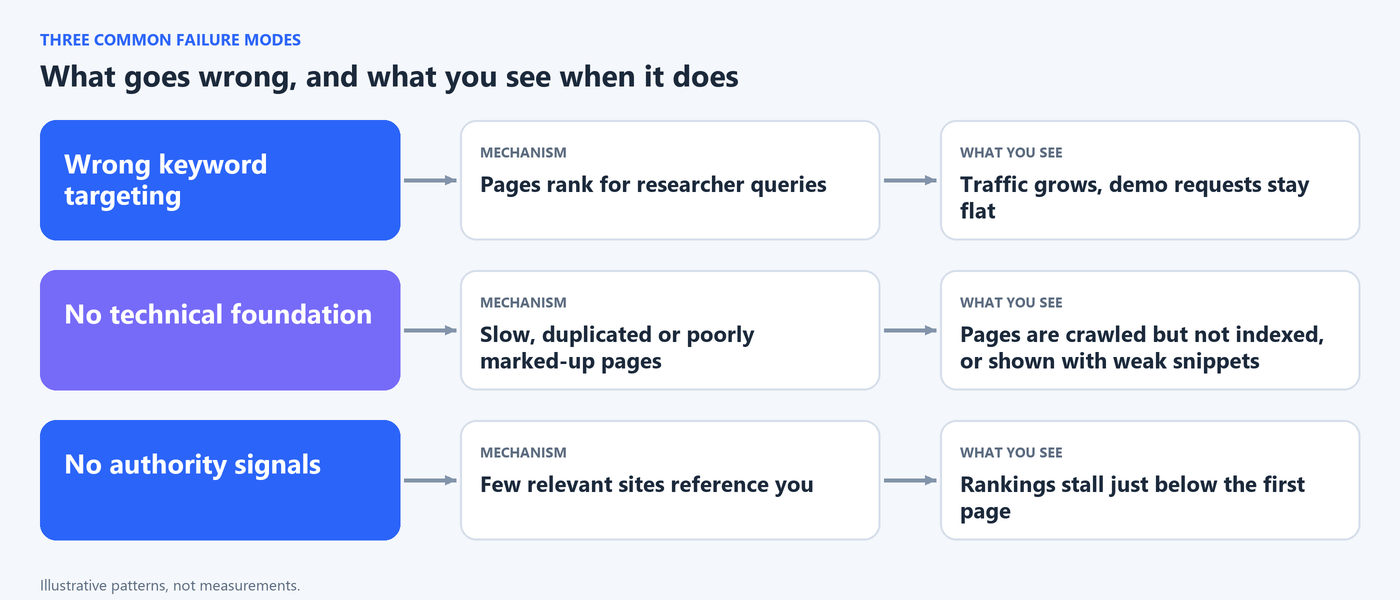
The failure pattern is predictable: a company hires an agency, publishes a few posts a month, watches a third-party authority score tick up, and sees no change in pipeline after a year. The agency blames an algorithm update. The company blames SEO. The cause is usually one of three things.
- Wrong keyword targeting. Ranking for informational queries that attract researchers, not buyers. “What is CRM software” drives little pipeline for a CRM vendor selling to a VP of Sales.
- No technical foundation. Slow or unstable pages, duplicate content, and schema gaps that make it harder for search engines to understand the site.
- Content without authority signals. Publishing on a domain that few relevant sites reference gives search engines little outside evidence of your expertise.
B2B companies tend to have long sales cycles and high customer lifetime value, so every month of misdirected effort has a real opportunity cost: the pipeline a competitor captures instead.
A hypothetical example shows how it plays out. A human resources software vendor publishes a year of articles on “what is employee onboarding” and “HR compliance checklist.” Traffic grows, demo requests do not, because every article answers a coordinator doing research, not a VP of People comparing vendors. Rebuilding the plan around commercial queries such as “employee onboarding software for enterprise” points the same effort at the people who sign contracts. This is an illustration, not a client result.
Our view, offered as opinion: for many B2B companies a handful of precisely targeted commercial pages will do more for pipeline than a large volume of informational posts. Content volume is an activity metric. It can hide strategic confusion.
What Are the Four Pillars of a B2B SEO Strategy?
The sections below take each pillar in turn, with the evidence behind each claim.
1. Technical Foundation
Before content and links, verify that search engines can crawl, render and index the site. A technical audit covers:
- Internal link architecture. A common rule of thumb is that important pages should sit within a few clicks of the homepage. That is a working guideline, not a Google requirement.
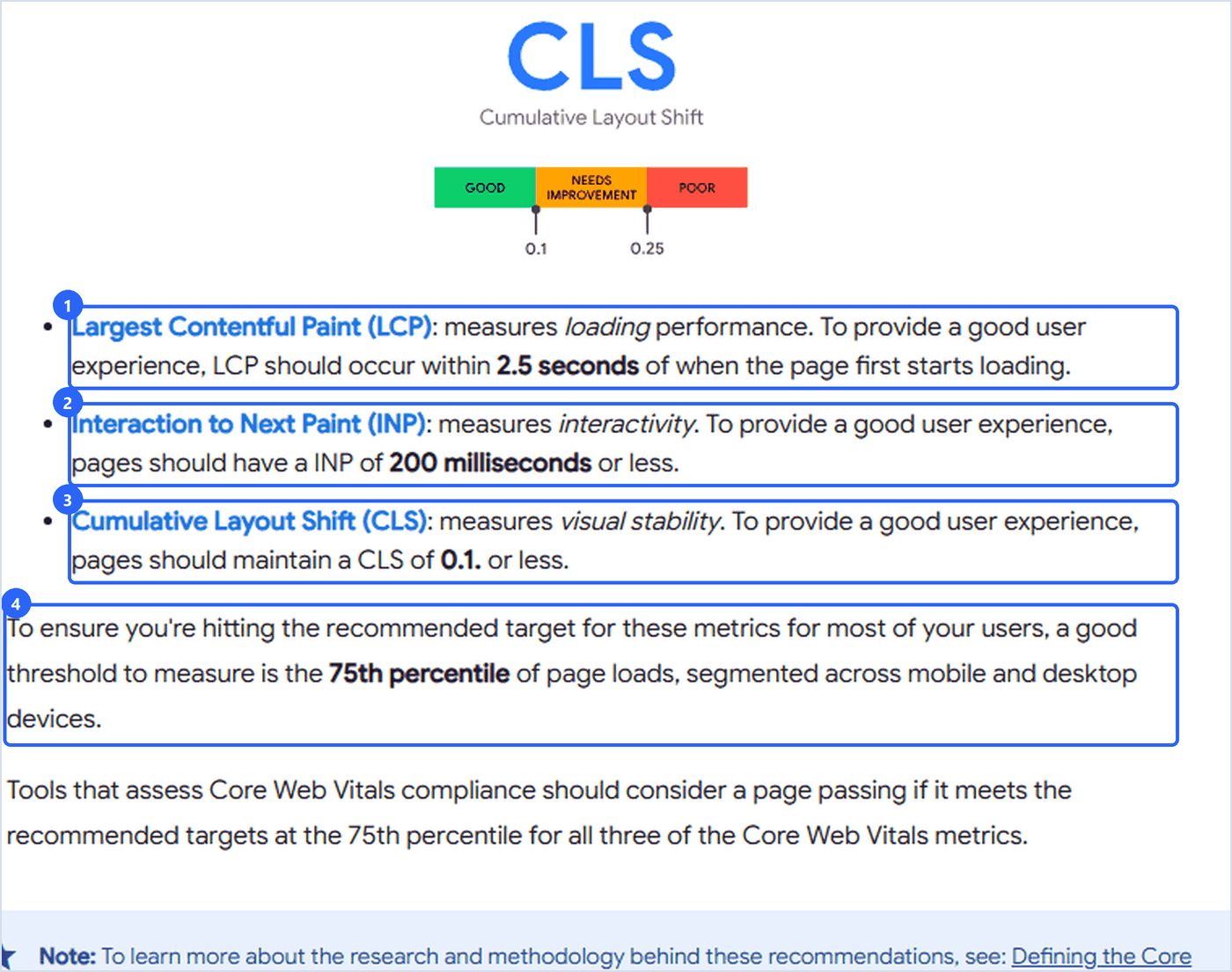
- Core Web Vitals. Google lists the “good” targets as LCP within 2.5 seconds, INP of 200 milliseconds or less and CLS of 0.1 or less, measured at the 75th percentile of page loads.
- Schema markup: Organization, Service, Article, FAQ and BreadcrumbList at minimum, matched to what is visible on the page.
- Canonical tags, hreflang and robots.txt configuration.
- Index bloat: thin pages, paginated archives, tag pages and parameter URLs that add noise.
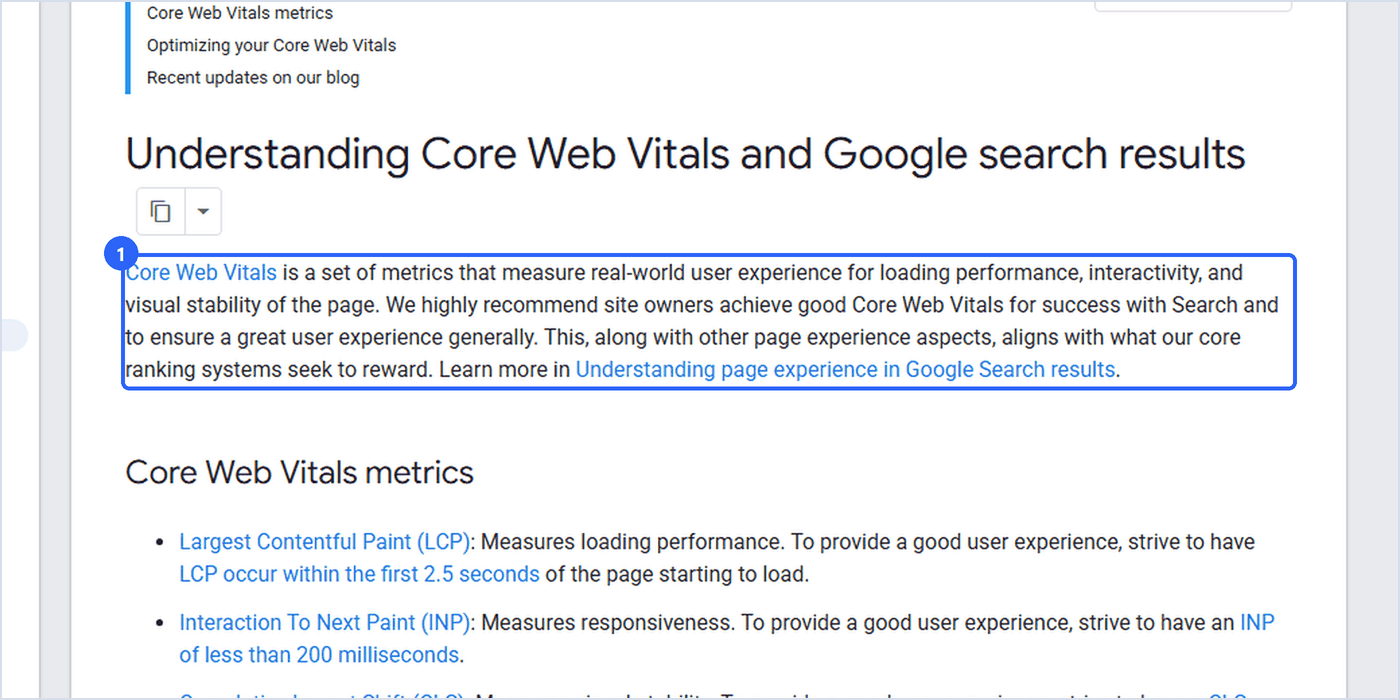
On Core Web Vitals, be precise about what Google says. Its documentation states that it highly recommends good Core Web Vitals for success with Search and that this “aligns with what our core ranking systems seek to reward.” It does not say that crossing a threshold guarantees a ranking gain. Treat the thresholds as quality targets for user experience.
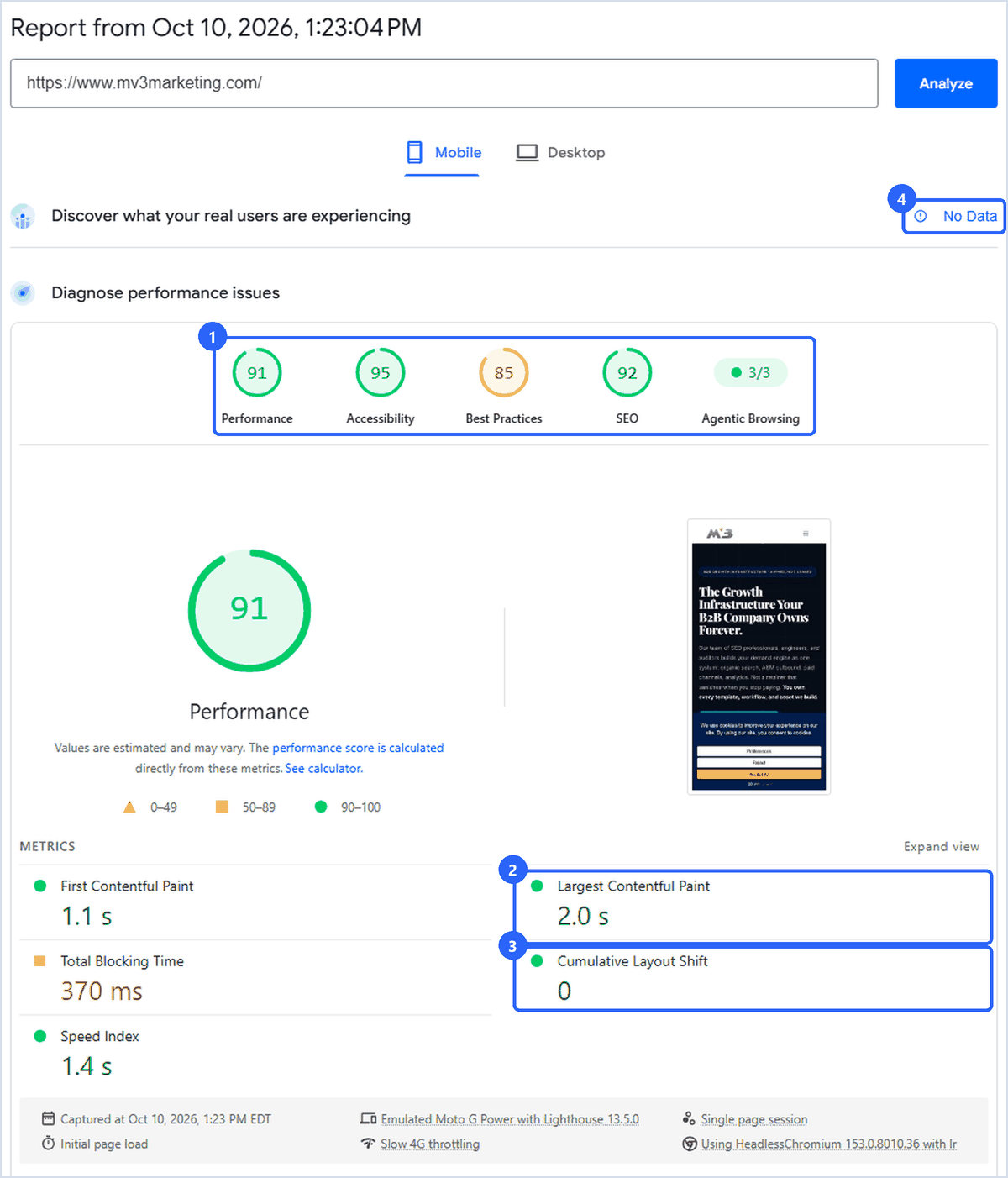
To audit a page, run it through PageSpeed Insights. The report separates field data from real users from a lab run. Lab runs vary: we ran our own homepage twice within two minutes on 2026-10-10 and the mobile performance score came back as 86 and then 91. Field data was not available for the site at all, which is normal for a low-traffic domain. Use lab runs to find problems and field data, when you have it, to judge them.
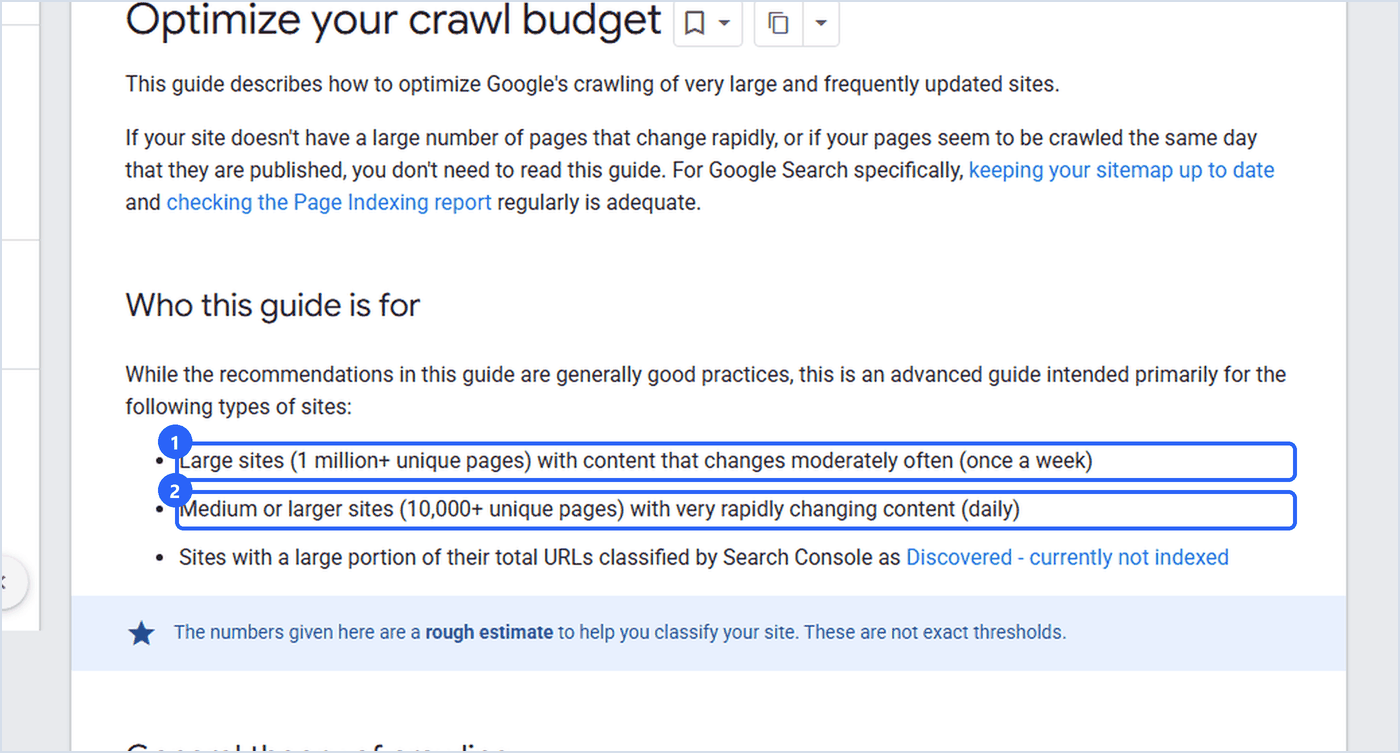
What about index bloat? It is worth cleaning up, but be careful about why. Google’s crawl budget guide says plainly that it is written for very large or fast-changing sites: roughly a million or more unique pages, or ten thousand or more with daily changes, and that these numbers are “a rough estimate” rather than exact thresholds. For a smaller site, the guide says that keeping the sitemap current and checking the Page indexing report is adequate. So for most B2B sites the argument for pruning thin pages is quality and clarity, not crawl budget.
The technical audit sequence we run:
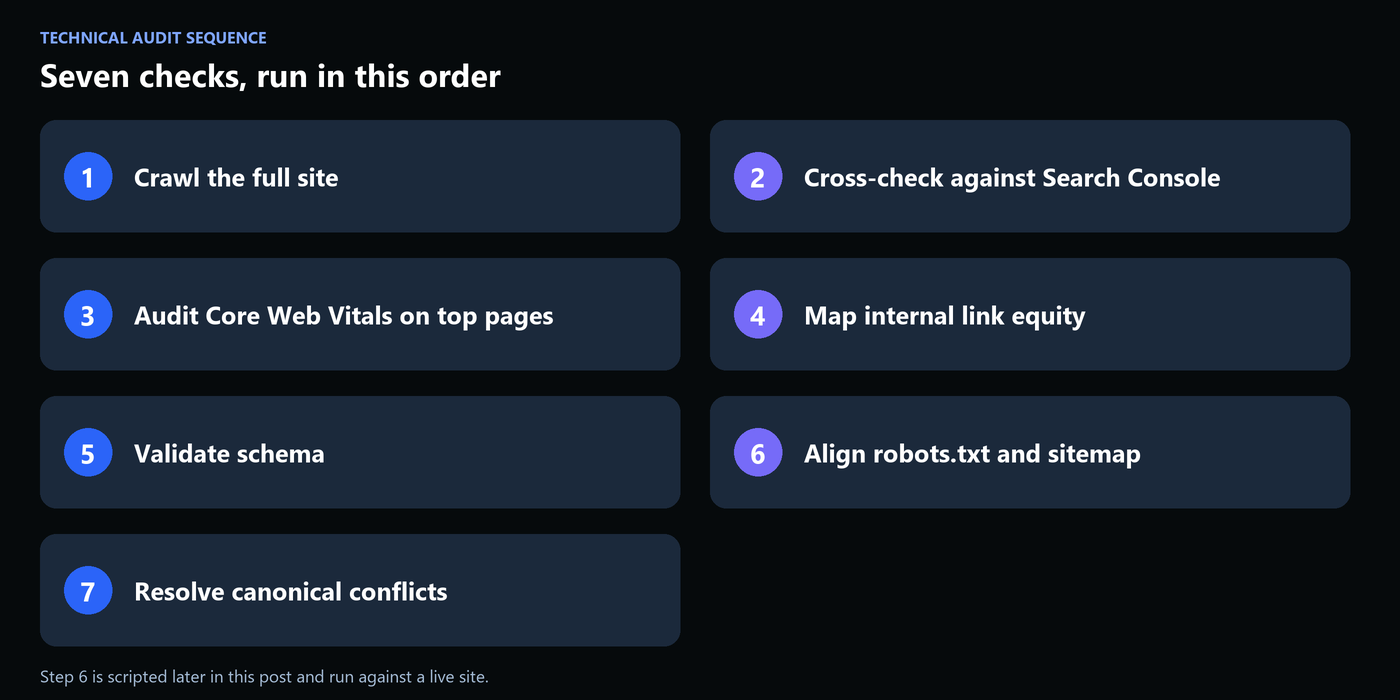
- Crawl the full site with a crawler such as Screaming Frog or Sitebulb and export URLs, status codes and metadata.
- Cross-reference against Google Search Console to see which URLs are indexed, crawled or neither.
- Audit Core Web Vitals in PageSpeed Insights for the top commercial pages, where performance is closest to conversion.
- Map internal link equity from the crawl data to find orphaned pages and over-linked low-priority pages.
- Validate schema with Google’s Rich Results Test or the Schema Markup Validator and note missing types.
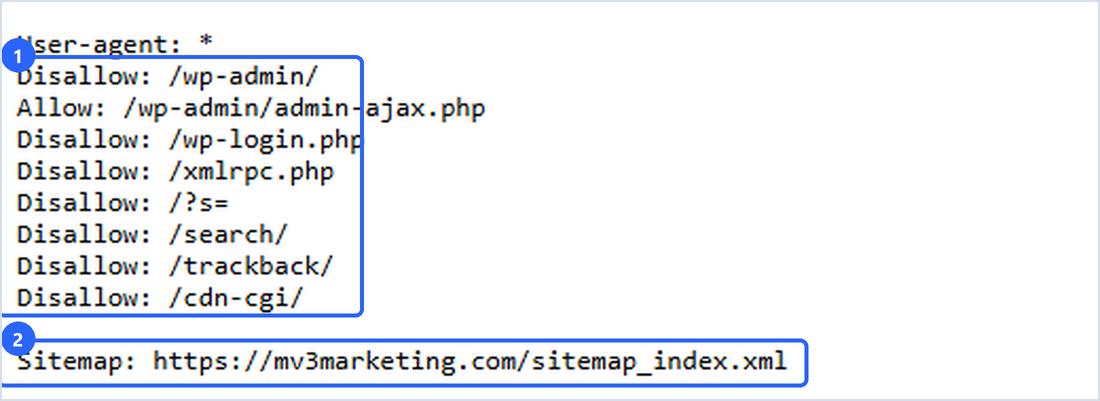
- Align robots.txt and the XML sitemap. Everything in the sitemap should be crawlable, and nothing a robots.txt rule blocks should appear in it.
- Resolve canonical conflicts, common on sites with filter and sort parameters.
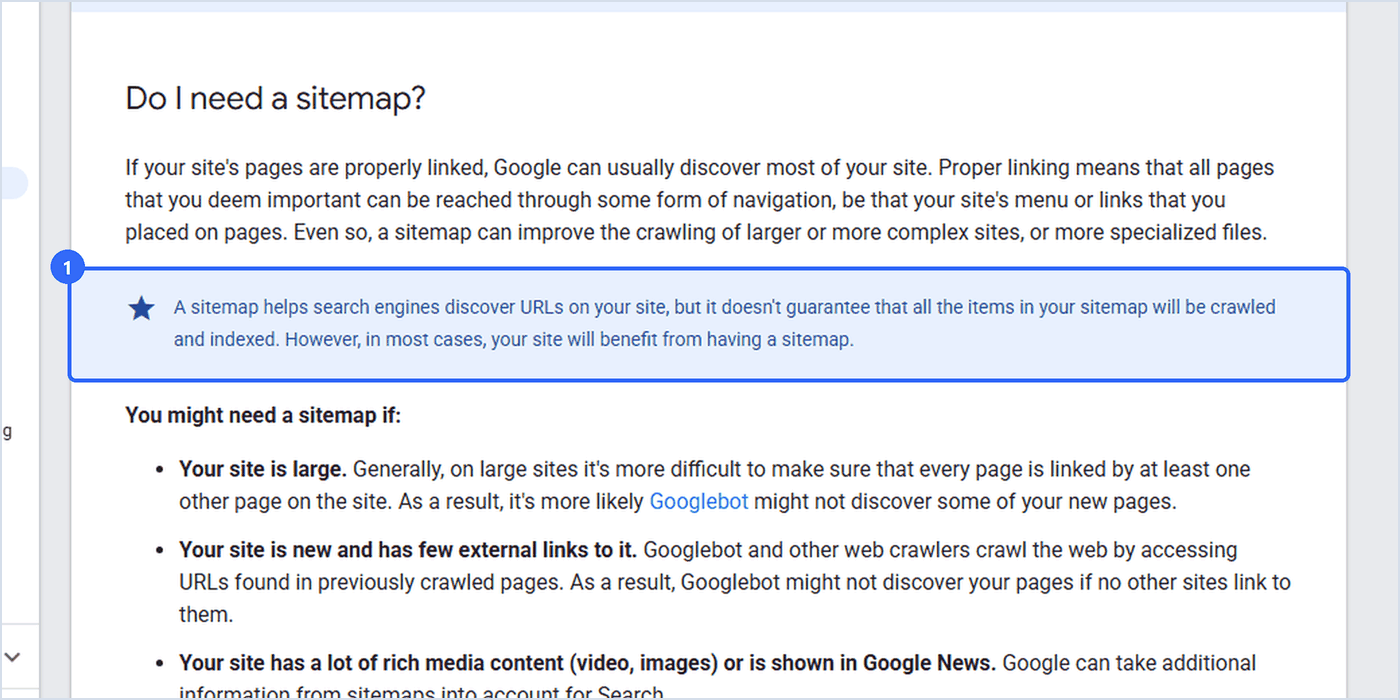
Step 6 is easy to script. Google notes that a sitemap helps search engines discover URLs but does not guarantee they will be crawled and indexed, so it pays to keep it clean. The script below reads robots.txt, fetches every child sitemap, tests each URL against the Googlebot rules, and spot-checks the HTTP status of the first few URLs in each file. We ran it against our own site.
sitemap_robots_check.py, part 1: fetch and parse helpers. Common error: some sites list the sitemap in robots.txt on a different host than the one they serve, so the script reports the host as well as the block count.
"""Check that nothing in the XML sitemaps is blocked by robots.txt.

Usage: python sitemap_robots_check.py https://www.example.com
Reads robots.txt, fetches the sitemap index and every child sitemap,
tests each URL against the robots.txt rules for Googlebot, and spot-checks
the HTTP status of the first few URLs in each sitemap.
"""
import sys
import urllib.robotparser
import xml.etree.ElementTree as ET
from urllib.parse import urlparse

import requests  # pip install requests

UA = "Mozilla/5.0 (compatible; sitemap-check/1.0)"
LOC = "{http://www.sitemaps.org/schemas/sitemap/0.9}loc"


def get(url):
    r = requests.get(url, headers={"User-Agent": UA}, timeout=30)
    r.raise_for_status()
    return r.status_code, r.url, r.content


def locs(xml_bytes):
    return [e.text.strip() for e in ET.fromstring(xml_bytes).iter(LOC)]


def status_of(url):
    try:
        r = requests.head(url, headers={"User-Agent": UA}, timeout=20)
        return r.status_code
    except requests.RequestException:
        return "ERR"
Part 2: walks every child sitemap and prints a summary.
def main(site):
    site = site.rstrip("/")
    host = urlparse(site).netloc
    rp = urllib.robotparser.RobotFileParser()
    rp.parse(get(site + "/robots.txt")[2].decode("utf-8").splitlines())
    declared = rp.site_maps() or []
    print("robots.txt sitemaps:", declared)
    code, final, body = get(site + "/sitemap_index.xml")
    print("index", code, final)
    total = blocked = off_host = 0
    for child in locs(body):
        urls = locs(get(child)[2])
        b = [u for u in urls if not rp.can_fetch("Googlebot", u)]
        o = [u for u in urls if urlparse(u).netloc != host]
        sample = [status_of(u) for u in urls[:3]]
        name = child.rsplit("/", 1)[-1]
        print(f"{name:<28}{len(urls):>6} urls  blocked={len(b)}  "
              f"off-host={len(o)}  status(first 3)={sample}")
        total += len(urls)
        blocked += len(b)
        off_host += len(o)
    print(f"TOTAL {total} urls, {blocked} blocked by robots.txt, "
          f"{off_host} on a different host")
    for d in declared:
        if urlparse(d).netloc != host:
            print(f"NOTE robots.txt declares a sitemap on "
                  f"{urlparse(d).netloc}, canonical host is {host}")


if __name__ == "__main__":
    main(sys.argv[1] if len(sys.argv) > 1 else "https://www.mv3marketing.com")
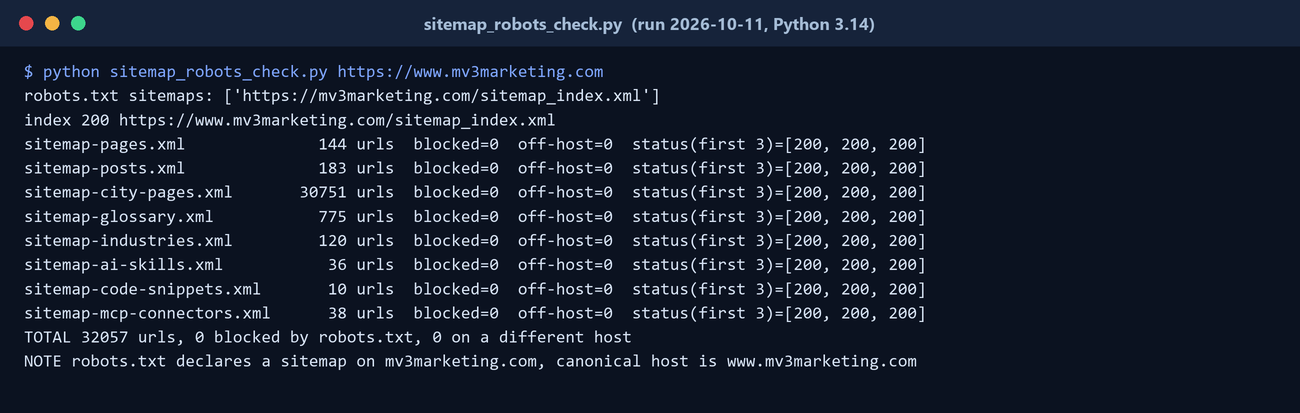
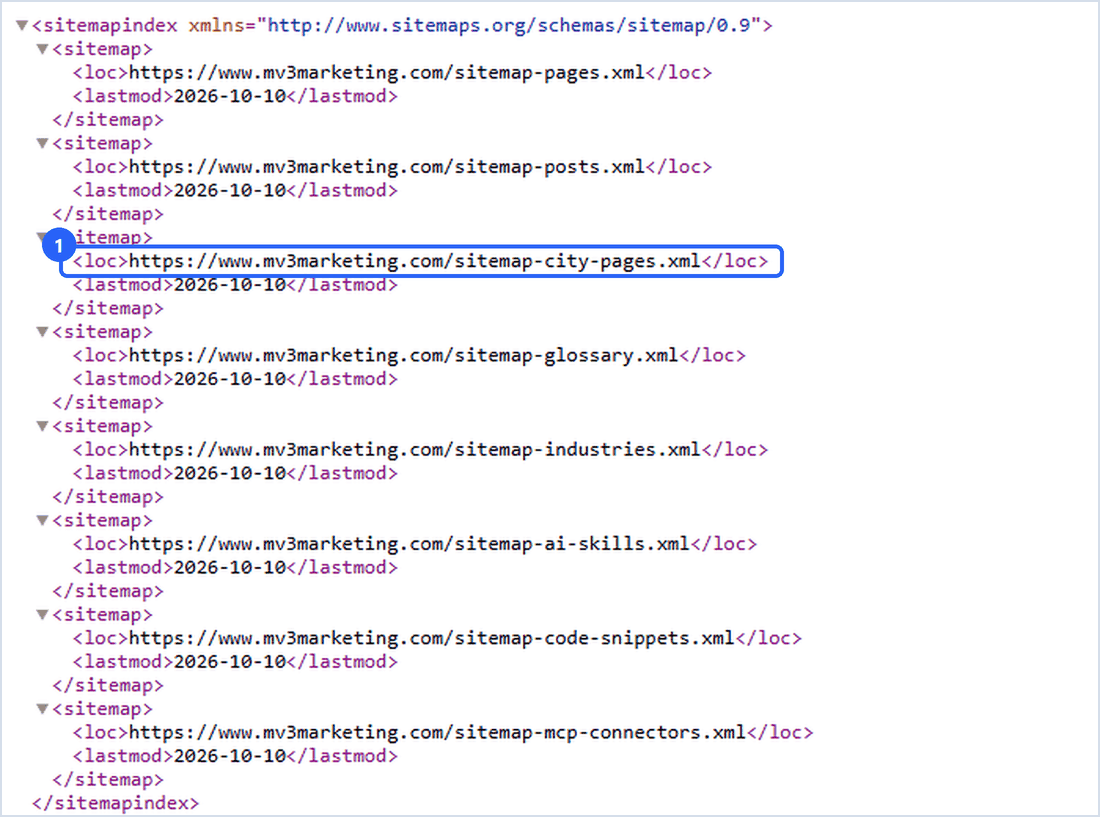
The output is clean on the checks that matter: no sitemap URL is blocked by robots.txt and every sampled URL returns 200. It also surfaced one thing worth fixing. The robots.txt file declares its sitemap on the non-www host, while every URL is served on the www host. The non-www address redirects, so crawlers still arrive, but a sitemap line that matches the canonical host is tidier.
2. Keyword Strategy and Topical Authority
B2B keyword strategy means mapping three intent layers and building the closest-to-purchase layer first.
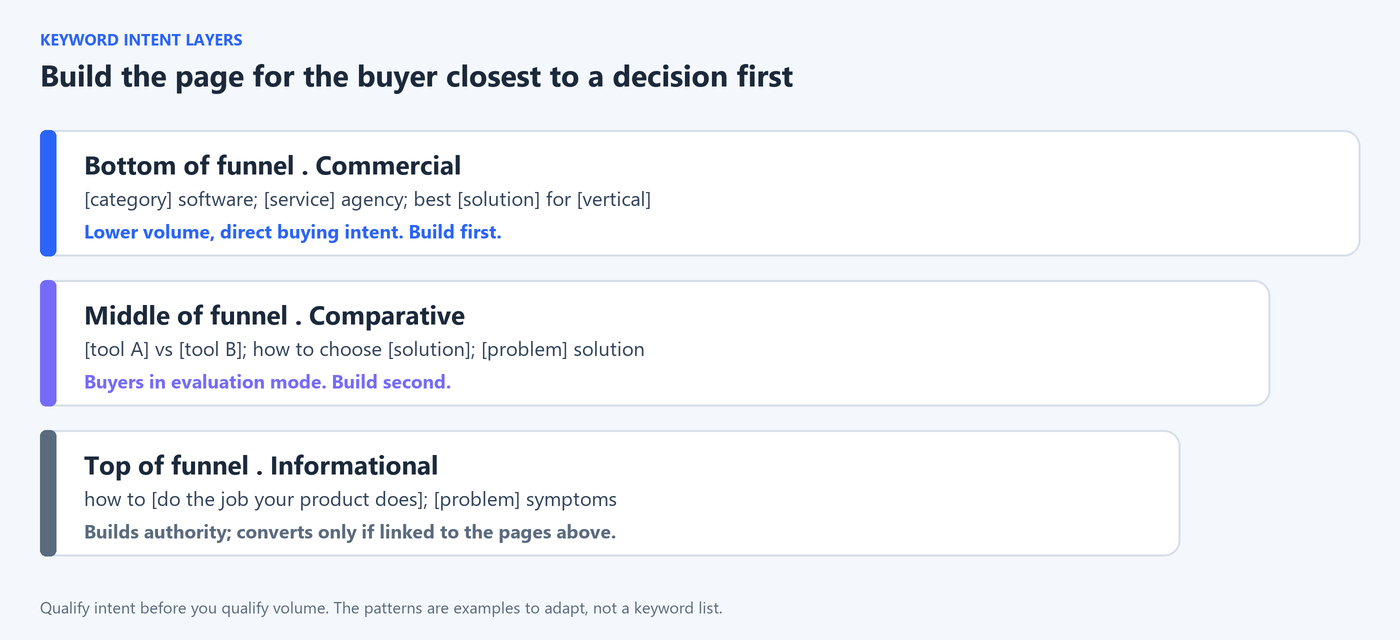
- Bottom of funnel (commercial): “[category] software,” “[service] agency,” “best [solution] for [vertical].” Lower volume, direct purchase intent. Target these first.
- Middle of funnel (comparative): “[tool A] vs [tool B],” “how to choose [solution].” Buyers in evaluation mode.
- Top of funnel (informational): “how to [do what your product does],” “[problem] symptoms.” These build topical authority but convert only when the funnel is connected.
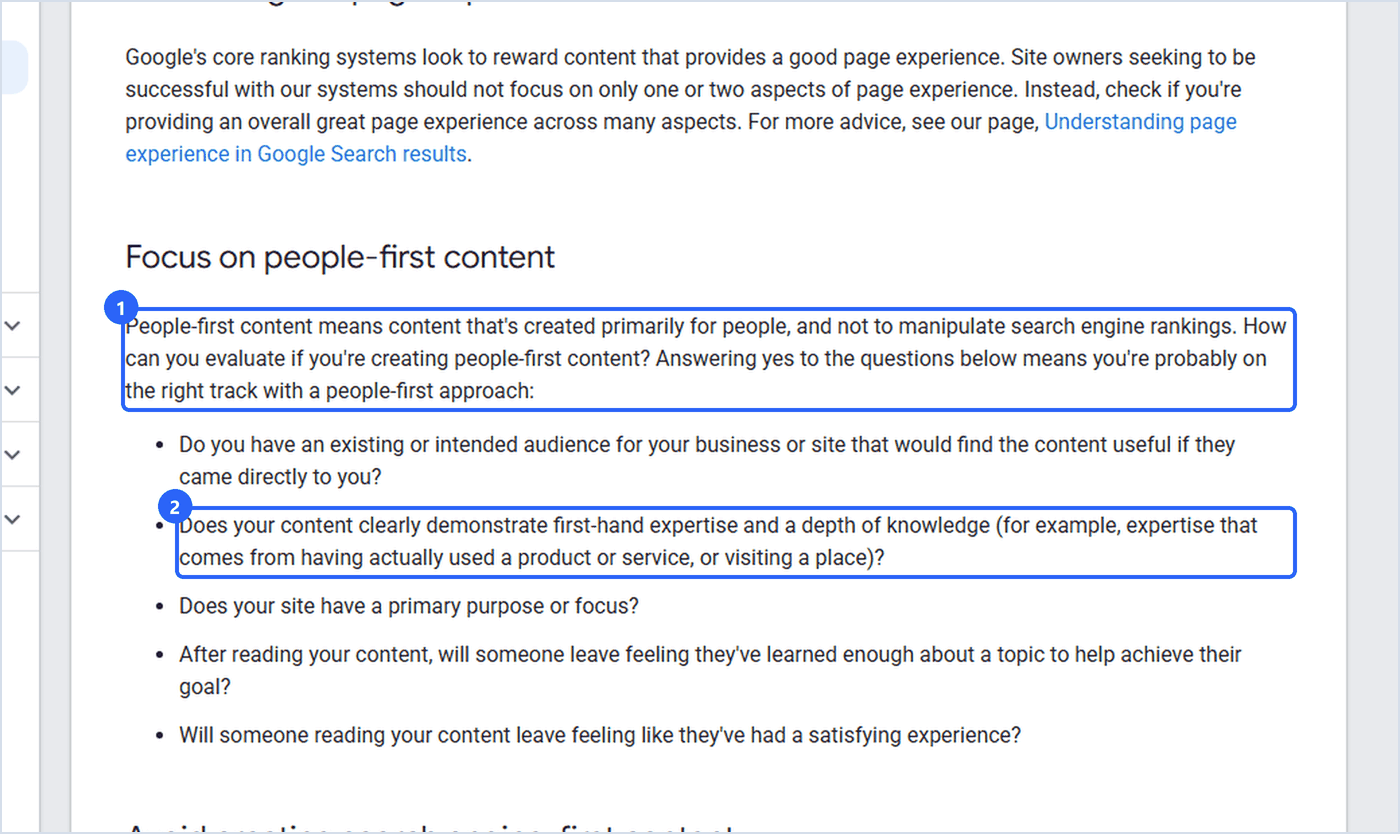
Topical authority means covering a subject cluster thoroughly rather than writing one article per topic. Google’s guidance on people-first content asks whether content shows first-hand expertise and a depth of knowledge, whether the site has a primary purpose or focus, and whether a reader leaves having learned enough to achieve their goal. Those questions favor depth on a focused set of topics over breadth across unrelated ones.
B2B keyword research differs from B2C in one way that matters: volume is a trap. A phrase a VP of Operations types when frustrated with a current vendor can be worth more than a broader phrase searched by people doing competitive research. Qualify intent before you qualify volume. For example, a supply chain visibility platform selling to mid-market manufacturers would likely do better with a page on “real-time inventory visibility for manufacturers” than a page chasing the broad “inventory tracking software,” where results tend to be written for small business owners. Check the live results for your own terms before you decide.
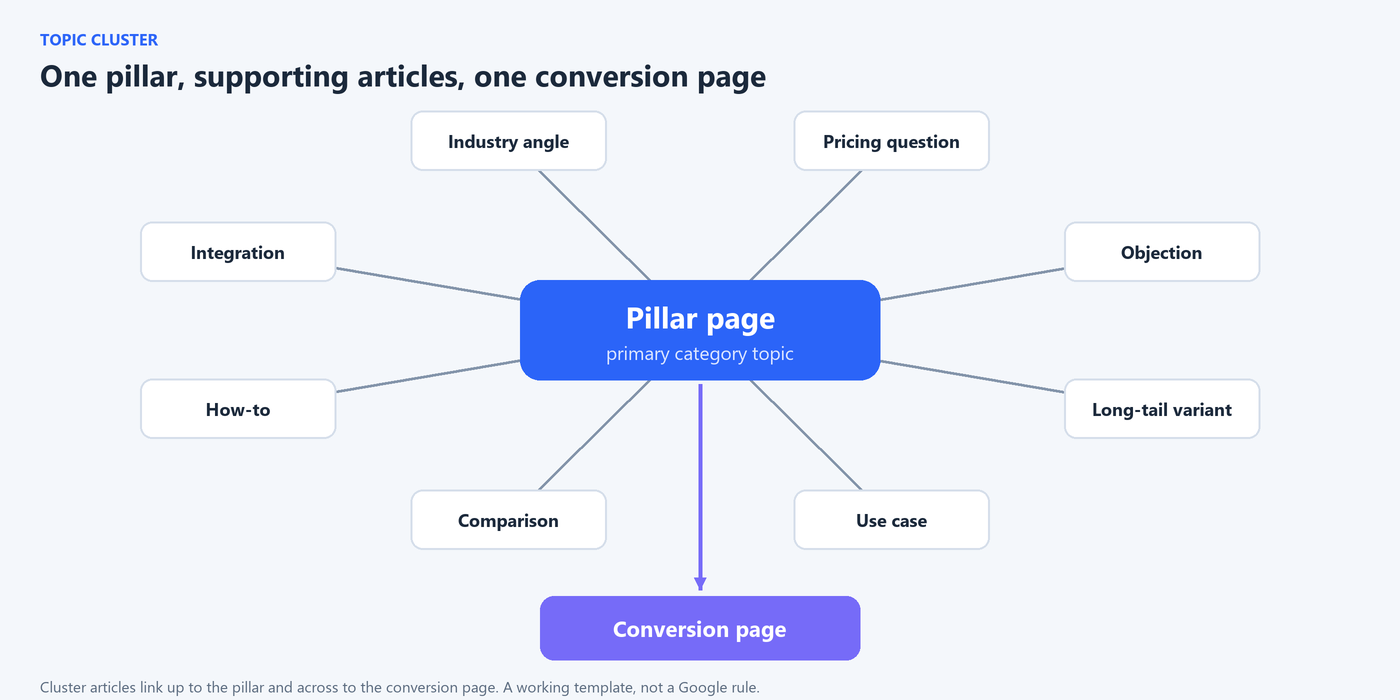
The cluster structure we use as a working template is one pillar page on the primary category topic, supported by a set of cluster articles on related long-tail variants, all linked back to the pillar and to a relevant conversion page. It is a template, not a Google rule, and the right number of cluster articles depends on how much there is to say.
3. Content Infrastructure
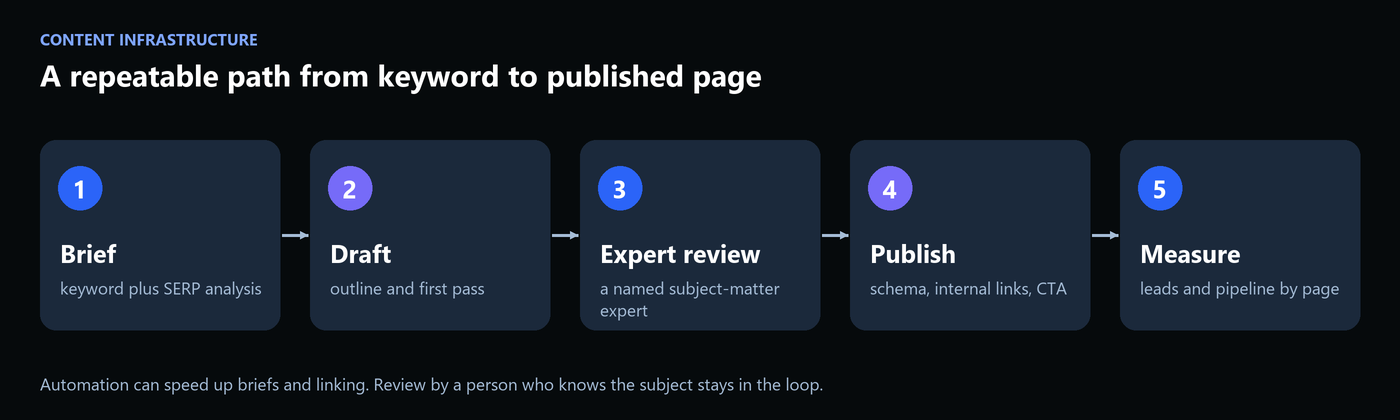
The operational challenge for most B2B companies is not knowing what to write. It is publishing consistently without letting quality slide. A content system helps:
- Briefs generated from keyword and SERP analysis
- Outlines and first drafts produced faster with AI assistance
- A named subject-matter expert reviewing every page before it publishes
- Programmatic pages only where each page has something genuinely distinct to say (comparison pages, use-case pages)
- Internal linking that connects each page to the pillar and to a conversion page
A caution: scale without distinctness backfires. Thin pages produced in bulk add noise, and our own data in the next section shows how many impressions can arrive without a click.
4. Authority and Link Building
External links remain an important signal. For B2B companies the approaches that tend to work are:
- Digital PR: data-led studies, original research and expert commentary that earn coverage in industry publications.
- Expert contributions: bylined articles in trade publications your buyers read, not only SEO publications.
- Competitor link gap analysis: sites that link to your top competitors but not to you are the most likely outreach targets.
- Resource pages and roundups: tool comparison pages, vendor lists and category resource pages.
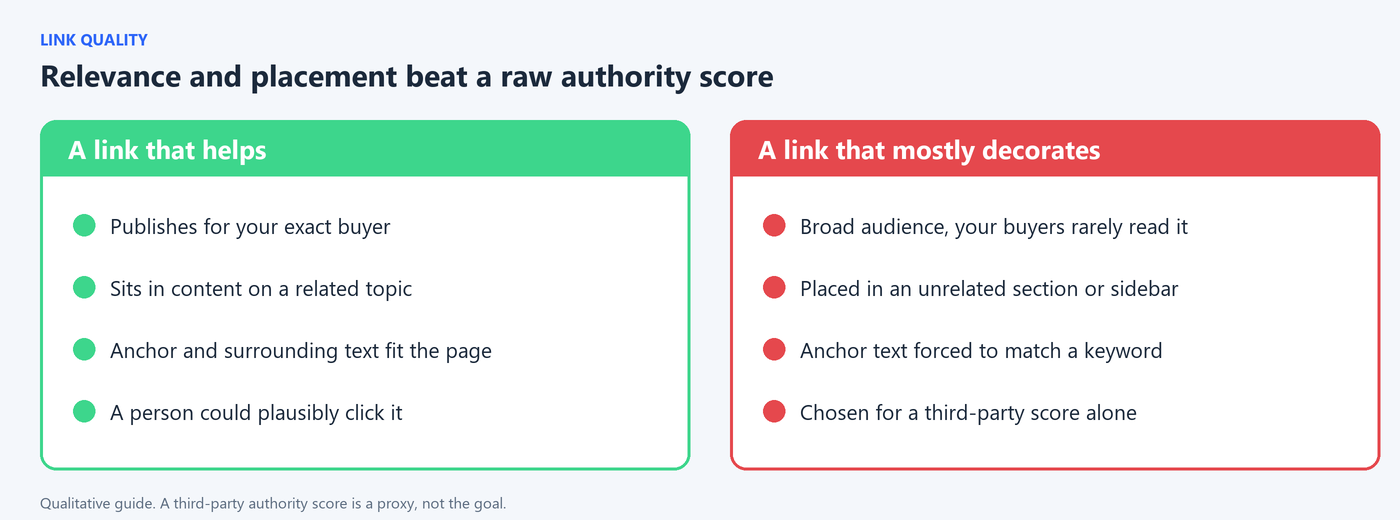
The mistake many B2B companies make is chasing an authority score instead of relevance and placement. Moz, which publishes Domain Authority, states that the score is not a Google ranking factor and is a comparative metric. A link in content that your buyers actually read, on a topic related to yours, is evidence that others in your space vouch for you. A link from a large general publication that your buyers never visit adds far less for your business. Google notes that E-E-A-T (experience, expertise, authoritativeness and trustworthiness) is not itself a specific ranking factor, but that its systems use a mix of factors that can identify content demonstrating it. Earned, relevant mentions are part of that mix.
How Do You Measure B2B SEO Success?
Traffic is the wrong primary metric for B2B SEO. The metrics that matter are:
- Organic-attributed leads: form fills, demo requests and trial signups from organic sessions.
- Organic-attributed pipeline: deals in the CRM where organic was the first or last touch.
- Keyword rank movement: positions on target commercial terms, not vanity informational terms.
- Share of voice: your visibility against competitors across the full keyword set in your category.
The measurement stack needs three layers. Google Search Console shows impressions, clicks and position for target queries. GA4, with conversion events configured, shows which organic sessions convert. CRM source tracking records organic as a first touch and a last touch separately. Without the CRM layer you are measuring activity, not outcomes. A common cause of “SEO is not working” is broken attribution: leads arrive through organic and get filed under direct or unknown because UTM parameters were lost between the form and the CRM.
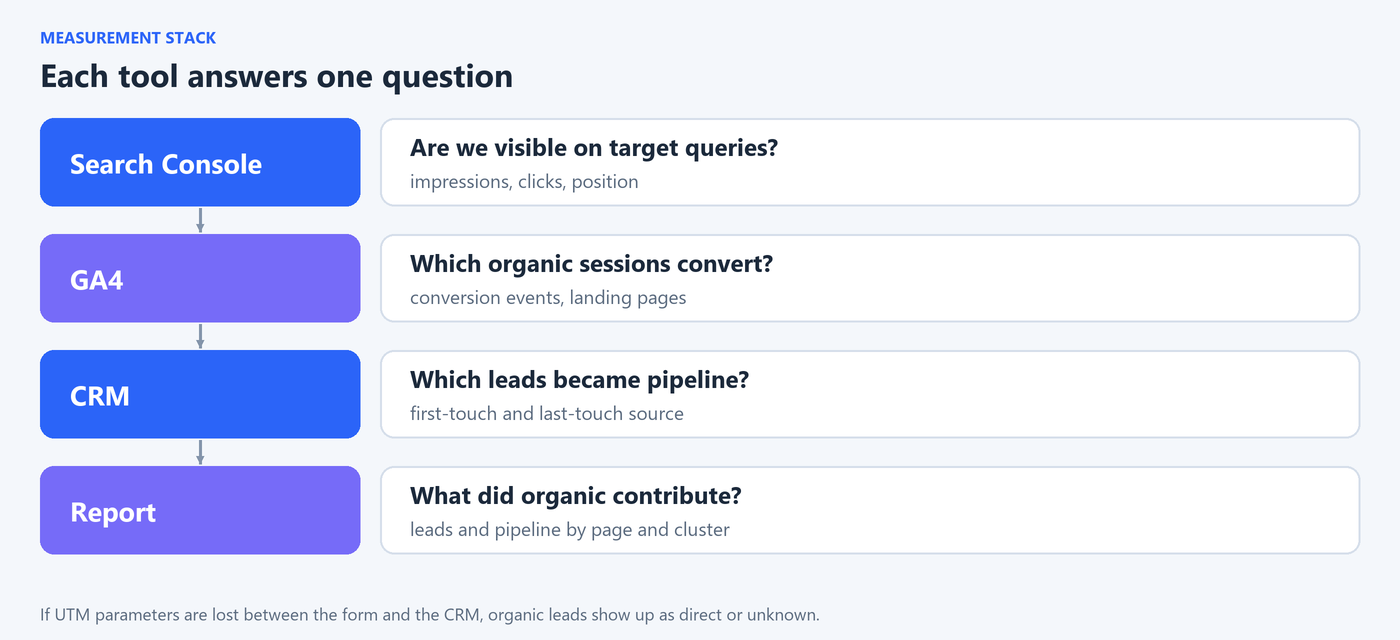
| Question | Source | Review cadence |
|---|---|---|
| Are we visible on target commercial queries? | Search Console, rank tracker | Weekly on 20 to 30 target keywords |
| Which organic landing pages produce leads? | GA4 conversion events | Monthly |
| Which leads became pipeline? | CRM first-touch and last-touch source | Monthly |
| Are competitors gaining share in our category? | Share of voice across the keyword set | Quarterly |
The cadence in the table is our recommended working rhythm, not an industry standard. The quarterly review is where strategy gets decided: if a competitor gains visibility, you need to know which keyword clusters drove it and whether they reveal a gap in your topical coverage.
What does the Search Console check look like in practice?
Search Console has an API, and the searchanalytics.query method lets you pull queries with clicks, impressions and position for a date range. The script below groups the queries into intent buckets using simple word lists and reports each bucket. The buckets are a heuristic, so edit the word lists for your own market. We ran it on our own property.
gsc_intent_buckets.py, part 1: authentication, the word lists and the API call. Common error: a 403 means the OAuth token lacks the webmasters.readonly scope or the account has no access to that property.
"""Group Search Console queries into intent buckets.

Auth: set GSC_CLIENT_ID, GSC_CLIENT_SECRET and GSC_REFRESH_TOKEN
(an OAuth refresh token with the webmasters.readonly scope).
Usage: python gsc_intent_buckets.py sc-domain:example.com
"""
import datetime
import os
import re
import sys
from collections import defaultdict
from urllib.parse import quote

import requests  # pip install requests

# First match wins. Edit the word lists for your own market.
WORDS = {
    "brand": "mv3",
    "commercial": ("software tool tools platform agency service services "
                   "pricing price cost vendor consultant consultants "
                   "company companies"),
    "comparison": ("vs versus alternative alternatives best top review "
                   "reviews compare comparison"),
    "informational": ("what how why guide checklist template example "
                      "examples meaning definition framework strategy"),
}
BUCKETS = [(name, re.compile(r"\b(" + "|".join(w.split()) + r")\b"))
           for name, w in WORDS.items()]


def access_token():
    r = requests.post("https://oauth2.googleapis.com/token", data={
        "client_id": os.environ["GSC_CLIENT_ID"],
        "client_secret": os.environ["GSC_CLIENT_SECRET"],
        "refresh_token": os.environ["GSC_REFRESH_TOKEN"],
        "grant_type": "refresh_token",
    }, timeout=30)
    r.raise_for_status()
    return r.json()["access_token"]


def fetch_queries(site, days=90):
    # Search Console data lags by a few days
    end = datetime.date.today() - datetime.timedelta(days=3)
    start = end - datetime.timedelta(days=days - 1)
    url = ("https://www.googleapis.com/webmasters/v3/sites/"
           + quote(site, safe="") + "/searchAnalytics/query")
    body = {"startDate": str(start), "endDate": str(end),
            "dimensions": ["query"], "rowLimit": 25000}
    r = requests.post(url, json=body, timeout=60,
                      headers={"Authorization": "Bearer " + access_token()})
    r.raise_for_status()
    return start, end, r.json().get("rows", [])
Part 2: assigns each query to a bucket and prints the totals.
def bucket_of(query):
    for name, pattern in BUCKETS:
        if pattern.search(query.lower()):
            return name
    return "other"


def main(site):
    start, end, rows = fetch_queries(site)
    agg = defaultdict(lambda: dict(queries=0, clicks=0, impr=0, pxi=0.0))
    for row in rows:
        a = agg[bucket_of(row["keys"][0])]
        a["queries"] += 1
        a["clicks"] += row["clicks"]
        a["impr"] += row["impressions"]
        a["pxi"] += row["position"] * row["impressions"]
    print(f"{site}  {start} to {end}  ({len(rows)} queries)")
    print(f"{'bucket':<15}{'queries':>8}{'clicks':>8}{'impr':>8}{'avg pos':>9}")
    for name, a in sorted(agg.items(), key=lambda kv: -kv[1]["impr"]):
        pos = a["pxi"] / a["impr"] if a["impr"] else 0
        print(f"{name:<15}{a['queries']:>8}{a['clicks']:>8}"
              f"{a['impr']:>8}{pos:>9.1f}")


if __name__ == "__main__":
    main(sys.argv[1])
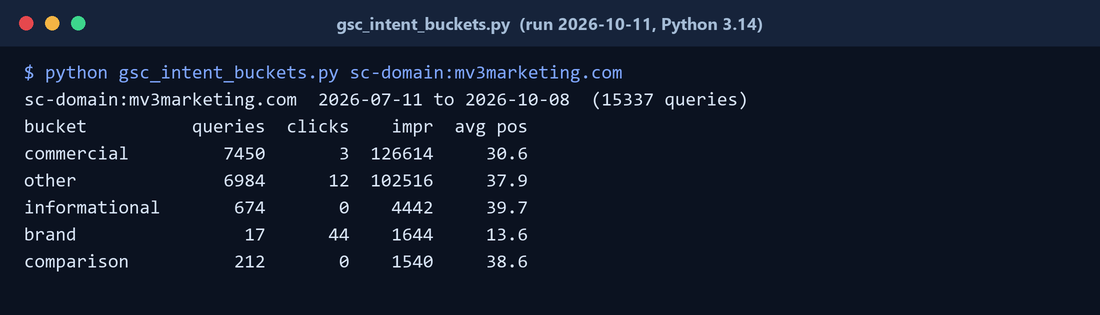
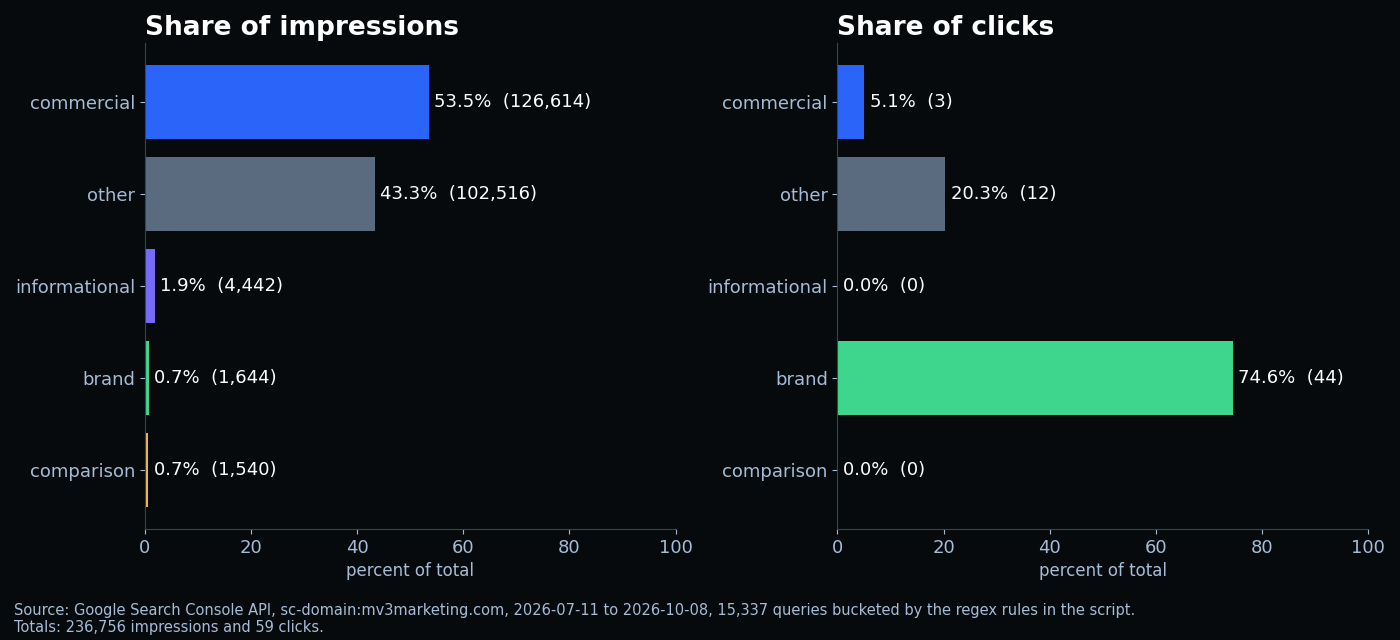
What the check shows for our own site: most impressions sit on commercial-pattern queries at an average position around 30, where almost nobody clicks, while nearly all clicks come from people searching for our name. That is a visibility gap, not a conversion problem, and it is exactly the sort of finding a traffic total would hide. The “other” bucket is large because the word lists are short. A real analysis would refine them. The point is the method: split by intent, then compare impressions with clicks.
How Long Does a B2B SEO Program Take?
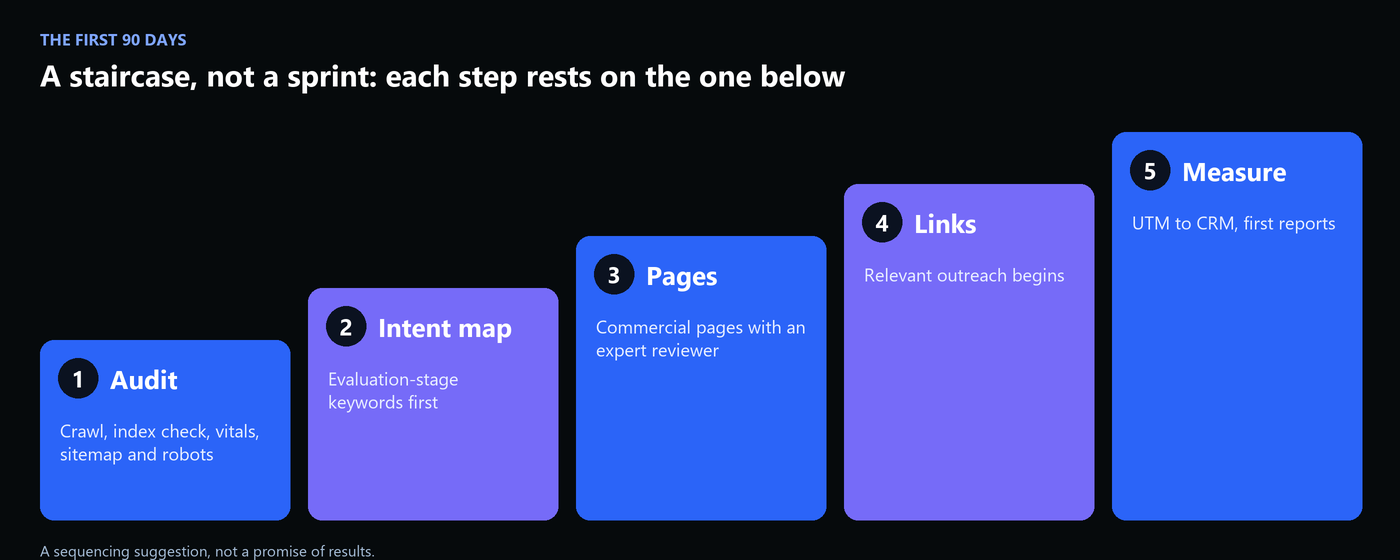
B2B SEO is not a 90-day play, and no honest provider can promise a date for a ranking. The chart below is a planning template we use to sequence work. The month boundaries are assumptions, and real timing depends on competition, starting authority and execution. For a longer treatment see how long SEO takes for B2B companies.
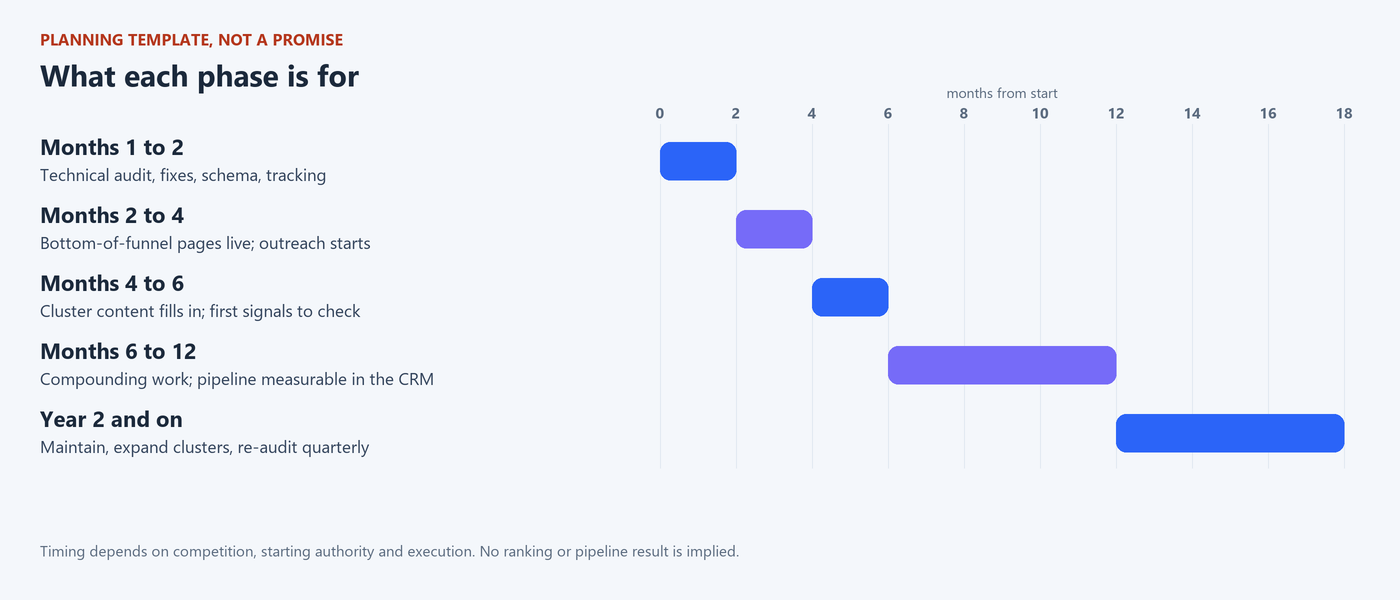
- Months 1 to 2: technical audit, fix critical errors, deploy schema, set up tracking.
- Months 2 to 4: bottom-of-funnel commercial pages published and indexed, outreach begins.
- Months 4 to 6: check for first commercial ranking signals while cluster content fills in.
- Months 6 to 12: compounding work; organic pipeline becomes measurable in the CRM.
- Year 2 and on: maintain, expand clusters and re-audit quarterly.
Why Treat SEO as Infrastructure Instead of a Tactic?
Tactical SEO produces traffic that stops when you stop paying. Infrastructure SEO produces assets: indexed content, earned links, clear entity relationships, a documented system. Those compound and cannot be taken away when you switch vendors. At MV3 Marketing we build every engagement on that principle: you should own your growth channel, not rent it. The audit, the content system and the link work stay with you.
What Mistakes Should You Watch For in an SEO Agency?
Some SEO retainers are sold on output (articles per month, links per quarter, reports per week) because output is easy to invoice and hard to dispute. Outcomes need accountability. These are patterns to watch for.
| Pattern | Why it fails | What to ask for instead |
|---|---|---|
| Chasing an authority score | Scores are proxies. Links from topically relevant sources serve buyers and search engines better than a higher score from an unrelated site. | A link report that shows relevance and placement for each link |
| Treating all keywords as equal | Sorting by volume pushes broad informational terms to the top and buries the phrases buyers use when ready to evaluate. | The 10 to 15 evaluation-stage keywords built first, then work up-funnel |
| Decoupling content from conversion | Articles with no path to a conversion page produce sessions that vanish in your CRM. | A defined next step for every page: demo CTA, service page link, or gated asset |
| Ignoring technical debt | New pages ship without schema, migrations add redirect chains, rendering changes break crawlability. | A quarterly re-audit, not a one-time onboarding checklist |
The common thread is the appearance of activity over the architecture of outcomes. Before signing any SEO retainer, ask for attribution-level reporting: organic leads and pipeline sourced to specific pages and keyword clusters. If a provider cannot commit to that standard, they are not set up to run an infrastructure-grade program.
Frequently Asked Questions
What is a B2B SEO strategy?
A B2B SEO strategy is a plan for earning organic search visibility from the buyers of a business-to-business product or service. It combines a technical foundation, keyword targeting mapped to buyer intent, a content system with expert review, and relevant link acquisition, and it is measured in organic-attributed leads and pipeline rather than traffic.
How is B2B SEO different from B2C SEO?
B2B SEO deals with longer sales cycles, smaller and more specific audiences and higher customer value, so intent matters more than volume. A phrase searched a few times a month by a decision maker can be worth more than a high-volume phrase searched by researchers, and success is judged by pipeline contribution instead of sessions.
| Dimension | B2B SEO | B2C SEO |
|---|---|---|
| Sales cycle | Long, several stakeholders | Short, often one decision maker |
| Keyword priority | Intent first, volume second | Volume and breadth matter more |
| Primary success metric | Organic-attributed leads and pipeline | Sessions, orders, revenue per visit |
| Typical conversion path | Demo request, call, trial | Add to cart, purchase |
Which keywords should a B2B company target first?
Start with bottom-of-funnel commercial keywords such as “[category] software,” “[service] agency” and “best [solution] for [vertical].” They have lower volume but show direct purchase intent. Then build comparison and evaluation pages, and add informational content that links back to those pages.
How do you measure B2B SEO ROI?
Track organic-attributed leads and pipeline, not sessions. Use Search Console for visibility on target queries, GA4 conversion events for organic sessions that convert, and CRM source tracking that records organic as both first touch and last touch. Make sure UTM parameters survive from the form to the CRM.
How long does B2B SEO take to work?
It takes months, and the timing depends on competition, starting authority and execution, so no one can promise a date. A sensible plan sequences technical fixes first, then commercial pages, then supporting content, and expects pipeline to become measurable in the CRM later than the first ranking signals.
Recap: What to Do First, and How to Check It
| Pillar | First action | How to check it worked |
|---|---|---|
| Technical foundation | Crawl the site and align robots.txt with the sitemap | Zero sitemap URLs blocked; key pages return 200 |
| Keyword strategy | List the evaluation-stage keywords and build those pages first | Impressions and clicks on commercial queries in Search Console |
| Content infrastructure | Assign an expert reviewer and a conversion link to every page | Each published page has a named reviewer and a next step |
| Authority and links | Shortlist relevant sites that link to competitors but not to you | New links come from pages your buyers read |
| Measurement | Confirm UTM data reaches the CRM | Organic leads appear as organic, not direct or unknown |
Download: B2B SEO technical audit and measurement checklist (CSV). It lists the checks from this guide in order, with a Done column.
Related Reading
Book a call and we will walk through your keyword gap, your competitor authority picture and a roadmap for the first 90 days before you commit to anything.
Sources
Google Search Central, Understanding Core Web Vitals and Google search results. web.dev, Web Vitals. Google Search Central, Crawl budget management for large sites. Google Search Central, Creating helpful, reliable, people-first content. Google Search Central, What is a sitemap. Google for Developers, Search Analytics: query. Moz, Domain Authority. Search Console figures are from our own property, pulled 2026-10-11.
Share this article

Vance Moore is Chief Growth Officer at MV3 Marketing and leads its team of SEO professionals, engineers and auditors.
Ready to audit your organic growth opportunity?
$2,500 flat. 5 business days. Six deliverables tied to pipeline , not rankings. No retainer required.
Get the Organic Growth Audit →