Amplemarket is an AI-powered sales engagement platform that combines B2B lead sourcing, buying-signal detection, and multichannel outreach (email, LinkedIn, phone) in one workspace. It’s built for B2B SaaS sales and RevOps teams who want to replace a stack of separate prospecting, sequencing, and deliverability tools with a single AI-driven system.
Disclosure: MV3 Marketing participates in affiliate and partner programs, including Amplemarket’s. This post contains affiliate links, and we may earn a commission if you sign up through them, at no additional cost to you. We only write about tools we’ve actually researched and tested against real product pages, not vendor talking points.
If you run outbound for a B2B SaaS company, you already know the problem. Building a target account list takes hours. Finding verified contact data for the people on that list takes more hours. Writing personalized outreach that doesn’t read like a template takes even longer. And by the time a rep gets a sequence live, half the “signals” that made a prospect worth contacting (a funding round, a new VP of Sales, a competitor complaint on G2) are already stale.
Amplemarket was built to compress that whole workflow into one tool. We spent time on the actual product pages, not just the marketing copy, to understand what it does and who it’s really for. Here’s what we found.
What Amplemarket Actually Is
Amplemarket describes itself as a “human + AI” sales platform. The core pitch is straightforward: instead of stitching together a data provider, a sequencing tool, a dialer, and a deliverability monitor, you run lead sourcing, engagement, and signal tracking from one place.

The platform is organized around a handful of core areas: Lead Generation & Signals, Multichannel Engagement, Deliverability Optimization, and Intelligence, tied together by an AI layer called Duo. Duo is positioned as an AI sales agent that watches for buying signals (a decision-maker visiting your site, a closed-lost opportunity mentioning “check back in Q3,” a prospect engaging with a competitor’s content) and builds outreach sequences around them, with reps approving before anything sends.
If you want to see the lead-sourcing side of this in action before committing to anything, the fastest way is to start a free trial through Amplemarket and run a real search against your own ICP.
AI-Sourced Lead Lists: How Searcher Works
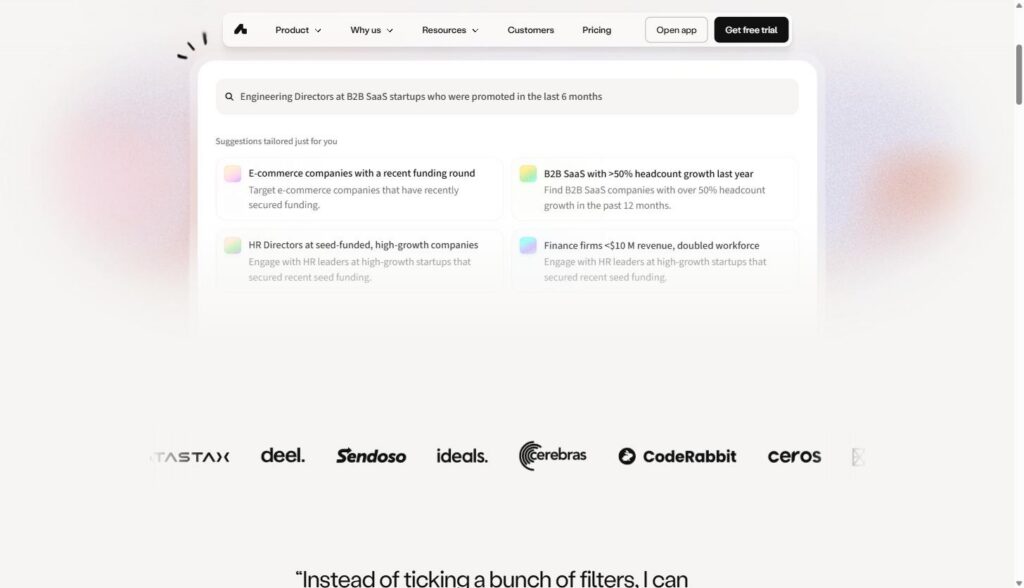
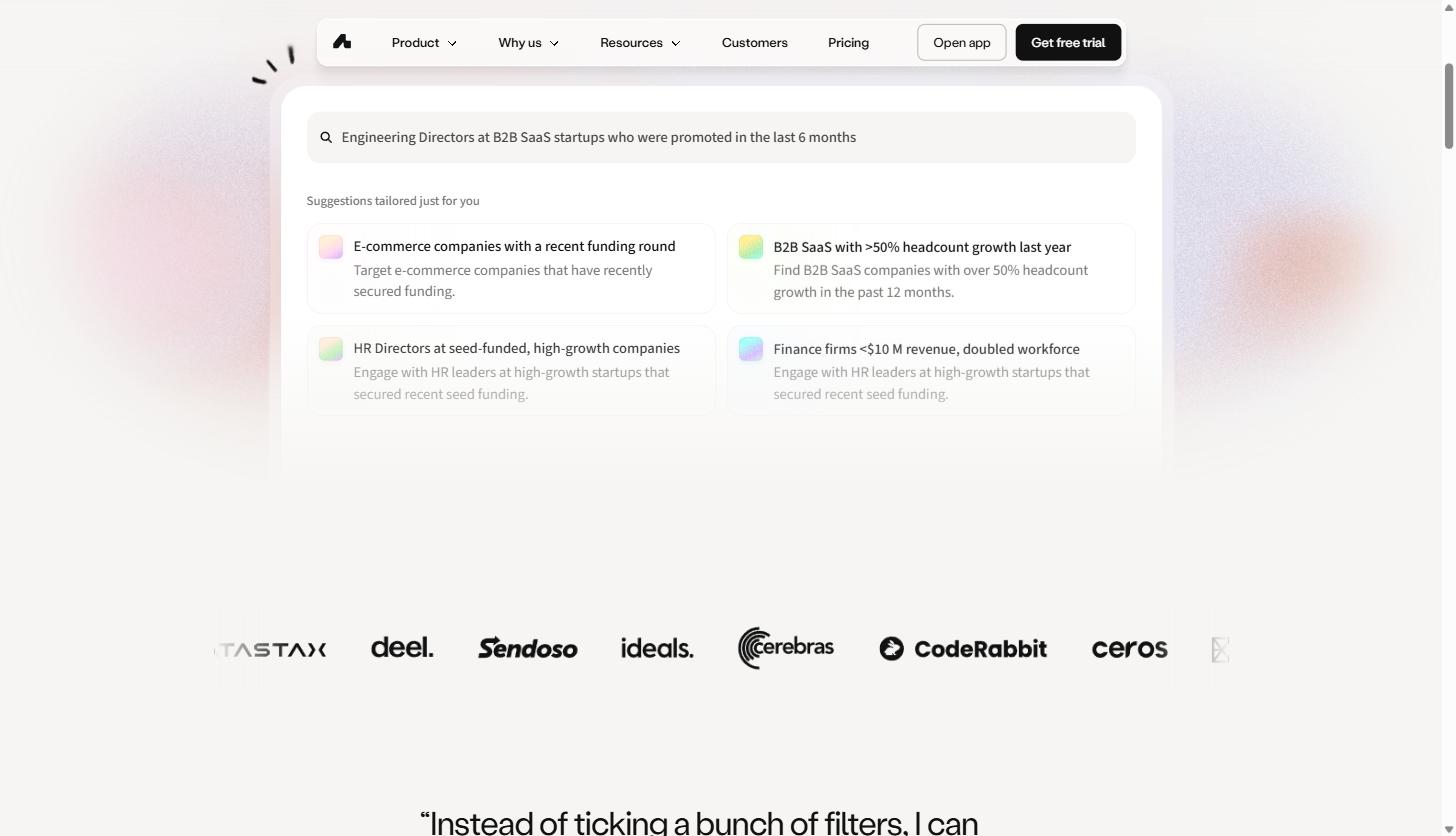
The lead-sourcing tool, called Searcher, is built around plain-language prospecting instead of stacked filter menus. On the live product page, the prompt example reads: “Engineering Directors at B2B SaaS startups who were promoted in the last 6 months.” You type a description of the buyer you want, and the system returns matching accounts and contacts, along with pre-built suggestions like “B2B SaaS with >50% headcount growth last year” or “E-commerce companies with a recent funding round.”
This matters for SaaS sales teams specifically because ICP criteria in this category are rarely a clean industry-and-headcount filter. “Series B company that just hired their first VP of RevOps” or “team that recently migrated off a competitor” are the kinds of signals that actually predict a good fit, and they’re hard to express in a traditional dropdown-filter search. Letting the AI parse a natural-language description against a broader signal set is meant to close that gap.
On the data side, Amplemarket’s own pricing page lists the contact volumes included per plan: 27,000 contacts on the Startup tier, 140,000 on Growth, and 400,000 on Elite, plus CRM-style filters (30+ listed), data enrichment for incomplete records, calendar enrichment, and real-time email validation to cut down on bounces. The product pages also state a specific claim worth noting exactly as written: Amplemarket says its data helps “reduce bounce rates by 50% and 5x increase in interest rates,” which is a vendor claim, not an independently verified benchmark, so treat it as directional rather than guaranteed.
Multichannel Sequences: Email, LinkedIn, and Phone in One Flow
Once a list is built, the Multichannel Engagement piece is where sequences actually go out. Amplemarket runs email, phone (with an outbound dialer for verified numbers), and social/LinkedIn touches from the same sequence builder, with conditional and A/B logic so a rep can branch messaging based on how a prospect responds (or doesn’t).
Duo Copilot sits on top of this and drafts the sequence itself, based on signals it’s tracking. In Amplemarket’s own product walkthrough, the flow looks like this: a signal fires (a prospect is attending the same event your sales team is going to), Duo drafts an email, adds a LinkedIn connection step, and can add a personalized AI voice note using a cloned version of the rep’s voice, then the rep reviews and approves before anything sends. That approval step is worth calling out because it’s the difference between “AI writes your outreach” and “AI ghostwrites outreach you never see,” and Amplemarket’s own materials consistently frame it as rep-approved, not fully autonomous.
For a SaaS sales team specifically, this multichannel layer replaces what used to require separate tools for email sequencing, a LinkedIn automation extension, and a dialer. One thing to watch for in a trial: multichannel automation only works if your team actually wants reps present in the loop for LinkedIn and calling, not just email. If your outbound motion is email-only today, you’re paying for channels you may not use yet.
Worth testing directly rather than taking on faith: build one real sequence in a free Amplemarket trial against a small segment of your own pipeline before rolling it out team-wide.
Intent-Based Prioritization: Working the Right Accounts First
The “Intelligence” piece of the platform is about deciding who to contact, not just how. Amplemarket’s signal feed on its homepage lists dozens of live signal types it tracks: a prospect visiting your website, a champion changing jobs, someone commenting on a competitor’s post, a company hiring for a role that suggests budget, a past closed-lost deal re-engaging. Two specific product features under this umbrella are Job Change Alerts (tracking when a contact moves roles) and Competitive Intelligence (monitoring competitors’ digital footprint, including things like a prospect leaving a low rating for a competitor on G2).
For B2B SaaS teams, this kind of intent layer is arguably more useful than raw list volume. A list of 10,000 technically-in-ICP contacts is much less valuable than 200 contacts who are actively showing buying signals right now. Amplemarket’s own pricing comparison page states the Intelligence feature is meant to “increase conversion rates by up to 50%,” another vendor-stated figure rather than a third-party benchmark, so validate it against your own pipeline data during a trial rather than assuming it’ll hold at your scale.
Deliverability: The Part Most Teams Ignore Until It’s a Problem
A sequence with great copy and a sharp target list still fails if it lands in spam. Amplemarket bundles a Deliverability Optimization layer that includes a Domain Health Center to monitor mailboxes and domains, an automated warmup tool (branded “Deliverability Booster”), an email spam checker, and mailbox recommendations aimed at protecting sender reputation. The product pages state this is meant to help teams “boost open rates by up to 50%” through AI-assisted scheduling, deliverability testing, and warmup, again a vendor figure worth testing against your own send data rather than treating as a guarantee.
This matters more for SaaS companies than it might seem. Outbound at scale from a single domain, without warmup and monitoring, is one of the fastest ways to get a sending domain blacklisted, which then quietly tanks reply rates on every channel, including your transactional and lifecycle email. Folding deliverability monitoring into the same platform as sequencing, instead of running it as an afterthought in a separate tool, is a real operational advantage if your team doesn’t already have someone dedicated to watching sender reputation.
Domain health is one of those things that’s easy to ignore until reply rates quietly drop for weeks before anyone notices. If that’s a gap in your current stack, it’s worth checking whether Amplemarket’s deliverability tools catch problems your current setup is missing.
Who Amplemarket Is Actually Built For
Amplemarket’s own site segments its audience into five groups: Sellers, Sales Leaders, Founders, RevOps, and Marketers. That’s a wide net, but the product itself is clearly weighted toward outbound-heavy teams rather than inbound or product-led motions. The homepage leads with stats aimed squarely at that audience: a claim of boosting meetings booked by up to 60% through signal-driven prospecting, and a claim of saving reps more than 10 hours per week on account research and email drafting. Both are vendor-reported figures pulled directly from Amplemarket’s marketing pages, not independently audited numbers, so treat them as a starting hypothesis to test against your own team’s baseline rather than a guarantee.
One detail worth calling out for SaaS RevOps leaders specifically: Amplemarket’s own site lists a stream of companies that “migrated off” other platforms, naming Apollo, Outreach, ZoomInfo, Salesloft, Cognism, and Seamless among the tools customers replaced. That’s a self-reported list, not a verified churn report, but it’s a useful signal about who Amplemarket is actively positioning against, and it lines up with the consolidation pitch: one platform instead of a data provider plus a sequencer plus a dialer.
Duo also builds what Amplemarket calls a shared “brand” for the sales team after onboarding, a library of competitor information, target personas, case studies, value propositions, and objection-handling guidance pulled from your website, CRM, and the broader web. Reps can then coach it directly, the same way you’d coach a new hire: telling Duo what to say when a prospect responds that they’re not the right contact, for example, and having that guidance apply to future conversations. For SaaS teams onboarding new SDRs regularly, that shared knowledge base is arguably as valuable as the automation itself, since it shortens the ramp time for reps who don’t yet know the product’s objection patterns.
Practical Use Cases for B2B Service Business Sales Teams
Based on what the product actually does, here’s where it fits a typical SaaS RevOps or sales motion:
- Building a fresh target list for a new segment. A SaaS company entering a new vertical or company-size band can describe the ICP in plain language through Searcher instead of manually building filter combinations, then export a list with enriched contact data already attached.
- Running a multi-touch sequence without five separate tools. Instead of a sequencing platform, a separate LinkedIn automation tool, a dialer, and a data provider, one workspace handles list building, email, LinkedIn, and calling.
- Prioritizing SDR time around signals instead of a static list. Reps working from the Duo signal feed can reach out when a prospect is actually showing intent (a job change, a competitor complaint, a funding event) instead of working a cold list in alphabetical order.
- Re-engaging closed-lost opportunities. The signal tracking is explicitly built to flag when a past “not now” prospect re-enters the market, which is a segment most SaaS teams under-invest in following up with.
- Consolidating tool spend during a renewal cycle. Teams currently paying for a data provider, a sequencer, and a dialer separately have a real case for evaluating whether one platform covers the same ground for less total license cost.
If any of those match how your team currently operates, it’s worth running the numbers yourself. Amplemarket’s free trial is the fastest way to see whether the consolidation case actually holds for your stack.
Integrations and Where It Fits in Your Existing Stack
Amplemarket lists Integrations as its own product area, described on the site simply as bringing your go-to-market tools together. In practice, that means connecting Amplemarket to a CRM (the platform is built to sync data both directions, so signals and sequence activity show up where your sales leadership already looks for pipeline data) rather than asking a team to abandon its system of record. For a SaaS company, this matters because the CRM is usually the source of truth for forecasting and reporting. A prospecting and sequencing tool that doesn’t sync cleanly with the CRM creates a second, disconnected version of the truth that RevOps ends up reconciling manually.
Before rolling Amplemarket out past a pilot, it’s worth confirming during a trial that your specific CRM setup, custom fields included, syncs the way you need it to. Vendor integration lists are usually accurate about which platforms are supported, but field-level mapping and how conditional logic in sequences reads CRM data can vary enough to matter for reporting accuracy.
Pricing: What It Actually Costs
Amplemarket’s pricing page lists three tiers, and we’re reporting exactly what’s published rather than estimating:
| Plan | Price | Users Included | Contacts Included | Notable Add-Ons |
|---|---|---|---|---|
| Startup | $600/mo (annual term) | 2 | 27,000 | Multichannel sequences, AI intent signals, Duo Copilot |
| Growth | Custom (not published) | 4 | 140,000 | Adds Duo Voice |
| Elite | Custom (not published) | 10 | 400,000 | Adds Duo Inbox, dedicated CSM |
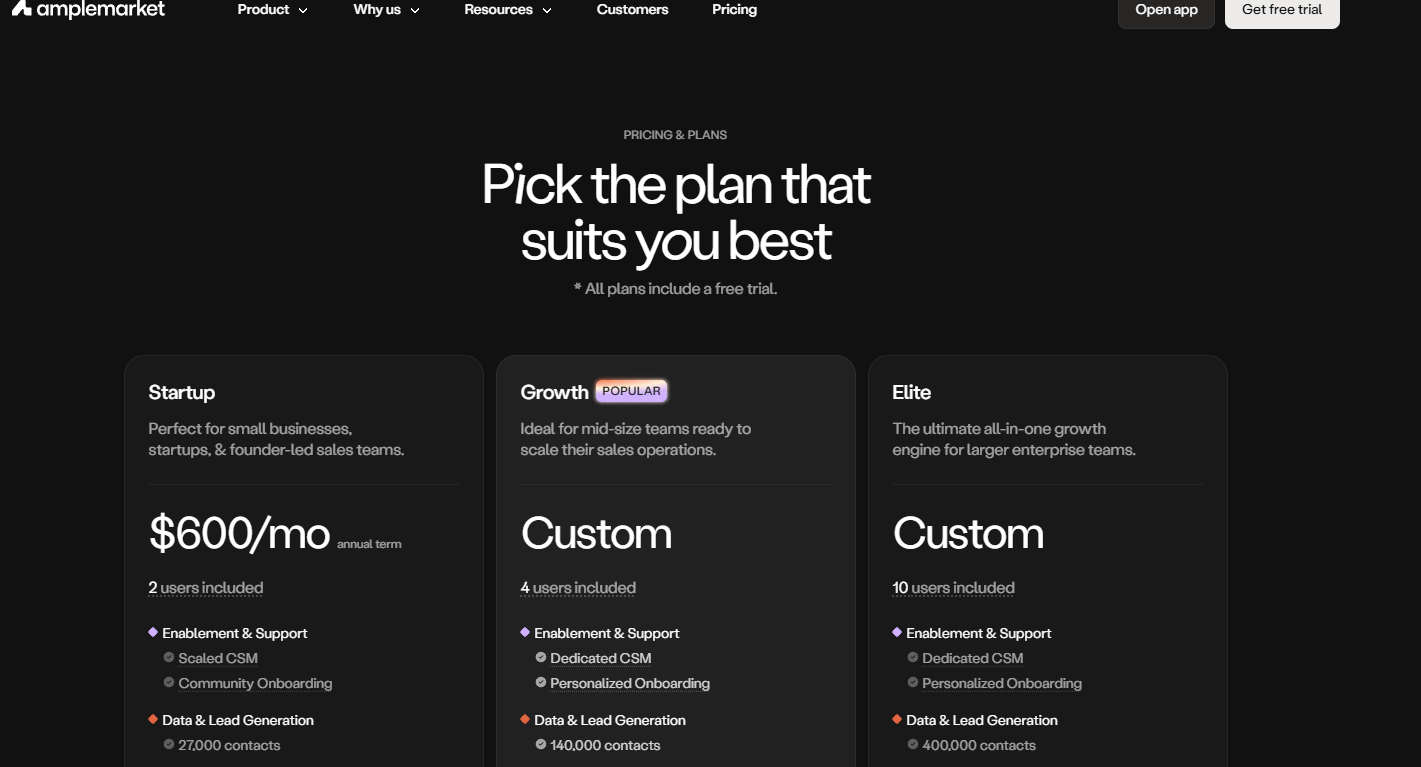
The honest read here: only the entry-level Startup plan has a public price, and it’s billed on an annual term rather than month-to-month. Growth and Elite are both listed as “Custom,” meaning you’ll need to talk to sales to get an actual number, and that number will scale with seats, contact volume, and which Duo add-ons (Voice, Inbox) you need. If your team is under 5 people and mostly needs core sequencing and signals, the Startup tier gives you a real number to budget against. If you’re evaluating Growth or Elite, build the request-a-quote step into your evaluation timeline rather than assuming it’ll match a competitor’s published pricing.
AI-Assisted Prospecting vs. Manual List-Building
The comparison that actually matters for most SaaS teams isn’t Amplemarket versus one specific competitor, it’s AI-assisted prospecting versus the manual process most teams still run: pull a list from a database tool, cross-reference it in a spreadsheet, hunt for verified emails, build a sequence in a separate platform, and manually track who’s shown intent.
That manual process isn’t wrong, it’s just slow, and it puts the burden of noticing signals (a job change, a funding round, a competitor complaint) entirely on a rep’s memory and manual research time. The tradeoff with a consolidated AI platform is you’re trusting one vendor’s data quality and AI output across your whole funnel instead of picking a best-in-class tool for each step. For a lean SaaS sales team without a dedicated ops function to manage five integrated tools, that tradeoff usually favors consolidation. For a larger team with an established best-of-breed stack and dedicated RevOps headcount, the calculus is closer, and it’s worth running a real trial against your own data before switching.
If your team is still building lists manually or juggling separate tools for search, sequencing, and deliverability, comparing that workflow against a real Amplemarket trial is the only way to know which one actually saves your reps time. For more on how AI fits into broader B2B outbound and demand-gen strategy, see our marketing glossary, and if you want a partner to help design the outbound motion around whichever tools you choose, our sales tech marketing services page covers how we work with revenue teams in this category.
Common Questions From Service Business Sales Teams
Does Amplemarket replace our CRM?
No. It’s positioned as a prospecting and engagement layer that syncs into your CRM, not a replacement for it. Salesforce and HubSpot are among the systems customers reference integrating with in Amplemarket’s own customer stories.
Can a small service business sales team (2 to 3 reps) justify it?
The Startup plan is explicitly scoped for that segment, 2 users included with room to add more, and it’s the only tier with a public price ($600/mo on an annual term). If your team is smaller than that or needs month-to-month flexibility, that annual commitment is worth weighing against your cash flow before signing.
Is the AI fully autonomous, or does a rep review outreach before it sends?
Based on Amplemarket’s own product demonstrations, Duo drafts sequences and signal-based recommendations, but sending requires rep approval. The workflow shown on the product pages consistently has a human clicking approve before an email, call step, or voice note goes out.
What don’t we know from the public site?
Exact Growth and Elite pricing isn’t published, so budget conversations for anything beyond the Startup tier require a sales call. Data accuracy and deliverability results will also vary by industry and target geography, and the only way to validate either for your specific ICP is a trial against your own list, not the vendor’s aggregate stats.
Getting Started
If you’re a B2B SaaS sales or RevOps leader evaluating how to consolidate lead sourcing, sequencing, and deliverability into fewer tools, the practical next step is a trial run against a real segment of your pipeline, not a demo call. Describe your actual ICP in Searcher, build one real sequence with Duo, and watch what the signal feed surfaces for your accounts over a week or two before making a call on which tier fits.
You can start a free Amplemarket trial here and test it against your own target list rather than a canned demo environment.
Share this article

Jordan Reeves leads account-based marketing and outbound pipeline strategy at MV3 Marketing, specializing in account selection, intent-signal targeting, and multi-channel orchestration for B2B companies.
Ready to audit your organic growth opportunity?
$2,500 flat. 5 business days. Six deliverables tied to pipeline , not rankings. No retainer required.
Get the Organic Growth Audit →