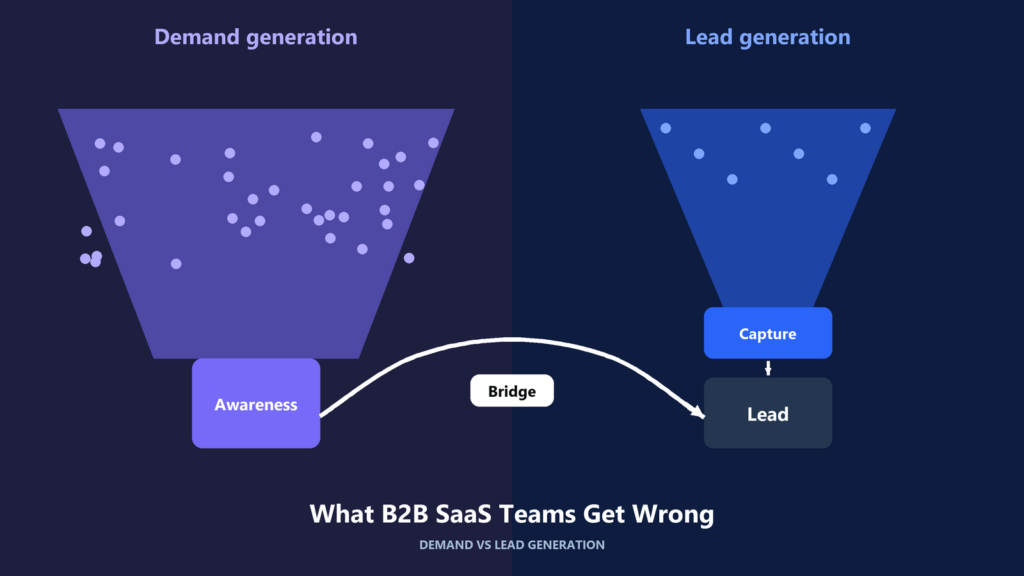
Quick answer: Demand generation builds market awareness and trust before a buyer is ready to fill out a form; lead generation captures contact details from buyers who already show intent. B2B SaaS companies need both, in sequence: demand gen fills the top of the funnel, lead gen converts what demand gen already warmed up. Running lead gen tactics without demand gen (or the reverse) is the most common reason B2B SaaS marketing spend underperforms.
Demand Generation and Lead Generation Are Not the Same Motion
Most B2B SaaS marketing teams use “demand generation” and “lead generation” interchangeably, and that habit is expensive. They are two different jobs that happen to feed the same pipeline.
Demand generation is the work of creating awareness, credibility, and pull for a category or product before a prospect is ready to talk to anyone. It looks like original research, founder-led LinkedIn content, community participation, podcast appearances, and educational content that ranks or gets shared without a gate in front of it. Nobody fills out a form to consume it. The goal is that when a buyer eventually starts a formal evaluation, your company is already on their shortlist.
Lead generation is the work of capturing contact information from people who are already showing intent, whether that’s a demo request, a gated whitepaper download, a pricing page visit that triggers outbound, or a paid search click on a bottom-funnel keyword. The goal is a named contact your sales team can work.
The confusion matters because the two require different content, different channels, different KPIs, and different patience. Treating them as one motion is what causes B2B SaaS teams to either flood a cold audience with “Book a Demo” CTAs nobody is ready to click, or produce brand content with no conversion path for the buyers who are ready right now.
Demand Generation vs. Lead Generation: Side-by-Side
| Dimension | Demand Generation | Lead Generation |
|---|---|---|
| Primary goal | Build awareness, trust, and category association | Capture contact info from intent-showing prospects |
| Funnel stage | Top of funnel, pre-intent | Middle to bottom of funnel, active intent |
| Typical tactics | Original research, ungated content, LinkedIn/founder content, SEO, podcasts, community | Gated content, demo request forms, paid search, retargeting, outbound sequences |
| Core metric | Branded search volume, share of voice, direct traffic, pipeline influence | MQLs/SQLs, form fills, cost per lead, conversion rate |
| Time to result | Slow to compound; measured in quarters | Faster, directly tied to spend on/off |
| Fails when… | Used alone, with no capture mechanism for buyers who are ready | Used alone, on a cold audience with no prior awareness |
When a B2B SaaS Company Needs Which
The right mix depends on where the company is, not on which tactic is trendy this quarter.
Early-stage, low brand awareness: lean demand generation. If almost nobody in the category has heard of the product, running lead gen ads at cold traffic burns budget on people who don’t yet have a reason to trust the claim. The priority is getting found in the moments buyers are researching the problem, not the vendor.
Established category presence, healthy inbound: the balance shifts toward lead generation, because demand already exists and the bottleneck is capture and speed-to-contact, not awareness.
Most B2B SaaS companies, most of the time: both, running concurrently. Demand generation content answers the questions buyers ask before they’re ready to talk to sales; lead generation gives the buyers who are ready an obvious, low-friction way to raise their hand. Neither one substitutes for the other.
Why Treating Them as the Same Thing Wastes Spend
According to 6sense’s 2023 survey of more than 900 B2B buyers, buyers consistently avoid engaging directly with a selling company until they are roughly 70% through their buying process, a pattern that held regardless of industry, deal size, or solution type. That’s the demand generation window. A company that only invests in lead generation is invisible for the majority of the decision, then wonders why paid demo-request campaigns convert at a trickle.
The reverse failure is just as costly. A company that pours budget into brand awareness content with zero conversion infrastructure lets the 30% of buyers who are actively evaluating slip to a competitor with a clearer next step. Demand without a capture mechanism is pipeline left on the table.
The practical fix is to stop asking “should we do demand gen or lead gen” and start asking “where is our current spend concentrated, and does it match where our buyers actually are in their decision.” For most B2B SaaS teams, that means auditing content and campaigns against the funnel stage they actually serve, not the stage marketing wishes they served.
How the Two Work Together
In practice, a healthy B2B SaaS growth motion treats demand generation and lead generation as sequential, not competing:
- Demand generation content (research, LinkedIn, SEO-driven education) builds the audience and trust that makes a prospect willing to convert later.
- Lead generation assets (demos, comparison pages, targeted outbound) sit downstream, ready to capture that prospect the moment they show intent.
- Attribution should track both: pipeline influenced by top-of-funnel content, and pipeline directly sourced by bottom-funnel capture.
If your team already has a lead capture and automation stack in place, it’s worth checking what that stack is actually replacing versus what still needs a human. Our related breakdown, Lead Generation Automation: What It Actually Replaces, covers that in detail.
Frequently Asked Questions
Is demand generation part of lead generation?
No. Demand generation happens before a buyer is ready to convert and has no capture mechanism attached. Lead generation is the capture step. Demand generation can feed lead generation, but it is a distinct activity with its own goals and metrics.
Which should a B2B SaaS startup prioritize first?
Early-stage companies with little brand recognition generally need to prioritize demand generation first, because lead generation campaigns aimed at an audience that doesn’t know or trust the product yet tend to convert poorly and cost more per lead.
Can a small marketing team run both at once?
Yes, but it usually means picking one or two demand generation channels (such as SEO-driven content or founder-led LinkedIn posting) and one or two lead generation channels (such as a demo request flow and targeted outbound) rather than spreading thin across everything at once.
How do you measure demand generation if it doesn’t produce leads directly?
Common proxies include branded search volume growth, direct traffic, content-influenced pipeline tracked through multi-touch attribution, and share of voice against named competitors, alongside the eventual lift in lead generation conversion rates once demand generation content has had time to compound.
MV3 Marketing builds and runs both sides of this for B2B SaaS companies: demand generation content and distribution paired with the outbound and lead capture infrastructure to convert it. If you’re not sure which side of the funnel your budget is actually serving, book a strategy call and we’ll show you the gap.
Share this article

Vance Moore is Chief Growth Officer at MV3 Marketing and leads its team of SEO professionals, engineers and auditors.
Ready to audit your organic growth opportunity?
$2,500 flat. 5 business days. Six deliverables tied to pipeline , not rankings. No retainer required.
Get the Organic Growth Audit →