
Two proposals for what reads like the same scope can differ by a factor of five, and both can be honest. The gap usually comes from scope the cheaper quote left out, from who does the work, or from how much risk the contract puts on you. This guide uses published pricing data, Google’s own advice on hiring an SEO, and a worked example to show how to read an AI agency quote. MV3 Marketing sells SEO and AI search retainers, so our own published prices appear below next to the market data; weigh them accordingly.
What does AI agency pricing look like per month in 2026?
The largest public dataset is Clutch, a B2B review marketplace. Its SEO Agency Pricing Guide, updated September 21, 2026, says SEO agencies typically charge a monthly fee of $2,000 to $20,000. Clutch puts the average project at $37,158.66 over a typical 12-month timeline, which it reports as an average monthly cost of $3,199.19. It also notes that the usual SEO project reviewed on its platform costs less than $10,000 in total, so the average is pulled up by a smaller number of large engagements.
A second, older dataset lands in the same place. A third-party poll of 439 SEO providers published by Ahrefs (last updated August 15, 2024) found agencies averaged $3,209 a month and freelancers $1,348. Treat that as a rough cross-check: the study computed its averages by assuming each respondent charged the top of the price band they picked, and it predates most AI search work.
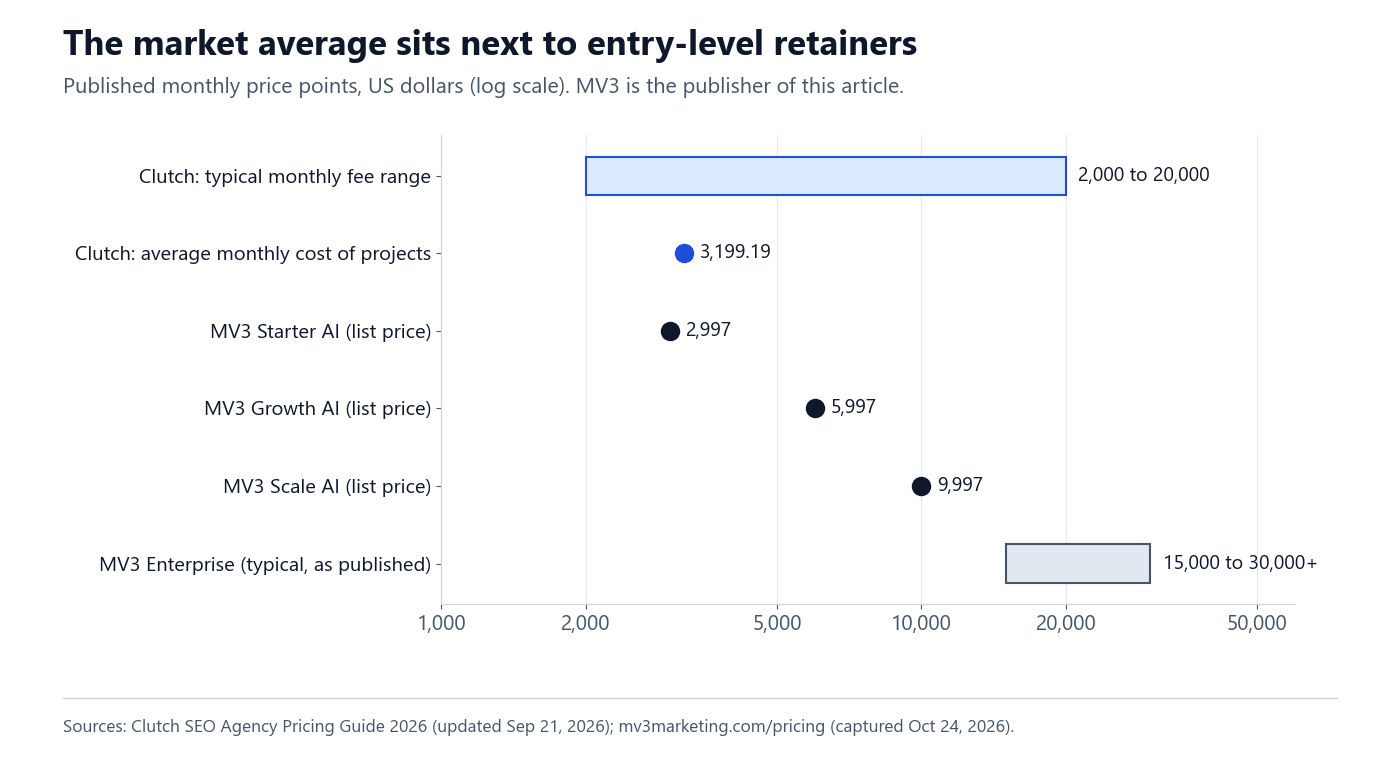
“AI agency” covers two different purchases. Most SaaS teams searching this phrase are buying SEO and generative engine optimization (GEO) work: content, technical fixes, and visibility in AI answers. Others are buying custom AI agent or automation builds, which are scoped like software projects. Public pricing data for the second group is thin, and we could not find a source we were willing to cite, so this article covers the first.
Which pricing model are you being quoted?
Nearly every proposal is a monthly retainer, a fixed-price project, or hourly billing. Clutch describes all three, and the model matters more than the headline number because the same fee buys different things under each.
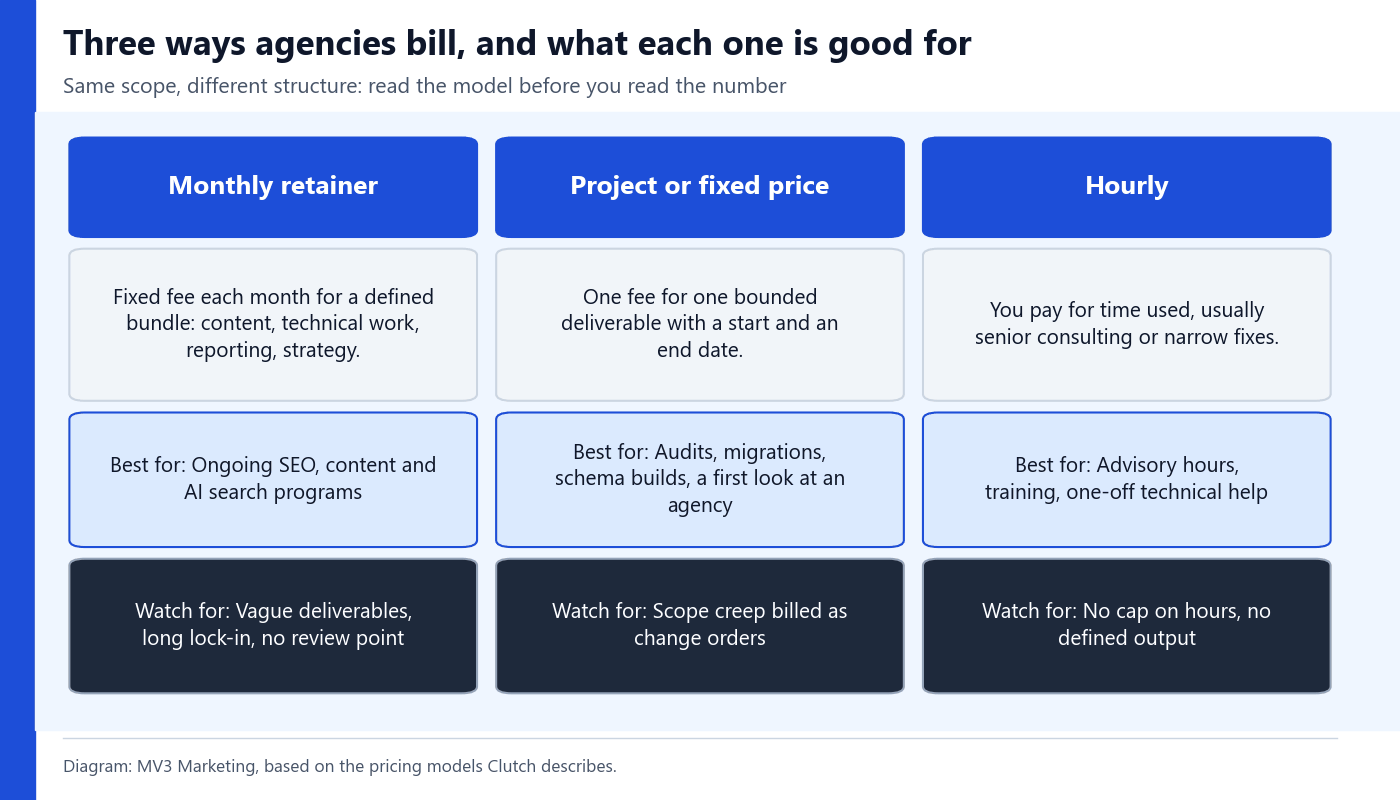
Monthly retainers fit ongoing work where results compound: publishing, technical maintenance, link earning and AI visibility tracking. The risk is paying every month for deliverables nobody counted. Projects fit bounded work such as a technical audit, a migration or a schema build, and they are the cheapest way to see how an agency thinks before you commit. Hourly billing fits senior advice and narrow fixes. Clutch reports that most SEO agencies on its platform charge $100 to $149 an hour; the Ahrefs-published poll found 90% of respondents charged $150 an hour or less.
How do hourly rates vary by service and location?
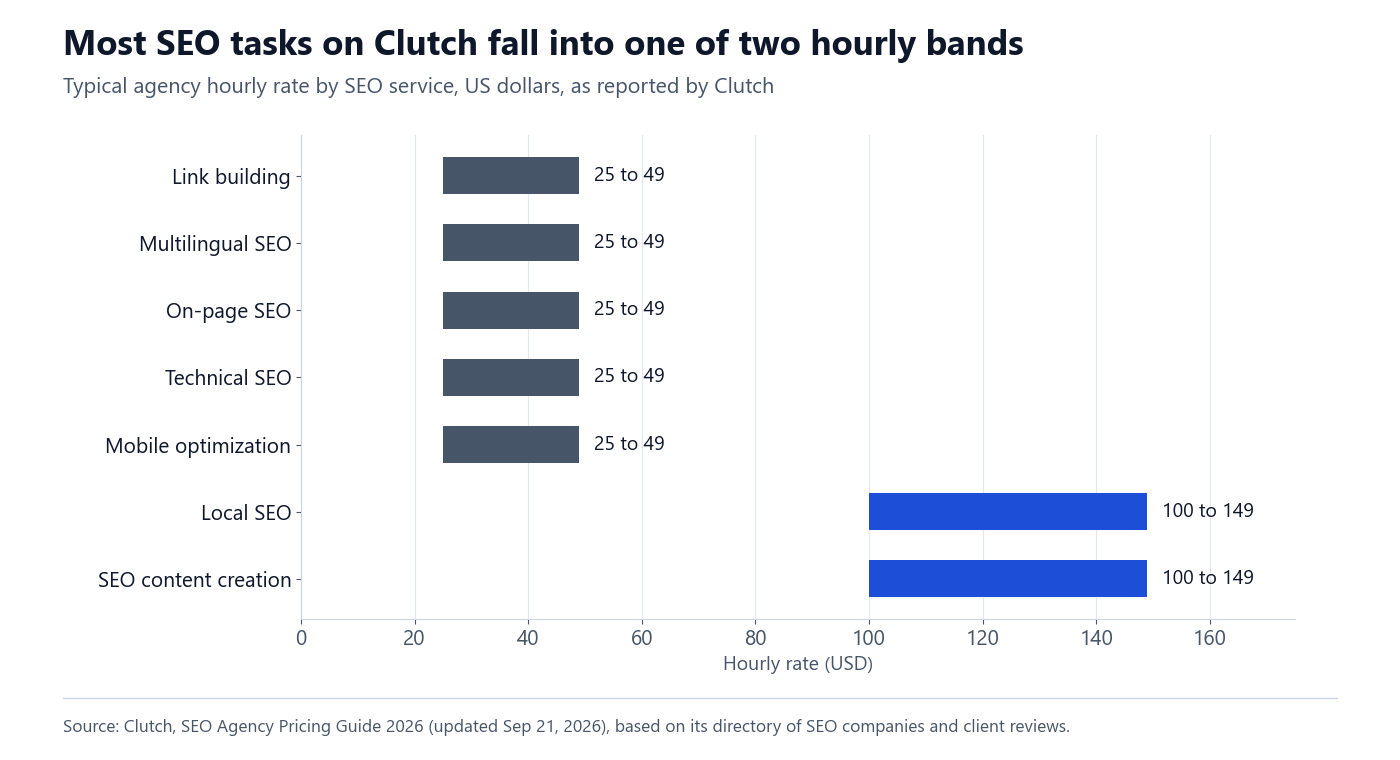
Clutch breaks hourly rates out by service. Content creation and local SEO sit in the $100 to $149 band. Link building, multilingual, on-page, technical and mobile work sit at $25 to $49. That split is worth knowing when a retainer bundles everything into one number, because the hours behind each line item are not equally expensive.
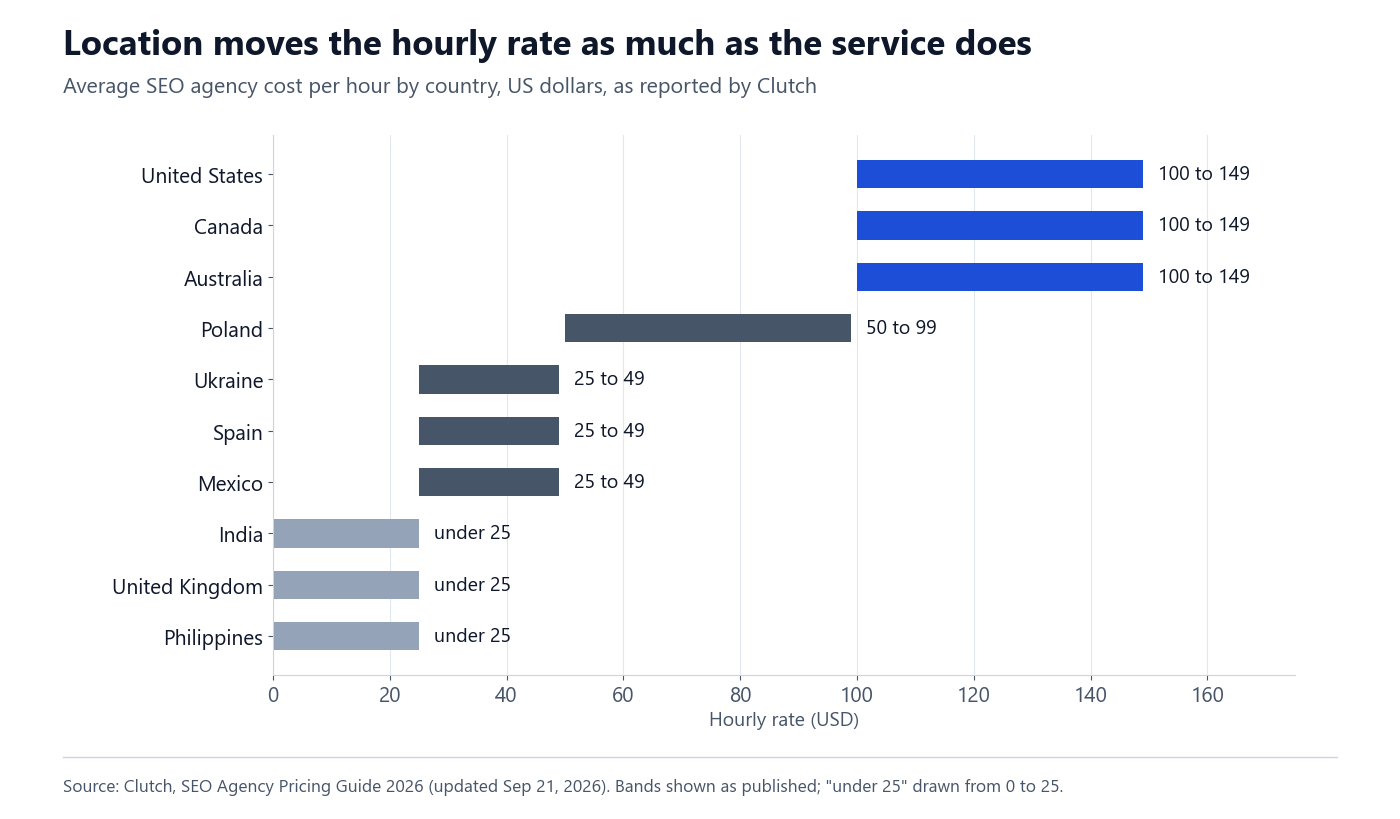
Location shifts rates as much as the service does. Clutch lists the United States, Canada and Australia at $100 to $149 an hour, Poland at $50 to $99, Ukraine, Spain and Mexico at $25 to $49, and India, the United Kingdom and the Philippines under $25. The UK band is far below the US band and may reflect the mix of agencies listed on Clutch, so read the chart as directional.
What does GEO add to the price, and is the premium real?
GEO is the work of getting your brand cited inside AI answers such as ChatGPT, Perplexity, Google AI Overviews and AI Mode. It shares most of its foundation with SEO, and Google says so directly: its guidance on AI features states “There are no additional requirements to appear in AI Overviews or AI Mode, nor other special optimizations necessary,” and adds that there is “no special schema.org structured data that you need to add.”
That has a direct pricing consequence. A GEO premium is justified when it buys extra work you can count: tracking which prompts cite you and your competitors, digital PR that earns mentions on the third-party pages AI answers draw from, and content built around the questions buyers type into AI tools. It is not justified when it buys a relabeled SEO retainer or “AI schema” that Google says it does not need. Other AI platforms publish their own guidance, so ask the agency which platforms it tracks and what it changes for each.
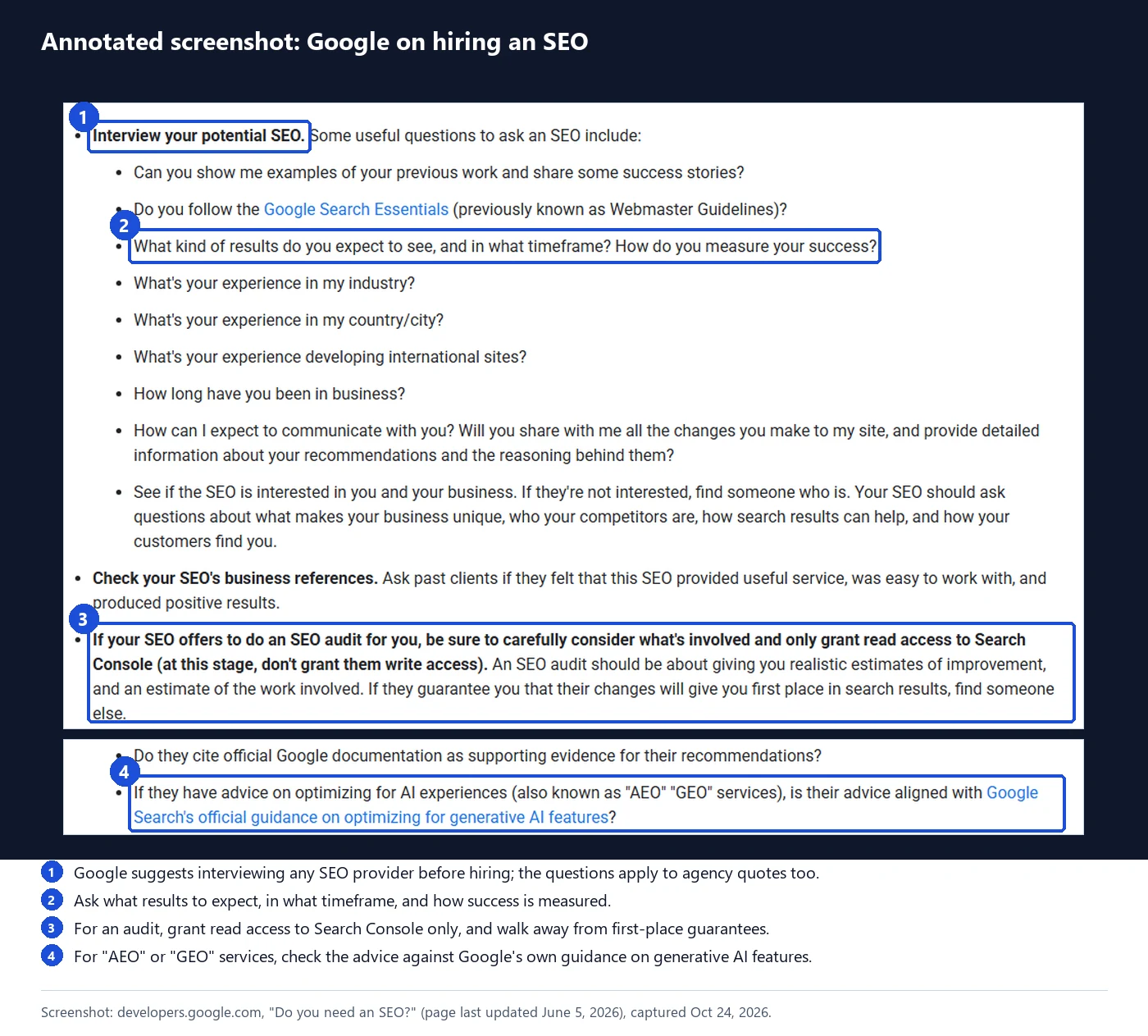
Google’s own page on hiring an SEO makes the same point from the buyer’s side. It suggests asking whether any “AEO” or “GEO” advice is aligned with Google’s guidance, and warns against guarantees of first place.
What actually moves the price between two quotes?
When two quotes differ by thousands of dollars a month, one of them has usually priced a variable the other left out. These five are the ones to check first.
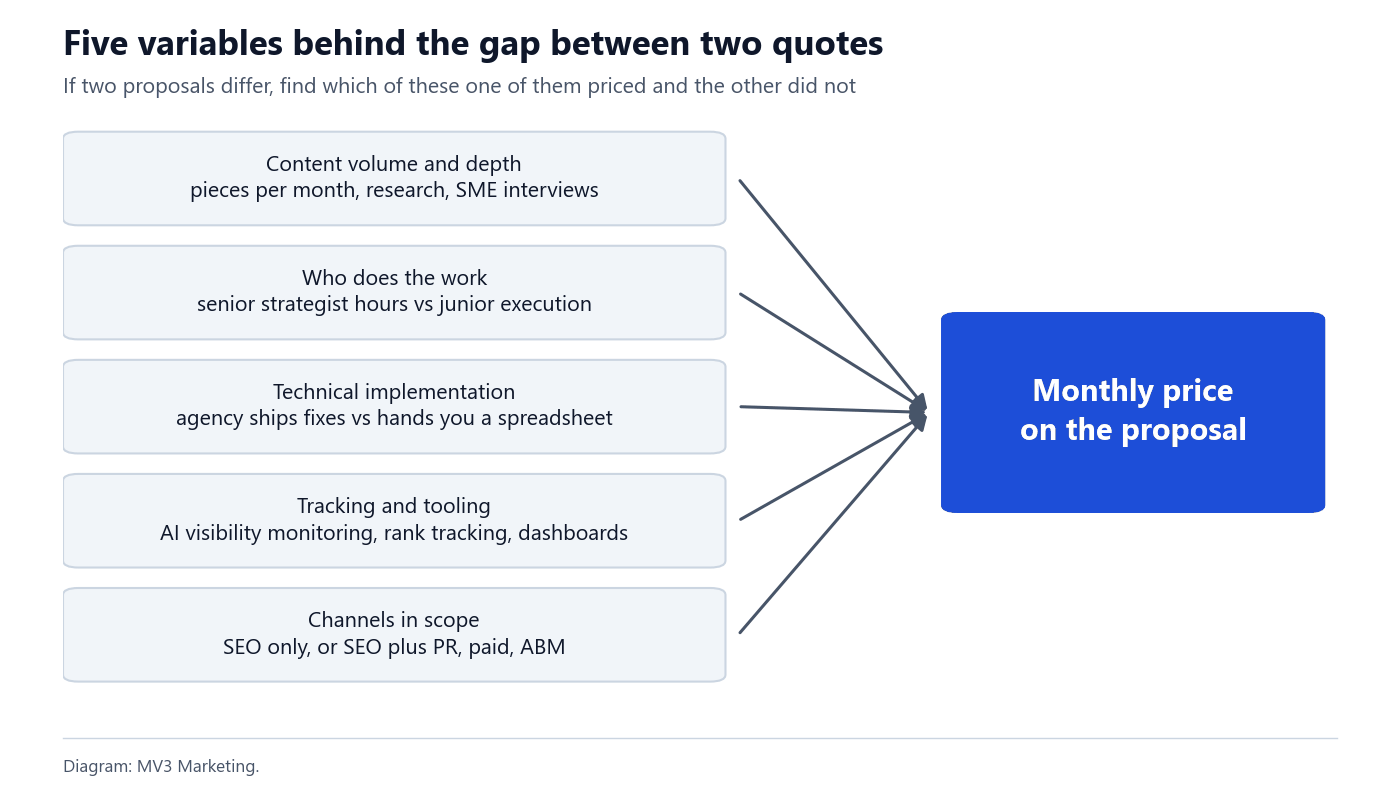
- Content volume and depth. Two posts a month built from keyword tools cost less than eight posts built from subject matter expert interviews. Content creation sits in Clutch’s top hourly band, so volume moves price fast.
- Who does the work. Ten hours of a senior strategist and twenty hours of a junior generalist can carry the same fee. Ask for names and roles, not just the person on the sales call.
- Technical implementation. An agency that ships fixes in your CMS costs more than one that sends a spreadsheet. The premium is worth paying if your developers are busy with product work.
- Tracking and tooling. AI visibility tracking, rank tracking and dashboards cost money to license or build. A quote without them is not cheaper if you need them.
- Channels in scope. SEO alone is a different purchase from SEO plus digital PR, paid media or account-based outreach.
| Scope level | Typically includes | Usually missing at this level |
|---|---|---|
| Foundational | Technical audit and fixes, a few content pieces a month, basic reporting | AI visibility tracking, digital PR, implementation beyond the CMS |
| Growth program | Regular content, technical implementation, entity and schema work, prompt-level AI visibility tracking | Multi-market coverage, dedicated senior lead |
| Multi-channel | All of the above plus digital PR, paid media or ABM, a named strategy lead | Rarely missing anything; the risk is paying for channels you do not use |
How do you compare two agency quotes fairly?
Line the proposals up item by item before you look at the totals. The four steps below work with two or three proposals open side by side.
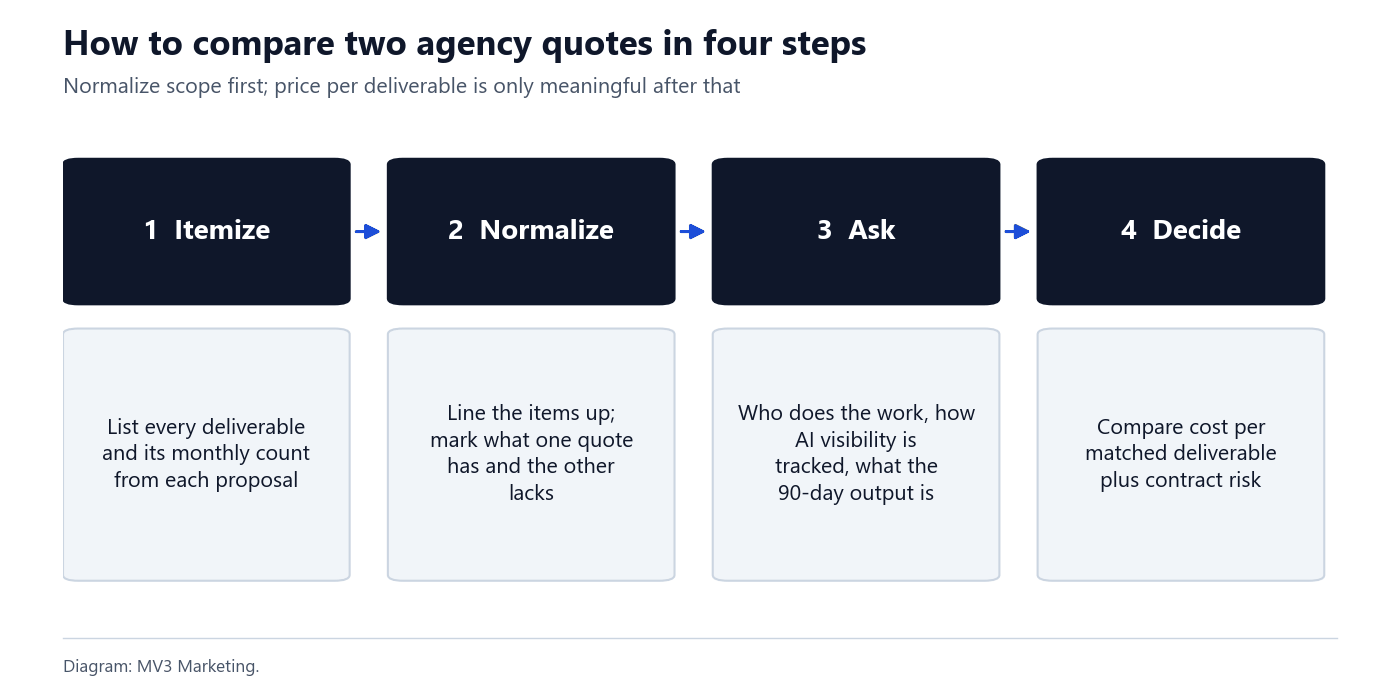
Worked example: two quotes, one decision
The numbers below are illustrative, not from a real client. Quote A costs $3,000 a month. Quote B costs $4,500 a month.
| Deliverable | Quote A ($3,000/mo) | Quote B ($4,500/mo) |
|---|---|---|
| Long-form content | 2 posts a month | 4 posts a month |
| Technical SEO | Recommendations in a spreadsheet | Fixes implemented in your CMS |
| AI visibility tracking | Not included | Tracked prompts reported monthly |
| Reporting | Monthly | Monthly |
| Contract | 12-month minimum | Month-to-month, 30-day notice |
B costs $1,500 more a month, or $18,000 more a year. For that it adds two posts a month, implementation and tracking. The decision is not “A is cheaper.” It is whether you could get those three additions for less than $1,500 a month elsewhere, for example from an in-house developer with spare capacity. The contract changes the risk too: A’s 12-month minimum commits you to $36,000 before you can leave, while B’s 30-day notice limits your exposure to one month, or $4,500.
What should a transparent proposal look like?
A proposal you can evaluate names countable deliverables, states contract terms next to the price, and separates ad spend from management fees. Here is how MV3 publishes its own tiers. We are the publisher of this article, so treat this as an example of format, not a neutral benchmark.
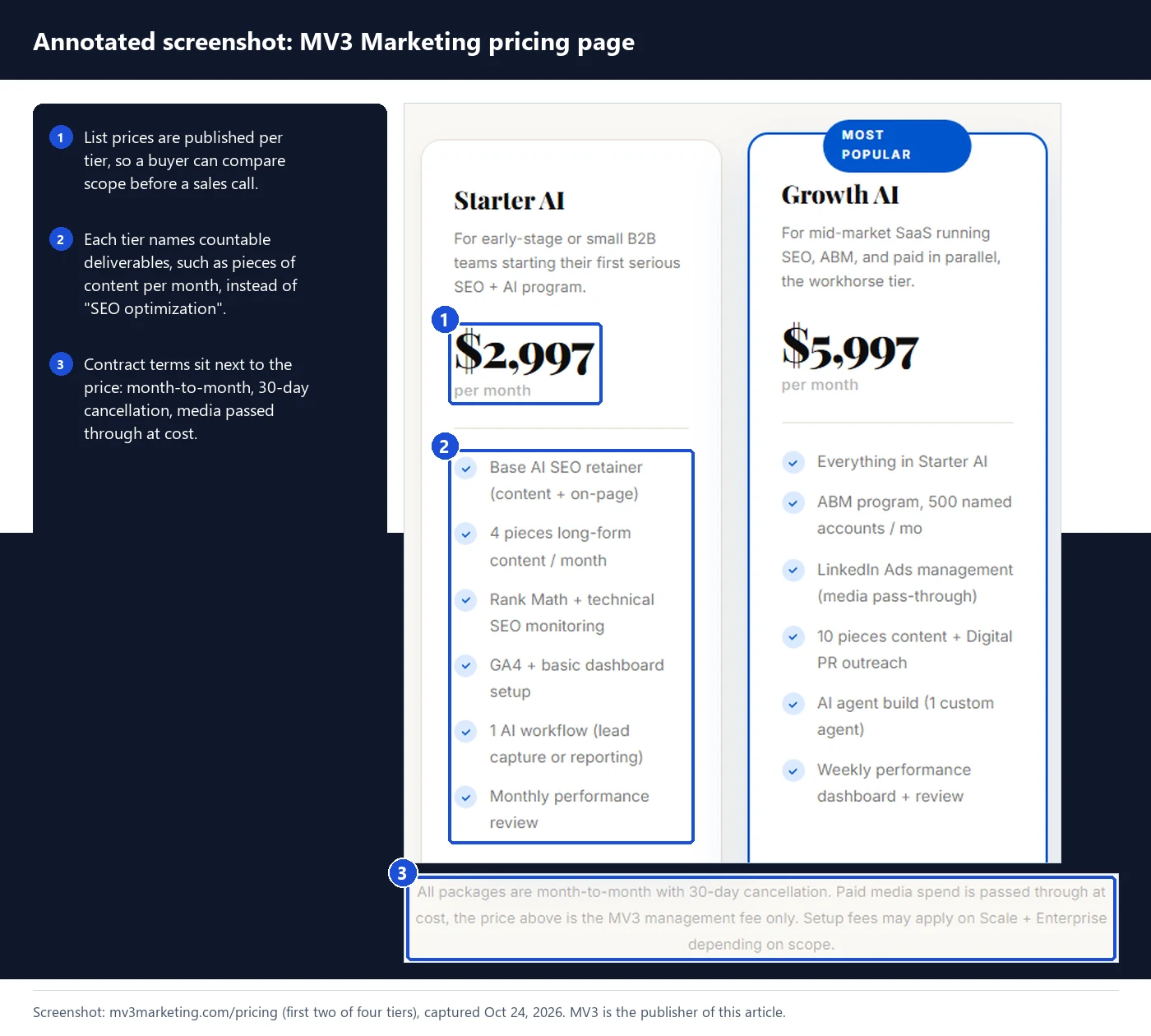
As of October 24, 2026, our pricing page lists Starter AI at $2,997 a month with four long-form pieces a month, Growth AI at $5,997 with ten, Scale AI at $9,997 with twenty, and custom Enterprise scopes. All tiers are month-to-month with 30-day cancellation, and paid media spend passes through at cost. Starter sits a few hundred dollars below Clutch’s reported monthly average. Use those figures to test any proposal, including ours.
Which red flags should stop you before you sign?
| What you see | What it usually means | What to ask |
|---|---|---|
| A firm price before anyone looks at your site | A template, not your situation | “What did you review to arrive at this scope?” |
| “SEO optimization” or “AI visibility” as a deliverable | Nothing countable is promised | “How many pieces, fixes and tracked prompts per month?” |
| Higher tiers that only add “faster results” | Price anchoring, not more work | “What extra deliverables does the higher tier include?” |
| A guaranteed first-place ranking or AI citation | A claim Google warns against | Walk away, per Google’s hiring guidance |
| A request for write access to Search Console during an audit | More access than an audit needs | Grant read access only, as Google advises |
| No names for the people doing the work | Junior or outsourced delivery | “Who executes, and what is their background?” |
If one of these came up in a proposal you are holding, book a short call and walk us through it. We will tell you whether it holds up, even when the answer is that the other agency priced it fairly. Our guide on how to vet an AI search optimization agency goes deeper on the questions themselves.
When is the market data a poor guide?
The numbers above come from SEO-focused agencies, mostly listed on one marketplace, and they describe averages. They fit less well in these cases:
| Situation | Why the averages fit poorly | What to do instead |
|---|---|---|
| Custom AI agent or automation builds | Priced like software projects, by scope and engineering time | Ask for a fixed-scope discovery phase and a build estimate in hours |
| Enterprise procurement | Security reviews, multiple brands and legal terms change price and timeline | Compare total contract value, not just the monthly fee |
| Performance-based deals | Rankings and citations move slowly and depend on factors no agency controls | Read the metric definitions and exit terms closely |
| Very early companies | Google says a small local business can probably do much of the work itself | Start with Google’s SEO starter guide or a one-off audit |
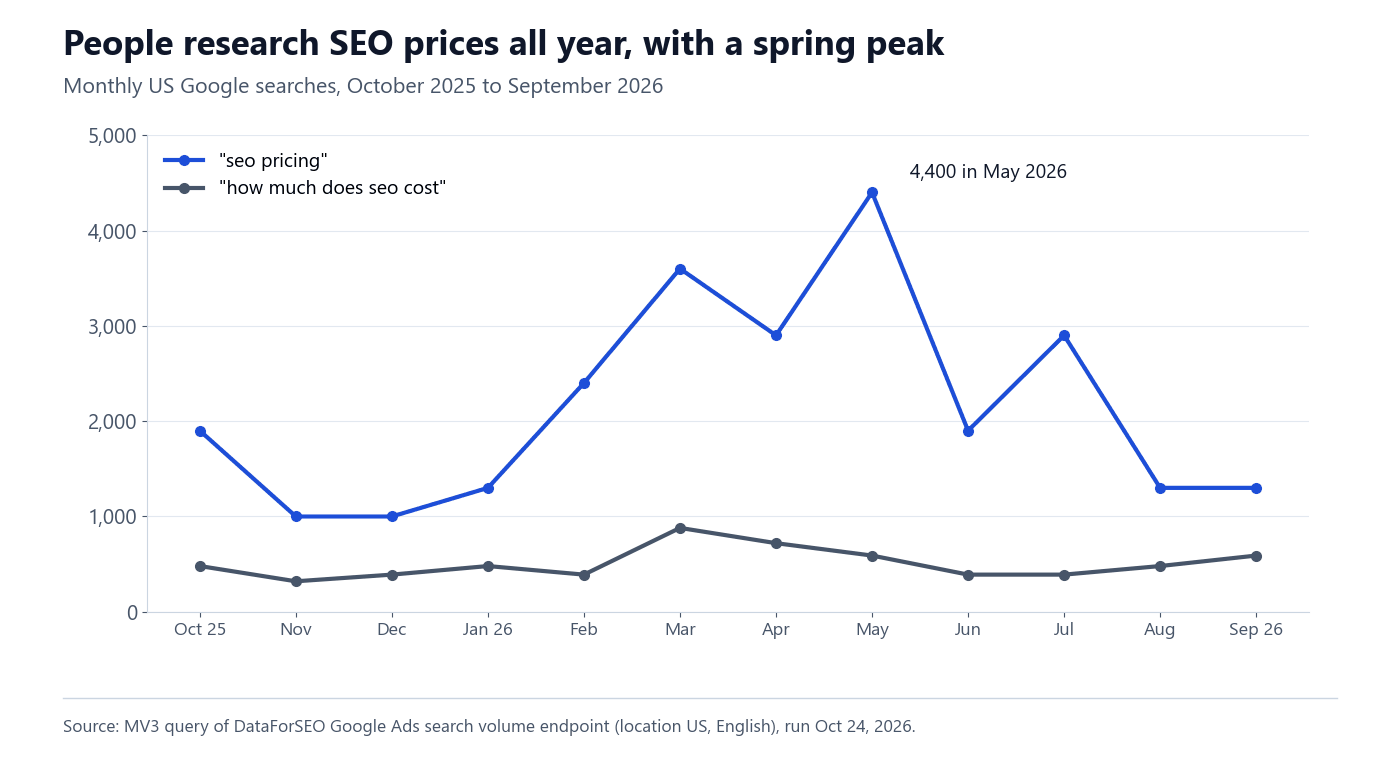
One more data point on timing: MV3 queried DataForSEO’s Google Ads search volume data on October 24, 2026. US searches for “seo pricing” averaged 2,400 a month and peaked at 4,400 in May 2026, with most months between March and July above the yearly average. If you plan to hire in spring, you will be shopping alongside the most buyers; starting the conversation a month or two earlier gives you more time to compare.
How long should you give an agency before judging the price?
| Question | A useful answer includes |
|---|---|
| What is included, itemized by deliverable? | Monthly counts: pieces, fixes, tracked prompts, reports |
| Who does the work? | Names, roles and hours on your account |
| How do you track AI visibility? | Which platforms, which prompts, how often, in what report |
| What is the first measurable output, and when? | A dated deliverable early in the engagement |
| How do we change or end the scope? | A review point and a notice period in writing |
Ask each agency what its first measurable output is and when it arrives, then hold it to that date. Content and technical work usually take months to show in rankings, which is why a review point inside the contract matters more than the monthly fee. Our breakdown of how long SEO takes for B2B companies covers realistic checkpoints, and our overview of generative engine optimization services explains what GEO deliverables should look like.
Frequently asked questions
Is a cheaper agency automatically a worse choice?
No. A lower fee usually means fewer pieces of content, a more junior team, narrower technical scope, or no AI visibility tracking, and any of those can be fine for your stage. The problem is a low price that promises the same scope as a quote twice its size. Itemize both before deciding.
Should GEO be a separate line item from SEO?
Either works if you can see what GEO adds. Google says no special optimization is needed to appear in AI Overviews or AI Mode, so a GEO premium should buy countable extras such as prompt tracking, digital PR for third-party mentions, and content mapped to AI questions.
How much does a standalone SEO or GEO audit cost?
Clutch reports that the usual SEO project on its platform costs less than $10,000 in total; it does not break out audits separately, and price varies with site size and depth. Make sure the audit is a deliverable you keep, not a sales step. MV3 offers a fixed-scope GEO audit.
What contract terms are reasonable?
An initial commitment is reasonable because SEO and GEO take months to show results. Push back on long terms with no review point and on long cancellation notices. A review point partway through, then month-to-month billing, keeps both sides honest.
Why do some agencies charge far more than these averages?
Usually because the scope is larger: several products or markets, a crowded category, digital PR, or senior people across more channels. A high fee is fine when the proposal shows what it buys. It is a red flag when it does not.
Share this article

Vance Moore is Chief Growth Officer at MV3 Marketing and leads its team of SEO professionals, engineers and auditors.
Ready to audit your organic growth opportunity?
$2,500 flat. 5 business days. Six deliverables tied to pipeline , not rankings. No retainer required.
Get the Organic Growth Audit →